BGS Centering Requirements: Complete Guide to Grading Standards
Learn BGS centering requirements, how they compare to PSA, CGC, SGC, and tips to measure centering accurately before grading your cards.


Estimated reading time: 14 min
Key Takeaways
- BGS centering requirements use strict, published ratios for each grade—50/50 for Black Label, up to 60/40 for a 9.
- Beckett evaluates front and back centering differently; back tolerances are more lenient.
- Centering can limit your card's max grade even if corners and surface are perfect.
- Midpoint and other centering tools help measure ratios before you grade—potentially saving you money.
- PSA, CGC, SGC, and TAG all have unique centering standards; some are more lenient than BGS.
Table of Contents
- Section 1: Why Centering Matters in Card Grading
- Section 2: BGS Centering Requirements by Grade
- Section 3: Front vs Back Centering—How Beckett Grades Each
- Section 4: Comparing BGS to PSA, CGC, SGC, and TAG Standards
- Section 5: How to Measure Card Centering Ratios Accurately
- Section 6: Centering Tools, Calculators, and Pre-Grading Tips
- Conclusion
- FAQ
Section 1: Why Centering Matters in Card Grading
The Impact of Centering on Card Value
Centering, the measurement of how evenly the card’s artwork is positioned between its borders, is one of the four main subgrades in trading card grading, alongside corners, edges, and surface. For collectors and investors, centering often makes or breaks a card's final grade and market value. Even a card with perfect corners and surface can be held back by poor centering, sometimes dropping from a Gem Mint (9.5 or 10) to a Mint (9) or lower. This is especially true for high-value cards, where the difference between a BGS 9.5 and a 9 can mean a difference of hundreds or even thousands of dollars, particularly in vintage sports cards, Pokémon, or Magic: The Gathering cards. For example, a 1986 Fleer Michael Jordan rookie card graded BGS 9.5 with 55/45 centering might sell for significantly more than the same card with a BGS 9 and 60/40 centering—a substantial difference due solely to centering.
- Visual appeal: Off-center cards look uneven, distracting from artwork and lowering desirability. This is especially noticeable in cards with thin borders or prominent designs, such as 1971 Topps Baseball or modern Panini Prizm issues; even a few millimeters of shift can be easily spotted.
- Grade limitation: Most grading companies, including BGS, limit the overall grade to the lowest subgrade—centering included. If a card has perfect corners, edges, and surface (all 10s), but centering is only a 9, the final grade cannot exceed 9.5 under BGS’s half-point rule.
- Market impact: The difference between a BGS 9.5 (Gem Mint) and BGS 9 (Mint) can mean hundreds or thousands of dollars for key cards, especially in the case of rookie cards, short prints, or cards from limited print runs.
Why Grading Companies Emphasize Centering
Manufacturing flaws are common, especially in older sets—such as miscut 1970s baseball cards or off-center 1990s basketball issues. Graders use centering standards as a way to reward cards produced with care and to create a level playing field. BGS, PSA, CGC, SGC, and TAG all publish centering standards that define how much off-centering is allowed for each grade tier. These standards increase transparency and help collectors set realistic expectations. For example, a card from the notoriously miscut 1972 Topps set that achieves a BGS 9 for centering is likely among the better-centered copies available, making it more desirable among set builders and investors alike.
- BGS centering requirements are among the most detailed in the hobby, with explicit published cutoffs for each subgrade, providing a clear grading roadmap for submitters.
- See how centering impacts price in our detailed value guide.
Why Pre-Check Centering Before Submitting
Grading fees can be $30–$100 or more per card, especially for express or premium services. Submitting cards that can't meet minimum centering standards risks wasting money, as off-center cards are unlikely to return the investment in grading costs. That's where tools like Midpoint come in—helping you measure centering precisely and estimate the grade before you submit. By doing a pre-submission check, you can avoid paying grading fees on cards that would be capped at lower grades due to centering, and instead focus your budget on cards with the best odds of achieving high grades.
- Example: If you have a raw card with 60/40 centering, using Midpoint can instantly tell you it is not eligible for a BGS 9.5 or 10, helping you avoid a costly mistake.
- Bulk submissions: Accurate pre-checks are especially valuable when submitting large batches of cards, as you can filter out low-potential cards quickly.
Section 2: BGS Centering Requirements by Grade
Understanding BGS's Published Centering Ratios
Beckett Grading Services (BGS) uses strict numerical cutoffs for centering. Each grade requires the card's borders to fall within a certain ratio—typically expressed as percentages like 50/50, 55/45, 60/40, or 65/35. These ratios mean the border on one side may be, for example, 60% of the total width, and the opposite border 40%. For instance, if the left border is 3mm and the right border is 2mm, the centering would be 60/40. These measurements are taken both horizontally (left/right) and vertically (top/bottom), with the worst ratio used for grading.
- Front centering ratios are always stricter than back, as the card's face is the primary display for collectors.
- Exact subgrades for centering are assigned based on these thresholds, with no rounding up allowed.
- BGS publishes these cutoffs for each major grade tier, making them publicly available for submitters to consult.
BGS Centering Thresholds by Grade
- BGS Black Label 10 (Pristine): 50/50 on front, 50/50 on back. Only cards with absolutely perfect centering on both sides qualify for this elite grade. This is extremely rare—very few submissions achieve Black Label status.
- BGS 10 (Pristine): 50/50 front, 55/45 back. This grade allows for a slight, nearly imperceptible shift on the back, but the front must be perfect. Most modern cards with advanced printing can achieve this, but vintage or mass-produced cards rarely do.
- BGS 9.5 (Gem Mint): 55/45 front, 60/40 back. This is the most common top grade for high-end cards, and many collectors target this ratio when submitting. A typical modern card in good condition can reach this threshold, but anything worse will drop to a Mint 9 or lower.
- BGS 9 (Mint): 60/40 front, 65/35 back. This is the cutoff where visible off-centering is acceptable but still within the Mint range. Most pack-fresh cards from the 1990s onwards should meet this, but older cards may struggle.
- BGS 8.5: 65/35 front, 70/30 back. Cards with noticeable off-centering but still a balanced appearance fall here. Many vintage cards, especially from the 1970s and earlier, will land in this range due to production variability.
- BGS 8: 70/30 front, 75/25 back. Cards with obvious centering flaws, but not severe enough to be considered miscut, are graded at this level. For collectors of rare vintage cards, this may be the highest achievable grade for some issues.
For lower grades, the tolerance widens further, but these are the most relevant cutoffs for collectors targeting high grades. For instance, a card with 80/20 front centering would likely receive a grade of 7 or lower, unless there are additional issues.
Subgrades and Final Grade Impact
- If centering is the lowest subgrade, it usually caps the final BGS grade within 0.5 of the centering subgrade. For example, a card with 10/10/9.5/9 for subgrades (where 9 is centering) will receive a final grade of 9.5—not a 10. This rule prevents cards with significant off-centering from achieving Gem Mint or Pristine status, regardless of their other qualities.
- Example: Suppose you have a card with subgrades Corners: 10, Edges: 10, Surface: 9.5, Centering: 9. The highest possible final grade is 9.5 due to the 0.5-point rule.
- Read more about how graders weigh subgrades in our grading estimate guide.
- Strategy tip: If your card is likely capped by centering, consider whether to submit to BGS or another grader with more lenient requirements.
Section 3: Front vs Back Centering—How Beckett Grades Each
Why Front Centering Matters More
BGS, like most graders, places more visual emphasis on the front of the card. The front is what collectors and buyers see, making perfect centering more critical to the card's eye appeal. As a result, front centering tolerances for each grade are tighter than the back. For many cards, especially those displayed in cases or sold online, the back is rarely scrutinized as closely as the front. This is reflected in BGS’s published standards and in actual grading outcomes.
- Black Label 10: Demands perfect (50/50) front and back centering. Only cards with factory-perfect alignment qualify.
- BGS 10: Allows 50/50 front, but up to 55/45 back. This recognizes the difficulty of achieving perfection on both sides, even with modern printing.
- 9.5: 55/45 front, 60/40 back. A small deviation is permitted, but the card must still appear well-centered at a glance.
- 9: 60/40 front, 65/35 back. Cards with slightly visible shifts in centering fall here, but the card should still look well-balanced to the naked eye.
How Beckett Measures Centering
BGS graders use magnifiers, rulers, and sometimes digital tools to measure the border widths. For most cards, a 1% deviation can be the difference between a BGS 10 and a 9.5. Border designs, foil thickness, and printing quirks can complicate this process, but graders follow the published ratio as closely as possible. The standard method is to measure each border in millimeters, sum opposite borders, and calculate the percentage. Graders may also use centering templates or overlays that match the card size and aspect ratio, offering a fast way to check if a card falls within the required tolerance.
- Back centering is more forgiving—so a card off-center on the back but perfect on the front can still achieve a high grade, even up to BGS 10 (Pristine), provided the back is within 55/45.
- Beckett does not round up—cards must meet or exceed the ratio for a given subgrade. For example, a card at 55.1/44.9 is not rounded down to 55/45.
Examples of Borderline Cases
- If a card measures 56/44 front, it's ineligible for a BGS 10, but fits 9.5 standards. This means even the smallest deviation can lead to a drop in subgrade, which is why precision measurement is so important.
- If a card is 60/40 front but 70/30 back, it's capped at an 8.5 centering subgrade, regardless of how perfect the front looks. This often occurs with vintage cards or cards with design quirks.
- Cards with "diamond cut" (tilted images) may have centering docked even if border widths are within range. If the artwork is visibly rotated, BGS may penalize centering, as this affects the card’s visual appeal.
- Example: A modern card with a thick bottom border and thin top border (e.g., 2020 Panini Prizm) might appear off-center even if the measurements are within 55/45 due to design illusions. BGS graders are trained to account for these effects, but measuring at multiple points is advised.
For further reading on how BGS interprets tricky centering cases, see Beckett's official grading documentation or our in-depth analysis of borderline centering case studies.
Section 4: Comparing BGS to PSA, CGC, SGC, and TAG Standards
PSA Centering Standards
PSA centering standards are similar, but with a few key differences:
- PSA 10 (Gem Mint): 55/45 front, 75/25 back. This means PSA is more forgiving of back centering than BGS, allowing a 25% deviation versus just 5% for BGS 10.
- PSA 9: 60/40 front, 90/10 back. Here, the back can have a very significant shift and still earn a Mint grade.
PSA is generally more lenient on back centering than BGS, allowing a wider variance on the card's reverse. This can make PSA a better choice for cards with perfect fronts but flawed backs. For example, a card with 58/42 front and 80/20 back would likely receive a PSA 9 but only a BGS 8.5. See our measuring guide for more details.
CGC and SGC Centering Standards
- CGC: 55/45 front, 75/25 back for Gem Mint 9.5. This is almost identical to PSA's standard, making CGC a strong option for cards with minor back centering flaws.
- SGC: 55/45 front, 80/20 back for SGC 10. SGC is the most forgiving on back centering among major graders, ideal for issues where backs are often off-center, such as T206 tobacco cards or 1950s Topps baseball.
TAG grading centering uses AI analysis and typically follows standards similar to CGC or PSA, but may vary for modern vs. vintage cards. Always check each company's current published tolerances before submitting. For some TAG submissions, the AI will measure down to 0.1mm, reducing human error but making the process more precise—and potentially less forgiving if your card just misses the cutoff.
Which Grader Is Most Lenient on Centering?
- Back centering: PSA and SGC are the most lenient, with up to 90/10 on some grades. For collectors with cards that have one perfect side and one off-center side, these companies provide the best chance at a high grade.
- Front centering: All major graders require 55/45 or better for top grades, but PSA and SGC sometimes round up slightly in ambiguous cases, especially for vintage cards.
- BGS: Most strict for Black Label and Pristine 10—50/50 or nothing. Beckett's Black Label is widely seen as the toughest standard in the hobby, with only a tiny percentage of cards qualifying.
- Practical impact: If your card has 58/42 front and 80/20 back, submit to PSA or SGC for a shot at a 9 or 10, but avoid BGS if targeting Gem Mint or higher.
Section 5: How to Measure Card Centering Ratios Accurately
Manual Measurement Techniques
To determine if your card meets BGS centering requirements, you need to measure the border widths on the relevant sides—usually top/bottom and left/right. The process involves:
- Use a millimeter ruler: Place the card on a flat, well-lit surface. Measure the width of the left and right borders (for horizontal centering) and the top and bottom borders (for vertical centering).
- Calculate centering ratios: For each axis, add the two border measurements to get the total border width. The ratio is then expressed as (border1 / (border1 + border2)) and (border2 / (border1 + border2)). Always use the larger number as the "high" side of the ratio.
- Example: If the left border is 2mm and the right is 3mm, centering is 40/60. For a card measuring 63mm wide, with the artwork measuring 59mm, the remaining 4mm is split between both borders; if the left is 1.5mm and the right is 2.5mm, the ratio is 37.5/62.5, or rounded to 38/62.
- Repeat for top/bottom borders. Take the worst (most off-center) ratio as your card’s centering grade.
For detailed, step-by-step instructions, see our centering measurement guide.
Digital Tools and Calculators
Manual measurement can be error-prone, especially for cards with uneven designs or foil. Digital tools like Midpoint allow you to scan or photograph your card, then automatically calculate centering ratios down to the tenth of a millimeter. Midpoint streamlines the measurement process in several ways:
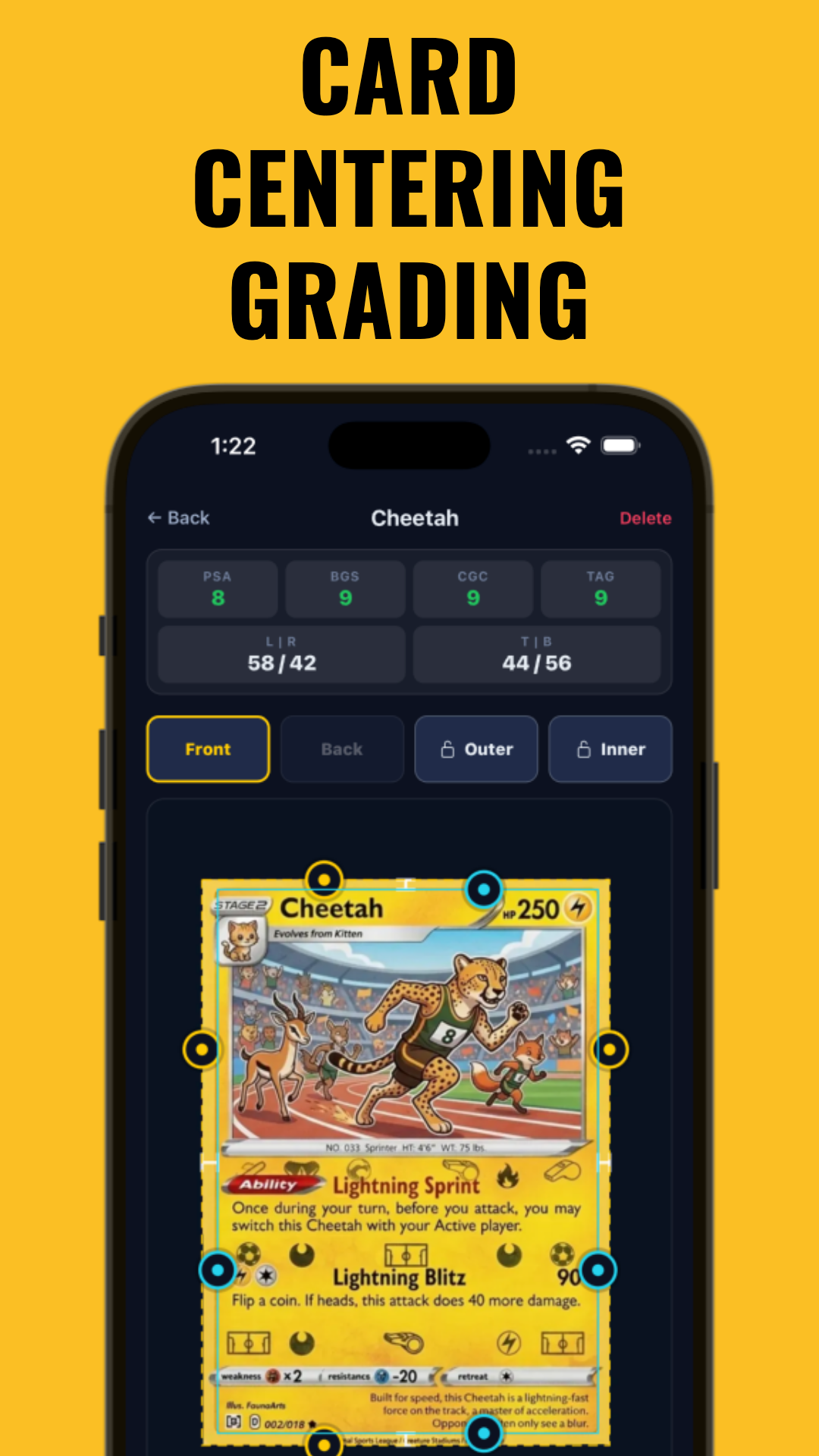
- Upload an image, adjust crop marks, and get instant centering ratios for both front and back. Midpoint offers an interactive interface where you can drag edges to match the card's borders, and the software does the math.
- Midpoint provides estimated grades for BGS, PSA, CGC, and TAG—helping you decide the best grading company for your card's condition. For example, if your card is 57/43 front and 76/24 back, Midpoint will recommend PSA or SGC for maximum grade potential.
- Bulk upload options are available for large collections. This is especially helpful for dealers or collectors processing dozens or hundreds of cards for grading.
Midpoint also stores your measurements, allowing you to track your collection and remember which cards have already been checked.
Common Pitfalls When Measuring
- Misaligned scans: Always ensure the card is square in your image or scanner. Crooked cards can lead to incorrect border measurements and underestimate centering issues.
- Uneven border designs: Some cards have thicker bottom borders, inconsistent side borders, or foil overlays that obscure true edges. Measure at the thickest points or use the card’s frame (not just the artwork) as your reference.
- Diamond cuts: If the image is rotated or "diamond cut," centering may look correct but actually be off. Always check both horizontal and vertical axes, and use a grid overlay if available.
- Human error: Small mistakes in measurement can mean the difference between a 9.5 and a 10. Always double-check, and consider using a digital tool for confirmation.
For the highest accuracy, use a combination of manual and digital methods, especially on high-value cards.
Section 6: Centering Tools, Calculators, and Pre-Grading Tips
Using Centering Tools for Pre-Grading
With rising grading fees, accurately pre-grading your cards is more important than ever. Tools like Midpoint are designed to help you:
- Check centering down to 0.1mm accuracy, minimizing human error and maximizing your chance at top grades.
- Instantly compare your card to BGS, PSA, CGC, SGC, and TAG standards, giving you a direct recommendation on which company to use for each card.
- Organize and track which cards are grading candidates and which need to be filtered out. Midpoint’s dashboard allows you to tag, sort, and export grading lists for easy batch submission.
For a practical guide on using digital centering tools, see our guide to pre-grading cards.
Best Practices Before Submitting to BGS
- Measure both sides: Don’t neglect back centering, especially for BGS submissions. A card with 56/44 front and 66/34 back will be limited by its back centering, capping it at a BGS 9.
- Know the cutoff: If your card is 56/44 front, it's not a BGS 10 candidate, but could be a 9.5. Knowing these breakpoints can save you from disappointment and wasted fees.
- Consider alternate graders: PSA or SGC may be more forgiving for cards with back centering flaws. Use Midpoint’s recommendations to optimize your submission strategy.
- Batch pre-grading: Use bulk upload features to quickly screen large collections and minimize wasted grading fees. This is especially helpful for dealers or those submitting dozens or hundreds of cards per month.
- Double-check with digital and manual methods: On valuable cards, always verify centering with both a ruler and a digital tool to ensure precision.
Interpreting Grader Standards—What BGS Publishes vs. Interprets
- BGS publishes exact centering cutoffs for high grades, but graders may allow minor human error on the back for vintage cards. For example, a 1952 Topps card may receive a more lenient assessment if the set is known for extreme centering issues, though this is not guaranteed and is subject to grader discretion.
- For modern cards, standards are enforced strictly—no rounding up. Always ensure your measurements are within the published limits, not just close.
- Always check current BGS documentation, as centering requirements are occasionally updated. Subscribe to company newsletters or blogs for the latest changes, especially before major submission events or new grading tiers are introduced.
Tip: If you’re submitting a rare or high-value card, consider consulting with BGS customer service to confirm current standards—especially for vintage cards where some discretion may apply.
How AI Is Changing Centering Assessment
Some companies (including TAG and new AI tools) use advanced algorithms to detect borders and calculate centering more precisely. These AI-driven tools analyze digital scans to measure border thickness, artwork alignment, and even detect "diamond cuts" or skewed prints. The result is more objective and consistent grading, reducing human error and subjectivity. Learn how this technology is transforming the hobby in our AI grading comparison.
- Pros: Consistent, repeatable results. AI can measure to very fine tolerances, flagging even tiny deviations missed by the human eye.
- Cons: No room for "judgment calls" on design quirks or vintage nuances. AI grading may be less forgiving when a card is borderline.
Takeaway: As the hobby moves toward digital assessment, learning to use tools like Midpoint and understanding AI grading standards will be increasingly important for collectors seeking top grades.
Conclusion
Understanding BGS centering requirements is essential for maximizing your card's grade and value. While Beckett uses some of the strictest standards in the industry—50/50 for Black Label, 55/45 or 60/40 for most high grades—knowing these numbers lets you make smarter grading decisions. Measuring centering accurately, with tools like Midpoint, can help you avoid costly grading mistakes. Remember, each grading company uses slightly different centering tolerances, so always check their latest published standards and pre-grade carefully before submitting.
For collectors and dealers, a disciplined approach to pre-checking centering can mean the difference between profit and loss. Even a 1% deviation can cost you a grade, and thus hundreds or thousands of dollars. Use a combination of manual measurement, digital tools, and up-to-date research on grading company standards to ensure your cards get the grades—and the prices—they deserve. As AI grading becomes more prevalent, mastering these skills now will make you an expert in tomorrow's hobby landscape.
FAQ
Q: What are the centering requirements for a BGS 10?
A: For a standard BGS 10 (Pristine), the card must have 50/50 centering on the front and up to 55/45 on the back. Black Label 10 requires a perfect 50/50 front and back. These are among the strictest standards in the hobby, and only a small percentage of cards qualify.
Q: What centering is needed for a BGS 9.5?
A: To receive a BGS 9.5 (Gem Mint) centering subgrade, your card must be within 55/45 on the front and 60/40 on the back. Any deviation beyond this will lower your centering subgrade and can cap your overall grade.
Q: Does BGS use different centering standards for the front and back of the card?
A: Yes, BGS is stricter on front centering because it impacts visual appeal more. Back centering tolerances are wider for each grade, allowing slight imperfections without penalizing the card as heavily as front-side deviations.
Q: What is the difference between a BGS 10 and a Black Label 10?
A: Both require near-perfect cards, but Black Label 10 demands flawless 50/50 centering on both front and back, while a standard BGS 10 allows up to 55/45 on the back. Black Label is reserved for the absolute best examples and is especially prized by collectors.
Q: How does BGS centering compare to PSA centering?
A: BGS is stricter on both front and back centering for top grades. PSA allows up to 75/25 on the back for a PSA 10, compared to BGS's 55/45 for a Pristine 10. This means cards with perfect fronts but off-center backs may do better with PSA.
Q: Can a card with imperfect centering still get a high BGS grade?
A: Yes, as long as the centering meets the minimum ratio for the desired grade. For example, a card with 60/40 front and 65/35 back can achieve a BGS 9 (Mint), even if other subgrades are higher. However, centering will always cap your overall grade if it is the lowest subgrade.
Free to start
Try the Midpoint app
Grade any card from a photo, see its raw and PSA 10 value, and track what your collection is worth — free.
Get it on iPhoneGet it on Android