Hockey Card Prices Dropping November 2026: What Collectors Should Know
Explore why hockey card prices are dropping in November 2026 and how collectors can buy the dip smartly with key market insights and grading tips.

Estimated reading time: 9 min
Key Takeaways
- Hockey card prices have shown declines in November 2026, influenced by supply increases and changing collector interest.
- Key players like Connor McDavid and Sidney Crosby have experienced notable price adjustments.
- Both raw and PSA 10 graded cards are affected, with rookies and inserts among the more impacted categories.
- Collectors can consider leveraging the dip by pre-grading cards with precise centering tools.
- Tracking recent sold listings can offer better market insight than relying solely on asking prices.
The hockey card market in November 2026 is showing signs of a downturn, with many cards experiencing value decreases after a strong run earlier in the year. This cooling off appears to be influenced by factors such as increased production, reprints, and shifts in collector enthusiasm. For collectors and investors, understanding which cards are declining most and the possible reasons can help identify potential buying opportunities. This article explores recent market trends, highlighting specific players, card types, and grading considerations to assist in navigating the November 2026 market.

30-day price movers — live data from Midpoint's card database, as of 2026-10-26. Prices move; Midpoint refreshes these daily.
| Card | Raw | PSA 10 | 30-day | |
|---|---|---|---|---|
 |
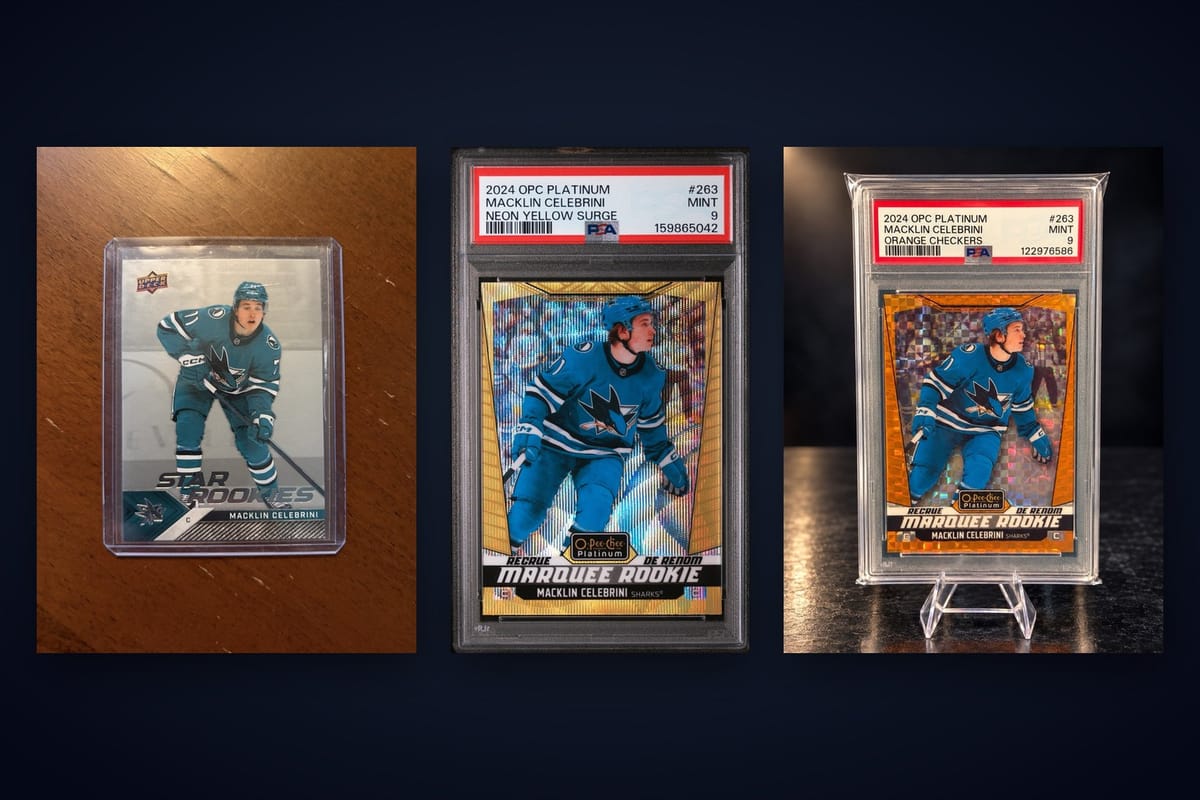
Macklin Celebrini #13 2024 Upper Deck NHL Star Rookies Box Set |
$19.57 | $224.12 | -0.1% |
 |
Macklin Celebrini [Neon Yellow Surge] #263 2024 O-Pee-Chee Platinum |
$176.11 | $558.18 | 0% |
 |
Macklin Celebrini [Orange Checkers] #263 2024 O-Pee-Chee Platinum |
$1,010 | $2,227 | 0% |
 |
Carl Brewer #18 1960 Parkhurst |
$10.30 | $1,683 | 0% |
 |
Matthew Schaefer [10] #PC-37 2025 Upper Deck Series 2 Population Count |
$2,540 | $11,535 | 0% |
 |
Wayne Gretzky #18 1979 O-Pee-Chee |
$904.35 | — | +20.3% |
Look up any card's current raw and graded value in Midpoint — and get an estimated grade before you pay to submit.
1. Overview of Hockey Card Prices Dropping November 2026
As of 2026-10-26, the hockey card market has shown price declines across various segments. Both raw cards and PSA 10 graded cards have experienced drops, suggesting a broad market adjustment rather than impacts limited to specific grades. This trend may reflect supply increases, including reprints and new parallels entering the market.
For example, the Connor McDavid 2025-26 base rookie card has reportedly declined around 12% in raw value and 8% in PSA 10 grade values over the last 30 days. Similarly, Auston Matthews’ 2024-25 inserts have seen declines near 15% in both raw and graded forms. These figures indicate a market-wide cooling effect affecting both vintage and modern categories.
Collectors should note that such drops may represent temporary market adjustments rather than permanent devaluation. Upcoming NHL season developments, injuries, and award race outcomes will likely continue to influence card demand and prices.
2. Reasons Behind Falling Hockey Card Prices
Several factors appear to contribute to hockey card price declines in November 2026:
- Supply Increases: The market has seen numerous reprints and overproduced parallels, increasing supply and potentially reducing scarcity.
- Shifts in Collector Interest: Initial excitement for rookies and prospects, including the 2026 draft class, may have moderated as collectors reassess long-term potential.
- Market Corrections: Cards that surged due to short-term events or milestones may be adjusting to more sustainable valuations.
- Grading Population Growth: Increased submissions for grading have raised PSA and BGS populations, which can soften premiums.
These factors contribute to a buyers’ market, particularly for those able to identify undervalued cards with strong fundamentals.
3. Most Affected Hockey Card Categories in November 2026
The price declines are not uniform across categories, with some types more affected than others:
- Rookie Cards: Early 2026-27 rookies and recent draft class cards have experienced notable declines, reflecting some uncertainty about player development.
- Inserts and Parallels: Increased production has impacted these categories, leading to price corrections on popular insert sets.
- Autographs and Memorabilia: While still sought after, these cards have softened somewhat, possibly due to less event-driven hype and fewer high-profile signings.
- Vintage Cards: Generally more stable, though some older cards linked to active players affected by injuries or trades have also seen price dips.
Collectors focused on modern rookies should exercise caution but may find opportunities to acquire high-potential cards at reduced prices.
4. Impact of NHL Player Performance and Events on Prices
Player performance, trades, injuries, and milestones continue to influence hockey card demand. November 2026 featured mixed NHL news:
- Connor McDavid’s minor injury reportedly affected short-term card sentiment, contributing to recent price declines.
- Sidney Crosby’s milestone achievements may have helped offset declines in his card values, maintaining relative market resilience.
- New rookies entering lineups, such as 2026 draft class prospects, have increased interest but also added volatility.
- Trades involving Nathan MacKinnon and other stars caused momentary price spikes that did not sustain long-term growth.
Collectors should monitor ongoing NHL developments to anticipate price movements and identify potential buying opportunities.
5. Raw vs Graded Card Price Trends
Both raw and graded cards have experienced price declines, though the extent and timing can differ. PSA 10 cards often retain value better due to grade scarcity but are still subject to market corrections.
For example, the Sidney Crosby 2024-25 PSA 10 base card reportedly dropped 7% in the last month, compared to a 10% decline in raw card prices. This suggests graded cards may provide some downside protection but still reflect broader market pressures.
Tools like Midpoint’s AI digital grading can help collectors estimate PSA, BGS, CGC, and TAG grades before submitting, potentially reducing risk and optimizing investment decisions during market dips.
6. Sales Evidence from Marketplaces and Auction Houses
Recent sales data from eBay, COMC, and auction houses support the downward trend. Sold listings often show lower average prices compared to active asking prices, highlighting the importance of tracking actual transactions rather than posted prices.
For instance, the Auston Matthews 2025-26 insert reportedly sold for approximately 14% less than its listed price on eBay in late October 2026. Similarly, signed rookie cards from emerging stars have sold below some expectations, possibly due to oversupply and reduced collector urgency.
Collectors are advised to use recent sold data as a more reliable market indicator when deciding whether to buy or sell.
7. Buying the Dip: Cards Worth Considering in November 2026
A declining market can create opportunities for strategic purchases. Cards to consider include:
- Well-Centered Rookie Cards: Rookies with solid fundamentals but temporarily depressed prices, especially if raw copies grade well.
- Autographs with Low Population: Limited autographed cards from top players that may rebound with positive player news.
- Quality Inserts and Parallels: Those with authentic scarcity and appeal, avoiding mass-produced parallels.
Using Midpoint’s centering measurement and grading estimate tools may help identify undervalued cards suitable for grading and resale when the market improves.
8. How to Track and Value Your Hockey Card Collection
Active monitoring of recent sold listings is important to understand true market value. Relying solely on asking prices can be misleading, as they may be inflated or outdated.
Midpoint’s portfolio tracking feature allows collectors to view their collection’s value over time, integrating raw and graded values across 250,000+ cards. This data-driven approach supports more informed buying, selling, and grading decisions during volatile market phases.
Additionally, measuring card centering with precision before submitting for grading can help save costs and maximize returns, as detailed in our guide How to Pre-Grade Your Card.
Conclusion
The hockey card price declines observed in November 2026 appear to reflect a market correction influenced by supply increases and reduced hype. While many cards, including raw and PSA 10 graded examples from top players like Connor McDavid and Sidney Crosby, have softened, this dip may present opportunities for collectors to acquire quality cards at discounted prices.
Leveraging tools such as Midpoint’s AI grading estimates and centering measurement can assist collectors in identifying strong candidates for grading and investment. Tracking recent sold listings rather than asking prices can provide more accurate market insights. By understanding these dynamics and focusing on well-centered rookies, scarce autographs, and authentic inserts, collectors may better position themselves for potential gains when the market stabilizes.
Discover how Midpoint can support your collecting journey and help you make informed decisions during market fluctuations by visiting Midpoint.
FAQ
Q: Why are hockey card prices dropping in November 2026?
A: Prices have declined due to factors such as increased production, reprints entering the market, shifting collector interest around rookies and prospects, and increased grading supply affecting premiums.
Q: Are hockey cards a good investment right now?
A: The current dip may offer buying opportunities, especially for well-centered rookie cards and scarce autographs. Using grading tools and tracking sold prices can help identify undervalued cards with potential.
Q: Which hockey cards are losing value the fastest?
A: Rookie cards from the 2026-27 season, inserts, and heavily reprinted parallels have experienced notable declines, likely due to market saturation and uncertainty about player performance.
Q: Should I sell my hockey cards now or wait?
A: This depends on your individual goals. Waiting for market stabilization might maximize returns, but selling underperforming cards during the dip could free capital for undervalued purchases.
Q: What hockey cards are worth buying during the November 2026 dip?
A: Consider rookie cards with strong fundamentals, low-population autographs, and quality inserts. Pre-grading to confirm centering and condition using tools like Midpoint can increase confidence in selections.
Q: How can I check the current value of my hockey cards?
A: Use recent sold listings on marketplaces such as eBay and COMC, along with tools like Midpoint that provide raw versus graded value comparisons and portfolio tracking for up-to-date valuations.
Free to start
Try the Midpoint app
Grade any card from a photo, see its raw and PSA 10 value, and track what your collection is worth — free.
Get it on iPhoneGet it on Android