Hockey Card Prices Dropping October 2026: 10 Key Market Insights
Explore why hockey card prices are dropping in October 2026, which cards lost value, and how collectors can smartly buy the dip or hold.

Estimated reading time: 8 min
Key Takeaways
- Hockey card prices are broadly declining in October 2026, influenced by supply, grading trends, and seasonality.
- Young Guns, rookies, and inserts show notable price drops, especially in PSA 10 and raw grades.
- Vintage cards remain relatively more stable, often outperforming modern parallels amid current market cooling.
- Key players like Connor McDavid and Macklin Celebrini influence market swings, but prices are softening for some of their rookie and base cards.
- Collectors can leverage tools like Midpoint for pre-grading and precise centering analysis to identify potentially undervalued cards.
As of October 2026, hockey card prices are showing declines across multiple segments. Whether you're a seasoned collector or investor, understanding the factors behind this downturn can help you make more informed decisions. From recent sold-comparable data to grading nuances and market dynamics, this listicle covers important insights about the hockey card market in October 2026 — including which cards are experiencing value changes, possible reasons why, and how you might approach buying during this period.
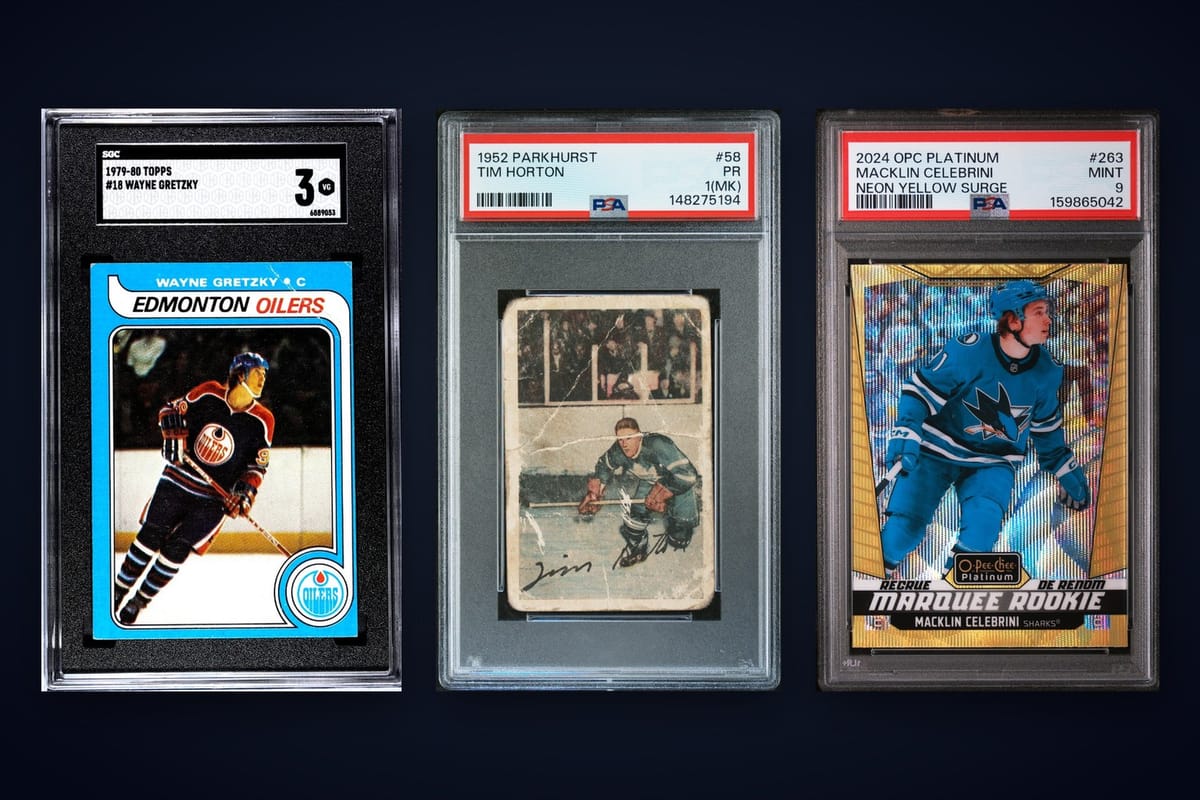
30-day price movers — live data from Midpoint's card database, as of 2026-09-16. Prices move; Midpoint refreshes these daily.
| Card | Raw | PSA 10 | 30-day | |
|---|---|---|---|---|
 |
Wayne Gretzky #18 1979 Topps |
$645.85 | $56,286 | -92.2% |
 |
Tim Horton #58 1952 Parkhurst |
$609.40 | $161,206 | -10.1% |
![Macklin Celebrini [Neon Yellow Surge] #263 2024 O-Pee-Chee Platinum card](https://i.ebayimg.com/images/g/gCcAAeSwfwRqUyEd/s-l500.jpg) |
Macklin Celebrini [Neon Yellow Surge] #263 2024 O-Pee-Chee Platinum |
$176.11 | $558.18 | -6.5% |
![Ryan Leonard [Exclusive] #238 2025 Upper Deck card](https://i.ebayimg.com/images/g/A4MAAeSwyudqfLhR/s-l500.jpg) |
Ryan Leonard [Exclusive] #238 2025 Upper Deck |
$226.94 | $952.73 | -0.5% |
![Auston Matthews [Seismic Gold] #P-AM 2023 O-Pee-Chee Platinum Preview card](https://i.ebayimg.com/images/g/fhQAAeSw1sJodCd~/s-l500.jpg) |
Auston Matthews [Seismic Gold] #P-AM 2023 O-Pee-Chee Platinum Preview |
$65.68 | $219.41 | -0.5% |
![Ryan Leonard [Gold] #DZ-41 2025 Upper Deck Dazzlers card](https://i.ebayimg.com/images/g/2~IAAeSwR51prHAs/s-l500.jpg) |
Ryan Leonard [Gold] #DZ-41 2025 Upper Deck Dazzlers |
$227.01 | $951.52 | -0.5% |
 |
Busher Curry Goes Up and Over #89 1954 Parkhurst |
$11.18 | $2,579 | 0% |
 |
Gordie 700th Goal #22 1968 O-Pee-Chee Puck Stickers |
$32.76 | $4,287 | 0% |
 |
Jacques Plante #15 1968 O-Pee-Chee Puck Stickers |
$14.94 | $2,117 | 0% |
![Delvecchio Finds [Leaf Defense Hard to] #90 1954 Parkhurst card](https://i.ebayimg.com/images/g/4NEAAeSwi0lqGeRn/s-l500.jpg) |
Delvecchio Finds [Leaf Defense Hard to] #90 1954 Parkhurst |
$12.63 | $2,971 | 0% |
 |
Michael Walton #14 1966 Topps USA Test |
$22.47 | — | 0% |
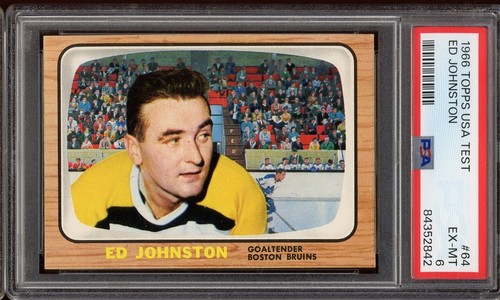 |
Ed Johnston #64 1966 Topps USA Test |
$31.79 | — | 0% |
Look up any card's current raw and graded value in Midpoint — and get an estimated grade before you pay to submit.
1. Hockey Card Market October 2026: Overview of Falling Prices
In October 2026, the hockey card market is experiencing a broad-based decline. Data from Midpoint's database indicates that both raw and graded cards have seen price drops in many segments over the last 30 days. This decline appears more pronounced in certain segments like Young Guns and rookies, while vintage cards have held up comparatively better.
Market conditions reflect a combination of increased supply, grading population inflation, and seasonal factors coinciding with the NHL season start. Auction volume remains high but with softer realized prices, suggesting increased buyer caution.
- Raw 2025-26 Young Guns rookie cards down roughly 20% in median sale price in some cases.
- PSA 10 graded versions of top rookies like Macklin Celebrini showing declines around 18-22% in recent data.
- Vintage cards from the 1980s and earlier down less than 10% on average, showing relative resilience.
2. Hockey Cards Losing Value: Which Segments Are Most Affected?
The segments experiencing the most notable value declines in October 2026 include Young Guns, rookies, prospects, and limited parallels. Inserts and specialty parallels have also softened as initial hype fades post-launch.
For example, Macklin Celebrini’s 2025-26 Young Guns PSA 10 card has seen median prices decrease from around $1,700 to approximately $1,350 as of mid-September 2026. Similarly, Sidney Crosby inserts and parallels have experienced declines in the 10-15% range as collectors focus on more stable assets.
- Rookie cards with high population reports appear particularly vulnerable.
- Low-population raw cards with poor centering or condition often see steeper discounts.
- High-grade PSA 10 and BGS 9.5 cards show smaller but noticeable price corrections.
3. Modern vs. Vintage: Performance Comparison
Vintage hockey cards continue to show more stability compared to modern cards during this downturn. Their scarcity, historical significance, and collector demand provide some buffer against rapid price drops.
In contrast, modern cards, especially those with high print runs or recent reprints, face downward pressure. This trend is more evident in rookie-heavy sets where oversupply is common.
- Vintage cards down less than 10% on average.
- Modern rookies and inserts down 15-25% in many cases.
- Parallel sets with limited editions maintain some premium but still face declines.
4. Key Players Driving Market Movement
Top players like Connor McDavid, Sidney Crosby, Alex Ovechkin, and emerging rookies such as Macklin Celebrini remain central to market trends. However, even some of their highly sought-after cards are experiencing price declines.
McDavid’s 2022-23 base PSA 10 has recently declined about 12% in observed sales, while Celebrini’s rookie cards saw sharper dips likely due to rookie hype normalizing. This suggests a market correction rather than a fundamental loss of interest.
- Strong followings help prevent top player cards from crashing.
- Rookie hype cycles influence short-term volatility.
- Grading and centering quality impact individual card pricing significantly.
5. PSA 10, BGS 9.5, Raw, and Lower Grade Price Spreads
Price spreads between high-grade and raw or lower-grade cards have widened during this downturn. PSA 10 and BGS 9.5 cards retain a premium, but the gap to raw cards is increasing as demand softens.
Collectors looking to buy the dip may find value in well-centered raw cards that are candidates for grading upgrades. For instance, a raw 2025-26 Young Guns rookie with excellent centering could be a worthwhile investment before submitting to PSA or BGS.
- PSA 10 cards down approximately 15%, raw cards down closer to 25% in some cases.
- Mid-grade cards (BGS 8.0-9.0) see steeper declines.
- Centering quality plays a larger role in grading potential and value.
6. Causes of Falling Hockey Card Prices: Supply and Market Dynamics
Several factors appear to contribute to the October 2026 price declines:
- Increased supply: High grading submissions swelling PSA and BGS population reports.
- Reprints and parallels: Oversaturation dilutes demand for base rookies.
- Hype fading: Early excitement around new rookies and inserts cooling off.
- Seasonality: NHL season start brings natural market adjustments.
These combined pressures create a buyer-friendly environment but require careful selection.
7. Seasonality and Speculation-Driven Volatility
October traditionally sees market adjustments as collectors reassess holdings after summer hype and before holiday buying. The 2026 NHL season start adds to volatility, with player performance news influencing sentiment.
Speculative buying and selling cycles around rookie cards and inserts cause price spikes and corrections. This can create opportunities for those monitoring recent sold listings and trends carefully.
- October price dips often precede a rebound if NHL stars perform well.
- Speculation can exaggerate short-term price swings.
- Monitoring auction volume helps gauge market sentiment.
8. Verifying Declining Prices Using Online Tools
Collectors should verify price trends using reliable data sources. Platforms such as eBay sold listings, 130point, and PriceCharting provide transparent recent sales data. Card pricing indexes like Midpoint aggregate millions of transactions for accurate insights.
Using Midpoint’s AI grading and centering tools, collectors can also estimate card grades before submitting for costly professional grading, helping avoid overpaying during downturns.
- Check exact player, set, card number, and parallel sold comps.
- Compare raw versus graded sale prices.
- Use Midpoint’s grading estimates and portfolio tracking for market awareness.
9. Which Hockey Cards to Buy the Dip
Buying the dip strategically means targeting undervalued cards with strong long-term potential and good condition. Focus on:
- Well-centered raw rookies eligible for grading upgrades.
- Underappreciated inserts and parallels with historic demand.
- Low-population vintage cards showing price stability.
- Top players like McDavid and Crosby with proven track records.
Using Midpoint’s digital grading tools can help identify cards with excellent centering and surface condition, maximizing grading value and minimizing risk.
10. Should Collectors Sell, Hold, or Buy?
Current market softness suggests a mixed strategy:
- Hold: Stable vintage cards and blue-chip graded rookies likely to recover.
- Sell: Over-hyped modern inserts and high-population parallels if short-term liquidity is needed.
- Buy: Well-centered raw cards and undervalued rookies to grade and hold long term.
Patience can pay off, and using tools like Midpoint to pre-grade and estimate card condition before submitting to PSA or BGS may save money and improve investment outcomes.
For more tips on protecting and maximizing your collection’s value, check out our guide on how to store valuable cards.
Conclusion
Hockey card prices are declining in October 2026, influenced by supply, grading population growth, and seasonal market cycles. Young Guns, rookies, and inserts are among the most affected segments, while vintage cards offer relative stability. Key player cards remain influential but are also experiencing price corrections. Collectors can consider capitalizing on this dip by focusing on well-centered raw cards with grading upside, verified with tools like Midpoint for AI-powered grading estimates and centering analysis. Whether to sell, hold, or buy depends on your collection goals, but informed decisions during downturns can potentially yield rewards when the market recovers.
Explore Midpoint’s free tools to measure card centering down to the millimeter and get instant PSA, BGS, CGC, and TAG grade estimates before you spend on grading fees. Visit Midpoint to start optimizing your hockey card investments today.
FAQ
Q: Are hockey card prices dropping in October 2026?
A: Yes, hockey card prices are broadly declining in October 2026, especially in rookie and insert segments, with observed average drops of 15-25% over the past month in many cases.
Q: Why are hockey card prices going down right now?
A: Prices are falling due to increased supply, higher grading submissions inflating population reports, fading hype around recent rookies, and seasonal market adjustments tied to the NHL season start.
Q: Which hockey cards are losing the most value in 2026?
A: Young Guns, rookies, and inserts—particularly those with high print runs or lower centering quality—are losing the most value, while vintage cards remain relatively more stable.
Q: Is it a good time to buy hockey cards during the October 2026 dip?
A: Buying well-centered raw cards at discounted prices can be a reasonable strategy, especially if you plan to submit them for grading to capture potential value gains when the market rebounds.
Q: Should I sell my hockey cards now or wait for prices to recover?
A: It depends on your cards and goals. Holding stable vintage and blue-chip graded rookies, selling over-hyped modern parallels if needed, and considering buying undervalued raw cards with grading potential are all valid approaches.
Q: How can I check the current value of a hockey card using recent sold listings?
A: Use platforms like eBay sold listings, 130point, PriceCharting, and Midpoint’s card lookup and grading tools to see comparable sales by player, card number, set, and grade for more accurate market pricing.
Free to start
Try the Midpoint app
Grade any card from a photo, see its raw and PSA 10 value, and track what your collection is worth — free.
Get it on iPhoneGet it on Android