How Much Does PSA Grading Cost? Complete 2026 Pricing & Tips
Discover how much PSA grading costs in 2026, turnaround times, declared values, and whether grading your cards is worth it. Use Midpoint's AI grading app first.


Estimated reading time: 12 min
Key Takeaways
- PSA grading costs vary by tier, declared value, and membership status, with fees generally starting around $20+ per card.
- Turnaround times range from about 30 days to several months depending on service level and demand.
- Midpoint’s AI digital grading tool can help estimate your card’s grade and value before submission, potentially saving money and time.
- Choosing the right tier depends on your card’s value and desired turnaround; bulk submissions often reduce cost per card.
- Understanding PSA vs BGS vs CGC differences can clarify grading scale, fees, and label preferences.
Card values — live data from Midpoint's card database, as of 2026-09-04. Prices move; Midpoint refreshes these daily.
| Card | Raw | PSA 10 | Gem premium | |
|---|---|---|---|---|
 |
Larry Costello #33 1957 Topps |
$26.74 | $5,633 | 210.7× |
 |
Larry Costello #9 1961 Fleer |
$18.50 | $3,926 | 212.2× |
 |
Elmer Costa #60 1951 Topps Magic |
$3.76 | $969.55 | 257.9× |
![Cost Down [1st Edition] DCR-053 YuGiOh Dark Crisis card](https://i.ebayimg.com/images/g/whwAAeSwvBFqQFJm/s-l500.jpg) |
Cost Down [1st Edition] DCR-053 YuGiOh Dark Crisis |
$5.75 | $375.00 | 65.2× |
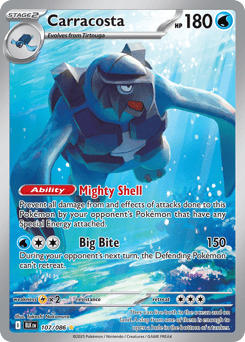 |
Carracosta #107/086 Black Bolt (2025) |
$13.77 | $253.94 | 18.4× |
 |
Black Costume #12 Marvel 2009 Rittenhouse Spider-Man Archives (2009) |
$4.95 | $200.00 | 40.4× |
Look up any card's current raw and graded value in Midpoint — and get an estimated grade before you pay to submit.
Table of Contents
- Section 1: How Much Does PSA Grading Cost and What Are the Fees?
- Section 2: Understanding PSA Grading Tiers, Declared Value Limits, and Turnaround Times
- Section 3: Comparing PSA, BGS, CGC, and TAG Grading Services
- Section 4: How Does Card Grading Work? Subgrades and Grade Estimates
- Section 5: When Is It Worth Grading My Cards? Value, Rarity, and Premiums
- Section 6: How to Submit Cards to PSA: Direct vs Dealer and Bulk Tips
- Conclusion
- FAQ
Section 1: How Much Does PSA Grading Cost and What Are the Fees?
PSA Pricing Tiers and Per-Card Fees
PSA grading costs are tiered based on declared card value and desired turnaround time. As of mid-2024, PSA grading price tiers generally start around $20 to $30 per card for the most basic service, increasing with declared value and speed. Here's an overview:
- Value Tier 1: Cards valued under $499 typically start around $20 to $30 per card.
- Higher Tiers: Cards declared between $500 and $5,000+ may incur fees from approximately $50 up to $300+ depending on the tier.
- Premium and Express Services: These offer faster turnaround but cost significantly more per card.
Note that PSA membership is usually required for the lowest-priced tiers, while higher tiers may not require membership but have elevated fees.
Additional Costs Beyond Grading Fees
Beyond the base grading fee, collectors should budget extra for:
- Shipping and Insurance: Safely shipping cards to and from PSA with insurance can add approximately $10–$40+ per submission depending on value and service.
- Submission Supplies: Card holders, top loaders, and semi-rigid holders needed for submission add to cost.
- Membership Fees: PSA Collectors Club membership costs about $60/year and may be required for certain tiers.
Cost Examples for Single Card vs Bulk Submissions
Submitting single cards individually is generally more expensive per card than bulk submissions. PSA offers lower per-card pricing for bulk submissions (e.g., 25+ cards). For example:
- Submitting a single Larry Costello #33 (1957 Topps) valued at over $5,000 graded PSA 10 involves fees potentially over $100+ per card.
- Bulk submitting lower-value cards like Elmer Costa #60 (1951 Topps Magic) with a raw value under $5 may reduce per-card fees via volume discounts.
For detailed pricing and service availability, always verify the current PSA price guide on their official site.
Section 2: Understanding PSA Grading Tiers, Declared Value Limits, and Turnaround Times
Current PSA Tiers and Which Are Open
PSA offers multiple service tiers such as Value, Regular, Express, and Premium. Each tier has declared value limits and turnaround expectations. As of mid-2024:
- Value Tier: For cards under $499 declared value, with turnaround times typically around 30–45 days. Requires PSA membership.
- Regular Tier: For cards between $500 and $2,499, turnaround generally 60–90 days. Membership optional.
- Express Tier: For cards $2,500 to $4,999, faster turnaround (around 30 days), higher fees.
- Premium and Super Express: For cards $5,000+, fastest turnaround but highest cost.
Note that some tiers may be paused or restricted depending on PSA’s current capacity. Always check PSA’s website for open tiers before submitting.
Declared Value Limits and Their Impact
The declared value is the maximum retail value PSA accepts for grading on your submission form. The declared value affects:
- Fee tier selection
- Insurance coverage during shipping
- Potential resale value and protection
For example, declaring a value of $5,000+ means you must choose a premium tier with higher fees and faster turnaround but better insurance.
Turnaround Times by Tier
Turnaround times vary significantly, influenced by demand, tier, and submission volume. Typical estimates:
- Value Tier: Approximately 30–45 days
- Regular Tier: Approximately 60–90 days
- Express Tier: Around 30 days or less
- Premium Tier: Approximately 7–14 days
During peak seasons, expect possible delays. Using Midpoint’s AI grading app can help you decide whether the wait and cost are justified.
Section 3: Comparing PSA, BGS, CGC, and TAG Grading Services
Differences in Grading Scales and Labels
PSA, BGS, CGC, and TAG each maintain their own grading scales and label styles:
- PSA: Grades from 1 to 10; PSA 10 is Gem Mint, PSA 9 is Mint. Known for consistent scale and strong market demand.
- BGS (Beckett): Uses subgrades (centering, edges, corners, surface) and overall grade. Pristine 10 is top, Gem Mint 9.5 is common highest grade.
- CGC: Similar numeric scale, popular for non-sports cards like Magic and Pokémon.
- TAG: Newer entrant, offers fast turnaround and competitive pricing, with similar grading scale.
Each company has different label aesthetics and holder designs, influencing collector preference.
Fee Structures and Submission Requirements
Fee structures vary:
- PSA: Tiered pricing by declared value and membership status.
- BGS: Grades often cost more than PSA, especially for subgrade breakdowns.
- CGC: Competitive for non-sports, with similar tiering.
- TAG: Offers affordable, faster options but less widespread market recognition yet.
Turnaround and Market Acceptance
PSA remains the most recognized, especially for sports cards, with robust resale premiums. BGS is favored for subgrade detail and some sports markets. CGC is gaining traction for Pokémon and Magic cards. TAG is emerging but less established.
Choosing a grading company depends on your card type, market, and budget.
Section 4: How Does Card Grading Work? Subgrades and Grade Estimates
PSA’s Grading Criteria: Centering, Corners, Edges, Surface
PSA evaluates cards based on four key criteria:
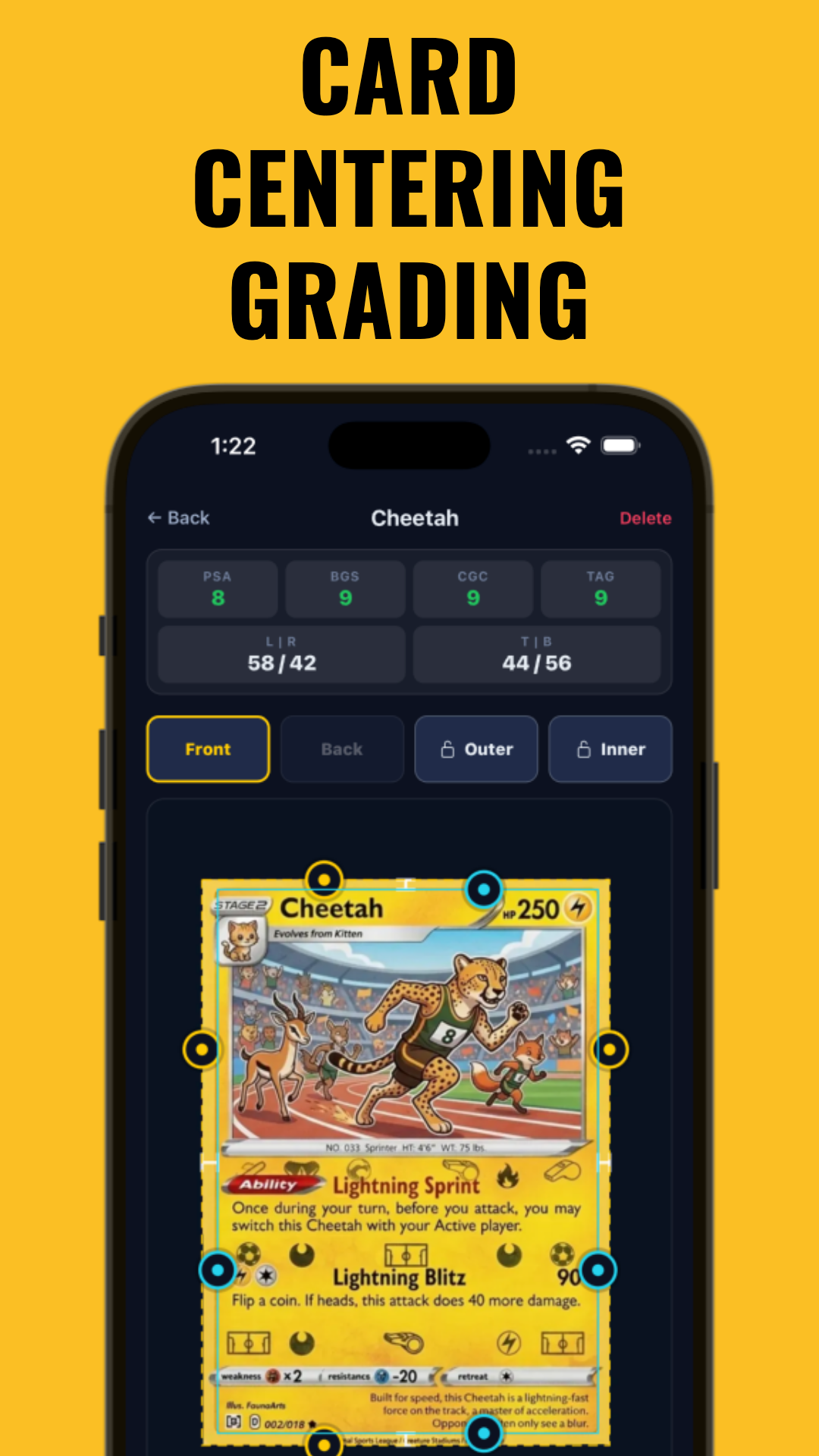
- Centering: The alignment of the card’s image within borders, measured often down to millimeters. Poor centering reduces grade.
- Corners: Condition of all four corners; sharpness means higher grades.
- Edges: Clean edges without chipping or wear are essential for top grades.
- Surface: Free of scratches, stains, print defects, or discoloration.
Each criterion affects the final grade. For example, a card with perfect corners but poor centering might receive a grade lower than 10.
Gem Mint vs Pristine and PSA 10 vs PSA 9 Value Difference
PSA 10 is Gem Mint — near perfect condition. PSA 9 is Mint — slight imperfections visible under close inspection. The value difference between PSA 10 and PSA 9 can be significant, often substantially increasing the card’s market value.
Example: Larry Costello #33 (1957 Topps) raw value around $26.74, PSA 10 has been known to fetch several thousand dollars, illustrating a large premium for gem mint condition.
How to Know What Grade a Card Will Get
Traditionally, grading is uncertain before sending cards. Midpoint’s AI-powered card grading app uses digital analysis to estimate grades by measuring centering to the millimeter and assessing corners, edges, and surface condition.
This pre-grade tool helps collectors decide if submitting a card is worth the cost based on likely outcomes, potentially preventing unnecessary grading fees.
Learn more about how to pre-grade your card for smarter submissions.
Section 5: When Is It Worth Grading My Cards? Value, Rarity, and Premiums
Evaluating Card Value and Market Demand
Not all cards are worth grading. Grading generally makes sense when:
- The card’s graded value is expected to significantly exceed raw value, justifying the grading cost.
- The card is rare or in high demand among collectors.
- The card benefits from authentication and protection for resale.
For example, a Larry Costello #9 (1961 Fleer) raw value around $18.50 graded PSA 10 has sold for several thousand dollars, showing a substantial premium. Grading in such cases can be financially rewarding.
When to Avoid Grading Low-Value Cards
Low-value cards with minimal premiums often don’t recoup grading fees. For instance, a card valued under $10 with a PSA grading fee of $30 may not be worth grading unless it has sentimental or rarity value.
Midpoint’s valuation and grading estimates enable collectors to make informed decisions, avoiding costly grading on low-return cards.
Other Factors: Population Reports and Card Condition
Cards with few graded examples (low population) can command higher premiums, making grading worthwhile even at moderate raw values.
High-condition raw cards near gem mint levels are prime candidates for grading. Midpoint’s precise centering measurements and AI grading tools assist in identifying such cards.
Section 6: How to Submit Cards to PSA: Direct vs Dealer and Bulk Tips
Direct Submissions vs Dealer or Bulk Submitters
Collectors can submit cards directly to PSA or through dealers/bulk submitters:
- Direct Submission: You send your cards and pay fees yourself, ideal for controlling the process and submitting small batches.
- Dealer/Bulk Submission: Dealers or third-party submitters consolidate many cards, often getting volume discounts and faster turnaround, but may charge additional fees.
Submission Process and Tips
Steps to submit directly:
- Create a PSA Collectors Club membership account (if required for your tier).
- Fill out submission forms online, declaring card values accurately.
- Package cards securely using proper holders and top loaders.
- Ship with insurance to PSA’s grading location.
- Track submission status through PSA.
For bulk submissions, coordinate with your dealer or submission service for consolidated shipping and payment.
Using Midpoint for Submission Preparation
Midpoint’s card grading tool streamlines submission prep by:
- Providing pre-grade estimates to select only worthwhile cards.
- Measuring centering and condition accurately.
- Helping track and organize your collection’s grading status.
Learn more about how Midpoint’s card grading app can optimize your submission strategy.
Conclusion
Understanding how much PSA grading costs and the associated factors such as declared value, turnaround times, and grading tiers is essential for trading card collectors aiming to maximize their investment. With fees generally starting around $20–30 per card and rising with higher value and speed, planning submissions carefully is important.
Comparing grading services like PSA, BGS, CGC, and TAG helps choose the best fit for your cards’ type and market. Knowing how grading works—centered on subgrades like centering, corners, edges, and surface—helps predict grades and potential premiums.
Using tools like Midpoint to digitally estimate your card’s grade before submission can help prevent unnecessary costs and optimize your collection’s value growth. Whether you submit individually or in bulk, understanding the costs and processes supports making informed grading decisions.
Start smart grading with Midpoint—your all-in-one app for AI digital grading, value tracking, and precise card condition analysis.
FAQ
Q: How much does PSA grading cost per card right now?
A: PSA grading costs vary by tier and declared value, generally starting around $20–30 per card for low-value tiers, increasing to $50–300+ for higher-value or expedited tiers. Additional fees for shipping and membership may apply.
Q: What is the cheapest PSA grading tier currently available?
A: The Value Tier is typically the cheapest, intended for cards declared under $499. It costs approximately $20–30 per card but requires PSA Collectors Club membership and has turnaround times around 30–45 days.
Q: Do I need a PSA Collectors Club membership to submit cards?
A: Membership is required for the Value Tier but optional for higher tiers. Membership costs about $60/year and provides submission access and other benefits.
Q: How much extra should I budget for shipping and insurance?
A: Shipping and insurance typically add approximately $10–$40+ depending on declared card value and packaging. Always insure your cards to protect against loss or damage.
Q: What declared value can I use for each PSA grading tier?
A: Declared values must fit within the tier limits: Value Tier under $499, Regular $500–$2,499, Express $2,500–$4,999, and Premium $5,000+. Declared value affects fees and insurance coverage.
Q: Is PSA grading worth it for low-value cards?
A: Generally, grading low-value cards is not cost-effective due to fees often exceeding potential resale premiums. Use tools like Midpoint to estimate if grading will add value before submitting.
Free to start
Try the Midpoint app
Grade any card from a photo, see its raw and PSA 10 value, and track what your collection is worth — free.
Get it on iPhoneGet it on Android