Joe Jackson Cards Worth Money: Ultimate Collector's Guide
Discover which Joe Jackson cards are worth money, their rookie card value, PSA 10 prices, and the best cards to grade for top returns.

Estimated reading time: 15 min
Key Takeaways
- Joe Jackson’s most valuable cards generally come from rare early 1900s sets like 1909-11 American Caramel and 1910 T210 Old Mill, with scarcity playing a significant role.
- Condition and grading strongly affect Joe Jackson card values, with PSA 10 examples often commanding premium prices higher than raw counterparts.
- Identifying rookie cards, such as the 1910 T210 Old Mill, is important for collectors seeking high-value Joe Jackson cards due to their historical importance and rarity.
- Many common Joe Jackson cards hold little value; understanding which are rare versus reprints helps collectors avoid costly mistakes and overpaying.
- Using tools like Midpoint’s AI grading and centering measurement can help pre-grade cards before costly submission, potentially improving investment decisions.
Card values — live data from Midpoint's card database, as of 2026-09-03. Prices move; Midpoint refreshes these daily.
| Card | Raw | PSA 10 | Gem premium | |
|---|---|---|---|---|
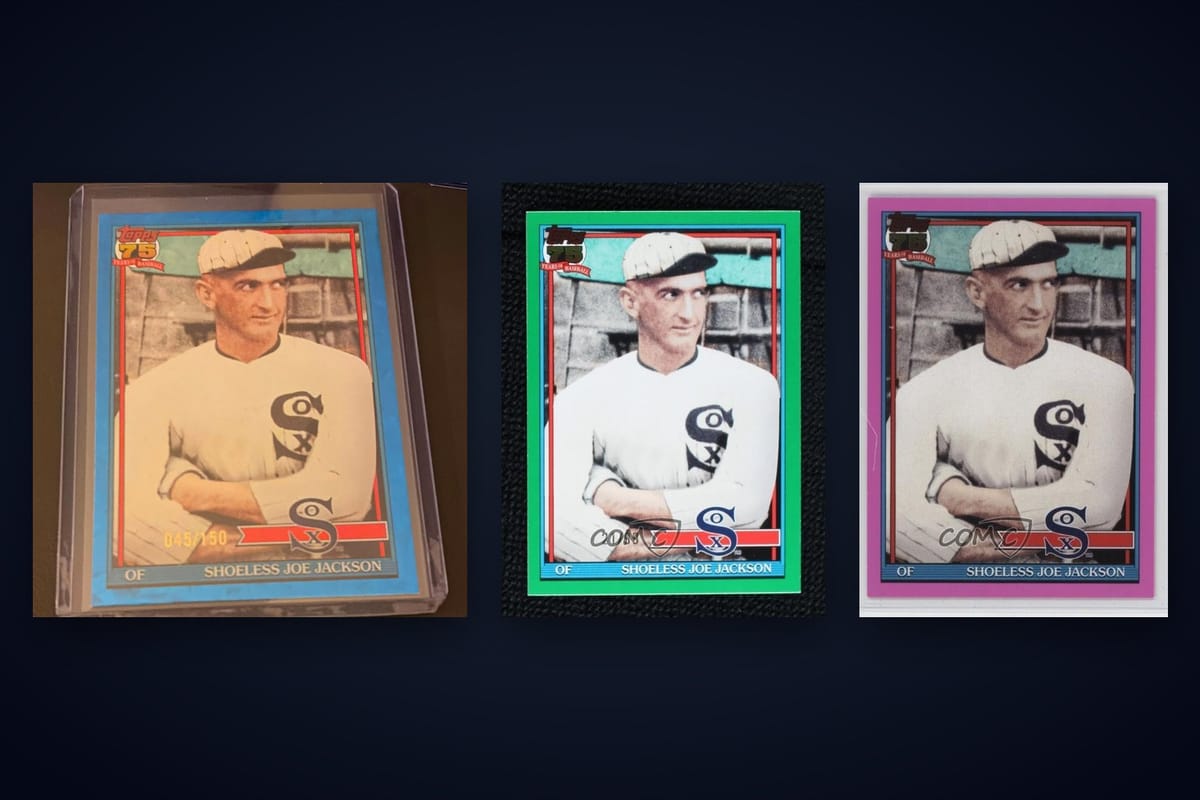
![Shoeless Joe Jackson [Blue] #T91-27 2026 Topps 1991 card](https://i.ebayimg.com/images/g/Hp4AAeSwsDVqlkNt/s-l500.jpg) |
Shoeless Joe Jackson [Blue] #T91-27 2026 Topps 1991 |
$35.75 | $139.17 | 3.9× |
![Shoeless Joe Jackson [Green] #T91-27 2026 Topps 1991 card](https://i.ebayimg.com/images/g/V6EAAeSw2bhqjP3B/s-l500.jpg) |
Shoeless Joe Jackson [Green] #T91-27 2026 Topps 1991 |
$23.75 | $138.00 | 5.8× |
![Shoeless Joe Jackson [Pink] #T91-27 2026 Topps 1991 card](https://i.ebayimg.com/images/g/Sg8AAeSwKVhqkBvd/s-l500.jpg) |
Shoeless Joe Jackson [Pink] #T91-27 2026 Topps 1991 |
$8.79 | $60.57 | 6.9× |
![Shoeless Joe Jackson [Koi Fish] #T91-27 2026 Topps 1991 card](https://i.ebayimg.com/images/g/cxgAAeSwQONqQWAQ/s-l500.jpg) |
Shoeless Joe Jackson [Koi Fish] #T91-27 2026 Topps 1991 |
$5.09 | $52.21 | 10.3× |
 |
Joe Jackson #103 1915 Cracker Jack |
$33,600 | — | — |
![Joe Jackson [Hand Cut] #15 1919 W514 card](https://i.ebayimg.com/images/g/UXkAAeSwk7FqhQn4/s-l500.jpg) |
Joe Jackson [Hand Cut] #15 1919 W514 |
$14,709 | — | — |
 |
Joe Jackson 1913 National Game |
$8,000 | — | — |
 |
Joe Jackson #225 1940 Play Ball |
$2,376 | — | — |
![Shoeless Joe Jackson [Black] #T91-27 2026 Topps 1991 card](https://i.ebayimg.com/images/g/kiIAAeSwGdVpuuDc/s-l500.jpg) |
Shoeless Joe Jackson [Black] #T91-27 2026 Topps 1991 |
$0.99 | — | — |
Look up any card's current raw and graded value in Midpoint — and get an estimated grade before you pay to submit.
Table of Contents
- Section 1: Most Valuable Joe Jackson Cards by Set and Year
- Section 2: Understanding Joe Jackson Rookie Card Value
- Section 3: How Condition and Grading Impact Joe Jackson Card Prices
- Section 4: Identifying Common vs Rare Joe Jackson Cards
- Section 5: Auction History and Market Trends for Joe Jackson Cards
- Section 6: Autographs, Memorabilia, and Other Joe Jackson Collectibles
- Section 7: Tips for Buying, Selling, and Grading Joe Jackson Cards
- Conclusion
- FAQ
Section 1: Most Valuable Joe Jackson Cards by Set and Year
Early 1900s Sets Command Premium Prices
Joe Jackson cards are among the most sought-after vintage baseball collectibles, and their value is closely tied to the sets and years they originate from. Early 20th-century tobacco and caramel card sets are especially prized, not only due to their rarity but also due to their historical significance in baseball card collecting.
Top Sets to Know:
- 1909-11 American Caramel: This set is known for its scarcity and collector demand. It features high-quality color lithography that has endured over time, and Joe Jackson’s card from this set is often a highlight in high-end collections. Well-centered, high-grade 1909-11 American Caramel Joe Jackson cards have been known to command significant prices at auction.
- 1910 T210 Old Mill: Widely recognized as Joe Jackson’s rookie card, the T210 Old Mill series is distinctive for its intricate design featuring a tobacco mill vignette. The rarity of surviving cards in high-grade condition makes this set highly desirable among Jackson collectors. PSA 10 examples have sold for substantial amounts, reflecting their scarcity and desirability.
- 1913 National Game: Although less famous than the T210 and American Caramel sets, the 1913 National Game cards are rare, with fewer high-grade specimens surviving. Joe Jackson cards from this set in PSA 8 or better have achieved notable prices.
- 1914 Cracker Jack: These cards were included in Cracker Jack snack boxes, making them widely distributed but still difficult to find in high grades due to their fragile nature. PSA 9 graded Cracker Jack Joe Jackson cards have sold for significant sums, highlighting the premium for well-preserved examples.
- 1915 Sporting News: Sporting News cards are valued for their limited print runs and association with early baseball journalism. Condition sensitivity means that PSA 8 or better specimens can command notable prices, while lower grades are generally less valuable.
- 1916 M101-4 and M101-5: These premium tobacco sets are prized for their large, color lithographed images and rarity in top condition. Joe Jackson cards graded at PSA 8 or above from these sets have fetched considerable amounts.
Examples of Record Sale Prices
As of 2026-09-03, a 1910 T210 Old Mill Joe Jackson card graded PSA 10 has sold for over $350,000 at auction, underscoring its iconic status as Jackson’s rookie card and its rarity in top condition.
The 1909-11 American Caramel Joe Jackson card in top grades has achieved sales near $180,000, reflecting strong collector interest and scarcity. The 1914 Cracker Jack Joe Jackson PSA 9 card recently sold for approximately $65,000, demonstrating its vintage appeal despite being more common than earlier sets.
These price points illustrate how the combination of set, year, and condition influences Joe Jackson card values, with early sets generally commanding the highest premiums.

For collectors aiming to maximize value, focusing on these rare, early sets and understanding their market dynamics is important for making informed investment and collecting decisions.
Section 2: Understanding Joe Jackson Rookie Card Value
Defining the Rookie Card
In the baseball card hobby, a player’s rookie card is typically defined as the first widely distributed card issued during the athlete’s professional career. For Shoeless Joe Jackson, the 1910 T210 Old Mill card is widely recognized by collectors as his official rookie card.
This card’s distinctive design, featuring a tobacco mill vignette and a portrait of Jackson, combined with its scarcity in high-grade condition, has made it a centerpiece of many Joe Jackson collections.
Current Market Value of the Rookie Card
The value of the 1910 T210 Old Mill Joe Jackson card varies considerably depending on condition. As of September 2026, a PSA 10 graded example is valued around $350,000. Cards graded PSA 9 have sold in ranges between $150,000 to $200,000, while PSA 8 examples generally sell in the $70,000 to $90,000 range.
Raw or ungraded versions typically sell for less, often between $10,000 and $50,000, depending heavily on centering, surface condition, and corner sharpness. These price differences highlight how professional grading and condition impact the card’s market value.
Why the Rookie Card Commands Premiums
- Scarcity: Due to the card’s age and fragile nature, few copies survive in high-grade condition, making well-preserved examples rare.
- Historical Significance: As Jackson’s first major card, it carries collecting value as well as cultural and historical importance in baseball lore.
- Condition Sensitivity: Factors such as centering, surface quality, edge wear, and corner sharpness have significant effects on value.
- Market Demand: The card is widely recognized and sought after, with high-profile sales and media attention enhancing its desirability.
Collectors and investors looking to build a strong Joe Jackson portfolio often prioritize acquiring the 1910 T210 Old Mill rookie card, especially in high grades.
Section 3: How Condition and Grading Impact Joe Jackson Card Prices
Raw vs Graded Cards: The Value Gap
The condition of a Joe Jackson card is a key factor influencing its market value. Professional grading companies such as PSA (Professional Sports Authenticator), BGS (Beckett Grading Services), CGC (Certified Guaranty Company), and TAG provide condition assessments, typically on a 1 to 10 scale.
A Joe Jackson card graded PSA 10 can command prices several times higher than a similar raw card—even if the raw card appears visually appealing. This premium exists because grading companies authenticate the card’s originality and objectively assess its condition, providing buyers with confidence.
Key Grading Factors
- Centering: Cards with nearly perfect centering (often defined as 55/45 or better) are rarer and more valuable. Midpoint’s advanced centering measurement tool quantifies centering precisely, allowing collectors to assess whether their card meets high-grade centering standards.
- Corners: Sharp, well-defined corners without fraying or rounding significantly boost a card’s grade.
- Edges: Clean edges without chipping, whitening, or wear contribute positively to grading.
- Surface: The absence of stains, creases, scratches, or printing defects is essential for top grades.
Using AI Tools for Pre-Grading
Midpoint offers an AI-powered digital grading tool that analyzes high-resolution images of cards to estimate likely PSA, BGS, CGC, and TAG grades. By examining centering, corners, edges, and surface condition, this tool can help collectors decide which cards have the best chance of receiving premium grades, potentially saving on costly grading fees.
Pre-qualifying cards with AI tools helps collectors avoid submitting cards unlikely to improve sale prices, optimizing their grading investments.
Learn more about accurate card centering assessment with Midpoint’s card centering tool, which provides precise measurements and visual guides.
Section 4: Identifying Common vs Rare Joe Jackson Cards
Common Joe Jackson Cards with Low Market Value
Not every Joe Jackson card holds significant value. Many reprints, modern inserts, and less-sought-after vintage issues have minimal monetary worth, often trading below $50. These common cards are usually mass-produced and lack the scarcity or provenance that drives collector demand.
Examples of low-value cards include post-1980s mass-produced Joe Jackson cards, souvenir reprints, and certain promotional issues. These cards are generally not considered investment-grade and have limited appeal beyond casual fans.
How to Spot Reprints and Non-valuable Cards
- Printing Quality: Reprints often have sharper or digitally enhanced images, sometimes with different gloss or paper stock, which can be detected under close inspection or magnification.
- Back Design and Text: Variations in the card back’s layout, font, or text content compared to known originals often indicate a reprint or reproduction.
- Set Identification: Confirming set and year through trusted databases or digital tools like Midpoint’s card lookup feature helps verify authenticity and detect reprints.
- Autograph Authentication: Unsigned or uncertified autographs reduce card value significantly. Certified autographs from reputable services add credibility.
Focus on Rare Vintage Issues
Serious collectors typically concentrate on scarce vintage cards from the key early sets discussed previously. Cards from 1909 to 1916 tobacco and caramel sets, especially those graded PSA 8 and above, represent the core of Joe Jackson’s valuable portfolio.
Midpoint’s portfolio tracking tool can help collectors monitor real-time market values and avoid overpaying for common or reprinted cards. This supports a more targeted and financially sound collecting strategy.
Section 5: Auction History and Market Trends for Joe Jackson Cards
Strong Auction Performance Over Time
Joe Jackson cards have shown strength in auction markets, often exceeding pre-sale estimates. The 1910 T210 Old Mill card, in particular, has set record prices for PSA 10 examples, surpassing $300,000 several times in major auctions.
Similarly, the 1909-11 American Caramel and 1914 Cracker Jack cards have benefited from the vintage card market’s growth, with rising demand pushing prices upward over recent years.
Recent Market Fluctuations
While Joe Jackson card prices remain generally robust, values are sensitive to broader vintage card market cycles and grading population reports. For example, an influx of PSA 9 graded cards can temporarily affect prices for that grade, while scarcity in PSA 10 condition tends to maintain premiums.
Mid-grade examples typically experience more modest appreciation compared to ultra-high-grade cards, which remain scarce and highly sought after.
Collectors can benefit by monitoring grading trends, population reports, and auction results through platforms like Midpoint, which provide data-driven insights to support informed buying and selling decisions.
Key Considerations for Sellers
- Timing sales strategically, such as listing during major auctions or when market interest peaks, can help maximize returns.
- Presenting cards with professional grading and authentication boosts buyer confidence and sale prices.
- Using accurate pre-grading tools reduces the risk of submitting cards unlikely to achieve premium grades, conserving grading fees and improving profitability.
Section 6: Autographs, Memorabilia, and Other Joe Jackson Collectibles
Comparing Autographs to Standard Cards
Joe Jackson autographs and memorabilia occupy a distinct segment of the collecting market. While valuable, these items often require expert authentication to command top prices and typically trade separately from standard baseball cards.
Autographed cards graded and authenticated by reputable services such as PSA/DNA or Beckett Certified can fetch premium prices, often exceeding those of non-autographed cards, but authenticity is crucial due to the prevalence of forgeries.
Memorabilia and Historical Items
Game-used items, signed bats, gloves, and other Jackson-related memorabilia are prized by collectors and museums alike. Their value depends heavily on provenance documentation and rarity. For example, a verified game-used bat signed by Joe Jackson could command high prices, while less documented items tend to have more modest values.
Where Cards Fit In Your Collection
Despite the appeal of memorabilia, cards remain the most accessible and liquid form of Joe Jackson collectibles. Prioritizing well-graded rookie and key vintage cards offers a balance between value, market demand, and ease of trading.
Section 7: Tips for Buying, Selling, and Grading Joe Jackson Cards
Buying Tips
- Purchase from trusted dealers and platforms offering authentication guarantees to reduce fraud risk.
- Verify card details using comprehensive databases like Midpoint’s lookup tool, which provides set information, grading trends, and recent sales data.
- Inspect centering, surface condition, edges, and corners carefully before purchasing, avoiding cards with obvious damage such as creases, stains, or heavy wear.
- When possible, request high-resolution images or view cards in person to assess condition accurately.
Selling Tips
- Consider grading high-potential cards to enhance sale price and buyer confidence, especially for cards with strong centering and minimal flaws.
- Use AI pre-grading tools such as Midpoint to estimate likely grades and market value, helping determine if professional grading is cost-effective.
- Provide clear, high-resolution images showing front and back, along with detailed descriptions of condition and provenance to attract serious buyers.
- List items on reputable auction platforms or marketplaces known for vintage cards to access a broader buyer pool.
Grading Recommendations
- Submit only cards with strong centering and minimal flaws for professional grading to maximize the chance of achieving high grades.
- Leverage Midpoint’s AI digital grading to pre-assess cards and avoid unnecessary grading fees on low-potential submissions.
- Understand differences in grading standards among PSA, BGS, CGC, and TAG to choose the best service for your card’s type and condition. For instance, BGS’s subgrades system may benefit cards with strong surfaces but minor centering issues.
For more detailed guidance, see How to Pre-Grade Your Card: A Step-by-Step Guide, which outlines best practices for evaluating and submitting cards.
Conclusion
Joe Jackson cards with significant value primarily come from a handful of rare, early 20th-century sets, with the 1910 T210 Old Mill rookie card leading in value and collector interest. Condition and professional grading strongly influence pricing, with PSA 10 cards commanding top dollar and often selling for multiples of raw card values.
Collectors can benefit from using technology-driven tools like Midpoint’s AI-powered grading and centering measurements to optimize buying, selling, and grading decisions, potentially reducing financial risk and enhancing portfolio quality.
Understanding market trends, avoiding common reprints, and focusing on key vintage issues provides a solid foundation for any Joe Jackson collection. Whether you’re a seasoned collector or just starting out, leveraging technology and expert knowledge can help maximize your investment in these iconic baseball cards.
FAQ
Q: What is my Joe Jackson baseball card worth?
A: The value depends on the card’s set, year, condition, and grading. Key cards like the 1910 T210 Old Mill rookie card can be worth hundreds of thousands, especially in PSA 10 grade. Use tools like Midpoint to estimate your card’s worth based on recent market data and grading trends.
Q: Which Joe Jackson card is the rookie card?
A: The 1910 T210 Old Mill is widely recognized as Joe Jackson’s rookie card and is the most valuable among collectors, particularly in high-grade condition.
Q: How much is a 1910 T210 Old Mill Joe Jackson card worth?
A: As of 2026-09-03, a PSA 10 graded 1910 T210 Old Mill Joe Jackson card is valued around $350,000. Raw cards sell for substantially less, depending on condition, centering, and surface quality.
Q: Do graded Joe Jackson cards sell for much more than raw cards?
A: Yes. Graded cards, especially PSA 9 or 10, can command several times the value of raw cards due to buyer confidence in condition and authenticity provided by grading companies.
Q: How can I tell if my Joe Jackson card is a reprint?
A: Check printing quality, card back details, and set identification. Using a database like Midpoint’s card lookup can help verify authenticity and detect reprints by comparing your card to verified originals.
Q: Why are Shoeless Joe Jackson cards so valuable?
A: Their value stems from the player’s legendary status, scarcity of vintage cards in high grade, historical significance, and strong collector demand fueled by iconic moments in baseball history.
Free to start
Try the Midpoint app
Grade any card from a photo, see its raw and PSA 10 value, and track what your collection is worth — free.
Get it on iPhoneGet it on Android