
Michael Jordan Cards Worth Money: Values, Grading & Key Picks
Discover which Michael Jordan cards are worth money, their PSA 10 values, rookie card insights, and best cards to grade for collectors.

Estimated reading time: 18 min
Key Takeaways
- Michael Jordan rookie cards, especially the 1986 Fleer #57 in PSA 10, are among the most valuable and often command high prices.
- High-end Jordan cards like autographs, Precious Metal Gems, and Logoman inserts can reach six-figure sales, reflecting their rarity and collector demand.
- Condition and grading are important; centering, corners, edges, and surface quality can significantly affect card value and desirability.
- 90s Jordan insert cards such as Chrome refractors and Metal Universe remain collectible, with well-graded examples fetching hundreds to thousands of dollars.
- Midpoint’s AI grading tool offers instant estimates of PSA 10 and other grades, allowing collectors to make informed decisions on which cards to send for professional grading and optimize investment.
Card values — live data from Midpoint's card database, as of 2026-08-23. Prices move; Midpoint refreshes these daily.
| Card | Raw | PSA 10 | Gem premium | |
|---|---|---|---|---|
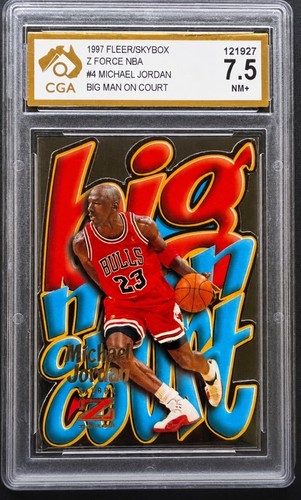 |
Michael Jordan #4 1996 Skybox Z Force Big Men on Court |
$3,215 | $89,955 | 28× |
 |
Michael Jordan #1GT 1997 Skybox Premium Golden Touch |
$2,872 | $73,057 | 25.4× |
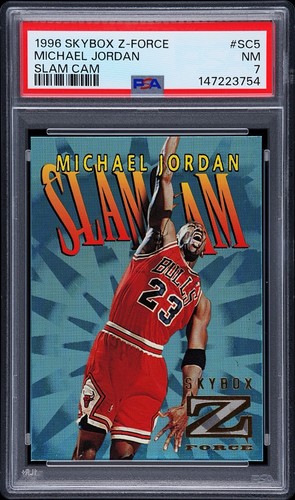 |
Michael Jordan #SC5 1996 Skybox Z Force Slam Cam |
$2,239 | $37,706 | 16.8× |
 |
Michael Jordan #15DG 1998 Skybox E-X Century Dunk 'N Go-Nuts |
$5,420 | $35,240 | 6.5× |
![Michael Jordan [Refractor] #1 1993 Finest card](https://i.ebayimg.com/images/g/WfoAAeSwxiZqOxEU/s-l500.jpg) |
Michael Jordan [Refractor] #1 1993 Finest |
$2,313 | $32,000 | 13.8× |
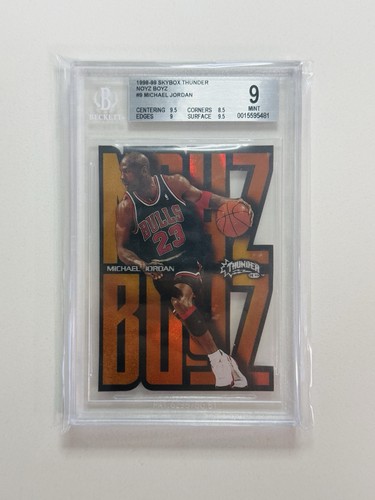 |
Michael Jordan #9 1998 Skybox Thunder Noyz Boyz |
$5,888 | $31,100 | 5.3× |
![Michael Jordan [Rubies] #16 1996 Skybox Premium card](https://i.ebayimg.com/images/g/DtMAAeSwtwtpuMvS/s-l500.jpg) |
Michael Jordan [Rubies] #16 1996 Skybox Premium |
$26.00 | $30,000 | 1153.9× |
 |
Michael Jordan #M1 1995 Skybox Premium Meltdown |
$1,502 | $29,009 | 19.3× |
 |
Michael Jordan #1 1997 Ultra Stars |
$550.00 | $28,038 | 51× |
 |
Michael Jordan #1 1997 Skybox Premium Silky Smooth |
$1,421 | $27,925 | 19.7× |
![Michael Jordan [Refractor] #139 1996 Topps Chrome card](https://i.ebayimg.com/images/g/5zcAAeSwQhRqOqfn/s-l500.jpg) |
Michael Jordan [Refractor] #139 1996 Topps Chrome |
$5,000 | $25,100 | 5× |
 |
Michael Jordan #2 1993 Ultra Power in the Key |
$443.59 | $24,244 | 54.7× |
Look up any card's current raw and graded value in Midpoint — and get an estimated grade before you pay to submit.
Table of Contents
- Section 1: Understanding Michael Jordan Rookie Card Value
- Section 2: Other Most Valuable Michael Jordan Cards
- Section 3: 1984 6 Star Company and Early Pre-Fleer Cards
- Section 4: 90s Insert Jordan Cards Worth Collecting
- Section 5: How Condition and Grading Affect Value
- Section 6: Recent Price Trends and Market Insights
- Section 7: Identifying and Grading Your Michael Jordan Cards
- Conclusion
- FAQ
Section 1: Understanding Michael Jordan Rookie Card Value
1986 Fleer #57 Rookie Card Overview
The 1986 Fleer #57 Michael Jordan rookie card is widely recognized as a cornerstone of Jordan card collecting and remains among the most valuable of his base cards. As of 2026-08-23, a PSA 10 (Gem Mint) Jordan rookie card has been reported to command values around $175,000, reflecting its iconic status and rarity in top condition. PSA 9 copies typically sell for significantly less, around $25,000, while PSA 8 cards may fetch approximately $6,000. These figures reflect demand from collectors and investors who view the card as a key asset in the sports card market.
Why the 1986 Fleer Rookie Card Stands Out
This card is considered Jordan's official rookie card by most collectors and grading companies. Its appeal is boosted by the scarcity of high-grade copies, particularly PSA 10s, which are difficult to obtain due to centering inconsistencies and surface wear common in the original print run. Centering often falls outside PSA's strict thresholds, and surface imperfections can arise from handling and storage over the decades. The card's design, featuring a young Jordan poised with the basketball, adds emotional and aesthetic value to its desirability.
Raw vs Graded Values
Raw, ungraded 1986 Fleer #57 cards typically sell for less than their graded counterparts. For example, a raw card in excellent condition might fetch between $500 and $1,500, depending on visible condition factors such as centering, corner sharpness, and surface wear. Once professionally graded as PSA 9 or 10, their value can increase substantially, underscoring the importance of grading in the market. However, sending cards for grading involves fees and potential risks, so collectors should weigh these factors carefully.
| Card | Grade | Value (USD) |
|---|---|---|
| 1986 Fleer #57 Michael Jordan Rookie | PSA 10 | $175,000 |
| 1986 Fleer #57 Michael Jordan Rookie | PSA 9 | $25,000 |
| 1986 Fleer #57 Michael Jordan Rookie | PSA 8 | $6,000 |
| 1997-98 Metal Universe Precious Metal Gem | Raw | $350,000+ |
| 1997-98 Upper Deck Logoman | Raw | $600,000+ |

Using tools like Midpoint's card centering grading interface helps collectors accurately measure centering with millimeter precision, enabling them to estimate grading potential before expensive submissions. This approach can reduce grading fees spent on low-potential cards and increase the likelihood of submitting cards capable of achieving PSA 9 or 10 grades, where value is significantly higher.
Section 2: Other Most Valuable Michael Jordan Cards
High-End Autographs and Precious Metal Gems
Beyond the iconic rookie card, some Jordan cards have sold for six-figure amounts, especially those featuring autographs or rare inserts. The 1997-98 Metal Universe Precious Metal Gem (PMG) card is a rare parallel card with a distinctive gem-like finish. PMGs are printed on thick, shiny stock with a unique holographic layer that enhances their appeal. Raw PMG cards have reportedly sold for over $350,000 due to their scarcity—estimated print runs are low—and collector demand. Autographed PMGs, especially those graded PSA 10 or BGS 9.5/10 with pristine signatures, can command even higher prices in private sales.
1997-98 Upper Deck Logoman Card
The Logoman card from 1997-98 Upper Deck is notable for its rarity and embedded NBA logo patch, making it highly prized among collectors. This card includes a small basketball jersey patch shaped like the NBA logo, adding uniqueness and appeal. Raw sales have reportedly surpassed $600,000, making it one of the most expensive Michael Jordan cards without professional grading. Graded examples of the Logoman card can command prices above this figure, especially in PSA 10 or BGS 9.5 grades, due to the combined rarity of the patch and the card's condition.
Why These Cards Are So Valuable
- Scarcity: Many of these cards had limited print runs or were only available through special promotions, making them rare in the marketplace.
- Condition Sensitivity: Due to their age and premium materials like patches and autographs, top-grade examples are few, driving prices higher.
- Collector Demand: Jordan's status as one of basketball's greatest players fuels ongoing market interest and competition among collectors.
- Investment Potential: These cards have shown appreciation over time, attracting collectors and investors seeking alternative assets.
Section 3: 1984 6 Star Company and Early Pre-Fleer Cards
Star Company Rookie Cards
Before Fleer's official 1986 release, the 1984 6 Star Company rookie cards are collectible and represent an important piece of Jordan's card history. Produced by Star Company, a Canadian manufacturer, these cards were distributed mostly in Canada and select U.S. markets. While these cards generally sell for less than the Fleer rookie, they can command prices ranging from $10,000 to $30,000 in high grades (PSA 9 or 10), reflecting their scarcity and historical significance. Their lower prices compared to Fleer may be due to less widespread recognition and lower print runs, although scarcity in top grades is significant due to production quality and handling issues.
Pre-Fleer Jordan Cards
Other early cards from 1984 and 1985 sets, such as Hoops and Star Company subsets, often feature Michael Jordan but are usually less valuable unless found in exceptional condition or graded PSA 9/10. Their appeal is mainly to collectors interested in the evolution of Jordan's card history and those specializing in obscure or regional releases. For example, the 1984 Star Company Supreme card is more sought after than the standard Star, often selling for premiums when in perfect condition.
Market Position of Star Company Cards
- Star Company cards are often more susceptible to surface wear and printing defects due to production quality, making high-grade examples more scarce.
- PSA population reports indicate fewer Star Company cards graded PSA 9 or 10 compared to Fleer, contributing to their value despite lower general market awareness.
- Raw cards typically trade much lower, emphasizing the importance of grading to unlock value.
- Collectors should be cautious about counterfeit or altered Star cards, as the high value of pristine examples has attracted fraudulent activity.
Section 4: 90s Insert Jordan Cards Worth Collecting
Popular 90s Inserts
The 1990s saw a boom in trading cards with many insert sets introduced to boost collector interest and market sales. Some notable Jordan inserts from this era include:
- Chrome Refractors: Cards with a chrome-like reflective surface and refracted light patterns, increasing visual appeal.
- Metal Universe cards: Known for their futuristic design and metallic finishes, these cards have a dedicated following.
- Scoring Kings: An insert series celebrating scoring leaders, often with limited print runs.
- Upper Deck inserts: Including Logoman and other premium subsets with patches, autographs, or special foil treatments.
Value and Collectibility
While these inserts generally do not reach the high values of rookie cards or Precious Metal Gems, they hold collector interest. Well-preserved examples graded PSA 9 or 10 can sell for hundreds to several thousands of dollars depending on rarity and demand. For example, a 1997-98 Metal Universe Jordan Chrome Refractor graded PSA 9 can fetch between $800 and $2,500, while rare patches or autographed inserts from this era may command higher prices.
Common Misconceptions
Many casual collectors mistakenly believe that all 90s Jordan cards are valuable, leading to disappointment. Mass-produced base cards from this era, often printed in the millions, typically hold minimal value and rarely justify grading costs, which can run $20 to $50 or more per card. Collectors should focus on identifying inserts, parallels, and rare variants that genuinely command premiums. Market saturation has led to price volatility for many 90s cards, so careful market research and condition assessment are essential before investment.
Section 5: How Condition and Grading Affect Value
Centering, Corners, Edges, and Surface
Condition is a key factor in determining a card's value. The four main factors graded by leading services such as PSA, Beckett Grading Services (BGS), Certified Guaranty Company (CGC), and TAG Grading include:
- Centering: How evenly the image is positioned within the card borders. PSA requires centering to be within 55/45 to 60/40 for top grades, with exact measurements influencing grade increments. Midpoint's AI tools can assess centering accurately, helping collectors anticipate grading outcomes.
- Corners: Sharp, undamaged corners free from fraying, bends, or whitening are essential for high grades. Minor corner wear can reduce a PSA 10 candidate to an 8 or 9.
- Edges: Clean edges without chipping, white spots, or surface wear are critical. Edge damage is common in cards stored without protective sleeves and can impact grades.
- Surface: The absence of scratches, stains, print defects, or discoloration boosts grading potential. Surface gloss and texture also factor into the final grade.
Raw vs Graded: Value Impact
Raw cards with seemingly near-perfect condition can still underperform graded cards due to uncertainty about authenticity and condition nuances that only professional graders detect. Grading provides a trusted third-party evaluation, increasing buyer confidence and resale value. For example, a raw 1986 Fleer Jordan rookie card might sell for around $1,000, but the same card graded PSA 9 can command significantly higher prices. This premium is driven by the assurance of condition and authenticity that grading delivers, reducing transaction risk in the secondary market.
Population Scarcity and Grade Distribution
The scarcity of cards within certain grade tiers adds another dimension to value. For instance, the PSA population report for the 1986 Fleer #57 Jordan rookie card shows relatively few PSA 10 graded examples compared to PSA 8 and 9, which elevates the price of those rare top-grade cards. This scarcity effect means that even small differences in grade can translate to large price gaps. Collectors should consider population reports and grade distributions when evaluating potential purchases or submissions.
Learn more about centering's critical role in grading and value at How Centering Impacts Card Value: A Detailed Guide.
Section 6: Recent Price Trends and Market Insights
Post-Pandemic Market Cooling
The trading card market, including Michael Jordan cards, experienced significant growth during the COVID-19 pandemic as new collectors entered the market and economic stimulus increased disposable income. However, recent data through mid-2026 suggests a market cooling or stabilization phase. While high-grade rookie cards and premium inserts remain strong, price appreciation has slowed, and some mid-tier cards have seen price corrections. For example, the average sale price of a PSA 10 1986 Fleer Jordan rookie card has plateaued near $175,000, compared to rapid gains in 2020-2021 where prices surged from approximately $80,000 to $150,000 within months.
Rebound Potential
Jordan's enduring legacy as one of basketball's greatest players, combined with the limited supply of top-grade cards, suggests potential for long-term value retention and rebound in the market. Strategic grading and condition-focused collecting remain important to maximizing returns. Investors and collectors who focus on cards with strong provenance, low population grades, and verified authenticity may be well positioned to benefit from future market upswings. Additionally, emerging markets and international collectors continue to fuel demand, especially for iconic cards.
Using Midpoint to Track and Analyze
Midpoint's portfolio tracking feature enables collectors to monitor the value fluctuations of their Michael Jordan cards over time, with real-time updates and historical trend analysis. This tool helps identify optimal buying or selling windows by analyzing market cycles, grading population reports, and recent sales data. The AI-driven grading estimates also allow collectors to prioritize grading submissions for cards with the highest upside, minimizing exposure to grading fees and maximizing return on investment.
Section 7: Identifying and Grading Your Michael Jordan Cards
How to Identify Your Card
Proper identification is the first step in understanding a card's potential value. Key factors to verify include:
- Year and set: Confirming the card's production year and issuing set, such as 1986 Fleer or 1997-98 Metal Universe, is essential as this determines rarity and market demand.
- Card number: For example, the famed Fleer rookie card is number #57 in the 1986 set, a detail collectors often use to verify authenticity.
- Parallel or variant: Some cards exist in multiple parallels or subsets, such as Precious Metal Gems, Chrome Refractors, or Logoman inserts, each with different print runs and values.
- Features and attributes: Look for autographs, patches, serial numbering, and holographic elements that can increase value.
Which Cards Are Worth Grading?
Cards expected to reach PSA 9 or 10 grades or those with inherent rarity are prime candidates for grading. High-value cards such as the 1986 Fleer #57 rookie card, high-end inserts like Precious Metal Gems and Logoman, and early Star Company rookies are often worth investing in grading. Conversely, common cards or those with obvious condition flaws may not yield a positive return on grading investment. Consider factors such as population reports, recent sale prices, and physical condition before deciding.
Using AI Pre-Grading Tools
Before submitting to professional grading companies, utilize AI-based grading apps like Midpoint to get instant estimates of PSA, BGS, CGC, and TAG grades based on detailed analysis of centering, corners, edges, and surface condition. This approach can save costly grading fees on low-value or low-grade cards and improve submission strategy by focusing on cards with high grading potential. Midpoint also offers batch processing features and historical data comparison, enabling efficient portfolio management.
For a full step-by-step on pre-grading, see How to Pre-Grade Your Card: A Step-by-Step Guide.
Conclusion
Michael Jordan cards worth money span a broad spectrum from the iconic 1986 Fleer #57 rookie card to ultra-rare high-end inserts like Precious Metal Gems and Logoman cards. Condition and professional grading remain critical factors influencing value, with PSA 10 grades commanding premium prices that can differ significantly from lower grades. While 90s insert cards can be collectible and hold value, many common cards from that era have minimal worth. Utilizing modern tools like Midpoint's AI grading and centering analysis empowers collectors to make informed decisions about grading, submission strategies, and portfolio management. This approach can maximize returns and enjoyment in the dynamic world of Michael Jordan card collecting.
FAQ
Q: What Michael Jordan cards are worth money?
A: The most valuable Michael Jordan cards include the 1986 Fleer #57 rookie card in high grades, rare autographed cards, Precious Metal Gems, Logoman inserts, and early Star Company rookies. Condition and grading greatly affect value, with top-grade examples commanding the highest prices.
Q: How much is a 1986 Fleer Michael Jordan rookie card worth?
A: As of 2026-08-23, a PSA 10 1986 Fleer #57 Michael Jordan rookie card has been reported to be worth approximately $175,000. PSA 9 copies fetch around $25,000, and PSA 8 cards about $6,000. Raw cards typically sell for less, highlighting the importance of professional grading.
Q: Which Michael Jordan cards are the most valuable?
A: Besides the 1986 Fleer rookie, the most valuable include 1997-98 Metal Universe Precious Metal Gems, 1997-98 Upper Deck Logoman, and early Star Company rookies, with some examples selling for six-figure amounts depending on condition and rarity.
Q: Are Michael Jordan cards from the 1990s worth anything?
A: Yes, certain 1990s inserts like Chrome refractors and Metal Universe cards are collectible and can command hundreds to thousands of dollars in top condition. However, most common base cards from the 90s have limited value and generally do not justify grading expenses.
Q: How do I know if my Michael Jordan card is rare or valuable?
A: Check the card's year, set, card number, and variant. High-grade rookie cards, rare inserts, and autographs typically hold value. Using AI grading tools like Midpoint helps estimate potential grades and market values before investing in grading or sales.
Q: Should I get my Michael Jordan card graded?
A: Grading is recommended if the card is expected to receive a high grade (PSA 9 or 10) or if it has rarity that can significantly increase its value. Using pre-grading tools like Midpoint can assess grading potential and save grading fees by avoiding submissions of low-grade or low-value cards.
Free to start
Try the Midpoint app
Grade any card from a photo, see its raw and PSA 10 value, and track what your collection is worth — free.
Get it on iPhoneGet it on Android


