MTG Card Prices Dropping October 2026: What Collectors Need to Know
Explore why MTG card prices are dropping in October 2026 and how to navigate the market dip with smart grading and buying strategies.

Estimated reading time: 8 min
Key Takeaways
- October 2026 shows notable price drops across some key MTG cards, influenced by rotation, bans, and reprints.
- Standard rotation and Commander format bans are contributing to selloffs and shifts in market liquidity.
- Premium and reserve-list cards often remain relatively more stable amid falling MTG card prices.
- Using AI grading tools like Midpoint can assist in identifying potentially undervalued cards during market dips.
- Tracking cross-version price differences and centering quality is helpful when market prices fluctuate.
MTG card prices dropping in October 2026 have prompted concern and opportunity among collectors and investors. The recent market dip reflects typical post-spike adjustments influenced by Standard rotation, Commander bans, and reprints increasing supply. Understanding which MTG cards are losing value more rapidly, why this is happening, and how grading technology might help buy the dip can assist collectors in managing their portfolios. This guide explores current market trends, highlights vulnerable staples, and suggests strategies to navigate this period.
30-day price movers — live data from Midpoint's card database, as of 2026-09-13. Prices move; Midpoint refreshes these daily.
| Card | Raw | PSA 10 | 30-day | |
|---|---|---|---|---|
 |
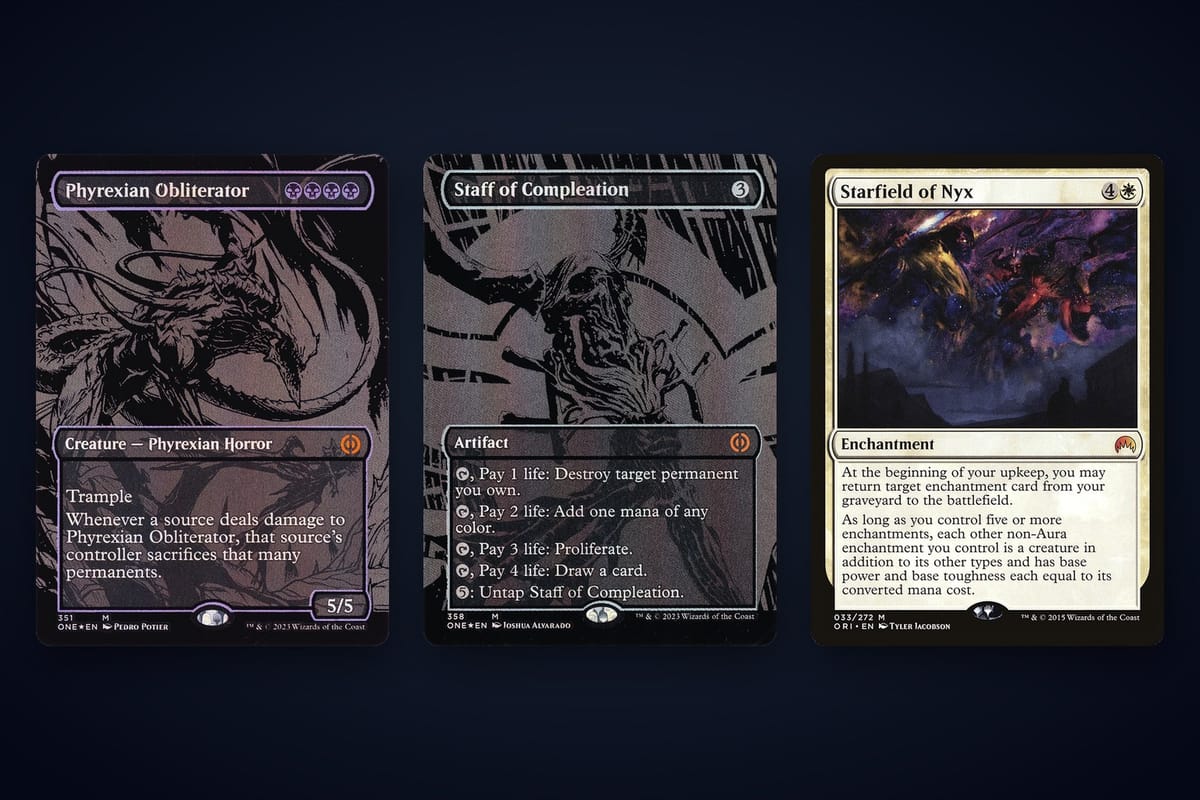
Phyrexian Obliterator #351 Phyrexia: All Will Be One (2023) |
$45.03 | — | -4.3% |
 |
Staff of Compleation #358 Phyrexia: All Will Be One (2023) |
$37.33 | — | -4% |
 |
Starfield of Nyx #33 Magic Origins (2015) |
$70.29 | — | -4% |
 |
Sword of Forge and Frontier #244 Phyrexia: All Will Be One (2023) |
$11.47 | — | -3% |
 |
The Mind Stone #386 Marvel Super Heroes (2026) |
$1,652 | — | -2.3% |
 |
Vraska, Betrayal's Sting #337 Phyrexia: All Will Be One (2023) |
$18.88 | — | -1.9% |
 |
Vraska, Betrayal's Sting #361 Phyrexia: All Will Be One (2023) |
$20.07 | — | -1.8% |
 |
All Will Be One #352 Phyrexia: All Will Be One (2023) |
$52.14 | — | -1.4% |
 |
Brainstealer Dragon #127 Outlaws of Thunder Junction Commander (2024) |
$10.93 | — | -1% |
 |
Alhammarret's Archive #221 Magic Origins (2015) |
$47.20 | — | -0.9% |
 |
Tyrranax Rex #355 Phyrexia: All Will Be One (2023) |
$19.70 | — | -0.9% |
 |
Solphim, Mayhem Dominus #312 Phyrexia: All Will Be One (2023) |
$29.72 | — | -0.5% |
Look up any card's current raw and graded value in Midpoint — and get an estimated grade before you pay to submit.
1. October 2026 Market Overview: MTG Card Prices Dropping
The MTG card market in October 2026 is experiencing a noticeable cooldown with many popular cards seeing declines. This drop is relatively widespread, affecting raw and PSA 10 graded values. For example, as of 2026-09-13, cards like Fable of the Mirror-Breaker and Goldspan Dragon have reportedly declined by around 20% in raw prices, with PSA 10 copies similarly affected.
This shift aligns with typical market cycles influenced by the recent Standard rotation and a wave of reprints increasing supply and accessibility.
- Standard-legal staples are particularly vulnerable due to rotation out of format play.
- Commander bans have contributed to selloffs in some previously sought-after cards.
- Market liquidity changes have affected buylist spreads and seller behavior.

2. Why MTG Card Prices Are Falling: Rotation, Bans, and Reprints
Several factors contribute to the downward pressure on MTG card prices in October 2026. Standard rotation pushes older sets out of competitive play, reducing demand for cards like Teferi, Who Slows the Sunset. Additionally, bans in the Commander format have led to value decreases for cards formerly staples in popular decks.
Reprints also influence the market. Cards reprinted in various sets or special editions can increase supply, especially when new printings are abundant and widely available.
- Rotation reduces competitive demand and collector interest in Standard staples.
- Commander bans can cause decreases in format-driven value.
- Reprints increase supply, often leading to short-term price dips.
3. MTG Cards Losing Value Fastest This October
Some cards have experienced faster and deeper price drops than others. As of mid-September 2026, notable examples include:
- Fable of the Mirror-Breaker: Reported to be down nearly 25% in raw and graded prices due to rotation and a recent reprint.
- Goldspan Dragon: Experienced over 20% value decline amid waning Standard demand.
- Teferi, Who Slows the Sunset: Fell approximately 18% as it rotated out of Standard play.
- Dockside Extortionist: Commander ban fallout contributed to a decline around 22%.
Collectors should monitor these rapid movers closely, especially if holding raw copies without premium centering or grading.
4. Commander Ban Fallout and Format-Driven Selloffs
The October 2026 market dip also reflects effects from recent Commander bans that have disrupted deck-building staples. Cards like Dockside Extortionist and Felidar Guardian have been impacted, with prices dropping as players and speculators adjust holdings.
This highlights the importance of understanding format-specific influences on card demand and value.
5. Standard Rotation Pressure on Rotating Cards
Standard rotation remains a significant factor behind falling MTG card prices. Cards that lose format legality often see declines because their competitive usage decreases. This year, cards from sets like Mystical Archive and Kamigawa: Neon Dynasty are among those affected.
Knowing which cards are on the rotation list helps collectors anticipate value changes and consider selling or trading ahead of time. For a deeper understanding, collectors can refer to MTG Card Prices Dropping October 2026: What Collectors Need to Know.
6. Supply and Market Liquidity Factors
Supply dynamics and market liquidity also contribute to price fluctuations. Limited stocks of certain cards can mean fewer buyers and sellers, causing variable spreads between buylist and retail prices. Panic selling can exacerbate this effect, pushing prices down as collectors seek to liquidate.
- Low supply of graded copies can sometimes support prices temporarily.
- Wider buylist spreads may indicate seller uncertainty.
- Market dips can create opportunities to acquire undervalued cards with solid centering.
7. Cross-Version Price Differences: Foil, Printing, and Special Editions
Price variation across card versions is notable in October 2026. Foil editions, alternate art, and special printings often retain value better than regular base sets due to scarcity and collector demand.
For example, the foil variant of Goldspan Dragon has reportedly dropped less sharply than the standard printing, reflecting a premium on rarer versions.
Collectors should consider these cross-version differences when buying or selling during market dips. For more comprehensive strategies, see TCG Card Collecting: The Ultimate Guide for 2026 Collectors.
8. Using Midpoint to Track MTG Price Trends and Grades
Midpoint offers tools to track MTG card prices daily and weekly, monitor portfolio value, and estimate grading potential before submitting cards for grading. By measuring centering with millimeter precision and AI-analyzing corners, edges, and surface, Midpoint helps collectors evaluate if a raw card may be worth grading during a dip.
Using Midpoint’s card lookup for raw vs graded values across 250,000+ cards, collectors can identify potential bargains and avoid costly grading mistakes. See Card Centering Tool: Accurate Card Grading Estimates for more on grading value impact.
9. MTG Cards to Buy the Dip: Premium Variants and Reserve-List Cards
While many cards face falling MTG card prices, some tend to be more resilient. Premium variants like PSA 10 foils and Reserve List cards often hold value relatively better amid market dips. These cards are generally less affected by rotation and reprints, making them potentially safer long-term holds.
Collectors looking to buy the dip might focus on well-centered raw copies of such cards for grading, especially when supported by Midpoint’s AI grading estimates.
10. How to Protect and Grow Your Collection During Market Dips
Market downturns present both risks and opportunities. To protect and grow your collection during falling MTG card prices, consider:
- Using tools like Midpoint to pre-grade cards before submitting to PSA or BGS.
- Tracking market trends regularly to time buys and sells more effectively.
- Focusing on premium and Reserve List cards during periods of volatility.
- Learning how centering impacts card value through guides like How Centering Impacts Card Value: A Detailed Guide.
- Storing valuable cards safely with expert tips from The Ultimate Collector's Guide.
Conclusion
The MTG card prices dropping in October 2026 reflect a combination of rotation, bans, reprints, and market sentiment. While many cards are losing value, collectors can potentially use this dip to their advantage by leveraging AI grading tools like Midpoint to identify well-centered raw cards worth grading and holding. Staying informed about format changes, supply trends, and version differences is important to navigate this market phase. For those interested, visit Midpoint to explore grading and tracking features designed to support your collection.
FAQ
Q: Why are MTG card prices dropping in October 2026?
A: Prices are influenced by Standard rotation pushing cards out of competitive play, Commander bans contributing to selloffs, and multiple reprints increasing supply and reducing scarcity.
Q: Which MTG cards are dropping the most right now?
A: Cards like Fable of the Mirror-Breaker, Goldspan Dragon, Teferi, Who Slows the Sunset, and Dockside Extortionist have reportedly seen some of the fastest and deepest price declines as of September 2026.
Q: Do Standard rotation and bans always cause MTG prices to fall?
A: Generally, rotation removes cards from popular competitive formats, decreasing demand, while bans limit card usage in formats like Commander, which can prompt selling.
Q: Should I sell my MTG cards before prices drop further?
A: It depends on the card’s format relevance, rarity, and condition. Using tools like Midpoint to assess grading potential can help inform decisions on holding or selling.
Q: Which MTG cards are safest to hold when the market is down?
A: Premium variants (such as PSA 10 foils) and Reserve List cards often maintain value better during downturns due to scarcity and collector demand.
Q: How do reprints affect MTG card prices in the short term?
A: Reprints increase supply, which can cause short-term price dips, particularly for cards that were previously scarce or highly sought after.
Free to start
Try the Midpoint app
Grade any card from a photo, see its raw and PSA 10 value, and track what your collection is worth — free.
Get it on iPhoneGet it on Android