Pedri Cards Worth Money: Values, Rookies, and Grading
See which Pedri cards are worth money, key rookie cards, PSA 10 value drivers, and the best cards to grade or sell.

Estimated reading time: 12 min
Key Takeaways
- Pedri cards worth money are usually driven by rookie-year demand, low print runs, premium brands, and strong condition—not just player popularity.
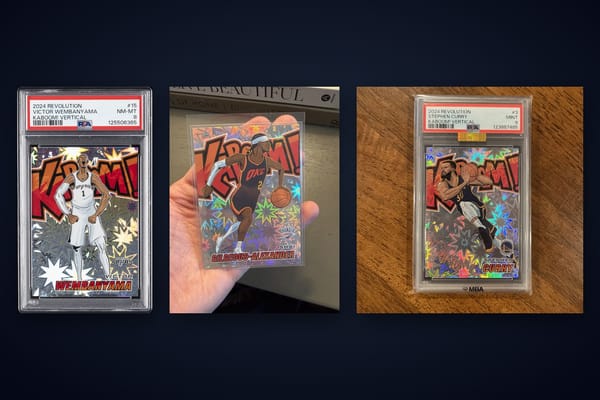
- The most valuable Pedri cards tend to be rare parallels, autographs, patch autos, and ultra-short-print inserts like SuperFractors, Color Blast, and Kaboom-style chase cards.
- Pedri rookie card value depends heavily on set, parallel, serial number, and whether the card is raw or graded PSA 10.
- Not every Pedri card should be graded; the best Pedri cards to grade are clean, centered, low-population, and from recognizable flagship or premium products.
- For pricing, compare completed sales, active listings, and grading results together, then verify centering before paying grading fees.
Card values — live data from Midpoint's card database, as of 2026-09-04. Prices move; Midpoint refreshes these daily.
| Card | Raw | PSA 10 | Gem premium | |
|---|---|---|---|---|
 |
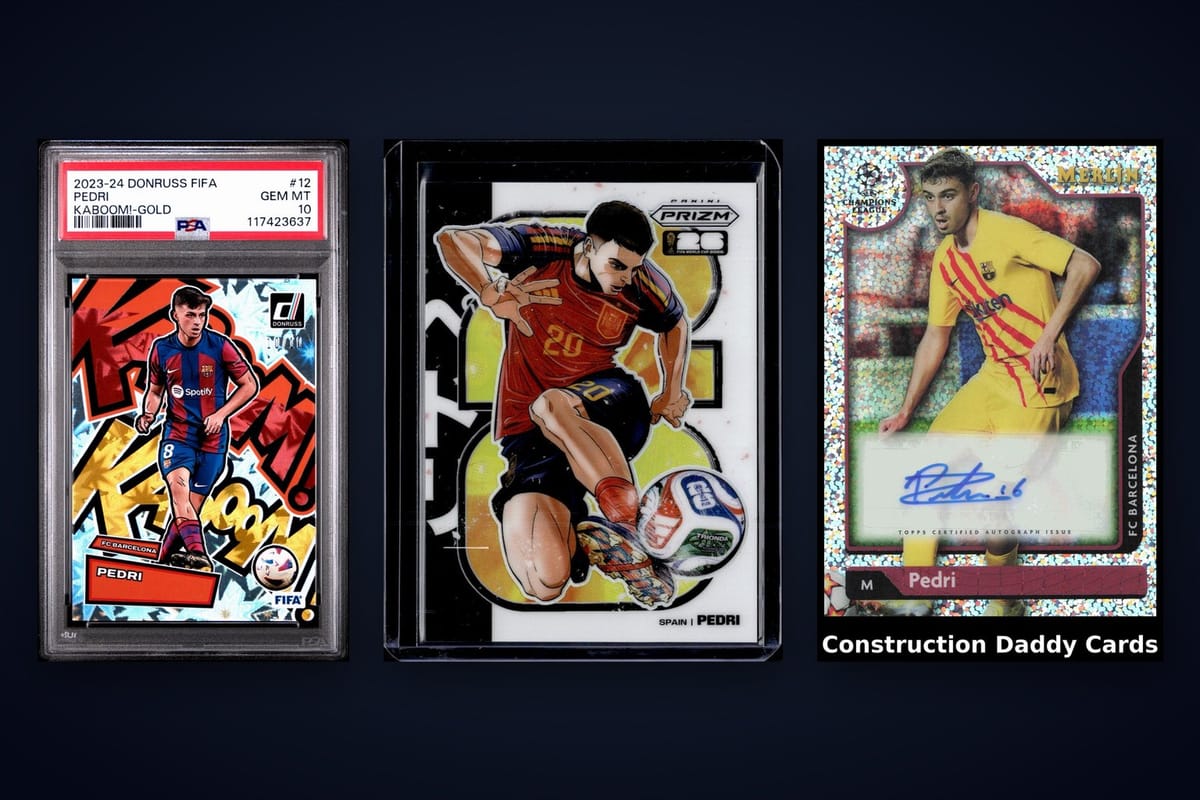
Pedri [Gold] #12 2023 Panini Donruss Kaboom |
$1,050 | $2,400 | 2.3× |
 |
Pedri #12 2026 Panini Prizm FIFA Manga |
$461.21 | $2,166 | 4.7× |
 |
Pedri [Orange] #A-P 2021 Topps Merlin Chrome UEFA Autographs |
$70.27 | $1,535 | 21.8× |
 |
Pedri #13 2025 Panini Donruss Road to FIFA Kaboom |
$285.00 | $1,525 | 5.4× |
 |
Pedri #6 2025 Panini Prizm FIFA Manga |
$682.50 | $1,188 | 1.7× |
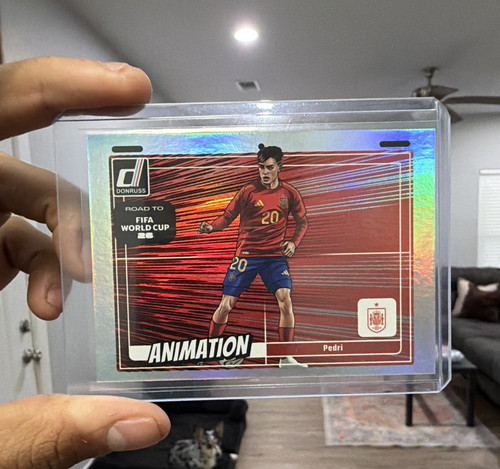 |
Pedri #13 2025 Panini Donruss Road to FIFA Animation |
$221.75 | $1,036 | 4.7× |
 |
Pedri #19 2022 Panini Donruss Kaboom |
$379.99 | $761.25 | 2× |
 |
Pedri [Aqua] #61 2020 Topps Chrome UEFA Champions League Sapphire |
$199.17 | $750.00 | 3.8× |
 |
Pedri #BN-4 2024 Topps Chrome UEFA Euro Berlin at Night |
$263.30 | $700.00 | 2.7× |
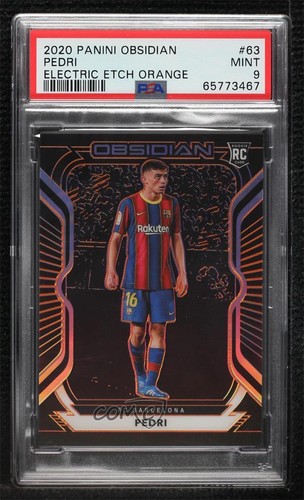 |
Pedri [Orange] #63 2020 Panini Obsidian |
$182.47 | $700.00 | 3.8× |
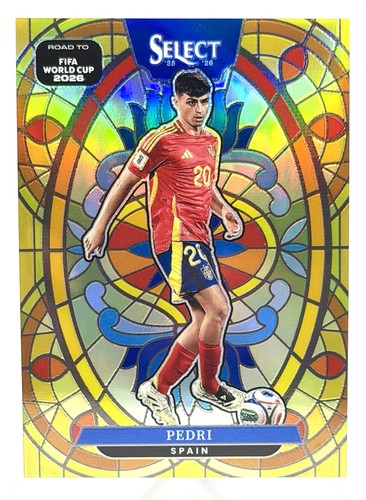 |
Pedri #16 2025 Panini Select Road to FIFA Stained Glass |
$134.25 | $670.16 | 5× |
 |
Pedri #12 2023 Panini Donruss Kaboom |
$289.00 | $665.01 | 2.3× |
Look up any card's current raw and graded value in Midpoint — and get an estimated grade before you pay to submit.
Table of Contents
- Section 1: What makes Pedri cards worth money
- Section 2: The most valuable Pedri cards and chase parallels
- Section 3: Pedri rookie card value and key rookie-year releases
- Section 4: Raw vs PSA 10 Pedri pricing and grading decisions
- Section 5: How to identify a Pedri card and verify authenticity
- Section 6: Where to check prices, sell cards, and manage risk
- Section 7: Investment outlook and which Pedri cards are worth collecting
Section 1: What makes Pedri cards worth money
Pedri demand starts with the player, but the card decides the price
Pedri cards worth money usually come from a simple mix: star-power demand, limited supply, and condition sensitivity. Pedri is a modern soccer name collectors recognize quickly, so his market benefits from both Barcelona and Spain fan interest. But the card itself matters just as much as the player.
The biggest price swings usually come from:
- Rookie-year status — first-year cards often attract the most collector attention.
- Set prestige — Topps Chrome, Merlin Chrome, Panini Prizm, Select, Obsidian, Donruss, Mosaic, and Match Attax all have different buyer demand.
- Parallel scarcity — numbered color parallels can price far above base cards.
- Autographs and relics — signatures, patch autos, and memorabilia cards usually bring the strongest premiums.
- Condition — centering, corners, edges, and surface can change value dramatically.
If you are trying to decide whether a Pedri card is worth grading, the first question is not “Is this Pedri?” It is “How rare is this version, and is the copy clean enough to earn a top grade?” That is where tools like Midpoint can help before you spend grading money.
Why completed sales matter more than asking prices
For soccer cards, asking prices can be misleading. A seller can list a Pedri card high for weeks and never move it. Completed sales, especially recent sold listings, are the best reality check for raw value, PSA value, and whether a parallel has real liquidity.
When comparing comps, look at:
- Exact card year and set
- Parallel color or serial number
- Raw versus graded condition
- Sale venue and buyer demand
- Whether the card is a base issue, insert, auto, or relic
That is the cleanest way to judge true market strength instead of relying on hype alone.
Use card-specific signals, not generic player buzz
Pedri’s market is strongest when a card checks multiple boxes at once. For example, a rookie-year serial-numbered parallel in a respected chrome product is far more likely to be sought after than a common base card from a mass-market release.
In practical terms, buyers pay for:
- Low print run
- Scarcity by parallel and numbering
- Premium brand recognition
- Strong eye appeal
- Clean grading potential
Section 2: The most valuable Pedri cards and chase parallels
Ultra-rare inserts and one-of-ones lead the market
The most valuable Pedri cards are typically the rarest ones: SuperFractors, Color Blast-style cards, Kaboom-style inserts, autographs, patch autographs, and true one-of-ones. These cards combine collector appeal with extreme scarcity, which is the recipe for top-end values.
When a Pedri card carries both a premium insert design and low serial or one-of-one status, it can separate itself from the rest of the market quickly. That is especially true when the player is still in a strong career phase and the card comes from a high-demand product line.
Examples of card types that usually sit at the top of the market:
- SuperFractor / 1/1 style cards
- Color Blast and similar artistic case-hit inserts
- Kaboom-style inserts from chase-heavy sets
- On-card or sticker autographs
- Patch autographs with low numbering
- Low-numbered refractors and color parallels
Product families that matter most
Some Pedri sets are followed more closely because they are easier to trade and price. Topps Chrome and Merlin Chrome tend to matter because chrome refractors and rookie-year designs are familiar to collectors. Panini Prizm, Select, Obsidian, Donruss, and Mosaic each create different layers of scarcity and demand. Match Attax can also matter, especially for certain chase variants and early-year issues.
The highest-value Pedri market is not defined by one single set. It is defined by rarity plus brand strength. A low-numbered parallel from a well-known premium product often beats a common insert from a less desirable checklist.
That is why collectors often watch these categories most closely:
- Numbered golds, blacks, and one-of-ones
- Autograph parallels
- Patch autos and memorabilia autos
- Short-print inserts with strong visual appeal

What usually separates a top Pedri card from a good one
Two Pedri cards can look similar at a glance and have very different price points. The difference is often in print run, serial number, and collector preference. A non-numbered insert may be attractive, but a /10 or /5 parallel from the same set can be in another tier entirely.
In the top tier, buyers want:
- Authenticated signatures
- Clean patch windows and centered design
- Low serials such as /25, /10, /5, and 1/1
- Premium sets with strong resale liquidity
That is why the most valuable Pedri cards are rarely ordinary base cards. They are usually the cards that were hard to pull the day they were released and are still hard to find in clean condition today.
Section 3: Pedri rookie card value and key rookie-year releases
Why rookie cards matter so much
Pedri rookie card value is anchored by the first-year premium. Collectors want the earliest issues because they represent the first major wave of cards tied to a player’s mainstream market. For Pedri, that generally means releases from the 2020-21 season are the core area to study.
Rookie cards are especially important when they come from:
- Flagship chrome products
- Recognizable Panini and Topps brands
- Numbered parallels
- Autographs or memorabilia versions
If you are sorting a stack, the rookie-year cards are usually the first ones to inspect closely for serial numbers, variations, and grading potential.
Key rookie-year set types collectors track
Collectors often look at the following product families for Pedri’s rookie-year cards, though you should confirm each product’s checklist to see whether he is included: Topps Chrome, Merlin Chrome, Panini Prizm, Select, Obsidian, Donruss, Mosaic, and Match Attax. Each one behaves differently in the market. Chrome releases often reward crisp edges and sharp centering. Optic-style and Donruss-style products can offer lower-entry points. Prizm and Select are commonly watched for parallel hierarchies and recognizable design language.
Merlin Chrome and Topps Chrome are often discussed because they create a strong bridge between modern soccer collecting and the familiar “rookie card” mindset that basketball and baseball collectors already understand.
Important rookie-card identifiers include:
- Year printed on the card
- Set name and checklist designation
- Card number
- Parallel color or pattern
- Any RC, rookie, or debut notation
How to estimate rookie-year value without overpaying
Do not assume every rookie Pedri card is expensive. Base rookies can be affordable, while low-numbered rookies can command much more. The value spread depends on condition and print run. A centered raw copy may outperform a badly off-center graded card if the grade is capped by flaws.
A good rookie-year buying process is:
- Confirm exact set and card number
- Check whether the card is a base, insert, or parallel
- Look for serial numbering
- Compare recent sold listings, not just asking prices
- Decide whether grading can realistically add value
For grading decisions, a quick pre-check with how to pre-grade your card can save money and help you focus on cards with real upside.
Section 4: Raw vs PSA 10 Pedri pricing and grading decisions
When PSA 10 is worth the premium
Pedri PSA 10 cards can carry meaningful premiums when the underlying card is already desirable. The strongest candidates are usually premium rookie parallels, scarce inserts, and cards with a strong buyer base. A PSA 10 confirms top-tier condition, which can improve liquidity and confidence for buyers.
The key idea is not that every PSA 10 is automatically profitable. It is that the premium must be large enough to justify grading fees, shipping, insurance, and wait time.
PSA 10 makes the most sense when:
- The card is a low-population or scarce parallel
- The raw card already sells actively
- Centering is strong enough to support a gem grade
- Surface and corners are clean under close inspection
PSA 9 and raw cards still matter
PSA 9 Pedri cards can be useful if the underlying card is rare or highly collectible. Sometimes the gap between a raw copy and a 9 is modest compared with the gap to a 10, so buyers still chase 9s as a more affordable entry point.
Raw cards matter too. In fact, many buyers prefer raw cards for lower-end Pedri inserts or cards where they believe a high-grade outcome is unlikely. The important question is whether the raw asking price leaves enough room for condition risk.
A simple framework:
- Raw — best for cheaper cards or cards with obvious flaws
- PSA 9 — useful for scarce cards where a 10 is difficult
- PSA 10 — strongest for clean, recognizable, in-demand pieces
Best Pedri cards to grade
The best Pedri cards to grade are usually not the cheapest ones. They are the cards that combine strong value, low population potential, and visible condition quality. That usually means premium rookie cards, short-printed parallels, and autographs with enough market demand to support a graded premium.
Before submitting, inspect:
- Centering on front and back
- Edge whitening
- Corners
- Surface scratches, print lines, and dimples
Midpoint is built for this exact decision. You can measure centering to the millimeter and estimate PSA, BGS, CGC, or TAG before you pay grading costs. If you are deciding whether a Pedri card deserves a slab, that is exactly the kind of pre-submission check that protects margin. You can also use the free centering calculator to check a card before sending it in.
Section 5: How to identify a Pedri card and verify authenticity
Use the year, set, card number, and parallel first
Identifying a Pedri card correctly is essential because pricing can change dramatically based on the exact version. A buyer who misidentifies a parallel or confuses a base card with a refractor can overpay fast.
Start with these details:
- Year — especially 2020-21 rookie-era products
- Set name — Topps Chrome, Merlin Chrome, Prizm, Select, Obsidian, Donruss, Mosaic, Match Attax
- Card number — often the fastest way to verify checklist position
- Parallel or variation — color, refractor, pattern, or print variation
- Serial number — look for /99, /50, /25, /10, /5, or 1/1
If the card includes a signature or memorabilia piece, check the back and front for authentication language, manufacturer marks, and whether the relic swatch or auto is officially inserted.
Spotting condition and authenticity issues
Counterfeits and altered cards are a real concern in any valuable soccer market. The more expensive the Pedri card, the more important it becomes to verify everything carefully before buying.
Watch for:
- Misaligned print or odd fonts
- Suspiciously perfect serial stamping
- Texture mismatches on chrome surfaces
- Trimmed edges or altered corners
- Missing holofoil or incorrect manufacturer marks
For higher-end pieces, buy from sellers with clear return policies and check images for centering, edge wear, and surface defects. If you already own the card, compare it against trusted database images and grading examples before listing it or submitting it.
Why centering can make or break the final grade
Even when a Pedri card is otherwise sharp, centering can cap the grade. That is one reason collectors use pre-grading tools before submission. A card that looks great in a sleeve can still miss a gem grade if the borders or image placement drift too far off-center.
If centering is the main question, a dedicated guide like how centering impacts card value is worth reading before you ship the card out.
Section 6: Where to check prices, sell cards, and manage risk
Use multiple sources, then compare apples to apples
To price Pedri cards worth money correctly, use completed eBay sales first, then cross-check active marketplace listings, price guides, and grading databases. No single source is enough on its own because soccer card pricing can move quickly and asking prices are often aspirational.
A reliable workflow looks like this:
- Search completed sold listings for the exact card
- Compare raw and graded copies separately
- Check population and grading outcomes if available
- Scan marketplace listings for current ask levels
- Adjust for condition, centering, and serial number
For a rare Pedri card, the difference between a raw sale and a PSA 10 sale can be large enough to change your whole strategy. That is why many collectors check the card in hand before deciding whether to list it raw, grade it, or hold it longer.
Where liquidity is strongest
Most collectors want a card they can actually sell. Liquidity matters. A flashy but obscure card may look amazing, but if only a handful of buyers care, the price can be harder to realize. Cards from respected flagship products generally trade more easily than obscure issues.
Liquidity tends to be better for:
- Recognizable rookie-year cards
- Premium chrome and Optic-style products
- Numbered parallels from major brands
- PSA 10 examples of desirable cards
There is also a storage and preservation angle. If you plan to hold higher-end Pedri cards, keep them protected from surface damage and humidity. A good storage routine can preserve centering appearance, corners, and surface quality over time. If you need help with that, see how to store valuable cards.
Risk factors that can crush returns
Buying Pedri cards as a speculative play carries real risk. Player performance matters, but so does market mood, supply, and grading outcomes. A rising star can cool off. A popular insert can become overhyped. And a card that looks gem-mint in a scan may come back centered too poorly to hit PSA 10.
Main risks include:
- Performance volatility — form, injuries, and transfer narratives matter
- Grading spreads — a 9 can erase expected profit
- Counterfeit risk — especially at higher price points
- Illiquidity — not every card sells fast, even if it is rare
Section 7: Investment outlook and which Pedri cards are worth collecting
Are Pedri cards worth anything as an investment?
Yes, Pedri cards can be worth money, but they are not all equal investments, and no card is guaranteed to hold or increase in value. The best long-term candidates are scarce rookie-year cards, premium parallels, and authenticated autos with clean grades or strong raw eye appeal. Less desirable cards can still be collectible, but they may not offer much upside after fees.
As a rule, the safest collecting zones are:
- Rookie-year Pedri cards from respected sets
- Low-numbered parallels
- Premium autographs and patch autos
- Cards with gem-grade potential
Which Pedri cards are worth collecting or investing in?
If your goal is upside, focus on quality over quantity. A small number of strong cards is usually better than a stack of common base issues. The best Pedri cards to grade are often the ones with a clear path to a premium slab outcome and a buyer base that understands the product.
A good collecting plan might include:
- One flagship rookie card
- One low-numbered parallel from a premium set
- One autograph or patch auto if budget allows
- One or two raw cards with excellent centering for grading
That approach gives you exposure to different parts of the market without overcommitting to one price tier.
How Midpoint fits into the decision
If you are unsure whether a Pedri card belongs in your grading pile, use Midpoint to estimate condition, compare raw versus graded value, and check centering before you submit. That is especially useful for modern soccer cards where gem rates and margins can be tight.
One smart pre-grading check can save you from sending in a card that is better sold raw. Another can reveal a hidden gem candidate that deserves a slab.
That is the real edge: not guessing, but measuring.
Conclusion
Pedri cards worth money are usually the ones with a strong combination of rookie-year importance, scarcity, brand recognition, and top-end condition. The most valuable Pedri cards are typically rare parallels, autographs, patch autos, and chase inserts from respected sets. Raw cards can still sell well, but Pedri PSA 10 examples often command the strongest premiums when the card is clean enough to gem.
If you want to buy, sell, or grade Pedri cards intelligently, focus on exact identification, completed sales, serial numbering, and condition. Then use pre-grading tools to decide whether the upside justifies the fee. That is the best way to separate true value from hype.
FAQ
Q: How much are Pedri cards worth?
A: It depends on the exact card. Base cards, rookie-year parallels, autographs, and short prints all sit in different value bands. To price one correctly, compare recent completed sales for the exact set, parallel, and grade.
Q: What is the most valuable Pedri card?
A: The most valuable Pedri cards are usually the rarest chase versions, such as SuperFractors, Color Blast-style inserts, Kaboom-style inserts, autographs, patch autographs, and true one-of-ones.
Q: What is Pedri’s rookie card?
A: Pedri’s rookie card typically refers to his 2020-21 first-year releases, with collectors commonly looking at products like Topps Chrome, Merlin Chrome, Panini Prizm, Select, Obsidian, Donruss, Mosaic, and Match Attax. Check each product’s checklist to confirm which cards are his.
Q: Are Pedri cards worth anything?
A: Yes. Many Pedri cards are collectible and sell for real money, especially rookie-year cards, numbered parallels, and autographs. Common base cards are usually lower value than rare or graded versions.
Q: How much is a PSA 10 Pedri card worth?
A: A PSA 10 Pedri card can be worth significantly more than the raw version, but the premium depends on the exact card, set, scarcity, and buyer demand. Always compare recent sold prices for the specific PSA 10 example.
Q: Which Pedri cards are worth collecting or investing in?
A: The best Pedri cards to collect or invest in are rookie-year premium cards, low-numbered parallels, autographs, patch autos, and cards with strong gem-grade potential and healthy market demand.
Free to start
Try the Midpoint app
Grade any card from a photo, see its raw and PSA 10 value, and track what your collection is worth — free.
Get it on iPhoneGet it on Android