2024 Panini Revolution Kaboom Vertical Basketball Value
2024 Panini Revolution Kaboom Vertical basketball cards value guide: raw vs PSA 9 vs PSA 10, top cards, parallels, and which are worth grading.

Estimated reading time: 11 min
Key Takeaways
- 2024 Panini Revolution Kaboom Vertical basketball cards value is driven mostly by player demand, parallel color, and grade, in that order.
- The gap between raw, PSA 9, and PSA 10 prices (the gem premium) decides whether grading pays off. Compare all three, not just one.
- Kaboom cards are inserts with busy, high-contrast designs. That can make centering and surface flaws harder to spot by eye, and costlier when you miss them.
- Use sold prices, not asking prices. Check the data table above for figures as of 2026-11-22, then verify against recent sales.
- Pre-grade before you submit. Centering alone can rule a card out before you pay a fee.
Card values — live data from Midpoint's card database, as of 2026-11-22. Prices move; Midpoint refreshes these daily.
| Card | Raw | PSA 10 | Gem premium | |
|---|---|---|---|---|
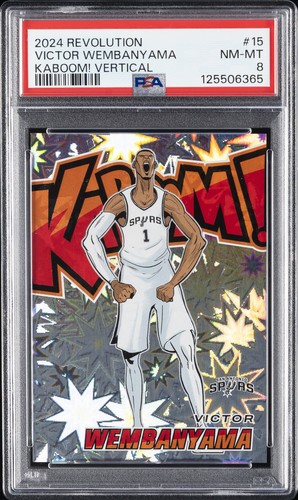 |
Victor Wembanyama #15 2024 Panini Revolution Kaboom Vertical |
$11,021 | $74,407 | 6.8× |
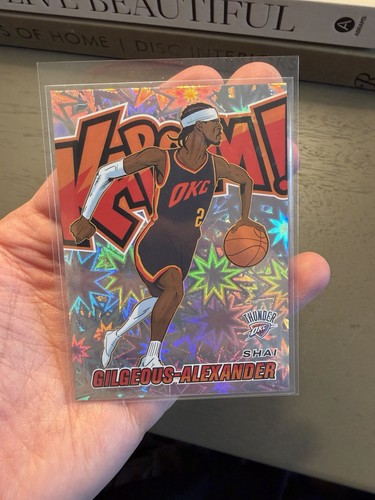 |
Shai Gilgeous-Alexander #6 2024 Panini Revolution Kaboom Vertical |
$3,850 | $15,735 | 4.1× |
 |
Stephen Curry #3 2024 Panini Revolution Kaboom Vertical |
$4,073 | $14,000 | 3.4× |
 |
LeBron James #2 2024 Panini Revolution Kaboom Vertical |
$4,050 | $12,100 | 3× |
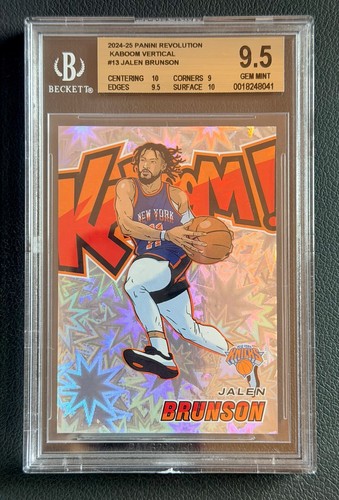 |
Jalen Brunson #13 2024 Panini Revolution Kaboom Vertical |
$3,200 | $9,390 | 2.9× |
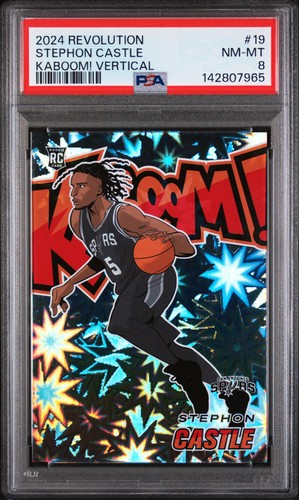 |
Stephon Castle #19 2024 Panini Revolution Kaboom Vertical |
$2,000 | $6,210 | 3.1× |
 |
Anthony Edwards #9 2024 Panini Revolution Kaboom Vertical |
$1,326 | $5,332 | 4× |
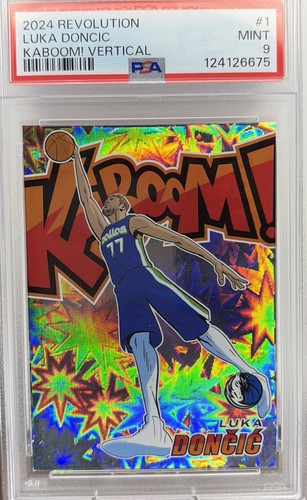 |
Luka Doncic #1 2024 Panini Revolution Kaboom Vertical |
$1,363 | $4,366 | 3.2× |
 |
Nikola Jokic #8 2024 Panini Revolution Kaboom Vertical |
$987.81 | $4,000 | 4.1× |
 |
Paolo Banchero #12 2024 Panini Revolution Kaboom Vertical |
$767.89 | $3,050 | 4× |
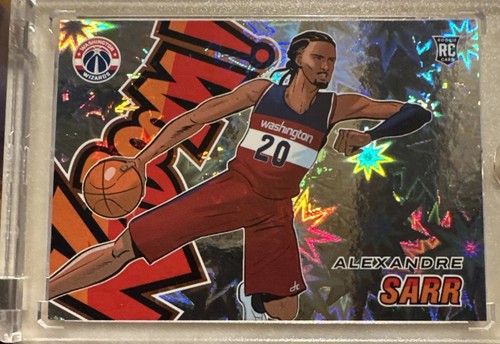 |
Alexandre Sarr #17 2024 Panini Revolution Kaboom Vertical |
$700.00 | $2,639 | 3.8× |
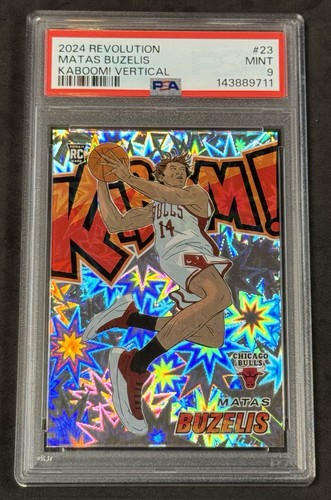 |
Matas Buzelis #23 2024 Panini Revolution Kaboom Vertical |
$1,205 | $2,525 | 2.1× |
Look up any card's current raw and graded value in Midpoint — and get an estimated grade before you pay to submit.
Table of Contents
- Section 1: What the Kaboom Vertical Set Is and Why It Matters
- Section 2: Price Guide: Reading Raw, PSA 9, and PSA 10 Values
- Section 3: Most Valuable Kaboom Vertical Cards by Player
- Section 4: Base, Green, and Gold: Parallels and Scarcity
- Section 5: Are Kaboom Vertical Cards Worth Grading?
- Section 6: Checklist, Rookies, and Authenticity Checks
- Section 7: Avoiding Misleading Prices and Protecting Value
- Conclusion
- FAQ
Section 1: What the Kaboom Vertical Set Is and Why It Matters
If you are researching 2024 Panini Revolution Kaboom Vertical basketball cards value, start with what the card actually is. Kaboom is an insert in Panini Revolution, a product known for its bold, cosmic-style design. The Kaboom name comes from the comic-book explosion look: loud, saturated artwork built to pop on a shelf or in a binder.
It is not a base card. That one fact shapes every price conversation about it.
Kaboom as a Revolution insert
Inserts in a premium product usually trade on design appeal and player strength rather than on a sheer count of cards. Kaboom has a following among collectors who treat it as a modern "must-have" for stars, much as Downtown and Color Blast carry that role in other Panini products. Demand for a card is therefore tied to who is on it far more than to what the set is.
Vertical vs. Horizontal
Kaboom cards may come in both orientations, and collectors price them separately. Key differences to keep in mind:
- Layout: The vertical version frames the player in a portrait-style composition. A horizontal version uses a landscape layout.
- Centering behavior: Orientation changes which borders you measure. Check the side and top/bottom margins specifically for the layout you hold.
- Market: Comps do not transfer cleanly. A horizontal sale is not a valid price for a vertical card, so filter your searches carefully.
Why this set draws value searches
The set is generally understood to mix established stars with recent rookies, so a single checklist can cover veterans such as LeBron James, Stephen Curry, and Luka Dončić alongside newer names like Victor Wembanyama and Stephon Castle. Confirm exactly who appears against the official checklist. That spread makes the set a useful way to see how star power, rookie status, and grade interact in one place.
The table that follows this section shows the specific cards we track, with raw, PSA 9, and PSA 10 values as of 2026-11-22. The rest of this guide explains how to read it.
Section 2: Price Guide: Reading Raw, PSA 9, and PSA 10 Values
A useful 2024 Panini Revolution Kaboom Vertical price guide shows three numbers per card: raw, PSA 9, and PSA 10. Each answers a different question.
What each column tells you
- Raw: What an ungraded copy typically sells for. It is the entry point and the price you pay if you are buying to grade.
- PSA 9: A strong, clean copy with a small flaw. It is the "safe" outcome for many submissions.
- PSA 10: Gem Mint. This is where the premium lives, and it is what most people mean when they search for 2024 Panini Revolution Kaboom Vertical PSA 10 value.
All figures in the table above are dated as of 2026-11-22. Card prices move with player performance, injuries, and hobby sentiment, so treat any number as a snapshot, not a promise.
The gem-premium gap
The most important calculation is the spread between PSA 9 and PSA 10, and between raw and PSA 9. A wide PSA 10 premium means the market pays heavily for perfection, but it also means a PSA 9 result can leave you underwater after fees. A narrow gap means grading adds little.
Run this simple check for any card in the table:
- Take the PSA 10 value and subtract the raw price you paid.
- Subtract grading fees, shipping, and insurance.
- Repeat with the PSA 9 value.
- Weigh both outcomes by how likely you think each grade is based on your pre-grade.
If the PSA 9 outcome loses money and you think a 10 is a long shot, skip the submission.
Why one sale can mislead
Insert cards trade infrequently, especially graded gems. One unusually high or low sale can distort a "value." Look for the median of several recent sold listings, check sales volume, and note the date range. Thin volume means wider uncertainty, so lean on the range rather than a single figure.
Section 3: Most Valuable Kaboom Vertical Cards by Player
When people search for the most valuable 2024 Panini Revolution Kaboom Vertical cards, they usually want a ranked list. The current ranking sits in the data table above. Here is why certain names tend to sit at the top, and what could change that order.
The usual drivers of value
- Player popularity: Global stars with huge collector bases tend to hold demand through down periods. LeBron James, Stephen Curry, and Luka Dončić fit that profile.
- Rookie status: A first-year card of a top prospect often commands a premium. Stephon Castle, a 2024 rookie, is the kind of name where rookie interest can lift a card. Victor Wembanyama is no longer a rookie in this release, but his strong collector demand can still support prices.
- Team and market: Big-market teams and deep playoff runs widen the buyer pool.
- Performance: Awards, all-star nods, and breakout seasons can shift prices quickly, sometimes within weeks.
Stars versus rookies
Established stars tend to trade on stability. Their prices move less on a single game and more on career narrative. Rookies trade on momentum. A strong stretch can push a rookie card up fast, and a slump or injury can pull it back just as quickly.
That difference matters if you are deciding whether to hold or sell. A veteran card is closer to a long-term hold, while a rookie card rewards good timing.
Do not assume the name equals the price
A big name on a base Kaboom Vertical can be worth less than a lesser-known player on a scarcer parallel. Always match three things: the player, the parallel, and the grade. A star's raw base copy and the same star's PSA 10 are almost different products.
Also remember that the "most valuable" label depends on the column. The top raw card is not always the top PSA 10 card, because grading difficulty and population change the premium. Check each column in the table separately.
Section 4: Base, Green, and Gold: Parallels and Scarcity
Parallels are where scarcity enters the picture, and they are a frequent source of confusion. Collectors comparing Kaboom Vertical, Gold, and Green cards need to know how to tell them apart before they can price them.
How the parallels differ
- Base Kaboom Vertical: The standard version. It is the most available and the baseline for every comparison.
- Green: A color variant, generally scarcer than base and usually priced above it for the same player.
- Gold: Usually positioned as the more limited and more sought-after color among these three. Gold parallels are often serial-numbered, which makes them a premium tier.
Verify exact print runs on the back of the card or on the official checklist rather than relying on a seller's description. We do not list print runs here because they are best confirmed against the card in hand.
How to identify a parallel correctly
- Check the color of the foil and design accents under good, neutral light.
- Look for a serial number stamp, usually on the front or back.
- Compare against a confirmed image of the same card and parallel.
- Read the listing title and photos together. If they disagree, ask the seller.
Is Kaboom rare?
Kaboom is an insert, so it is harder to pull than base cards, but rare is relative. Base Kaboom Vertical copies are not scarce in the way a numbered Gold card is. Rarity increases sharply once you add a serial number, a top-tier player, and a high grade together.
For the long-run picture on how few copies exist at top grades, see this guide on grading low population cards. Scarcity at the grade level can matter as much as scarcity at the print-run level.
Section 5: Are Kaboom Vertical Cards Worth Grading?
This is the practical question behind 2024 Panini Revolution Kaboom Vertical cards worth grading. The short answer: grade the ones where the PSA 10 premium is large and your copy looks like a real gem candidate.
What graders look at
- Centering: How evenly the artwork sits within the borders. This is a common reason a good-looking card misses a 10.
- Corners: Soft or whitened tips can cost grades quickly on dark or colorful designs.
- Edges: Chipping shows readily on foil and chrome-style stock.
- Surface: Print lines, scratches, and fingerprints are easy to miss until you tilt the card in light.
Revolution-style finishes reflect light, so flaws can hide at one angle and appear at another. Inspect every copy under a bright light, and tilt it slowly.

Centering first
Measure centering before anything else, because it is the quickest filter. A copy with clearly off-center borders is unlikely to reach a 10 no matter how clean the surface. Our guide on how centering impacts card value explains the ratios in detail, and the free centering calculator gives you a number in seconds.
A simple decision rule
- Submit if centering is strong, corners and edges are clean, and the PSA 10 premium clearly beats fees plus a PSA 9 downside.
- Hold raw if the PSA 9 value barely beats raw, since grading fees would consume the gain.
- Skip if centering is visibly off or the surface has lines.
With Midpoint, you can measure centering and get an estimated grade before you spend on a submission. Grading fees vary by company and service level, so check current pricing.
Section 6: Checklist, Rookies, and Authenticity Checks
A reliable value guide starts with knowing exactly which card you hold. The Kaboom Vertical checklist covers a mix of veterans, rookies, and multi-player cards across many teams. Rather than trusting a number quoted second-hand, pull the official checklist and confirm the card number, the player, and the team.
Using the checklist well
- Confirm the card number printed on the back against the checklist.
- Identify rookies by checking whether the player is in a first-year designation for this release.
- Watch for multi-player cards. A card that features more than one player can trade differently from a single-player card, because buyers may target just one of the names.
Rookies versus veterans on the checklist
Rookies add speculative demand. A single hot month can change a rookie's price, while veteran prices tend to stay steadier. When you read the table, look at whether the highest-value entries are rookies, veterans, or a mix, because that tells you how much of the value is performance-sensitive.
Verifying authenticity
Counterfeits and altered cards exist in the hobby, so a few habits help:
- Compare the print quality, font, and foil pattern against a known genuine copy.
- Check that the card back, copyright line, and card number are consistent.
- Be cautious of prices far below the market with vague photos.
- For high-value copies, buy from sellers with clear return policies, or buy already graded.
Grading companies authenticate as part of the process, which is part of what you pay for. If a card is worth a meaningful amount, that authentication is added value, not only a number on a label.
To understand how the label itself is scored across companies, read about grading scale differences between PSA, BGS, and CGC. A "10" does not mean the same thing everywhere, and that affects what the card is worth.
Section 7: Avoiding Misleading Prices and Protecting Value
The hobby is full of numbers that look authoritative and are not. Reading Kaboom Vertical basketball card values correctly means separating what people ask from what buyers pay.
Sold versus asking prices
- Asking prices are wishes. Listings can sit for months at inflated numbers.
- Sold prices are evidence. Use the median of several recent sales, note the top sale as an outlier, and check how many sold.
- Raw versus graded: Never mix them. A raw sale tells you nothing about a PSA 10 and vice versa.
Traps to avoid
- Wrong parallel: Comparing base to Gold or Green.
- Wrong orientation: Using a Horizontal sale for a Vertical card.
- Cherry-picked comps: One lucky high sale presented as the market.
- Stale data: Prices from before a player's big run or injury.
Track and protect what you own
Once you know what a card is worth, protect that value. Handle cards by the edges, use a sleeve and top loader, and store them away from humidity. Our guide on how to store valuable cards covers the practical steps.
Tracking values over time also helps you decide when to sell. A portfolio view shows which cards have grown and which have flattened, so you can act on data instead of memory. Midpoint lets you look up raw and graded values and track your collection in one place, which keeps your numbers current without a spreadsheet.
Finally, remember that value is the market's opinion at a moment in time. Revisit the numbers before you buy, sell, or submit.
Conclusion
The value of 2024 Panini Revolution Kaboom Vertical basketball cards comes down to three levers: who is on the card, which parallel it is, and what grade it earns. Stars and in-demand young players such as Luka Dončić, Stephen Curry, LeBron James, Victor Wembanyama, and Stephon Castle tend to anchor demand, while Green and Gold parallels add scarcity on top of base copies.
For grading decisions, compare raw, PSA 9, and PSA 10 together. The gem premium is the number that matters, and fees and a realistic chance of a 9 should shape your choice. Measure centering first, inspect corners, edges, and surface under light, and only then decide to submit.
Before you spend on a submission, run your card through Midpoint for a centering measurement and an estimated grade, and use the step-by-step process in our guide on how to pre-grade your card. A few minutes of checking can save you real money.
FAQ
Q: How much is a 2024-25 Panini Revolution Kaboom Vertical card worth?
A: It depends on the player, the parallel, and the grade. Raw base copies of lesser-known players sit at the low end, while top stars, scarcer Green and Gold parallels, and PSA 10 copies sit at the high end. See the data table in this guide for raw, PSA 9, and PSA 10 values as of 2026-11-22, and check recent sold listings before you buy or sell.
Q: What is the most valuable 2024 Panini Revolution Kaboom Vertical card?
A: The top card changes with the column you look at, since the highest raw value is not always the highest PSA 10 value. Star players and top rookies tend to lead, and the current ranking is in the data table above as of 2026-11-22.
Q: How many Kaboom Vertical cards are in the 2024-25 Panini Revolution checklist?
A: The set includes a mix of veterans, rookies, and multi-player cards across many teams. Confirm the exact count and card numbers against the official Panini checklist, since totals can differ between listings and sources.
Q: What are the differences between Kaboom Vertical, Gold, and Green cards?
A: Base Kaboom Vertical is the standard version and the most available. Green and Gold are color parallels that are generally scarcer, and Gold is usually the more limited and more valuable tier. Check the card back for a serial number and compare it with a verified image to identify the parallel.
Q: Are 2024-25 Panini Revolution Kaboom cards rare?
A: Kaboom is an insert, so it is harder to pull than a base card. Base Kaboom Vertical copies are not especially scarce, but numbered parallels and high-grade copies of top players are much harder to find.
Q: Should I grade my 2024 Panini Revolution Kaboom Vertical card?
A: Grade it if the PSA 10 premium is clearly larger than fees plus the cost of a likely PSA 9, and your copy has strong centering and clean corners, edges, and surface. If the PSA 9 value barely beats raw or the centering is visibly off, keep it raw. Pre-grading with a centering tool helps you decide before you pay.
Free to start
Try the Midpoint app
Grade any card from a photo, see its raw and PSA 10 value, and track what your collection is worth — free.
Get it on iPhoneGet it on Android