Shai Gilgeous-Alexander Cards Worth Money: A Collector’s Guide
Discover which Shai Gilgeous-Alexander cards are worth money, their current market values, grading impact, and the best rookie cards to buy and grade.

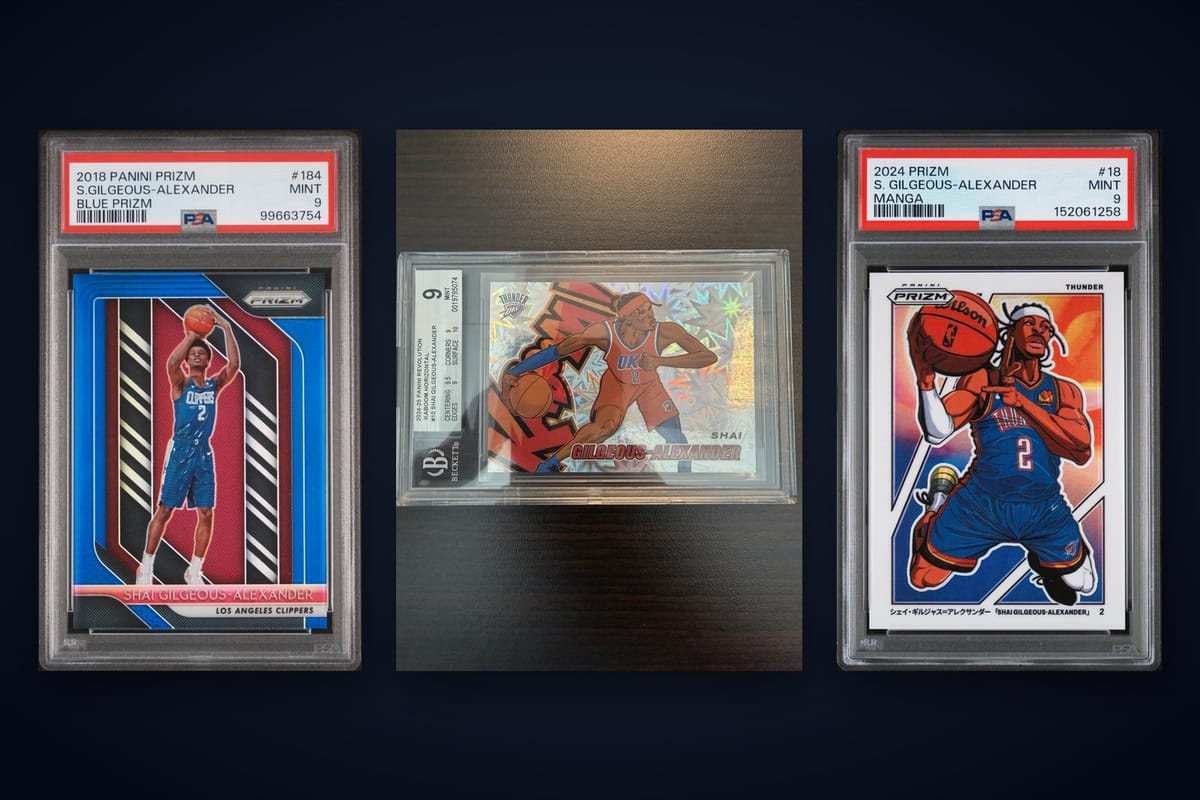
Estimated reading time: 17 min
Key Takeaways
- 2018 Panini Prizm Shai Gilgeous-Alexander rookie cards are widely regarded as the primary key to collecting valuable SGA cards, serving as a common benchmark for both collectors and investors.
- Autographed, patch, and parallel inserts such as Gold, Black, and Kaboom often command premiums due to their relative rarity and aesthetic appeal.
- PSA 10 grades generally increase card values compared to PSA 9 or raw cards, often resulting in prices that are 2-3 times higher.
- Affordable SGA cards under $25, $100, and $300 provide diverse entry points tailored to varying collector budgets and investment goals.
- Utilizing precise centering measurements with tools like Midpoint prior to grading submissions can help collectors better predict grade outcomes and potentially minimize grading risks.
Card values — live data from Midpoint's card database, as of 2026-09-04. Prices move; Midpoint refreshes these daily.
| Card | Raw | PSA 10 | Gem premium | |
|---|---|---|---|---|
![Shai Gilgeous-Alexander [Blue Prizm] #184 2018 Panini Prizm card](https://i.ebayimg.com/images/g/WpMAAeSwJAVqRcen/s-l500.jpg) |
Shai Gilgeous-Alexander [Blue Prizm] #184 2018 Panini Prizm |
$1,824 | $8,300 | 4.6× |
 |
Shai Gilgeous-Alexander #10 2024 Panini Revolution Kaboom Horizontal |
$1,925 | $8,161 | 4.2× |
 |
Shai Gilgeous-Alexander #18 2024 Panini Prizm Manga |
$1,510 | $5,407 | 3.6× |
 |
Shai Gilgeous-Alexander #AK-9 2025 Topps All Kings |
$1,596 | $4,592 | 2.9× |
 |
Shai Gilgeous-Alexander #UV-9 2025 Topps Chrome Ultra Violet All-Stars |
$774.90 | $3,401 | 4.4× |
![Shai Gilgeous-Alexander [Silver Prizm] #184 2018 Panini Prizm card](https://i.ebayimg.com/images/g/mooAAeSwEIpqVEJm/s-l500.jpg) |
Shai Gilgeous-Alexander [Silver Prizm] #184 2018 Panini Prizm |
$265.49 | $2,457 | 9.3× |
![Shai Gilgeous-Alexander [Blue, Yellow, and Green Choice Prizm] #184 2018 Panini Prizm card](https://i.ebayimg.com/images/g/1IoAAeSwCB9qAK50/s-l500.jpg) |
Shai Gilgeous-Alexander [Blue, Yellow, and Green Choice Prizm] #184 2018 Panini Prizm |
$312.39 | $1,963 | 6.3× |
Look up any card's current raw and graded value in Midpoint — and get an estimated grade before you pay to submit.
Table of Contents
- Section 1: Understanding Shai Gilgeous-Alexander Rookie Card Value
- Section 2: Most Valuable Shai Gilgeous-Alexander Cards and Market Trends
- Section 3: Grading Impact – PSA 10 vs PSA 9 vs Raw Cards
- Section 4: Parallel and Insert Cards That Command Premium Prices
- Section 5: Affordable Shai Gilgeous-Alexander Cards by Price Tier
- Section 6: How to Choose the Best Shai Gilgeous-Alexander Cards to Grade
Conclusion
FAQ
Section 1: Understanding Shai Gilgeous-Alexander Rookie Card Value
Why the 2018 Panini Prizm Rookie Set is the SGA Gold Standard
Shai Gilgeous-Alexander’s rookie cards from the 2018 Panini Prizm basketball set are widely regarded as a cornerstone for collectors seeking valuable SGA cards. This set is often considered a gold standard due to several factors: a print run that balances availability and scarcity; a wide variety of parallel and insert options; and market demand influenced by Shai’s rise in the NBA.
The 2018 Panini Prizm set is also noted for its clean, visually appealing design that has resonated with collectors. Its print quality, combined with the inclusion of sought-after parallels and autograph cards, has contributed to its status as a key rookie card source for SGA. This set offers a blend of accessibility—allowing new collectors to enter the market—and scarcity, which supports higher-end market transactions.
Unlike some other rookie card sets that may have overproduction issues or lack premium parallels, the 2018 Panini Prizm is often seen as striking a balance. This balance supports both casual collectors looking for base rookie cards and investors targeting scarce, high-value parallels and autographs.
Key Rookie Card Variations and Their Appeal
- Base Rookie Card: Serving as the foundational piece for many SGA collections, the base rookie card from the 2018 Panini Prizm set features a classic, clean design with a standard print run estimated in the tens of thousands. Its relative availability makes it an accessible entry point for collectors while maintaining value, especially when graded PSA 10.
- Autographed Rookie Cards: These cards are typically limited to print runs of 50 to 199 copies depending on the specific variant and parallel. The autograph adds authenticity and personalization, often driving demand higher. For example, a 2018 Panini Prizm SGA autograph numbered /99 can command prices multiple times higher than a base rookie card in comparable condition.
- Patch Cards: Incorporating game-used memorabilia such as jersey swatches, patch cards are among the rarer and more valuable types. Limited print runs often number as low as 25 or fewer, with some ultra-rare 1/1 patch cards fetching high prices during peak market conditions. Their appeal lies in both rarity and the tangible connection to game action.
- Parallels: Variations such as Gold (typically numbered to 100), Black (often /10 or /25), and Kaboom inserts (usually 1/1 or very limited) add rarity and striking visual appeal. These inserts often feature foil or holographic finishes, enhancing desirability. For example, a Gold parallel might sell for 2-3 times the price of the base card, while Kaboom inserts can reach multiples of that depending on condition and grade.
The Role of Market Demand in Rookie Card Value
The value of SGA rookie cards is influenced by market demand, which is affected by several key factors:
- Player Performance and Potential: Shai Gilgeous-Alexander’s development into an NBA All-Star caliber player fuels collector enthusiasm. Strong seasons, playoff success, or accolades typically lead to price appreciation across rookie card variations.
- Supply and Scarcity: Cards with limited print runs or those graded PSA 10 in pristine condition generally command higher prices. Market scarcity can result in competitive bidding during auctions.
- Collector and Investor Sentiment: Broader trends in the sports card market, including hype cycles and investment interest, impact demand. For example, during market surges in recent years, SGA rookie cards have experienced notable price increases.
As of 2026-09-04, the 2018 Panini Prizm base rookie card in PSA 10 condition maintains a strong resale value, typically ranging between $600 and $1,200 depending on centering and overall condition nuances. This consistent demand underscores the card’s status as a reliable entry point for collectors and investors alike.
Section 2: Most Valuable Shai Gilgeous-Alexander Cards and Market Trends
Top-Tier Cards That Command Premium Prices
The upper echelon of Shai Gilgeous-Alexander cards includes ultra-rare 1/1 cards, Logoman autographs, and high-grade patch cards primarily from the 2018 Panini Prizm set. These cards often represent the pinnacle of rarity, design, and player appeal, and have sold for high prices at major auctions.
For example, the 2018 Panini Prizm Gold Logoman Auto, a parallel featuring a gold foil "Logoman" patch and an autograph, is typically numbered to just 10 copies or fewer. In pristine PSA 10 condition, these cards can fetch prices in the range of several thousand dollars depending on market conditions and player momentum. Similarly, Kaboom inserts, known for their eye-catching explosion graphics and limited print runs (often 1/1 or under 10 copies), have sold for thousands of dollars when graded Gem Mint.
Other notable top-tier cards include 1/1 patch autographs, which combine the rarity of a single-copy print run with a game-used memorabilia patch and a signature. These are highly coveted by high-end collectors and investors, sometimes reaching very high prices at private sales or top-tier auctions.
Recent Sales and Auction Highlights
Recent auction data reveals the evolving market landscape for SGA cards. PSA 10 graded patch autographs have commanded prices above $5,000 at prominent auction houses such as Goldin and Heritage Auctions. These sales often feature multiple bidders, underscoring the card’s desirability and limited availability.
In contrast, PSA 10 base rookie cards have generally sold between $600 and $1,200, with pricing influenced by centering quality. Cards with perfect or near-perfect centering tend to push toward the higher end of this range, while those with slightly off-center images fetch less.
PSA 9 base rookie cards, which make up a larger population, typically sell for roughly half the PSA 10 price. For instance, a PSA 9 base rookie might sell for $300-$600 depending on market momentum. This illustrates the premium collectors place on the highest grade, highlighting the value of submitting only top-condition cards for grading.
Tracking Market Trends with Tools Like Midpoint
One way to stay informed on the SGA card market is through digital tools like Midpoint. This app leverages a database of over 250,000 cards, providing lookup capabilities for raw versus graded card values, auction results, and sales history.
Midpoint’s AI-powered features allow users to compare prices across grading tiers, identify undervalued cards, and track emerging trends before they hit peak prices. For example, a collector might use Midpoint to discover a raw SGA card with excellent centering that is overlooked in the market, submit it for grading, and potentially capitalize on the resultant value increase.
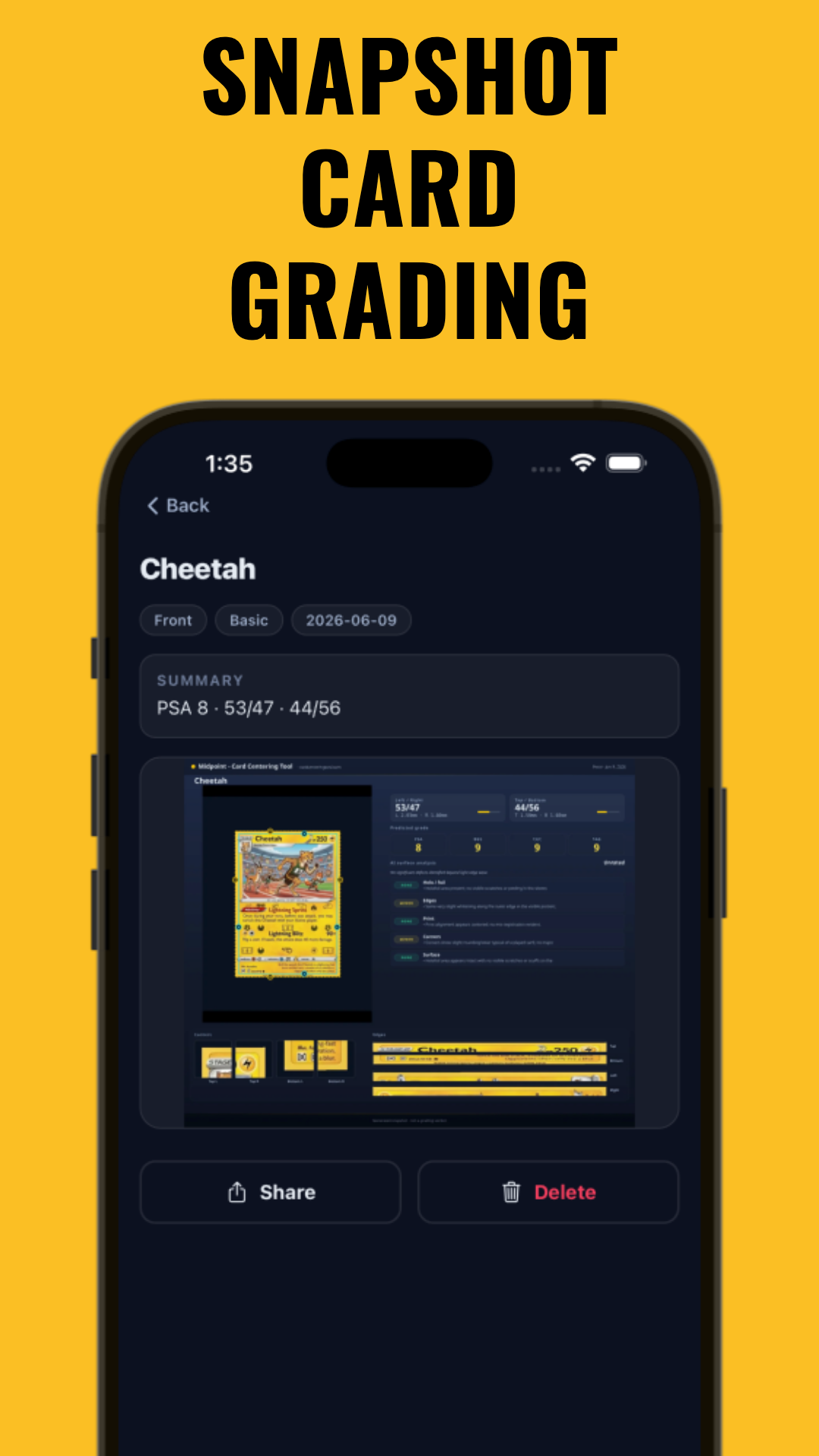
By monitoring price fluctuations and grading populations via Midpoint, collectors and investors can make more informed decisions, improving their chances of acquiring high-return cards.
Section 3: Grading Impact – PSA 10 vs PSA 9 vs Raw Cards
Why PSA 10 Grades Matter Most to Collectors
PSA 10, or Gem Mint, is the highest grade assigned by Professional Sports Authenticator (PSA). It signals pristine condition with near-perfect centering, sharp corners, flawless edges, and a clean surface free of visible defects under magnification. For Shai Gilgeous-Alexander rookie cards, this distinction generally translates to a substantial value premium.
Data often shows that PSA 10 SGA rookie cards command prices 2-3 times greater than PSA 9 cards. For example, a PSA 10 graded 2018 Panini Prizm base rookie might sell for around $1,000, while the same card graded PSA 9 would typically fetch $400-$500. This multiplier effect is due to collectors’ preference for perfection and institutional recognition of PSA 10 as a near-museum quality standard.
Moreover, PSA 10 cards tend to have better resale liquidity, attracting both collectors and investors seeking assets with minimal risk. This premium also reflects the card’s potential to appreciate further as the player’s career progresses.
Raw Cards: Risks and Rewards
Raw, ungraded cards offer a more affordable entry point but come with inherent risks. Without professional authentication and grading, buyers face uncertainty about condition, centering, authenticity, and potential defects. This ambiguity can depress prices and limit market appeal.
Many collectors opt to submit raw cards for grading to unlock higher market value. However, grading fees typically start at around $30 per card and can increase for expedited services or higher declared values. Additionally, there is a risk that the card might receive a lower than expected grade (e.g., PSA 8 or below), which can reduce value and negate grading costs.
To mitigate these risks, collectors increasingly rely on digital tools like Midpoint’s AI grading and centering measurement features. These tools evaluate a card’s likelihood of achieving PSA 10 or other high grades by analyzing centering ratios, corner sharpness, and surface condition from high-resolution photos. For example, Midpoint can measure centering down to 0.1% increments, enabling collectors to pre-grade with notable accuracy.
By pre-selecting only the best candidates for grading, collectors can save money and increase the chance of obtaining premium grades.
PSA 9: A Middle Ground
PSA 9, labeled Mint, represents a high-grade card with minor imperfections such as slight off-centering, small edge wear, or barely visible surface flaws. While not as flawless as PSA 10, PSA 9 cards offer a graded guarantee and improved marketability compared to raw cards.
These cards appeal to budget-conscious collectors who desire certification but cannot afford PSA 10 premiums. PSA 9 SGA rookie cards typically sell for about half the price of PSA 10, representing a balance of value and affordability.
For example, a PSA 9 graded 2018 Panini Prizm base rookie might fetch $500-$600, making it a popular choice for entry-level graded collectors. However, sellers should be cautious, as grading fees and turnaround times might not always justify submission of cards unlikely to reach PSA 10.
Section 4: Parallel and Insert Cards That Command Premium Prices
Popular Parallels: Gold, Black, and Kaboom
Parallels are alternative versions of base cards that feature distinctive color schemes, foil patterns, or graphic effects. For SGA, these parallels hold appeal due to limited print runs and unique aesthetics:
- Gold Parallels: Typically numbered to 100 copies, Gold parallels feature shiny foil borders and numbering. Their combination of rarity and visually striking design often results in prices 2-3 times higher than base cards. For example, a Gold parallel PSA 10 can sell for $1,500-$3,000 depending on centering and condition.
- Black Parallels: Scarcer, with print runs often limited to 10-25 copies. The black foil finish adds a sleek, premium look. Black parallels can command prices several times higher than Gold parallels, especially in PSA 10 condition.
- Kaboom Inserts: Among the rarest and most visually distinctive inserts, Kaboom cards feature explosion graphics and are often numbered as 1/1 or very limited. Their scarcity and bold design make them highly collectible, with prices ranging from a few thousand to over $10,000 for top-grade examples.
Autographed Parallels and Patch Inserts
Autographed parallels represent a fusion of rarity and personalization. They typically have very limited print runs—sometimes under 50 copies—and feature Shai's signature prominently. These cards appeal to collectors who value a direct connection to the player. For instance, a Kaboom auto parallel numbered /5 can command a significant premium over its non-autographed counterpart.
Patch inserts combine game-used memorabilia with autograph signatures, amplifying value. Colorful jersey swatches, sometimes multicolor or from special edition jerseys, elevate the card’s uniqueness. Limited print runs of 10 or fewer for these patches often drive prices into the thousands, with exceptional examples potentially exceeding $15,000.
Why These Cards Are Worth the Premium
- Scarcity: Limited print runs and unique features make these cards harder to acquire, increasing collector competition.
- Visual Appeal: Distinctive colors, foil treatments, and graphics make these cards stand out in collections and displays.
- Player Popularity: Shai’s rising star status supports sustained interest and potential future appreciation.
Section 5: Affordable Shai Gilgeous-Alexander Cards by Price Tier
Under $25: Entry-Level Options
Collectors on a tight budget can find raw base 2018 Panini Prizm SGA rookie cards or lower-tier parallels under $25. These cards serve as an accessible entry point for new collectors or casual fans wishing to own a piece of SGA memorabilia without significant investment.
Examples include ungraded base rookies with minor centering imperfections or low-numbered parallels with higher print runs. While these cards lack graded protection, they offer enjoyment and foundational value, especially if preserved carefully for potential future grading.
Additionally, some recent factory sets or retail-exclusive variants may fall into this price range, providing unique designs and affordable collecting opportunities.
Under $100: Mid-Tier Collectibles
This price tier opens access to autographed cards with moderate limited print runs (e.g., numbered to 99 or 49), and minor insert parallels. Collectors can also find PSA 9 graded base rookies near $100, offering certified condition assurance at a reasonable price point.
Within this bracket, cards often show solid centering and minimal wear, making them appealing for collectors seeking a balance between quality and affordability. For example, a PSA 9 2018 Panini Prizm SGA base rookie might be priced between $80-$120, depending on market cycles.
Some lower-tier patch cards or autograph parallels may also appear in this range if not graded or with less desirable serial numbers.
Under $300: Premium Collectibles and Investment Pieces
The sub-$300 range includes PSA 10 graded base rookies, some patch inserts with moderate rarity, and select autographed parallels. Collectors aiming for investment-grade pieces often look here for cards with strong resale potential and recognized grading.
For example, a PSA 10 2018 Panini Prizm base rookie card, depending on centering and market timing, can sometimes be found just under or around $300 in certain market conditions. Similarly, autographed parallels numbered to 25 or 50 and patch cards with decent patches may fall in this price tier.
This tier represents a sweet spot for many collectors balancing budget, quality, and long-term value.
Section 6: How to Choose the Best Shai Gilgeous-Alexander Cards to Grade
Assessing Card Condition Before Grading
Prior to submitting an SGA card for professional grading, it is essential to evaluate four key condition areas: centering, corners, edges, and surface. Each factor contributes to the final grade and overall market value.
- Centering: Perfect centering usually falls between 55/45 and 60/40 ratios on the front and back. Even minor deviations can reduce the grade. Use precise measurement tools like Midpoint to gauge centering down to 0.1% increments, which helps predict PSA grading outcomes.
- Corners: Sharp, clean corners without dings, bends, or whitening are critical. Corners are often the first area to show wear and heavily influence grading.
- Edges: Smooth, unchipped edges free of nicks or print defects add to higher grades. Edge wear can significantly detract from value.
- Surface: The card’s front and back surfaces should be free of scratches, print defects, stains, or discoloration. Gloss retention and absence of print dots are key.
Using AI-powered digital grading tools such as Midpoint allows collectors to upload high-resolution images and receive an estimated grade and centering calculation. This pre-grade assessment can inform whether to pursue grading or hold the card.
Prioritizing Cards with Investment Potential
When selecting cards for grading, prioritize those with the highest potential for long-term value appreciation:
- Focus on rookie cards from the 2018 Panini Prizm set, as these form the core of the SGA card market.
- Target autographed cards, patch inserts, and scarce parallels like Gold and Kaboom due to their rarity and appeal.
- Choose cards with near-perfect centering and flawless condition to maximize chances of PSA 10 or BGS 9.5+ grades.
- Consider population reports to identify cards with lower overall graded populations, which tend to appreciate more.
Avoiding Grading Pitfalls
- Do not submit cards with obvious surface scratches, heavy corner wear, or poor centering, as these factors reduce grading and market value.
- Be mindful of grading fees and turnaround times; only grade cards with a strong likelihood of receiving premium grades.
- Utilize this step-by-step guide to pre-grade your card to maximize success and avoid costly mistakes.
- Evaluate market timing; grading during peak market interest may result in higher resale returns.
Conclusion
Shai Gilgeous-Alexander cards that hold significant monetary value are primarily centered around his 2018 Panini Prizm rookie set. PSA 10 graded base rookies, autographed patch cards, and scarce parallels such as Gold and Kaboom often command the highest premiums due to their rarity, visual appeal, and player popularity.
Recent auction results and market trends emphasize the premium placed on top grades, especially PSA 10, with prices often doubling or tripling compared to PSA 9 or raw cards. This underscores the importance of careful card selection and pre-grading assessment.
For collectors and investors, leveraging digital grading tools like Midpoint to measure centering and estimate potential grades before submission can be beneficial. This approach may help minimize grading risks and maximize returns by ensuring only the best candidates are submitted.
Whether starting with affordable raw cards under $25, moving into mid-tier graded collectibles, or investing in premium graded gems under $300 and beyond, understanding the nuances of card condition, grading, market demand, and rarity can lead to smarter and more informed collecting decisions.
FAQ
Q: What are the most valuable Shai Gilgeous-Alexander cards?
A: The most valuable SGA cards generally include ultra-rare 1/1 autographed Logoman patch cards and PSA 10 graded 2018 Panini Prizm Gold and Kaboom parallels. These cards can command prices well into the thousands due to their rarity, premium condition, and collector demand.
Q: Are Shai Gilgeous-Alexander rookie cards worth money?
A: Yes. Rookie cards from the 2018 Panini Prizm set are the primary SGA cards that hold notable value, particularly when graded PSA 10 or featuring autographs and patch memorabilia. These cards are widely recognized as sought-after collectibles with market demand.
Q: Which SGA cards should I buy now as an investment?
A: Focus on PSA 10 graded 2018 Panini Prizm base rookies, autographed patch inserts, and scarce parallels such as Gold and Kaboom. These variants have shown strong long-term appreciation potential, especially if the player continues to perform well.
Q: How much is a 2018 Panini Prizm Shai Gilgeous-Alexander rookie card worth?
A: As of 2026-09-04, a PSA 10 graded base rookie card typically sells between $600 and $1,200 depending on centering quality and overall condition. Cards graded PSA 9 will generally sell for roughly half this amount, while raw versions vary widely based on condition.
Q: Does PSA grading increase the value of Shai Gilgeous-Alexander cards?
A: PSA 10 grades can increase card values by 2-3 times compared to PSA 9 or raw cards by providing professional authentication and condition assurance that collectors and investors often trust.
Q: What are the cheapest Shai Gilgeous-Alexander cards that still have value?
A: Raw base rookie cards and lower-tier parallels priced under $25 offer entry points with modest value. These cards are suitable for beginners or budget-conscious collectors looking to start an SGA collection without significant expense.
Free to start
Try the Midpoint app
Grade any card from a photo, see its raw and PSA 10 value, and track what your collection is worth — free.
Get it on iPhoneGet it on Android