
What’s It Worth? How to Accurately Value Your Trading Cards
Discover how to determine what’s it worth for your trading cards with AI grading, market data, and portfolio tracking using Midpoint.


Estimated reading time: 12 min
Key Takeaways
- Understanding "what’s it worth" involves combining grading accuracy, market data, and traffic insights to form a comprehensive valuation approach.
- AI-powered grading like Midpoint can estimate PSA, BGS, CGC, and TAG grades by analyzing centering, edges, corners, and surface condition, helping collectors form realistic pre-submission expectations.
- Ranking positions and search intent influence the value and traffic potential of keywords related to card pricing, which can affect collector and seller strategies.
- Effective portfolio tracking helps collectors monitor how card values fluctuate over time with market trends, grading updates, and external events.
- Estimating the dollar worth of a card depends on its condition, current demand, grading costs versus expected ROI, and timing in the marketplace.
Table of Contents
- Section 1: Understanding What’s It Worth for Trading Cards
- Section 2: AI Digital Grading – The New Standard in Card Valuation
- Section 3: Market Data and Lookup Tools for Accurate Card Pricing
- Section 4: How Grading Affects Card Value and Return on Investment
- Section 5: Using Keyword and Traffic Insights to Gauge Online Card Value
- Section 6: Portfolio Tracking and Monitoring Value Fluctuations Over Time
- Conclusion
- FAQ
Section 1: Understanding What’s It Worth for Trading Cards
The Importance of Accurate Valuation
When collectors ask, “what’s it worth?” they seek an estimate of their trading cards’ monetary value. This value depends on multiple factors including card condition, rarity, demand, and grading standards. Understanding these factors can help avoid underpricing valuable items or overpaying for grading services. Accurate valuation is important for collectors aiming to maximize returns, whether they’re selling, trading, or insuring their cards.
Key Factors Influencing Card Worth
- Condition: The physical state of the card is important. Experts examine centering (the alignment of the image within the card borders), corners (sharpness and wear), edges (presence of fraying or whitening), and surface quality (scratches, print defects, or stains). Even subtle flaws can reduce a card’s value, though the exact impact varies by severity and market.
- Grading: Official grades from PSA, BGS, CGC, and TAG provide industry-recognized benchmarks. A PSA 10 Gem Mint grade often commands higher prices compared to ungraded or lower-graded cards. Each grading company has unique standards and population reports that impact scarcity and demand.
- Market Demand: Popularity of the card’s game, sport, player, or character influences buying interest. For example, rookie cards of star athletes or iconic Pokémon cards tend to have sustained demand, affecting prices positively.
- Rarity and Population: Scarcity, including print runs and card variants, combined with grading population reports, informs perceived value. A card with fewer than 100 PSA 10 copies is generally more valuable than one with thousands.
- Sales History: Recent sales prices on marketplaces like eBay, PWCC, or auction houses provide real-world pricing context, reflecting current market conditions rather than outdated retail values.
Why "What’s It Worth" Is More Complex Than a Simple Lookup
Unlike static retail prices, trading card values fluctuate with market trends, grading updates, and collector behavior. For instance, a player’s performance, changes in game meta, or viral social media trends can cause value changes. A card’s worth can vary depending on the buyer’s intent—whether for investment, personal collection, or resale. Additionally, timing plays a role; cards may command peak prices during championship seasons or anniversaries.
Digital tools like the Midpoint app incorporate AI grading and portfolio tracking to provide dynamic and personalized valuations. These tools analyze multiple data points simultaneously, offering collectors a nuanced and up-to-date perspective rather than a static number.
Section 2: AI Digital Grading – The New Standard in Card Valuation
How AI Grades Cards Before Submission
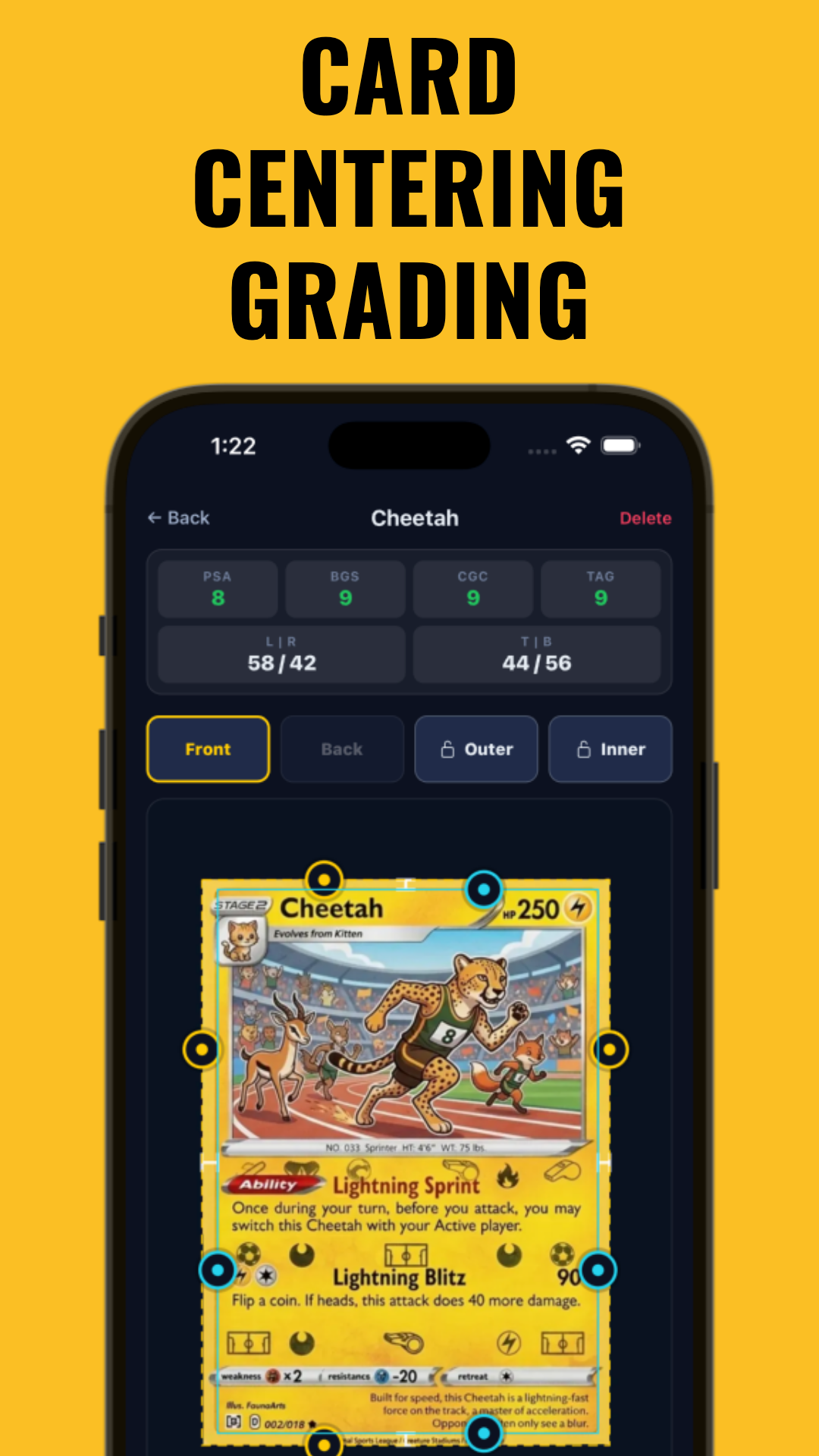
Submitting cards for professional grading can be costly, often $30 or more per card, plus shipping and insurance, with no guarantee of a high grade. Midpoint’s AI digital grading technology uses high-resolution images to analyze centering, corners, edges, and surface condition, providing estimated grades aligned with PSA, BGS, CGC, and TAG standards.
This pre-grade insight helps collectors decide whether submitting a card is worth the investment or if additional preservation (such as better storage or cleaning) might improve its condition. For example, a card estimated at PSA 7 might benefit from professional cleaning or edge repair before submission, potentially improving its grade and market value.
Measuring Centering with Millimeter Precision
Centering is one of the critical grading factors, often accounting for a significant portion of the overall grade. Midpoint’s card centering tool measures the card’s alignment down to the millimeter, providing an objective metric that correlates with professional grading thresholds.
For instance, PSA considers cards with centering within 55/45 or better to be eligible for top grades, while BGS has slightly different criteria. By quantifying centering precisely, Midpoint enables collectors to understand where their card stands relative to these benchmarks.
Accurate centering measurement supports better negotiation and pricing by establishing a transparent condition baseline. For more on centering’s impact, see our detailed guide on How Centering Impacts Card Value. This guide includes examples showing how a small shift in centering can reduce a card’s value significantly in some cases.
Integrating AI with Traditional Grading Scales
Midpoint’s AI is trained on extensive grading data sets and thousands of labeled images to approximate the evaluation criteria of top grading companies. This allows it to give estimated grades that can closely approximate official results, with an accuracy rate reported to be high in test cases.
Collectors get a preview of their card’s potential grade, helping them target cards with higher value and avoid costly grading disappointments. Moreover, AI grading can reduce subjective human bias and improve consistency across evaluations.
Section 3: Market Data and Lookup Tools for Accurate Card Pricing
Accessing Raw vs. Graded Card Values
Knowing what a card is worth involves comparing raw (ungraded) and graded values. Midpoint provides lookup functionality across 250,000+ cards spanning Pokémon, Magic: The Gathering, Yu-Gi-Oh, Lorcana, and major sports cards. This database is updated with marketplace sales and grading population data.
This data includes recent sales, population reports, and price trends for both raw and graded versions, enabling collectors to make informed decisions on buying, selling, or grading. For example, a raw Magic card might sell for around $75 on average, while a PSA 9 graded version of the same card might sell for significantly more, with PSA 10 copies commanding even higher prices in some cases.
Importance of Real-Time Market Data
Trading card values can change due to player performance, game meta changes, or collector sentiment. Tools that aggregate up-to-date sales data and market trends help ensure pricing reflects current demand rather than outdated catalogs.
For instance, during tournament seasons or after key player milestones, certain cards may increase in value within weeks. Midpoint’s integration with live sales feeds from eBay and auction houses allows users to see these trends in real time.
How Lookup Tools Support “What’s It Worth” Calculations
- Instant Price Estimates: Quickly assess card worth based on condition and grading status, with confidence intervals reflecting market volatility.
- Comparative Analysis: Evaluate your card against similar listings and sales filtered by date, grade, and condition.
- Decision Support: Determine if the cost to grade will likely be offset by increased card value, factoring in current market trends and grading turnaround times.
For collectors seeking to optimize grading investments, Midpoint’s lookup and tracking tools offer an integrated approach that pairs condition analysis with market valuation, reducing guesswork and enabling data-driven decisions.
Section 4: How Grading Affects Card Value and Return on Investment
Value Multipliers from Grading
Grading can increase a card’s value substantially. For example, a PSA 10 Gem Mint might fetch multiple times the price of a raw card or one graded lower, depending on the card’s rarity and demand. Midpoint’s AI grading estimates help quantify potential uplift before submitting cards.
To illustrate, consider a 1999 Pokémon Charizard card: raw copies might sell around $300, PSA 7 copies $1,200, PSA 9 copies $3,000, and PSA 10 copies significantly more. These multipliers show why selecting the right cards for grading is important.
Cost vs. Benefit: Is Grading Worth It?
Each grading submission involves fees, shipping, and wait time. Calculating the ROI means comparing expected value increase against these costs:
- Grading service fees ($30+ per card, which can increase based on value tiers and services like autograph authentication)
- Shipping and insurance expenses (typically $10-$30 depending on declared value and service level)
- Time waiting for results (ranging from 30 days to several months, potentially affecting market timing)
Using Midpoint’s pre-grade estimates and lookup values, collectors can run scenarios to decide whether grading is financially prudent. For example, if grading fees total $40 and the expected value increase exceeds $150, it may be worth submitting.
Examples of Grading Impact on Value
Consider a raw Magic: The Gathering card worth $50. If Midpoint estimates a PSA 9 grade, and market data shows PSA 9 sells for around $200, the expected value gain is $150. Subtract grading and shipping costs (~$40), the net gain is $110.
Another example: a raw sports card valued at $100 might only be worth grading if estimated to achieve a BGS 9.5 or higher, where market prices exceed $500. Conversely, cards with low grade potential or weaker market demand may not yield positive returns after grading costs.
This illustrates why grading selective cards with high grade potential can maximize returns while avoiding grading low-potential cards.
Section 5: Using Keyword and Traffic Insights to Gauge Online Card Value
Keyword Worth Based on Search Volume and Conversion
Collectors and sellers researching “what’s it worth” often use search engines. Keyword value calculators analyze search volume, click-through rates (CTR), and conversion rates to estimate how valuable ranking for these queries can be.
For example, “pokemon card worth” has high search volume, often tens of thousands of monthly searches globally, and strong buying intent, making it a valuable keyword for sellers and content creators. Similarly, niche keywords like “vintage baseball card value” may have lower search volume but higher commercial intent and conversion rates.
Traffic Value and Revenue Potential by Ranking Position
Ranking #1 for a keyword can capture over 30% of clicks, while positions 2 and 3 receive about 15-20%. This traffic can translate into potential sales or leads. For instance, if a keyword has 10,000 searches per month, the top-ranking site can expect approximately 3,000 visits monthly, increasing the chance of sales conversions.
Understanding these CTR differences helps prioritize SEO efforts, focusing on high-value keywords where ranking improvements yield substantial traffic gains.
How Search Intent Shapes Keyword Value
Keywords with buying intent (e.g., “sell baseball cards worth”) typically have higher conversion rates and value than informational queries like “how to grade cards.” Sellers should focus on transactional keywords to maximize ROI.
Midpoint’s own website benefits from targeting precise terms related to card grading and valuation, capturing interested collectors ready to act. Content strategies that combine educational material with transactional calls-to-action tend to perform well, balancing traffic volume with conversion efficiency.
Section 6: Portfolio Tracking and Monitoring Value Fluctuations Over Time
The Benefits of Collection Value Tracking
Trading card markets fluctuate based on player performance, game updates, and collector interest. Tracking the value of your collection over time provides insights into investment performance and helps identify the best times to buy or sell. For instance, tracking a rookie card’s value over a season can show whether holding or selling before playoffs might yield better returns.
How Midpoint Enables Dynamic Portfolio Management
Midpoint’s portfolio tracking feature aggregates your card values and updates them with current market data regularly, showing total collection worth and individual card trends. Users can upload their inventory, add condition notes, and link grading statuses to maintain an accurate snapshot.
This empowers collectors to:
- Spot rising stars and undervalued cards based on recent market movements
- Monitor how grading upgrades impact portfolio worth, observing value changes after PSA or BGS grading
- Make strategic decisions about sales and acquisitions by comparing historical price trends and forecasting potential
Examples of Value Fluctuations
For instance, a Yu-Gi-Oh card may increase in value after a competitive tournament or a new meta shift, sometimes rising 25% or more within weeks. Meanwhile, a sports card’s value might spike during championship seasons or following a player’s MVP announcement. Conversely, off-seasons or player injuries can depress values temporarily.
Midpoint’s tracking alerts collectors to these changes via notifications or dashboard highlights, helping maximize timing advantages and avoid missed opportunities.
Conclusion
Answering the question “what’s it worth” for trading cards requires a multifaceted approach. Combining AI grading tools like Midpoint with comprehensive market data lookup and portfolio tracking offers collectors a toolkit to better value their cards and maximize returns.
By measuring centering and condition before paying grading fees, understanding market trends driven by player performance and collector behavior, and managing collections with real-time portfolio insights, collectors can navigate the complex trading card market more confidently. Explore how Midpoint can help you determine what your cards are truly worth at Midpoint.
FAQ
Q: How much is a Google ranking worth in dollars?
A: The dollar value of a Google ranking depends on keyword search volume, click-through rate (CTR), and conversion rate. Ranking #1 can secure a significant portion of clicks, which may translate into revenue for transactional keywords like “what’s it worth” for cards. For example, a keyword with 10,000 monthly searches and a 3% conversion rate could generate sales, making the ranking potentially valuable.
Q: How do you calculate the value of a keyword ranking?
A: Keyword value is estimated by multiplying search volume by CTR by conversion rate and average transaction value. Tools like Midpoint use these metrics to assess the ROI of targeting specific keywords. For instance, a keyword with 5,000 searches, 30% CTR at position #1, 2% conversion, and $100 average sale value yields an estimated revenue potential.
Q: Is ranking on page one worth the SEO cost?
A: Ranking on page one, especially in the top 3 positions, typically delivers enough traffic and conversions to justify SEO investments, but ROI depends on the keyword’s commercial intent and competition. High-intent keywords with moderate competition often offer a good balance of cost and reward.
Q: How much traffic does position #1 get compared with positions #2 and #3?
A: Position #1 usually captures around 30-35% of clicks, while positions #2 and #3 get about 15-20% each, making the top spot more valuable for most keywords. This difference can translate to thousands more visitors per month on popular search terms.
Q: What factors make one keyword more valuable than another?
A: Keyword value depends on search volume, user intent (buying vs. informational), competition level, and average transaction value associated with the keyword. Keywords with high commercial intent and low to moderate competition are typically more valuable.
Q: How do I know if a keyword is worth targeting for SEO?
A: Evaluate the keyword’s search volume, commercial intent, competition, and potential conversion value. Tools that estimate these metrics, like those used by Midpoint, can guide your SEO strategy by projecting potential traffic and revenue gains versus optimization costs.
Free to start
Try the Midpoint app
Grade any card from a photo, see its raw and PSA 10 value, and track what your collection is worth — free.
Get it on iPhoneGet it on Android