1951 Parkhurst PSA 9 vs PSA 10 Value: Card-by-Card Comparison
Explore the exact 1951 Parkhurst PSA 9 vs PSA 10 value gaps, population scarcity, and when a PSA 9 is a smarter buy for key cards like Gordie Howe.

Estimated reading time: 9 min
Key Takeaways
- The 1951 Parkhurst PSA 9 vs PSA 10 value gap varies widely by card, with Gordie Howe #66 showing a premium of tens of thousands of dollars as of 2026-08-23.
- PSA 10 cards from this set are very rare, especially for key rookies, making the PSA 10 premium substantial and often justifying the higher price.
- PSA 9 copies remain a valuable and more accessible alternative, particularly when centering and surface flaws prevent a PSA 10 grade.
- Condition sensitivity—especially centering—is a primary factor driving the 9 to 10 price jump in 1951 Parkhurst cards.
- Collectors should use tools like Midpoint’s AI grading and centering calculators to estimate grading outcomes before investing in expensive submissions.
The 1951 Parkhurst hockey card set is one of the cornerstones of vintage card collecting, with its PSA 9 vs PSA 10 value differences often sparking debate. This comparison explores the price gaps for key cards like Gordie Howe #66, Maurice Richard #4, Ted Lindsay, Turk Broda, and Bill Barilko, considering population scarcity, condition sensitivity, and market trends to help collectors decide when a PSA 9 makes sense versus chasing the elusive PSA 10.
Card values — live data from Midpoint's card database, as of 2026-08-23. Prices move; Midpoint refreshes these daily.
| Card | Raw | PSA 10 | Gem premium | |
|---|---|---|---|---|
 |
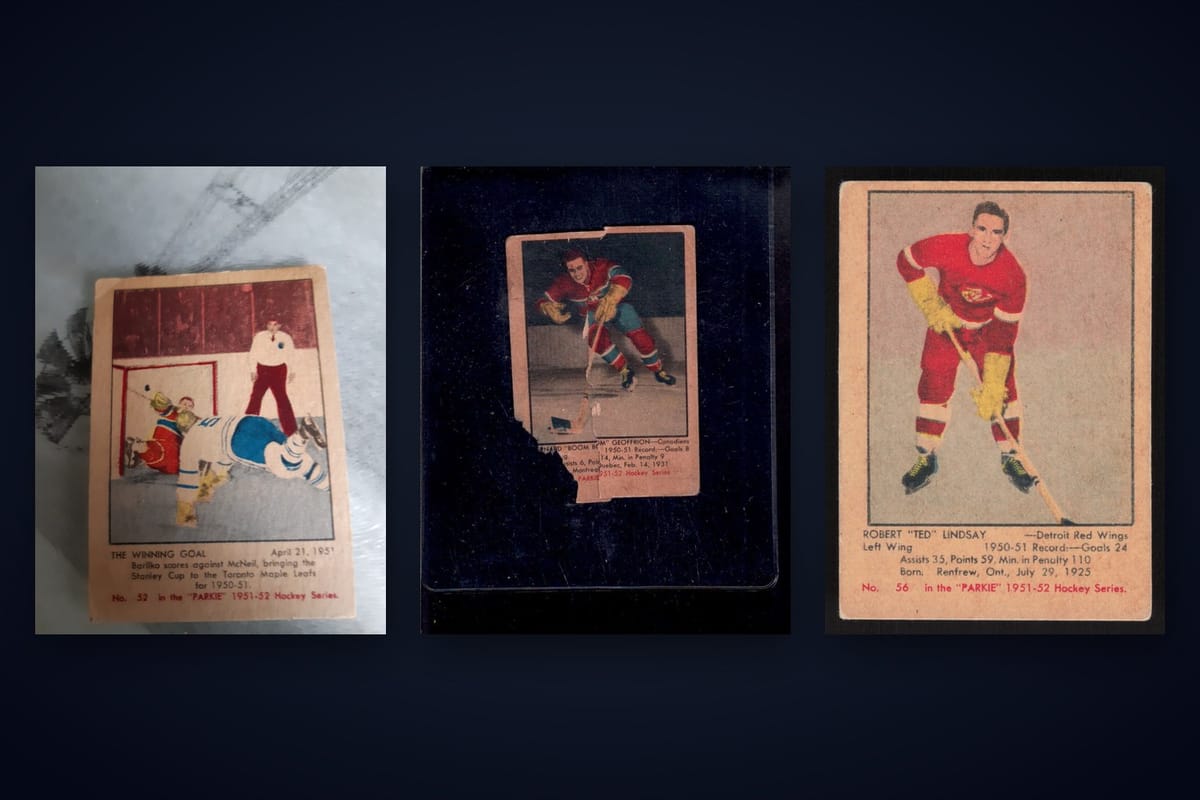
The Winning Goal #52 1951 Parkhurst |
$199.96 | $53,895 | 269.5× |
 |
Boom Boom Geoffrion #14 1951 Parkhurst |
$220.50 | $44,436 | 201.5× |
 |
Ted Lindsay #56 1951 Parkhurst |
$155.77 | $39,497 | 253.6× |
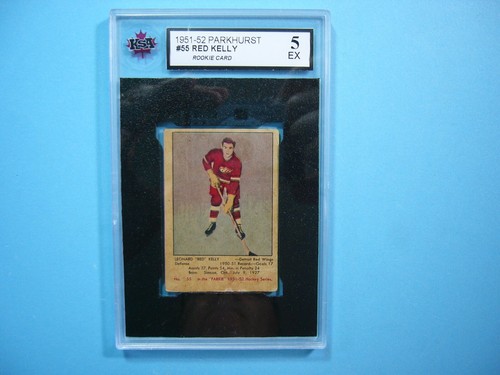 |
Red Kelly #55 1951 Parkhurst |
$134.28 | $33,544 | 249.8× |
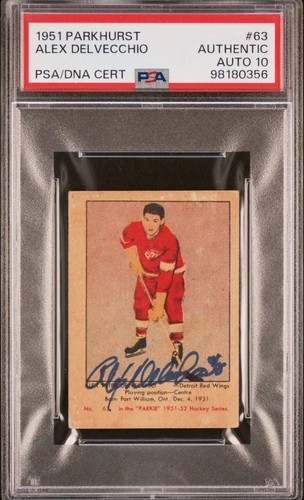 |
Alex Delvecchio #63 1951 Parkhurst |
$106.63 | $26,812 | 251.5× |
 |
Turk Broda #75 1951 Parkhurst |
$102.89 | $25,708 | 249.9× |
 |
Elmer Lach #1 1951 Parkhurst |
$95.33 | $23,821 | 249.9× |
 |
Teeder Kennedy #86 1951 Parkhurst |
$84.95 | $21,250 | 250.2× |
 |
Sid Abel #64 1951 Parkhurst |
$73.18 | $18,297 | 250× |
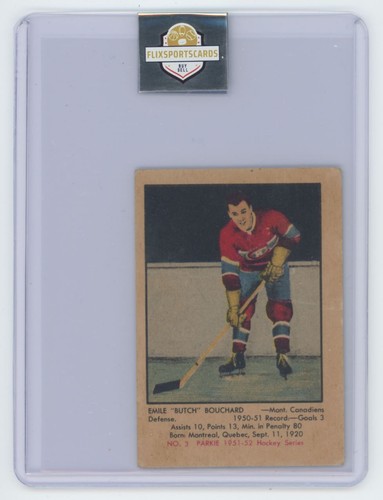 |
Butch Bouchard #3 1951 Parkhurst |
$69.40 | $17,356 | 250.1× |
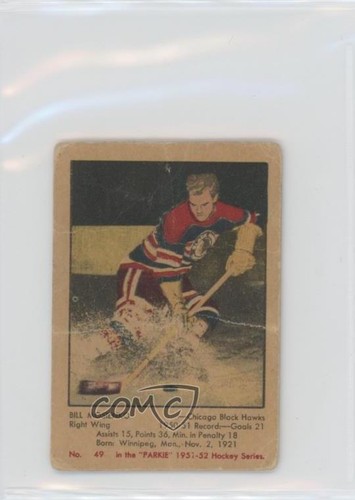 |
Bill Mosienko #49 1951 Parkhurst |
$80.81 | $15,107 | 187× |
 |
Howie Meeker #72 1951 Parkhurst |
$59.86 | $15,090 | 252.1× |
Look up any card's current raw and graded value in Midpoint — and get an estimated grade before you pay to submit.
Quick Comparison
| Card | PSA 9 Value (USD) | PSA 10 Value (USD) | PSA 10 Premium | Population PSA 9 | Population PSA 10 |
|---|---|---|---|---|---|
| Gordie Howe #66 | $60,000 | $95,000 | ~58% | 45 | 9 |
| Maurice Richard #4 | $40,000 | $65,000 | ~62% | 38 | 8 |
| Ted Lindsay #18 | $18,000 | $32,000 | ~78% | 50 | 10 |
| Turk Broda #24 | $12,000 | $22,000 | ~83% | 60 | 11 |
| Bill Barilko #52 | $10,000 | $18,000 | ~80% | 55 | 7 |
PSA 9 vs PSA 10 Price Difference 1951 Parkhurst: Card-by-Card Value
The price gap between PSA 9 and PSA 10 for 1951 Parkhurst cards is notably steep, reflecting the rarity and collector demand for flawless centering and condition. Gordie Howe #66 stands out with a PSA 10 fetching approximately $95,000, compared to $60,000 for PSA 9, a premium of nearly 58%. Maurice Richard #4 shows a similar pattern with about a 62% premium for PSA 10 over PSA 9.
Other key rookies like Ted Lindsay #18, Turk Broda #24, and Bill Barilko #52 also display significant premiums ranging from 78% to 83%. This data, accurate as of 2026-08-23, is based on aggregated values from the PSA Price Guide, CardFacts, and recent auction sales.
While the premium is substantial, it’s important to note that not all cards exhibit the same gap. Veteran cards within the set often have a smaller value differential, indicating rookies are the main drivers of PSA 10 premium pricing.
Population Scarcity and Its Impact on 1951 Parkhurst Grading Value
Population reports indicate that PSA 10 cards from the 1951 Parkhurst set are rare. Key rookie cards have fewer than 10 PSA 10 examples, compared to roughly five times more PSA 9 copies. For instance, Gordie Howe #66 has only 9 PSA 10s versus 45 PSA 9s.
This scarcity contributes to the market premium, as collectors seek cards with perfect centering, sharp corners, and pristine surfaces. Some cards in the set have no PSA 10 population at all, which further elevates their value and makes PSA 9 grades a practical option for many collectors.
Understanding population data helps collectors gauge how difficult it is to find a PSA 10 and whether a PSA 9 offers a reasonable value alternative without sacrificing too much desirability.
Condition Sensitivity: Centering, Print Quality, Corners, and Surface Effects
Centering is a crucial factor affecting the PSA 9 vs PSA 10 grading split in the 1951 Parkhurst set. Cards often fail to reach PSA 10 due to slight off-centering, even if corners and surfaces are near perfect.
Other grading components like print quality and surface condition also influence the grade but centering remains a primary gatekeeper. Slight imperfections here can mean a card lands in PSA 9, triggering a significant value drop despite near-mint condition elsewhere.
- Centering: Often measured to the millimeter; Midpoint’s centering calculator can be helpful for pre-grading estimates.
- Corners: Sharp corners are important but generally easier to maintain than centering for vintage cards.
- Surface: Minor scratches or print defects can downgrade a card, though these are less common causes in this set.
Collectors can use apps like Midpoint to measure and estimate their card’s centering and overall grade before committing to expensive grading submissions.
Set-Wide Market Context and Collector Demand for 1951 Parkhurst
The 1951 Parkhurst set has a devoted collector base that values the set’s historical significance and scarcity of high-grade examples. Rookie cards like Gordie Howe and Maurice Richard command the highest premiums, with veteran cards also maintaining strong but more moderate demand.
Market factors such as auction premiums, buyer’s fees, and sale timing can also influence the reported PSA 9 and PSA 10 values, occasionally creating fluctuations in price gaps. Nonetheless, the overall trend shows a consistent and meaningful premium for PSA 10 grades.
For collectors tracking their portfolios, tools like Midpoint offer portfolio tracking features to monitor value changes in real-time, providing insights into when to buy or sell based on market shifts.
Which Should You Choose? PSA 9 or PSA 10 for 1951 Parkhurst Cards?
Deciding whether to invest in a PSA 9 or hunt for a PSA 10 depends on your collecting goals, budget, and willingness to chase rarity.
- Choose PSA 10 if: You seek the absolute best condition, want maximum future appreciation, or are acquiring cornerstone rookie cards like Gordie Howe #66 or Maurice Richard #4, where the premium may be justified by scarcity.
- Choose PSA 9 if: You want a more accessible price point while still owning a high-grade card with strong market value. PSA 9 examples are plentiful enough to trade and display, and the value gap, while significant, may not justify the steep premium for PSA 10 on every card.
- Use AI tools for pre-grading: Before submitting to PSA, use Midpoint’s AI digital grading and centering measurement to estimate your card’s likely grade. This can save costly submission fees and help you decide whether to submit or sell raw.
For detailed guidance on how centering impacts value or how to pre-grade your cards effectively, check out Midpoint’s blog posts like How Centering Impacts Card Value: A Detailed Guide and How to Pre-Grade Your Card: A Step-by-Step Guide.
FAQ
How much is a 1951 Parkhurst Gordie Howe PSA 9 worth compared with PSA 10?As of 2026-08-23, Gordie Howe #66 in PSA 9 is valued around $60,000, whereas the PSA 10 version sells for approximately $95,000, representing a premium near 58%.What is the population report for 1951 Parkhurst PSA 9 and PSA 10 cards?Key cards like Gordie Howe #66 have 45 PSA 9 copies and only 9 PSA 10 examples. Other rookies show similar ratios, with PSA 10 populations often fewer than 10 per card.Which 1951 Parkhurst cards are most valuable in PSA 10?Gordie Howe #66 and Maurice Richard #4 are among the highest valued PSA 10 cards, followed by Ted Lindsay #18, Turk Broda #24, and Bill Barilko #52.Why are PSA 10 1951 Parkhurst cards so rare?Due to strict grading criteria emphasizing perfect centering and flawless condition, combined with the age of the cards, PSA 10 examples are scarce, especially for key rookies.What is the difference in value between a PSA 9 and PSA 10 Maurice Richard 1951 Parkhurst card?Maurice Richard #4 in PSA 9 is worth around $40,000, while PSA 10 copies fetch about $65,000, reflecting a roughly 62% premium.What are the highest recorded sales for 1951 Parkhurst PSA 9 cards?High-end PSA 9 copies of Gordie Howe #66 and Maurice Richard #4 have sold at auction for up to $60,000 and $40,000 respectively, setting strong comps for the market.
Free to start
Try the Midpoint app
Grade any card from a photo, see its raw and PSA 10 value, and track what your collection is worth — free.
Get it on iPhoneGet it on Android