1953 Bowman Football Cards Value: Raw vs Graded Guide
1953 Bowman football cards value explained: key rookies, raw vs graded gaps, PSA 10 premiums, and which cards are worth grading before you submit.

Estimated reading time: 11 min
Key Takeaways
- 1953 Bowman football cards value depends on three things: the player (Hall of Famers lead), the card's scarcity within the 96-card set, and, above all, condition.
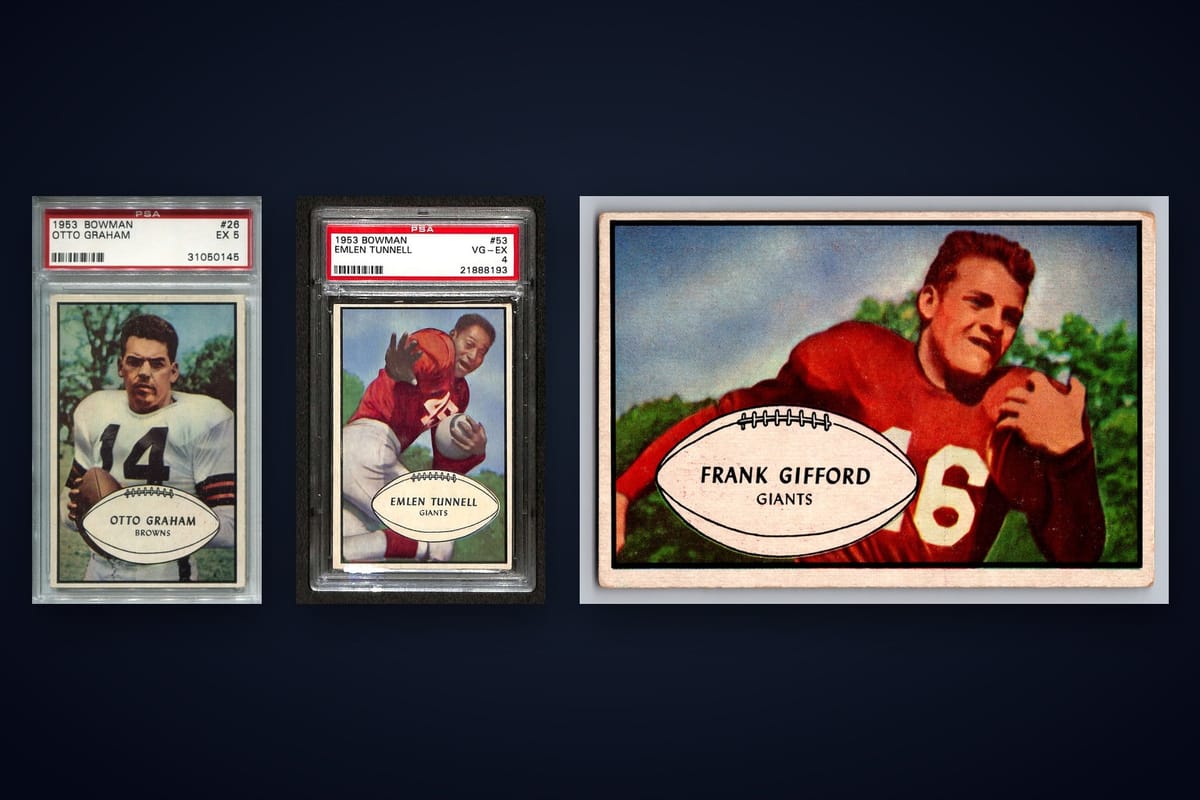
- The most valuable 1953 Bowman cards are generally the Hall of Fame names and other key cards: Eddie LeBaron #1, Y.A. Tittle #56, Marion Motley #9, Otto Graham #26 and John Dottley #2.
- The gap between a raw card and a PSA-graded gem is the biggest value lever in vintage football. Centering and corners are usually what decide the grade.
- Not every card is worth grading. Submit based on likely grade, current raw-vs-graded spread and the grading fee, not on hope.
- Pre-grade first. Measuring centering and checking corners costs nothing and can save you the grading fee on every card that would not have made the grade.
Card values — live data from Midpoint's card database, as of 2026-09-04. Prices move; Midpoint refreshes these daily.
| Card | Raw | PSA 10 | Gem premium | |
|---|---|---|---|---|
 |
Otto Graham #26 1953 Bowman |
$61.67 | $14,494 | 235× |
 |
Emlen Tunnell #53 1953 Bowman |
$18.25 | $11,346 | 621.7× |
 |
Frank Gifford #43 1953 Bowman |
$46.56 | $9,908 | 212.8× |
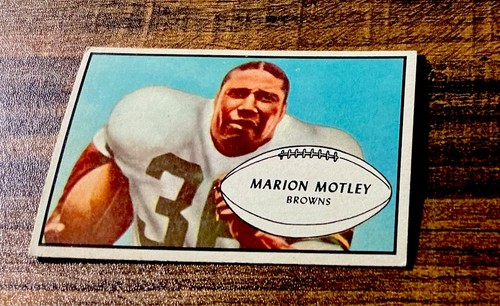 |
Marion Motley #9 1953 Bowman |
$39.00 | $9,866 | 253× |
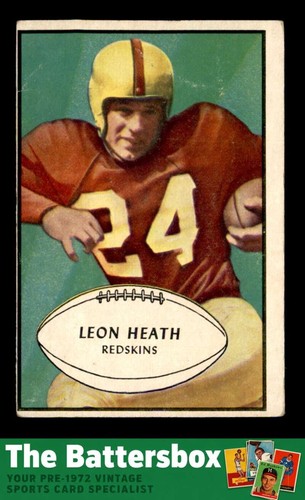 |
Leon Heath #63 1953 Bowman |
$10.73 | $7,800 | 726.9× |
 |
Bobby Layne #21 1953 Bowman |
$26.49 | $6,950 | 262.4× |
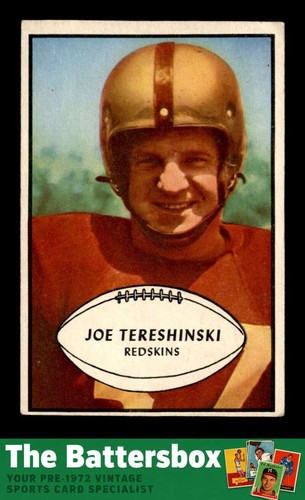 |
Joe Tereshinski #5 1953 Bowman |
$5.68 | $6,734 | 1185.6× |
 |
Norm Van Brocklin #11 1953 Bowman |
$21.30 | $6,295 | 295.5× |
 |
George Connor #37 1953 Bowman |
$12.22 | $6,295 | 515.1× |
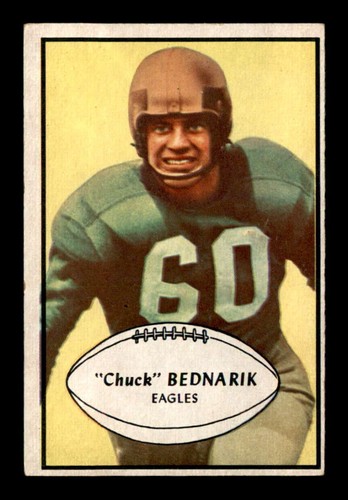 |
Chuck Bednarik #24 1953 Bowman |
$30.76 | $6,234 | 202.7× |
 |
Dub Jones #46 1953 Bowman |
$24.20 | $6,084 | 251.4× |
 |
George Ratterman #85 1953 Bowman |
$8.50 | $6,002 | 706.1× |
Look up any card's current raw and graded value in Midpoint — and get an estimated grade before you pay to submit.
Table of Contents
- Section 1: The 1953 Bowman Football Set at a Glance
- Section 2: Most Valuable 1953 Bowman Cards and Key Rookies
- Section 3: 1953 Bowman Price Guide by Grade
- Section 4: 1953 Bowman PSA 10 Value and the Gem Premium
- Section 5: How Condition Changes Value
- Section 6: Short Prints, Checklist and Complete-Set Values
- Section 7: 1953 Bowman Cards Worth Grading, and How to Sell
Section 1: The 1953 Bowman Football Set at a Glance
If you want to understand 1953 Bowman football cards value, start with the set itself. It is compact, historic and unforgiving about condition.
Set basics
- 96 cards in a single series, with no separate high-number run.
- Standard card size of roughly 2-1/2" x 3-3/4", the same larger format Bowman used for much of the early 1950s.
- The only football set Bowman issued in 1953. Topps went on to dominate football cards, which makes the Bowman run from this era a favorite among vintage collectors.
- Artwork-style color portraits rather than photographs, with a clean border that shows every nick and edge flaw.
Why the set carries a premium
Three factors keep demand steady:
- Hall of Fame content. Several quarterbacks, running backs and linemen from football's early television era appear here.
- Age. These cards are over 70 years old. Most were handled, flipped, stored in shoeboxes or held with rubber bands.
- Presentation. Large portrait cards with visible borders make centering and corner wear obvious, so high-grade copies are scarce.
How to read the data in this guide
The table that follows this section comes from Midpoint's own card database. Every price reference in this guide points to it and is dated as of 2026-09-04. Vintage prices move with auctions, so treat any number as a snapshot, not a promise. I deliberately avoid quoting figures from memory because 1950s card values swing sharply on a single high-grade sale.
You can look up any card in the set, raw and graded, in the Midpoint card lookup, which covers more than 1.5 million cards across sports and TCGs.
Section 2: Most Valuable 1953 Bowman Cards and Key Rookies
The most valuable 1953 Bowman cards tend to follow a predictable pattern: Hall of Fame quarterbacks and backs at the top, then notable stars, then the deep run of commons. Here are the names that matter most.
The headline cards
- Eddie LeBaron #1. As card number one, it sits on top of any stack and is often prone to handling damage. That is a big reason clean copies can be hard to find and why the LeBaron card draws attention at many grades.
- Y.A. Tittle #56. A Hall of Fame quarterback and one of the set's biggest names. Collectors who chase vintage QBs consistently look for Tittle cards.
- Otto Graham #26. One of the most decorated quarterbacks in the game's history. A Graham in sharp condition is a centerpiece for any 1950s football collection.
- Marion Motley #9. A Hall of Fame fullback with a legacy that goes beyond statistics. Motley cards carry strong historical appeal.
- John Dottley #2. Not a Hall of Famer, but the low card number matters. Early numbers are often among the most worn in a set, so condition-sensitive buyers pay attention.
Stars versus commons
A star card in a low grade can still outsell a common in a high grade. Commons rarely do the reverse, because there is a ceiling on what buyers will pay for a non-star, even a pristine one. The exception is a scarce card, which is covered in Section 6.
What the data shows
Check the Midpoint data table above for the entries on these players as of 2026-09-04. Look at two columns in particular: the raw value and the graded value. The relative gap between them, not just the headline number, tells you whether a card is a grading candidate.
Tip: Do not assume the cards in this set are rookie cards. Not every famous player's card here is a rookie card, and several of these players appeared in earlier Bowman issues. Verify rookie designations on the card's own listing and in a trusted checklist.
Section 3: 1953 Bowman Price Guide by Grade
A useful 1953 Bowman price guide is organized by grade, not by a single number per card. Vintage prices climb steeply as grades improve, and the slope is steeper for stars than commons.
The grade ladder
For 1950s cardboard, collectors typically think in these tiers:
- Poor to Good (PSA 1-2): heavy wear, creases, rounded corners, possible stains. Priced as affordable placeholders.
- VG to VG-EX (PSA 3-4): noticeable wear but a solid, presentable card. This is where most collectors build sets.
- EX to EX-MT (PSA 5-6): light corner wear, mostly clean surface. A common sweet spot for value-conscious collectors.
- NM to NM-MT (PSA 7-8): sharp corners, strong eye appeal. Premiums grow rapidly here.
- Mint (PSA 9) and Gem Mint (PSA 10): rare for 1953 issues and priced accordingly.
Commons, short prints and stars
Think of the set as three price curves:
- Commons: a gentle curve. Even higher grades stay accessible relative to stars.
- Scarcer cards: a steeper curve driven by scarcity.
- Stars and Hall of Famers: the steepest curve, because demand and condition scarcity combine.
Ungraded versus graded pricing
Raw cards sell on photos and seller reputation. A buyer discounts for uncertainty, since they cannot be sure about trimming, restoration or hidden creases. A graded card removes that uncertainty. This is why a PSA-slabbed card usually sells for more than a similar-looking raw one, and why authentication is part of the value.
Use the dated figures in the Midpoint table as your baseline, then compare against recent completed sales for the exact grade you hold. A single auction can move a thin vintage market, so look at several sales, not one.
Section 4: 1953 Bowman PSA 10 Value and the Gem Premium
Searches for 1953 Bowman PSA 10 value are common, but the first thing to know is that PSA 10s from this era are exceptionally scarce. Many cards in the set may have very few top-grade examples, or none. That scarcity is the premium.
Why gem copies cost so much more
Moving from a PSA 8 to a PSA 9 or 10 on a vintage card often multiplies the price rather than adding a modest bump. Three forces drive it:
- Population scarcity. Few cards survived 70 years in near-perfect condition.
- Registry demand. Set builders competing for top-ranked sets pay up for the best copy of each card.
- Trophy appeal. A gem Hall of Famer is a status piece, and buyers rarely haggle.
The gem-premium gap
The gem-premium gap is the difference between what a card sells for raw or in a mid grade and what it sells for in the top grades. When the gap is large, grading can pay off, but only if your card truly lands in the high tier. When the gap is small, grading mostly adds cost.
- Large gap + strong centering and corners: consider grading.
- Large gap + visible flaws: the realistic grade is probably lower, so run the math on the lower grade.
- Small gap: grade only for protection or resale convenience.
Know what the grades mean
A PSA 10 on a 1953 card is not the same experience as a PSA 10 on a modern card, and grading companies use different scales. If you are comparing slabs from different companies, read this breakdown of grading scale differences by company before you assume two top grades are equivalent.
Also pull the PSA population report for any card you are considering. A low population at the grade you expect is a sign the premium may hold. A high population at that grade is a warning that the spread could compress.
Section 5: How Condition Changes Value
For 1953 Bowman football, condition is not a footnote. It is the value. Here is what graders and buyers look at.
Centering
Visible borders make off-center printing easy to see. Even a card with great corners can be capped at a lower grade if the image sits too far to one side. For a deeper look at this, see our guide on how centering impacts card value.

Midpoint measures centering down to the millimeter and shows left/right and top/bottom ratios, so you can see whether a card is a realistic candidate before paying a fee.
Corners and edges
- Corners: look for fraying, rounding and soft points. Low-numbered cards (#1, #2) often show more wear.
- Edges: chipping along the border is highly visible on darker color areas.
Surface and print issues
- Creases: even a light crease limits the grade sharply.
- Stains and wax residue: common on cards stored in packs or in contact with other materials.
- Print defects: registration problems, print dots and ink spots can reduce eye appeal.
- Paper loss and back damage: album residue and thinning are major value killers.
Altered cards
Trimming and recoloring are real risks in vintage. A card that looks too sharp for its age, or measures slightly smaller than standard, deserves scrutiny. Grading companies reject altered cards, which is another reason authentication adds value.
Once you have a card you value, protect it. Our guide on how to store valuable cards covers sleeves, holders and humidity control.
Section 6: Short Prints, Checklist and Complete-Set Values
A set this size makes checklist knowledge useful. It also helps you spot the scarce cards.
Finding a checklist
You can find a full 1953 Bowman football checklist by card number in the major hobby databases and in the PSA set registry pages. Match every card you own by number and name, and note any variations. The set runs from #1 (Eddie LeBaron) through #96, a single series with no extra number ranges to track.
Short prints and scarcity
In many vintage sets, some cards were printed in smaller quantities than others because of how sheets were laid out. Such short prints are harder to find in any condition, so they command higher prices than similar commons. Whether and which cards in this set are short-printed is something to confirm in a reliable checklist. To identify scarcer cards:
- Cross-reference a trusted checklist that flags scarce numbers.
- Compare PSA population counts. Unusually low counts across all grades are a hint.
- Look at how often a card appears in auctions compared with its neighbors.
I am not listing specific short-print numbers here because sources differ, and guessing could cost you money. Verify with a checklist before you buy or sell.
Complete and near-complete sets
Set values scale with the grade you target:
- Good to Very Good sets: the entry point. Affordable by vintage standards, with plenty of wear.
- Excellent sets: a popular balance of eye appeal and cost.
- Better than Excellent: prices climb quickly because every card must clear the bar, and the stars and scarcer cards are the bottleneck.
Near-complete sets sell too, often at a discount per card relative to buying singles, because the buyer takes on the work of filling gaps. Whether a complete set sells for more than the sum of its parts depends on the market and the quality of the slabs.
Section 7: 1953 Bowman Cards Worth Grading, and How to Sell
So, which 1953 Bowman cards are worth grading? Here is a practical filter.
A grading decision checklist
- Star or Hall of Famer? Cards like Graham, Tittle and Motley are the most obvious candidates, along with the LeBaron #1.
- Clean corners and surface? No creases, stains or paper loss.
- Centering within range? Measure it first.
- Is the spread worth the fee? Compare the raw value to the realistic graded value in the Midpoint table, then subtract fees and shipping.
For commons, grading rarely pays unless the card is in exceptional condition. Run the numbers before you submit.
Pre-grade before you pay
Use this step-by-step pre-grading guide to inspect a card under good light. Then use Midpoint's AI digital grading for an estimated PSA, BGS, CGC or TAG grade based on centering, corners, edges and surface. It is free on iOS and Android, so you can screen a whole stack before submitting.
How to sell
- Auction houses and online auctions: best for high-grade stars and scarce cards, where competitive bidding can lift prices. Fees apply.
- Dealer offers: fast and simple, but expect a discount because the dealer needs margin.
- Online marketplaces: reach a wide audience. Use clear scans, show all four corners and disclose flaws.
- Team or player lots: useful for mid-grade commons that are not worth listing individually.
Whatever route you choose, check recent sold listings at the same grade, not asking prices. After selling or buying, track your collection's value over time with Midpoint's portfolio tools.
Conclusion
1953 Bowman football cards value comes down to a simple hierarchy: Hall of Fame names and key cards first, scarcer cards second, and condition across the board. The most valuable 1953 Bowman cards, including Eddie LeBaron #1, Y.A. Tittle #56, Marion Motley #9 and Otto Graham #26, reward sharp centering, clean corners and clean surfaces more than almost any other vintage football issue.
Before you spend on grading, measure, inspect and compare the raw-versus-graded gap using dated data. That one habit protects you from the most common mistake: paying fees on a card that will not grade high enough to justify them. Try Midpoint to check centering and estimate a grade first, and the free centering calculator if you just need a quick ratio.
FAQ
Q: How much are 1953 Bowman football cards worth?
A: It varies widely by player and condition. Commons in low grades are affordable, while Hall of Famers and scarce cards in high grades are worth many times more. Check the dated Midpoint data table (as of 2026-09-04) and recent sold listings for your exact grade.
Q: What is the most valuable 1953 Bowman football card?
A: The top value usually sits with the Hall of Fame stars and key cards, such as Otto Graham #26, Y.A. Tittle #56, Marion Motley #9 and Eddie LeBaron #1, especially in high grades. The exact top card on any given day depends on the grade and the latest sales.
Q: How much is a 1953 Bowman Eddie LeBaron card worth?
A: Its value depends heavily on condition. As card #1, it often has corner and edge wear, so clean examples earn a premium. Look up the LeBaron entry in Midpoint for raw and graded values as of 2026-09-04, and compare against recent sales at the same grade.
Q: What is a complete 1953 Bowman football set worth?
A: A complete 96-card set is priced by overall grade. Good to Very Good sets are the entry level, Excellent sets cost more, and better-than-Excellent sets climb steeply because the stars and scarcer cards are hard to find in high grades.
Q: Where can I find a 1953 Bowman football card checklist?
A: Major hobby databases and the PSA set registry list the full 96-card checklist by card number. Verify any short-print flags against more than one source before buying or selling.
Q: Are 1953 Bowman football cards rare or valuable?
A: The set is not impossibly rare, but high-grade copies are scarce because of the cards' age and the way they were handled. Stars and scarcer cards in strong condition are the most valuable.
Free to start
Try the Midpoint app
Grade any card from a photo, see its raw and PSA 10 value, and track what your collection is worth — free.
Get it on iPhoneGet it on Android