1957 Topps Hockey Cards Value: Complete Guide to Grading & Pricing
Discover the 1957 Topps hockey cards value, top rookies, grading tips, and how condition impacts prices for raw and PSA 10 graded cards.

Estimated reading time: 15 min
Key Takeaways
- The 1957 Topps hockey set features 66 cards with key rookies and Hall of Famers that can significantly affect value.
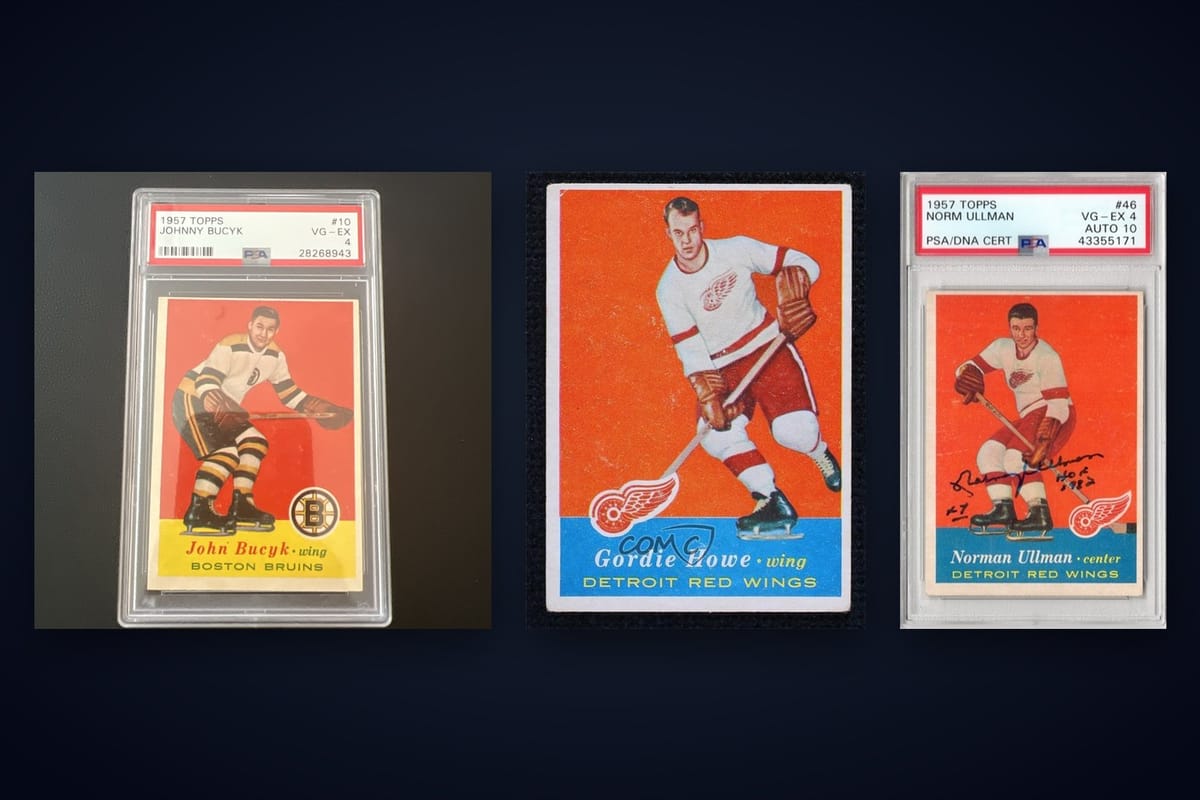
- Most valuable 1957 Topps cards often include Johnny Bucyk #10, Glenn Hall #20, Pierre Pilote #22, Norm Ullman #46, and Gordie Howe #42.
- Card condition and centering are critical for grading—Midpoint’s AI grading estimates can help assess before costly submissions.
- PSA 10 graded cards typically command substantial premiums over raw examples, making grading decisions strategic.
- Complete set values depend heavily on condition and presence of key rookie cards; partial sets vary widely in price.
Card values — live data from Midpoint's card database, as of 2026-11-01. Prices move; Midpoint refreshes these daily.
| Card | Raw | PSA 10 | Gem premium | |
|---|---|---|---|---|
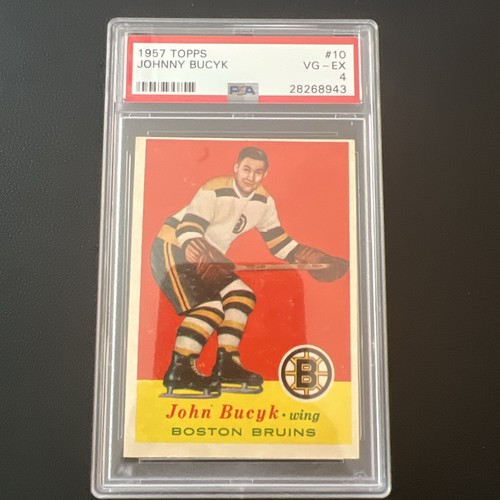 |
Johnny Bucyk #10 1957 Topps |
$316.50 | $53,782 | 169.9× |
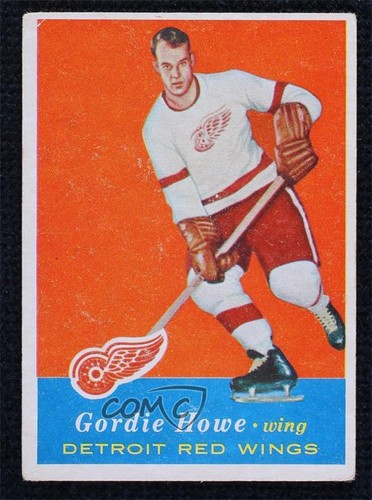 |
Gordie Howe #42 1957 Topps |
$276.04 | $41,987 | 152.1× |
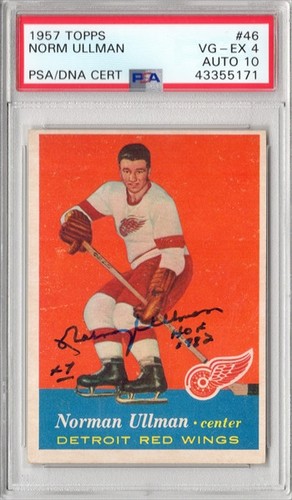 |
Norm Ullman #46 1957 Topps |
$127.12 | $26,577 | 209.1× |
 |
Pierre Pilote #22 1957 Topps |
$51.26 | $10,814 | 211× |
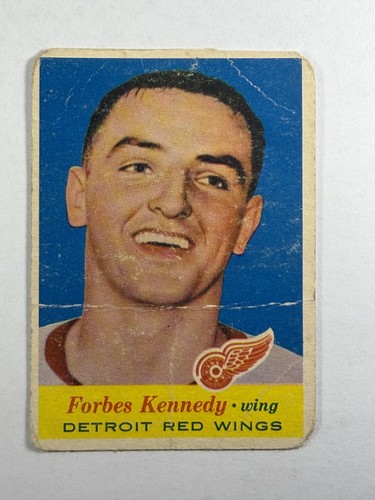 |
Forbes Kennedy #50 1957 Topps |
$38.77 | $8,068 | 208.1× |
 |
Dave Creighton #66 1957 Topps |
$11.89 | $7,056 | 593.4× |
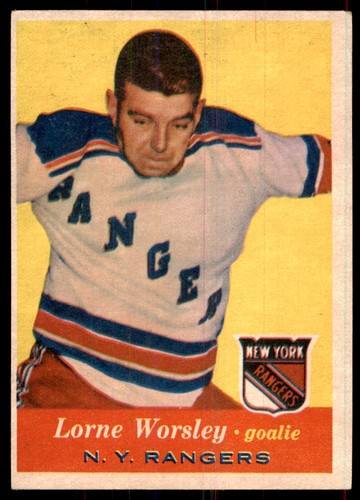 |
Gump Worsley #53 1957 Topps |
$37.55 | $6,381 | 169.9× |
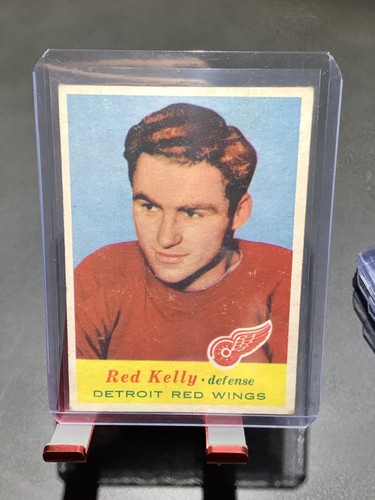 |
Red Kelly #48 1957 Topps |
$29.50 | $5,872 | 199× |
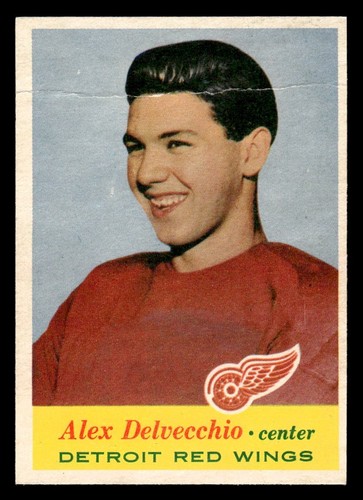 |
Alex Delvecchio #34 1957 Topps |
$27.59 | $5,492 | 199.1× |
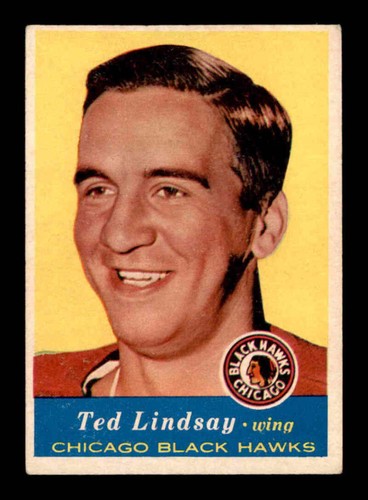 |
Ted Lindsay #21 1957 Topps |
$23.91 | $4,908 | 205.3× |
 |
Andy Bathgate #60 1957 Topps |
$21.07 | $4,399 | 208.8× |
 |
Don Simmons #14 1957 Topps |
$20.48 | $4,277 | 208.8× |
Look up any card's current raw and graded value in Midpoint — and get an estimated grade before you pay to submit.
Table of Contents
- Section 1: Overview of 1957 Topps Hockey Cards
- Section 2: Complete 1957 Topps Hockey Card Checklist and Key Rookies
- Section 3: Understanding 1957 Topps Hockey Cards Value by Condition
- Section 4: Most Valuable 1957 Topps Hockey Cards and Their Market Prices
- Section 5: Grading Considerations and 1957 Topps Cards Worth Grading
- Section 6: PSA 10 Value and the Gem-Mint Premium Gap Explained
- Conclusion
- FAQ
Section 1: Overview of 1957 Topps Hockey Cards
Background and Set Composition
The 1957 Topps hockey card set is a notable set in hockey card collecting history. Released as one of the first major bilingual sets, it includes 66 cards representing four U.S.-based NHL teams. The cards are standard size and feature player biographies in both English and French, making them distinctive collectibles from this era.
The set covers prominent players of the late 1950s, including Hall of Famers and rookies who have since become sought after. The bilingual aspect and the era’s limited print runs contribute to the set’s collectability.
Topps utilized lithographic printing techniques common in the 1950s, which sometimes resulted in slight color variations and centering inconsistencies. These printing nuances add an extra layer of challenge and interest for collectors aiming for top-grade examples. The cards measure approximately 2-5/8" by 3-3/4", a size standard for the time but slightly larger than many modern cards.
Key Features and Identification
- Card Numbers: Cards are sequentially numbered #1 through #66, facilitating identification and set completion tracking.
- Teams Covered: The four NHL U.S. teams represented are Boston Bruins, Chicago Blackhawks, Detroit Red Wings, and New York Rangers. The Montreal Canadiens and other Canadian teams are not included, likely due to licensing and regional marketing strategies of the era.
- Biographies: Bilingual player info on the back distinguishes this set from others, with text in both English and French reflecting the NHL’s fanbase and the Canadian market’s importance.
- Design Elements: The card fronts feature a portrait or action shot of the player, with a colored background and team logo. The back includes player stats, career highlights, and a brief bio, all bilingual.
Why the 1957 Topps Hockey Set Is Important
This set marks a transitional moment in hockey card design and marketing. Its bilingual nature reflects the NHL’s growing presence across North America. For collectors today, the set offers a blend of historical significance and potential investment value, especially for well-preserved cards.
Its release followed the 1956 Topps hockey set and preceded the 1958 set, making it a key link in Topps’ hockey card production evolution. The bilingual backs are particularly appreciated by collectors who value the cultural integration and uniqueness. Moreover, the limited print runs—estimated at tens of thousands of copies per card—make high-grade specimens relatively scarce in today’s market.
The 1957 Topps set also represents an era when hockey was solidifying its identity in the U.S., and the cards serve as a nostalgic window into the NHL’s Original Six era. This historical context increases the set’s appeal beyond mere collectible value to that of cultural memorabilia.
| Card # | Player | Team | Rookie | Hall of Fame |
|---|---|---|---|---|
| 10 | Johnny Bucyk | Boston Bruins | Yes | Yes |
| 20 | Glenn Hall | Chicago Blackhawks | Yes | Yes |
| 22 | Pierre Pilote | Chicago Blackhawks | Yes | Yes |
| 42 | Gordie Howe | Detroit Red Wings | No | Yes |
| 46 | Norm Ullman | Detroit Red Wings | Yes | No |
Section 2: Complete 1957 Topps Hockey Card Checklist and Key Rookies
Complete Set Checklist
The 1957 Topps hockey set consists of 66 cards. Each card is numbered and features player details, making it straightforward to track completeness. Collectors aiming for a full set should target each card by number, with special attention to high-value rookies and Hall of Fame players.
- Cards #1–66 cover players from the four NHL teams, including forwards, defensemen, and goaltenders, ensuring a comprehensive representation of team rosters.
- Rookies are clearly designated, such as Johnny Bucyk (#10), Glenn Hall (#20), and Pierre Pilote (#22), often marked with "Rookie" text on the front or denoted in the checklist.
- Hall of Famers like Gordie Howe (#42) are important for set value, often serving as centerpiece cards for collectors.
- Some cards include lesser-known players and role players, which may be less valuable individually but necessary for completing a set.
- Condition and centering vary across the checklist, so identifying which cards are more challenging to find in high grade can help prioritize collecting efforts.
Key Rookie Cards to Prioritize
Rookie cards generally command the highest interest and value in this set. The top rookies include:
- Johnny Bucyk (#10): One of the more valuable cards due to Bucyk’s Hall of Fame status and popularity. Bucyk had a long NHL career spanning over two decades and is remembered as one of the Boston Bruins’ all-time greats.
- Glenn Hall (#20): A legendary goaltender whose rookie card is highly prized. Hall was known for his durability and innovative goaltending techniques, playing 502 consecutive games.
- Pierre Pilote (#22): Another Hall of Fame defenseman with a strong collector following, Pilote won three Norris Trophies during his career.
- Norm Ullman (#46): Valued for rookie status despite not being in the Hall of Fame, Ullman was a consistent scorer and key player for the Detroit Red Wings and later the Toronto Maple Leafs.
- These rookies are often focal points when grading or selling the set, as their values significantly impact overall set worth.
Additional Hall of Fame Cards
Besides rookies, cards featuring Hall of Famers like Gordie Howe (#42) are sought after by collectors. While not a rookie card, Howe’s card remains a cornerstone of the set’s value.
Other Hall of Fame players included in the set bolster its desirability. For example, players like Ted Lindsay and Doug Harvey also appear, and their cards, while generally less valuable than the rookies listed, add depth to the collection. Collectors focusing on Hall of Fame subsets within the 1957 Topps set can target these specific cards to enhance their collections.
Given the set’s age, some cards are more difficult to find in high-grade condition due to handling and storage over the decades. Prioritizing key rookies and Hall of Famers for quality can maximize the set’s investment potential.
Section 3: Understanding 1957 Topps Hockey Cards Value by Condition
Condition Factors Affecting Value
For 1957 Topps hockey cards, condition is a major factor in determining value. Key condition aspects include:
- Centering: How well the image is centered on the card; poor centering can reduce value. Cards with centering closer to 50/50 ratios are most desired.
- Corners: Sharp, undamaged corners are essential for higher grading. Rounded or frayed corners are common issues that lower grades.
- Edges: Clean edges without chipping or wear increase card desirability. Edge wear is common in vintage cards due to handling and storage conditions.
- Surface: Absence of stains, creases, or print defects is important. Surface quality includes gloss preservation and the lack of scratches or print spots.
- Color Quality: Bright, vibrant colors without fading or discoloration are preferred and can influence grading.
- Print Defects: Misprints or ink smudges can detract from value unless they are rare error cards.
Raw vs. Graded Condition
Raw cards are ungraded and their value fluctuates based on visible condition to buyers. Graded cards, especially those graded by PSA, BGS, CGC, or TAG, provide verified condition levels that generally command higher prices.
Raw 1957 Topps hockey cards can be challenging to evaluate due to subtle nuances that affect value. For instance, a card that looks mint to an untrained eye may have centering that just misses PSA 9 standards, affecting pricing significantly.
Midpoint’s AI digital grading tool offers collectors an estimated grade before they pay submission fees, by measuring centering, edges, corners, and surface. This tool can help identify which cards are worth grading. It uses high-resolution scans and algorithms trained on many graded examples to provide estimates aligned with major grading companies.
Collectors may find such tools useful especially for sets like the 1957 Topps hockey cards, where centering and edge wear are common problems that can impact a card's grade.
Impact of Centering on Value
Centering is often the biggest hurdle for 1957 Topps cards reaching top grades. Cards with centering within 55/45 or better stand a better chance of achieving PSA 9 or 10 grades, which significantly boost value. Centering outside this range often causes grade drops of one or more points.
For example, a Johnny Bucyk #10 card with excellent centering and sharp corners can be graded PSA 10 and command a high premium. However, a similar card with off-center borders may grade PSA 8 or 7, resulting in a substantially lower market value.
Learn more about how centering impacts card value for deeper insights, including tips on spotting centering issues and preserving card quality.

Section 4: Most Valuable 1957 Topps Hockey Cards and Their Market Prices
Top Five Most Valuable Cards
As of 2026-11-01, some of the highest-value cards in the 1957 Topps hockey set include:
- Johnny Bucyk #10 Rookie: Raw cards can sell for around $1,200 in EX-MT (Excellent-Mint) condition; PSA 10 graded examples have been known to reach upwards of $12,000, reflecting a significant premium for Gem Mint condition.
- Glenn Hall #20 Rookie: Raw cards in NM (Near Mint) condition may sell near $900; PSA 10 copies can command prices around $9,000, highlighting the importance of professional grading.
- Pierre Pilote #22 Rookie: Raw value in EX-MT condition is approximately $800; PSA 10 values can climb to $8,500, making it a highly sought-after rookie defenseman card.
- Norm Ullman #46 Rookie: Raw EX-MT prices approach $750; PSA 10 graded cards have been valued near $7,500, notable given Ullman’s non-Hall of Fame status.
- Gordie Howe #42: While not a rookie, raw NM cards may be around $700; PSA 10 versions can reach $7,000, emphasizing Howe’s enduring popularity.
Price Guide Snapshot
These figures reflect a significant premium for graded cards, especially PSA 10. The market tends to reward high-grade examples by large margins, emphasizing the importance of condition and professional grading.
For context, a PSA 9 Johnny Bucyk #10 card typically sells around $6,000 to $7,000, showing a near doubling of value when achieving a PSA 10 grade. Similarly, Glenn Hall’s card may jump from roughly $4,500 at PSA 9 to $9,000 at PSA 10.
These price spreads illustrate the strategic nature of grading and the potential return on investment when submitting well-preserved cards. However, the grading process carries risks and fees, so pre-grading tools like Midpoint can be valuable in identifying candidates worth grading.
Examples of Recent Sales
Recent completed sales on platforms like eBay and Heritage Auctions support these values, with PSA 10 graded cards often achieving top dollar. For example, a recent auction featured a PSA 10 Bucyk #10 that sold for around $12,500, while a raw EX-MT example sold privately for about $1,250.
Similarly, Glenn Hall #20 PSA 10 examples have sold for $8,800 to $9,200 in the last year, while raw NM cards fluctuate around $850 to $1,000 depending on centering and surface quality.
Collecting these sales data points helps establish realistic expectations for sellers and buyers alike. It also assists dealers and investors in making informed purchasing and selling decisions.
Section 5: Grading Considerations and 1957 Topps Cards Worth Grading
Which 1957 Topps Cards Are Worth Grading?
Not all cards in the set justify the cost of professional grading. Focus grading efforts on:
- Key rookie cards such as Bucyk #10, Hall #20, Pilote #22, and Ullman #46, which tend to carry the most value and have the greatest potential for high-grade premiums.
- Hall of Fame cards with strong market demand, including Gordie Howe #42 and other notable players like Ted Lindsay and Doug Harvey.
- Cards with excellent raw condition, particularly those with good centering and sharp corners, as these are more likely to earn PSA 9 or 10 grades.
- Cards that have been stored carefully and display minimal surface wear, no creases, and vibrant color.
Lower-value or common cards in the set generally do not appreciate enough post-grading to offset grading fees, so grading them is often not cost-effective.
How Midpoint Helps Pre-Grade Your Cards
Before submitting to PSA or other grading companies, use Midpoint to scan and digitally grade your cards. This AI-powered tool analyzes centering down to the millimeter, corners, edges, and surface defects to produce an estimated grade aligned with PSA, BGS, CGC, and TAG standards.
The process involves uploading high-resolution images of the front and back of each card. Midpoint then applies machine learning models trained on tens of thousands of graded cards to estimate condition scores and identify flaws that may be difficult to detect visually. The tool provides detailed reports highlighting areas such as off-centering, corner wear, edge chipping, and surface imperfections.
Pre-grading with Midpoint can identify cards with high PSA 9 or 10 potential, saving submission fees on cards unlikely to achieve premium grades. This strategic approach reduces the risk of costly grading failures and helps plan submissions more effectively.
Learn the full process in our step-by-step pre-grading guide, which covers image capture tips, interpreting AI reports, and submission best practices.
Authenticity and Population Scarcity
In addition to condition, grading companies factor in population reports, which track how many cards have been graded at each level. Scarcer high-grade examples typically command higher premiums. For the 1957 Topps hockey set, PSA has graded fewer than 100 Bucyk #10 cards at PSA 10, making them highly sought after.
Authenticity checks by grading companies ensure cards are genuine and not counterfeit or altered. Given the vintage nature of the 1957 Topps set, counterfeits are rare but do exist, especially in online marketplaces. Buyers should verify authenticity through grading or expert opinion to maximize value.
Population scarcity combined with condition rarity creates a value multiplier. For example, a card that is both rare in the set and has very few PSA 10 examples will command higher prices than a common card graded the same.
Section 6: PSA 10 Value and the Gem-Mint Premium Gap Explained
Understanding the Gem-Mint Premium
PSA 10 (Gem Mint) is the highest standard grade and commands the steepest price premiums. For 1957 Topps hockey cards, the jump from PSA 9 to PSA 10 can significantly increase the card’s market value.
This premium is rooted in the rarity of true Gem Mint cards from the 1950s, when printing and centering were less precise. Collectors prize the absolute best condition, driving up prices for PSA 10 cards.
Cards graded PSA 10 are free from any visible defects, have perfect or near-perfect centering (usually within 55/45 or better), and exhibit sharp corners, clean edges, and pristine surfaces. Achieving this grade on a 1957 Topps hockey card is challenging and relatively rare.
Examples of PSA 10 Premiums
- Johnny Bucyk #10: PSA 9 value around $6,000 vs. PSA 10 at $12,000+ — approximately double the value.
- Glenn Hall #20: PSA 9 near $4,500; PSA 10 reaches about $9,000, roughly doubling value.
- Pierre Pilote #22: PSA 9 approximately $4,000; PSA 10 climbs to $8,500, a significant premium for top condition.
Why the Value Gap Exists
This premium exists because PSA 10 cards are exceedingly rare, especially from 1957 when centering standards and print quality were less precise. Collectors prize the absolute best condition, driving up prices for Gem Mint cards.
Furthermore, the appeal of owning a "perfect" or near-perfect card fuels demand. PSA 10 cards often become centerpiece pieces in collections and can appreciate faster over time due to their scarcity.
Given the cost difference, use tools like Midpoint to accurately assess centering and condition before investing in expensive grading submissions. This helps avoid spending fees on cards unlikely to reach PSA 10.
It’s also worth noting that some collectors and investors specifically seek PSA 10 examples for display and resale, which sustains the premium pricing environment.
Conclusion
The 1957 Topps hockey card set remains a prized collection for vintage hockey enthusiasts and investors alike. Understanding the 1957 Topps hockey cards value involves grasping the significance of key rookies, condition factors, and the impact of professional grading. Cards like Johnny Bucyk #10 and Glenn Hall #20 exemplify how condition and grading can multiply worth dramatically.
The bilingual nature, limited print runs, and Original Six era representation make this set historically significant and culturally valuable beyond pure monetary terms.
Using AI-powered tools like Midpoint to pre-grade cards, especially focusing on centering and surface condition, can help collectors make informed grading decisions and avoid costly submission mistakes. Whether you are completing the set or investing in high-value rookies, knowing the nuances of grading and market prices helps maximize your collection’s potential.
For more details on grading and card condition, visit Card Centering Tool: Accurate Card Grading Estimates. Employing these resources and strategies can empower both novice and veteran collectors in navigating the vintage hockey card market.
FAQ
Q: What are the most valuable 1957 Topps hockey cards?
A: The most valuable cards often include Johnny Bucyk #10, Glenn Hall #20, Pierre Pilote #22, Norm Ullman #46, and Gordie Howe #42. These cards, especially in high PSA grades, tend to command premium prices.
Q: How much is a 1957 Topps Johnny Bucyk rookie card worth?
A: As of 2026-11-01, a raw Bucyk rookie in EX-MT condition may be worth around $1,200, while a PSA 10 graded card can reach $12,000 or more.
Q: How much is a 1957 Topps Glenn Hall rookie card worth?
A: Raw Glenn Hall rookie cards in NM condition may sell near $900, with PSA 10 graded examples valued at approximately $9,000.
Q: How much is a 1957 Topps Gordie Howe hockey card worth?
A: Gordie Howe #42 cards in NM raw condition may be around $700, while PSA 10 graded versions can fetch $7,000 or more.
Q: What is a complete 1957-58 Topps hockey set worth?
A: Complete sets’ values vary widely based on condition and completeness. High-grade, near-complete sets including key rookies can reach several thousand dollars, but missing key cards or poor condition significantly lowers value.
Q: Are 1957 Topps hockey cards worth more graded or ungraded?
A: Graded cards, especially PSA 9 and 10, generally command higher prices than raw ungraded cards. Grading verifies condition and authenticity, boosting buyer confidence and price.
Free to start
Try the Midpoint app
Grade any card from a photo, see its raw and PSA 10 value, and track what your collection is worth — free.
Get it on iPhoneGet it on Android