1961 Fleer Football Cards Value: Which Cards Pay Off
1961 Fleer football cards value explained: most valuable cards, raw vs graded gaps, PSA 10 premiums, and which cards are worth grading before you submit.

Estimated reading time: 11 min
Key Takeaways
- 1961 Fleer football cards value is driven by three things: player (Hall of Famers and rookies), condition (centering and corners above all), and grade, with a steep gem premium at the top.
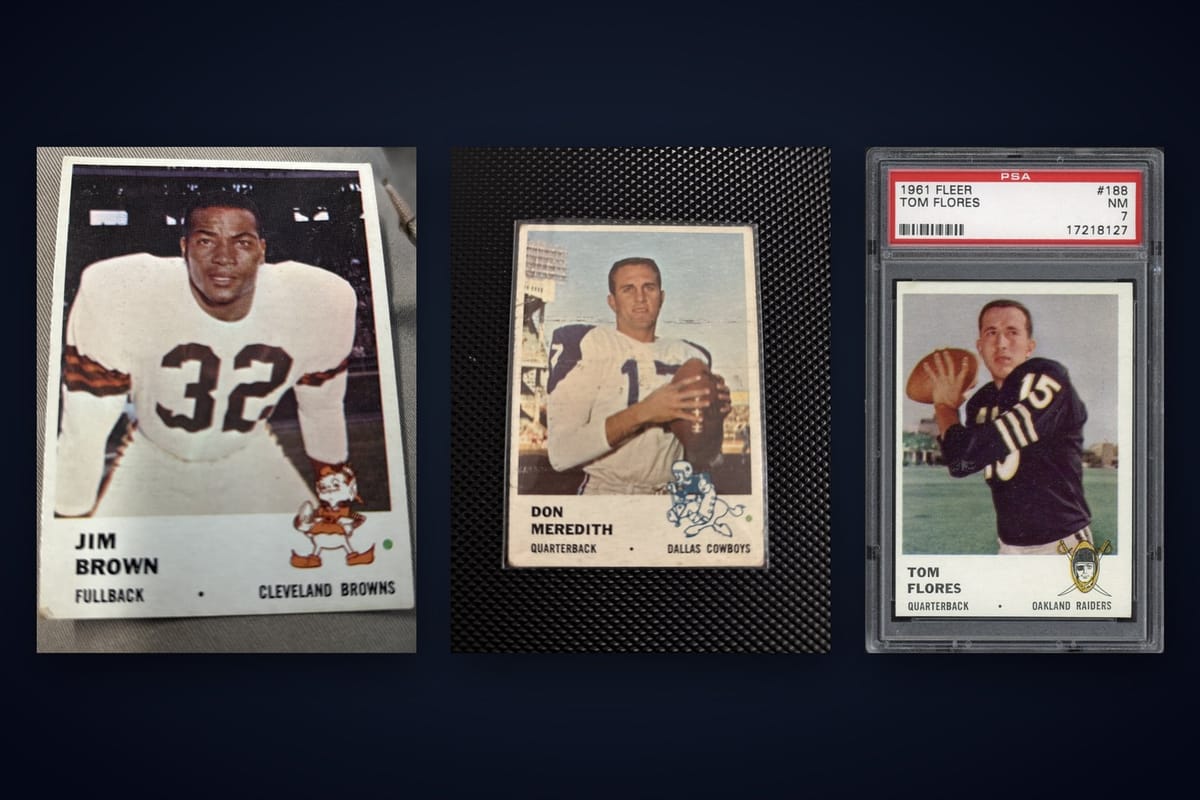
- The 220-card set splits into NFL cards #1-132 and AFL cards #133-220, and the most valuable 1961 Fleer cards cluster around Jim Brown #11, Don Meredith #41, Don Maynard #215, and the big NFL quarterbacks.
- Always separate recent sold prices from dealer asking prices; asking prices on vintage cards are often aspirational.
- Grading only pays when the likely grade multiplies the raw value by more than the cost of grading plus risk. Common cards rarely clear that bar.
- Pre-check centering and corners before you submit, so you only pay to grade cards with a realistic shot at a premium grade.
Card values — live data from Midpoint's card database, as of 2026-11-22. Prices move; Midpoint refreshes these daily.
| Card | Raw | PSA 10 | Gem premium | |
|---|---|---|---|---|
 |
Jim Brown #11 1961 Fleer |
$140.28 | $25,723 | 183.4× |
 |
Don Meredith #41 1961 Fleer |
$95.75 | $17,704 | 184.9× |
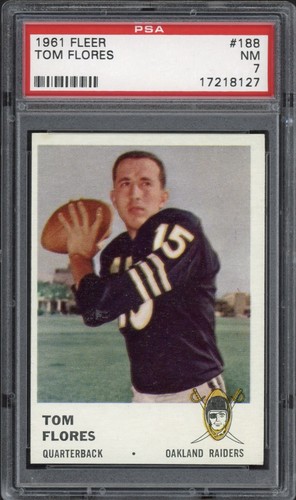 |
Tom Flores #188 1961 Fleer |
$55.48 | $10,155 | 183× |
 |
Johnny Robinson #202 1961 Fleer |
$44.95 | $8,174 | 181.9× |
 |
Maxie Baughan #56 1961 Fleer |
$21.77 | $6,250 | 287.1× |
 |
John Brodie #59 1961 Fleer |
$25.20 | $4,985 | 197.8× |
 |
John Unitas #30 1961 Fleer |
$25.60 | $4,671 | 182.4× |
 |
Eddie LeBaron #40 1961 Fleer |
$19.64 | $4,231 | 215.4× |
 |
Jack Kemp #155 1961 Fleer |
$19.99 | $3,653 | 182.7× |
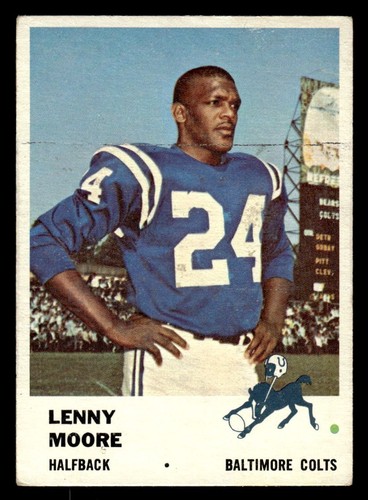 |
Lenny Moore #32 1961 Fleer |
$18.74 | $3,424 | 182.7× |
 |
Paul Hornung #90 1961 Fleer |
$18.35 | $3,184 | 173.5× |
 |
Chuck Bednarik #55 1961 Fleer |
$16.67 | $3,039 | 182.3× |
Look up any card's current raw and graded value in Midpoint — and get an estimated grade before you pay to submit.
Table of Contents
- Section 1: The 1961 Fleer Football Set at a Glance
- Section 2: Most Valuable 1961 Fleer Cards and Key Rookies
- Section 3: 1961 Fleer Price Guide Logic: Raw, Graded, and the Gem Gap
- Section 4: What Drives Condition and Grade on 1961 Fleer Cards
- Section 5: Variations, Errors, and the Backward Wisconsin Detail
- Section 6: 1961 Fleer Cards Worth Grading: A Decision Framework
- Section 7: Sets, Partial Sets, and How to Find Real Sold Prices
- Conclusion
- FAQ
Section 1: The 1961 Fleer Football Set at a Glance
Before you can judge 1961 Fleer football cards value, you need to know exactly what is in the set. The 1961 Fleer issue is a 220-card release and a landmark for vintage football collectors, because it covers both leagues in one checklist.
How the 220 Cards Are Organized
- NFL cards: #1-132. This first block features the established league, including the Cleveland Browns, Baltimore Colts, Green Bay Packers, New York Giants, and the then-new Dallas Cowboys.
- AFL cards: #133-220. The second block covers the upstart American Football League in its second season.
That split matters for pricing. NFL cards and AFL cards are often priced as different groups, and collectors often chase them for different reasons: star power on the NFL side, early-league history on the AFL side.
Why Collectors Pay Attention to This Set
Fleer produced a full football set in 1961, and it includes early cards of players who became Hall of Famers. Early cards of Don Meredith and Jim Otto, plus Don Maynard's #215, give the set depth beyond the NFL headliners.
The checklist also rewards completists: team, position, and Hall of Fame status all feed into demand, so a clean card of a lesser player can still carry a premium if it is a tough condition.
How to Read Prices in This Guide
Treat any single price you see for these cards as a snapshot, not a promise. Vintage cards sell infrequently, so one auction can move a number noticeably.
Throughout this 1961 Fleer price guide, I describe relationships (star versus common, raw versus graded) rather than quote prices from memory. Where you need a precise figure for a specific card and grade, look up the latest data in the app or check recent completed sales.
Section 2: Most Valuable 1961 Fleer Cards and Key Rookies
The most valuable 1961 Fleer cards generally follow a predictable pattern: legendary quarterbacks and running backs at the top, key rookies and AFL pioneers next, then Hall of Famers at lesser positions, then everyone else.
The Star Tier: Brown, Unitas, Starr, Gifford, Hornung
- Jim Brown #11 (Cleveland Browns): usually the headline card of the set, because Brown is widely regarded as one of the greatest running backs ever.
- Johnny Unitas (Baltimore Colts): a quarterback icon with consistent collector demand.
- Bart Starr (Green Bay Packers): Packers dynasty cards carry broad appeal, and Starr is a core name.
- Frank Gifford (New York Giants): a Hall of Famer with crossover fame from his broadcasting career.
- Paul Hornung (Green Bay Packers): another Packers cornerstone, and a favorite among vintage collectors.
Rookie and Key Cards: Meredith, Otto, Maynard
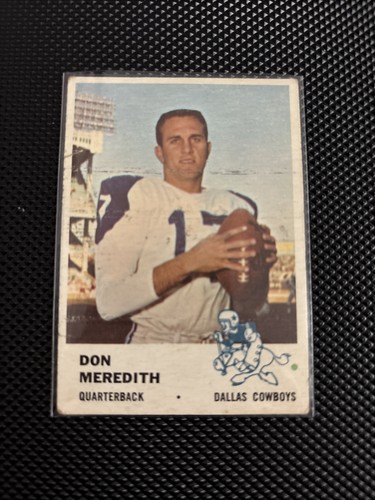
Don Meredith #41 is the key Cowboys card. Dallas joined the NFL in 1960, so early Cowboys cards have a built-in franchise-history appeal. Meredith's card is often the most-searched answer to "what is the value of a 1961 Fleer Don Meredith rookie card?"
Jim Otto is a notable early AFL card for Raiders collectors, and Don Maynard #215 is one of the major AFL cards, tied to the New York Titans, the franchise that later became the Jets.
Commons and Role Players
Most of the remaining cards are commons and minor stars. They are not worthless, but their raw values are modest, and their graded premiums are smaller in dollar terms. Values generally fall steeply once you leave the Hall of Fame names.
One practical note: team and position can matter. A Packers or Browns card of a mid-level player may outsell a similar player from a less-collected franchise.
Section 3: 1961 Fleer Price Guide Logic: Raw, Graded, and the Gem Gap
A useful 1961 Fleer price guide must show raw and graded values side by side. The difference between them, the gem premium gap, is what decides whether grading is worth it.
Raw Versus Graded Value
Raw means ungraded, and buyers price it by guessing the grade. That guess is usually conservative. Graded cards remove the guesswork, so they usually sell for more than a raw card of the same apparent condition.
Typical grade tiers you will see quoted for this set:
- PSA 5-6: a clearly circulated but presentable card, and a common grade band for vintage collectors on a budget.
- PSA 7: a sharper card with light wear, often the sweet spot for value-minded collectors.
- PSA 8: a clean, strong card with noticeably higher demand.
- PSA 9: a near-pristine example, scarce for a 1961 issue.
- PSA 10: an exceptional card that rarely appears.
1961 Fleer PSA 10 Value: Why It Is Different
The 1961 Fleer PSA 10 value is not a smooth continuation of PSA 9. On vintage issues, prices tend to jump sharply between grades because each step up is far scarcer than the one below it. When a true gem sells, it is often an auction event, and the final price can land far above any guide.
That is why I would not rely on a printed number for a PSA 10. Check recent sold results for that exact card, and note the date of each sale.
Using Grade Ladders Wisely
- Compare each card's raw number to its PSA 7 and PSA 8 numbers first. Most cards land there, not at 9 or 10.
- Check the gap between adjacent grades. A small gap means grading adds little; a big gap means grading is a bet on condition.
- Understand that grading companies use different scales; see our breakdown of grading scale differences between PSA, BGS, and CGC before comparing numbers across companies.
Section 4: What Drives Condition and Grade on 1961 Fleer Cards
Two 1961 Fleer cards of the same player can differ widely in value. Condition is the reason, and a handful of factors explain most of the gap.
Centering, Corners, and Edges
Cards from this era were not cut with modern precision. Many show uneven borders, so centering often decides whether a card reaches a higher grade. Sharp corners are the next hurdle: even slight rounding or fraying can cap a card at a lower grade.
If you want the detailed mechanics, our guide on how centering impacts card value walks through why a few millimeters can change a price tier.
Surface, Print Quality, and Stains
Surface problems on vintage football cards include scratches, wax or gum stains, print dots, and ink inconsistencies. Collectors forgive some print quality issues on a 60+-year-old card, but graders still count visible defects.
Creases, Trimming, and Alterations
Creases are a major value hit. Trimming is worse: cut-down edges to fake sharper borders can lead to rejection, because graders do not slab altered cards with a normal grade. Always compare the card's dimensions to a known-good example before you pay for a high-grade raw card.
Measure Before You Submit
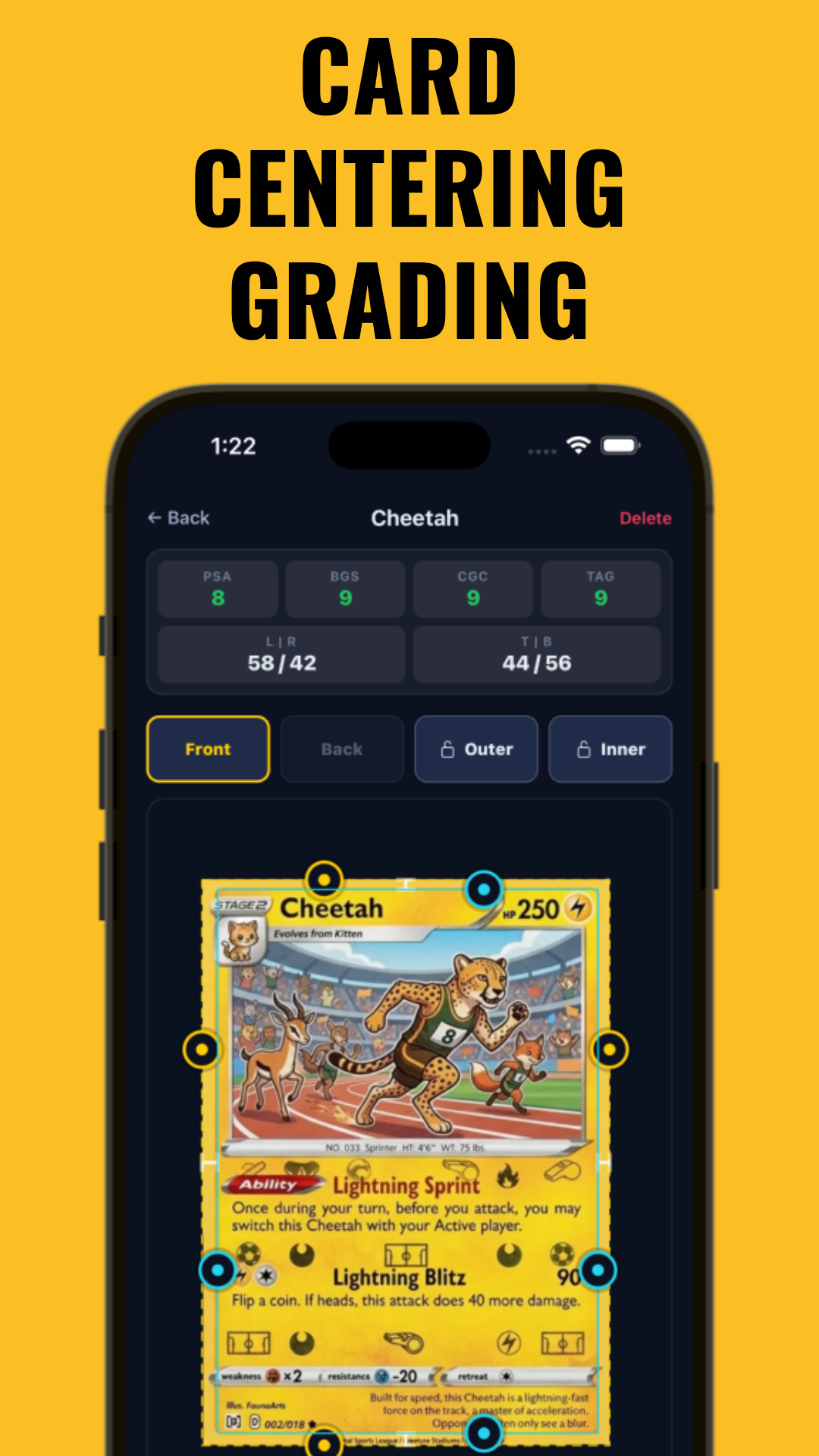
You can check a card's border ratios on your phone in a minute. The Midpoint app measures centering and gives an estimated PSA, BGS, CGC, or TAG grade from centering, corners, edges, and surface, so you can screen cards before paying for submission. For a quick ratio check, the free centering calculator works too.
Section 5: Variations, Errors, and the Backward Wisconsin Detail
Variations can matter more than collectors expect in a vintage set, and 1961 Fleer is sometimes discussed for a printing quirk on its Green Bay Packers cards.
The Backward Wisconsin Error
Some collectors and references mention a backward "Wisconsin" detail on certain Green Bay Packers cards in this set. I have not seen it confirmed as a scarce variant, so treat it as a curiosity rather than a rarity. Check the specific card against a reliable reference or a graded example before assuming anything about it.
Because I cannot verify that it commands its own premium, do not pay extra for it, and do not treat it as a condition defect when you evaluate a card. Judge the card on centering, corners, surface, and grade.
NFL Versus AFL Numbering
The set's numbering splits the NFL (#1-132) from the AFL (#133-220). Differences in handling and survival can show up as different condition profiles between the two groups. Before assuming a card is scarce, check its graded population report and recent sales rather than relying on folklore.
How to Spot Problems Specific to This Set
- Check the card number against the checklist. Make sure the player, team, and number match.
- Verify the stock and borders. Reprints and counterfeits often look too clean or too bright.
- Look for trimming. Measure all four sides and compare to a graded example.
- Check for back damage. Paper loss and glue residue lower grades fast.
If any of these points feel uncertain, buy graded, or buy raw only from sellers with clear return policies.
Section 6: 1961 Fleer Cards Worth Grading: A Decision Framework
The question behind most searches for 1961 Fleer cards worth grading is simple: will the slab pay for itself? Here is a practical way to decide.
The Basic Math
Compare the expected graded value to the raw value, then subtract the full cost of grading: the submission fee (which varies by company and tier), shipping, insurance, and your time. If the difference is slim, skip it.
- Star cards (Brown, Unitas, Starr, Gifford, Hornung, Meredith, Maynard): grading is usually worth considering, because a grade adds buyer confidence on high-value cards and protects against alteration doubts.
- Mid-tier Hall of Famers and key rookies like Jim Otto: grade the sharper, better-centered copies.
- Commons: usually not worth grading unless the card is clean and the gem premium is unusually large.
Grade for the Likely Outcome, Not the Dream
It is tempting to price a card at PSA 9 because you hope for a 9. Be realistic. For a vintage set with frequent off-center borders, the most likely outcome for a decent raw card is a mid-grade. Run the numbers at PSA 6, 7, and 8, and only submit if the result still works at the lower end.
Pre-Grade Before You Pay
Follow a structured routine: inspect under bright light, measure centering, check each corner, then scan the surface. Our step-by-step guide on how to pre-grade your card covers it in detail.
Midpoint's AI grading estimate does the same job digitally, giving you a likely grade band before you submit. That helps you avoid paying to grade cards whose centering already rules out a premium outcome.
Section 7: Sets, Partial Sets, and How to Find Real Sold Prices
Whether you hold a single card or a box of them, the way you establish value is the same: use sold data, not wishful asking prices.
Complete Sets, Partial Sets, and Unopened Material
- Complete sets: value depends on the grade of the stars, not just the count. A set with a sharp Brown and Meredith is worth more than one with weak key cards.
- Partial sets: usually priced by their key cards plus a modest value for the commons.
- Unopened material: rare and hard to authenticate. Have it verified by a trusted third party before paying a premium.
- High-grade examples: priced individually, because each slab stands on its own.
Sold Prices Versus Asking Prices
Always separate the two. Asking prices tell you what sellers hope for. Completed sales on eBay and other marketplaces tell you what buyers actually paid. When you check comps:
- Match the exact card number and grade.
- Look at several recent sales, not just one.
- Note whether the card had an eye-appealing look or a centering flaw, which can shift the price within one grade.
Track Value Over Time
Vintage prices drift. Use Midpoint's card lookup to compare raw and graded values and its portfolio tracking to see how your holdings move. For insurance purposes, see how card grade impacts insurance value, and protect what you own with proper storage.
Whatever the market does, condition protection is the one factor you control. Use rigid holders, avoid humidity, and keep cards out of direct light.
Conclusion
The value of 1961 Fleer football cards comes down to who is on the card, how well it survived, and whether it carries a verified grade. Jim Brown #11, Don Meredith #41, Don Maynard #215, and the big names like Unitas, Starr, Gifford, and Hornung anchor the set, while the gap between raw and graded cards, especially at the top, decides whether grading is worthwhile.
Before you submit anything, measure centering, inspect corners and surface, rule out trimming, and compare your expected grade to current sold prices. That discipline keeps you from paying to slab cards that will not return the cost.
Ready to screen your cards? Try Midpoint to measure centering, estimate a grade, and look up current values before you spend a dollar on grading.
FAQ
Q: What are 1961 Fleer football cards worth?
A: It depends heavily on the player and the grade. Commons are modest, while Hall of Famers and key rookies like Jim Brown, Don Meredith, and Don Maynard bring much more, and high grades bring a steep premium. Check Midpoint's database or recent sold listings for the exact card and grade.
Q: Which 1961 Fleer football cards are valuable?
A: The most valuable cards are typically Jim Brown #11, Don Meredith #41, Don Maynard #215, and star NFL names such as Johnny Unitas, Bart Starr, Frank Gifford, and Paul Hornung. Jim Otto is also a key AFL card.
Q: How much is a 1961 Fleer Jim Brown card worth?
A: Brown #11 is usually among the top cards in the set, but the price varies widely from raw to PSA 5-6, 7, 8, 9, and 10. Look up the latest sold price for your exact grade rather than relying on a general figure.
Q: What is the value of a 1961 Fleer Don Meredith rookie card?
A: Meredith #41 is a key early Cowboys card, so it tends to carry a franchise-history premium over most players. Its value depends on condition and grade, so compare recent completed sales for the same grade.
Q: Are 1961 Fleer football cards rare?
A: The set is more than 60 years old, so high-grade copies are scarce, especially PSA 9 and PSA 10. Most commons are easy to find in lower grades, so rarity is mostly a condition story.
Q: How do I identify and price my 1961 Fleer football cards?
A: Match the card number and player to the 220-card checklist (NFL #1-132, AFL #133-220), assess centering, corners, surface, and creases, then compare against recent sold prices for that grade. Midpoint can measure centering and estimate a grade before you decide whether to submit.
Free to start
Try the Midpoint app
Grade any card from a photo, see its raw and PSA 10 value, and track what your collection is worth — free.
Get it on iPhoneGet it on Android