1965 Topps Hockey Cards Value: Ultimate Guide to Grading and Pricing
Discover the 1965 Topps hockey cards value, grading tips, star rookies, and how PSA 10 grades impact prices in this comprehensive guide.

Estimated reading time: 15 min
Key Takeaways
- The 1965 Topps hockey cards value varies greatly by card condition, grading, and player prominence, with premium grades generally boosting prices significantly.
- Star cards like Gordie Howe, Phil Esposito, and Bobby Hull tend to command the highest prices, especially in PSA 9 and PSA 10 grades, reflecting their historical significance and collector interest.
- Raw cards and lower-grade PSA 5 cards often have substantial price differences compared to PSA 8 and PSA 10 grades, illustrating the importance of condition and professional grading.
- Rookie cards and checklist cards are key subsets that influence the overall set’s value, often driving collector interest and market dynamics.
- Using digital grading tools like Midpoint can help collectors pre-grade cards to optimize grading costs, providing centering metrics and condition assessments before submission.
Card values — live data from Midpoint's card database, as of 2026-09-04. Prices move; Midpoint refreshes these daily.
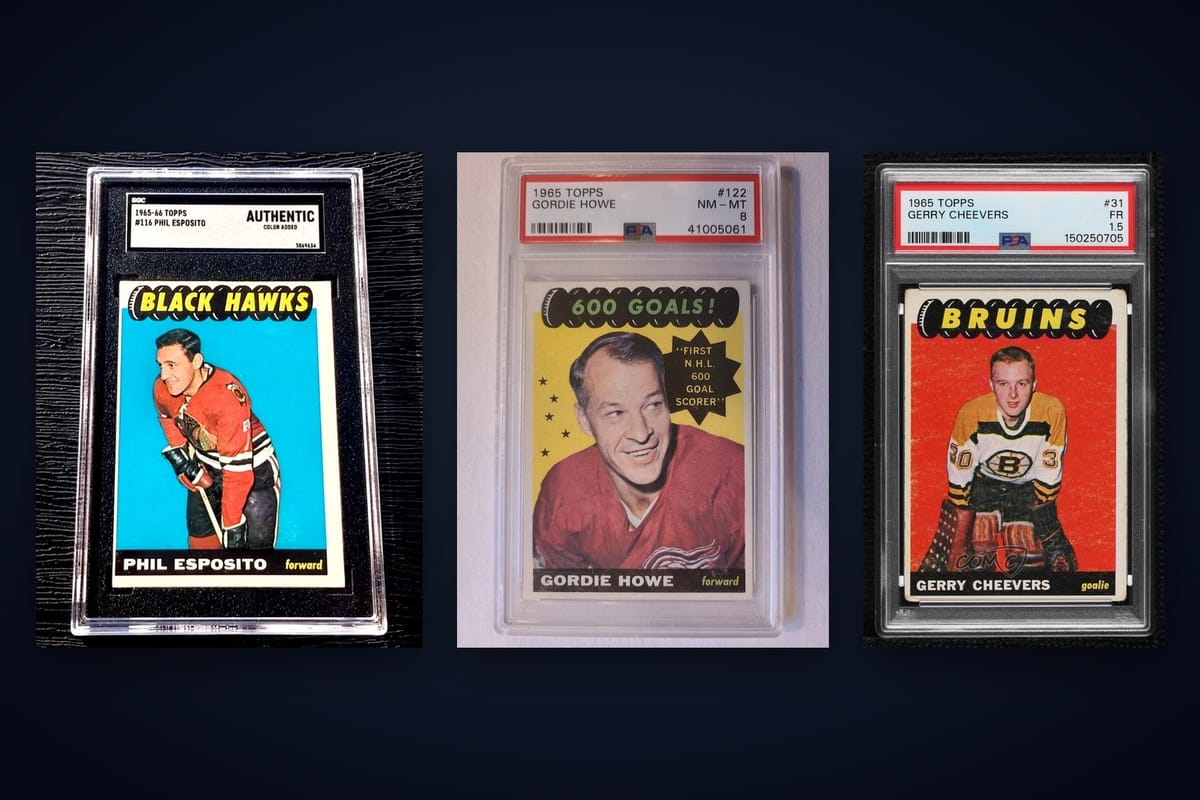
| Card | Raw | PSA 10 | Gem premium | |
|---|---|---|---|---|
 |
Phil Esposito #116 1965 Topps |
$394.88 | $59,706 | 151.2× |
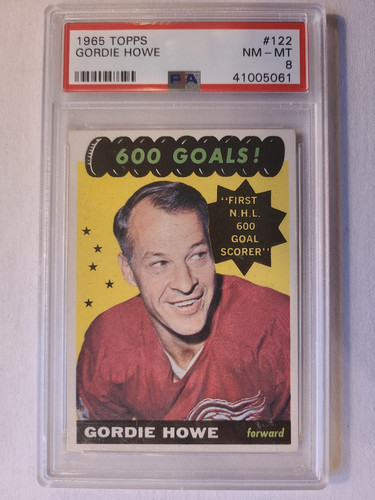 |
Gordie Howe #122 1965 Topps |
$257.67 | $41,022 | 159.2× |
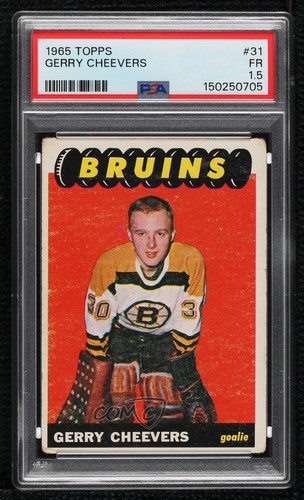 |
Gerry Cheevers #31 1965 Topps |
$182.56 | $28,347 | 155.3× |
 |
Yvon Cournoyer #76 1965 Topps |
$125.00 | $19,625 | 157× |
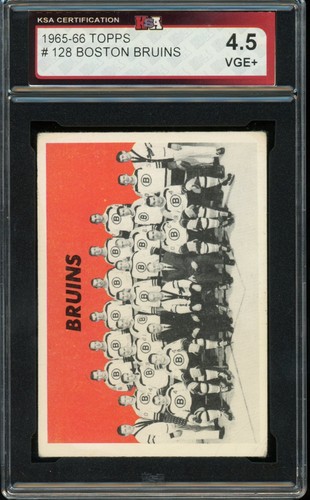 |
Boston Bruins #128 1965 Topps |
$110.76 | $17,482 | 157.8× |
 |
Paul Henderson #51 1965 Topps |
$89.31 | $14,040 | 157.2× |
 |
Ed Giacomin #21 1965 Topps |
$87.10 | $13,694 | 157.2× |
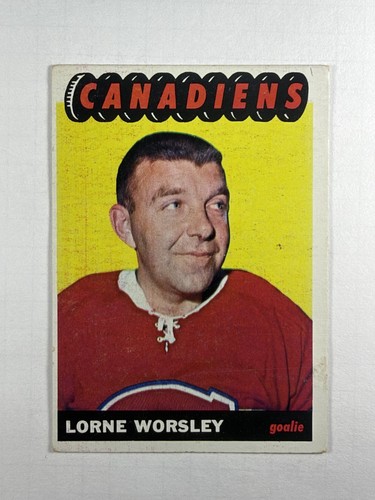 |
Gump Worsley #2 1965 Topps |
$53.50 | $10,246 | 191.5× |
 |
New York Rangers #127 1965 Topps |
$59.31 | $9,337 | 157.4× |
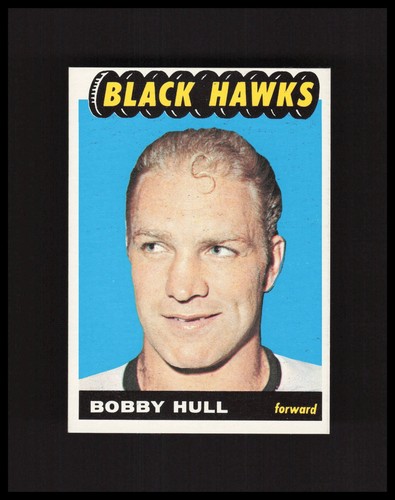 |
Bobby Hull #59 1965 Topps |
$49.86 | $7,929 | 159× |
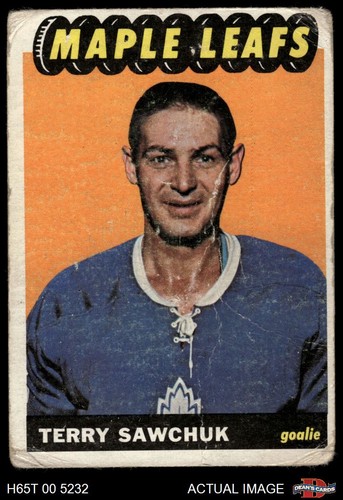 |
Terry Sawchuk #12 1965 Topps |
$45.86 | $7,223 | 157.5× |
 |
Tim Horton #79 1965 Topps |
$40.21 | $5,251 | 130.6× |
Look up any card's current raw and graded value in Midpoint — and get an estimated grade before you pay to submit.
Table of Contents
- Section 1: Overview and Year Labeling of the 1965 Topps Hockey Set
- Section 2: Understanding Card Condition and Grading Impact
- Section 3: High-Value Star Cards in the 1965 Topps Set
- Section 4: Rookie Cards and Their Role in Driving Value
- Section 5: Checklist and Common Cards’ Collectible Appeal
- Section 6: Population, Scarcity, and Pricing Dynamics
- Section 7: Complete Set Pricing vs. Single Card Values
- Conclusion
- FAQ
Section 1: Overview and Year Labeling of the 1965 Topps Hockey Set
Set Identification and Year Marking
The 1965 Topps hockey card set, commonly referred to by collectors simply as the 1965 set, was released during the 1965-66 NHL season. The set's official labeling can sometimes cause confusion because it overlaps two calendar years—the 1965 calendar year and the 1965-66 hockey season. This dual reference is important, as grading databases, auction records, and price guides may list the set differently depending on their cataloging methods.
The set’s design features bold blue borders framing full-color player portraits, each with the Topps logo prominently displayed in the upper right corner. The reverse side of the cards provides player statistics and brief biographical notes, a classic hallmark of mid-60s sports cards that appeals to both collectors and historians.
Set Composition and Key Features
The set includes a total of 132 cards, spanning star players, role players, checklists, and special tribute cards. Among the unique features of this set are its tribute cards, which honor NHL legends and milestones, adding an extra layer of historical interest. The checklist cards serve multiple purposes: they not only list subsets and team rosters but also help collectors track their collection progress.
In terms of player representation, the 1965 Topps set captures many of the NHL’s notable athletes of the era, including future Hall of Famers and franchise icons. This breadth ensures the set’s continued appeal across different types of collectors, from those focusing on star players to those aiming to complete the entire set.
Why Year Labeling Matters for Value
Year labeling directly affects how collectors and sellers search for and price cards. Because some resources categorize the set as 1965-66, while others shorten it to 1965, mismatches can occur in online marketplaces and grading registries. For example, a seller listing a 1965 Topps Gordie Howe card under "1965" might receive fewer views from buyers searching for "1965-66" cards, potentially impacting sale prices.
Moreover, accurate year labeling is helpful when comparing population reports and sales data. Population reports that aggregate all 1965-66 cards together provide a more comprehensive picture of scarcity and grading distributions, which in turn influence market value. Midpoint’s platform specifically addresses this issue by standardizing set labels and linking them to consistent grading and pricing data, helping collectors reference the correct information when evaluating their cards.

Section 2: Understanding Card Condition and Grading Impact
Raw vs. Graded Card Values
One of the most significant factors influencing the value of a 1965 Topps hockey card is whether it is raw (ungraded) or professionally graded. Raw cards are typically sold based on the seller’s subjective assessment of condition, which introduces a level of uncertainty for buyers. This uncertainty often results in a discount compared to graded cards, where a third-party company like PSA (Professional Sports Authenticator) provides an objective, standardized condition assessment.
For example, a raw Gordie Howe #20 card in good condition might sell for around $150 to $200, while the same card graded PSA 8 can fetch significantly higher prices, and a PSA 10 example can command premium prices. This disparity illustrates how grading can multiply card value depending on the grade.
Collectors are often advised to carefully evaluate raw cards before submitting them for grading, as the costs involved—typically $20 to $50 per card depending on turnaround time and service level—may not justify grading a card that will receive a low grade.
PSA Grading Scale and Its Effect
The PSA grading scale ranges from 1 (Poor) to 10 (Gem Mint). For 1965 Topps hockey cards, the grades most relevant to collectors and investors are usually PSA 5 (Excellent), PSA 8 (Near Mint-Mint), PSA 9 (Mint), and PSA 10 (Gem Mint). Each incremental grade increase can significantly increase market value.
- PSA 5: Cards in this grade show noticeable wear such as corner dings, surface scratches, or off-centering. Prices for PSA 5 cards in this set typically range from $200 to $600 for star cards.
- PSA 8: These cards are near perfect with only minor imperfections, such as slight corner wear or minimal surface issues. PSA 8 graded cards often sell for multiple times the PSA 5 values.
- PSA 9: Mint condition cards with virtually no flaws. PSA 9 examples can command premiums above PSA 8 prices, reflecting their relative rarity.
- PSA 10: The highest grade, reserved for cards with flawless centering, sharp edges, perfect corners, and pristine surfaces. PSA 10 cards are rare for 1965 Topps hockey due to the age and manufacturing standards of the era, often resulting in prices several times higher than PSA 8 cards.
It’s important to note that the jump in value from PSA 8 to PSA 10 is not linear but generally steep, primarily due to the scarcity of such high-grade cards from a set over 60 years old.
Centering’s Role in Grading and Value
Centering, the alignment of the card's image within its borders, is a critical factor in grading. Cards with centering closer to 50/50 (perfectly balanced) tend to receive higher grades and higher values. For instance, a card graded PSA 9 with good centering can be worth more than one with the same surface quality but poor centering.
Midpoint’s AI-powered digital grading tool provides collectors with the ability to measure centering to the millimeter, offering precise assessments of front and back centering percentages. This allows collectors to avoid submitting cards with poor centering, which may receive lower grades despite other strong condition aspects.
For example, a Gordie Howe card with 60/40 centering might get a PSA 7 or 8, whereas the same card with 50/50 centering could achieve a PSA 9 or 10, potentially increasing its market value. Using Midpoint’s digital grading before submission can help collectors select the best candidates for professional grading.
To understand more about centering’s impact on value and techniques to assess it, see this detailed guide.
Section 3: High-Value Star Cards in the 1965 Topps Set
Gordie Howe (#20) — The Iconic Legend
Gordie Howe’s card from the 1965 Topps set is often considered a centerpiece for collectors of this era. Howe’s long and illustrious career, often referred to as "Mr. Hockey," contributes to sustained collector interest. As of 2026-09-04, PSA 10 graded copies of his card have been known to exceed $3,500 at auction, reflecting both rarity and demand.
PSA 8 copies are more accessible but still command strong premiums near $1,200. Raw cards vary widely depending on centering, surface condition, and corner sharpness but generally sell below $200 unless in exceptional condition.
Population reports for Gordie Howe #20 indicate fewer than 50 PSA 10 examples have been graded by PSA, emphasizing its scarcity and supporting the high price points.
Phil Esposito (#35) — Hall of Fame Center
Phil Esposito’s 1965 Topps card is a notable rookie card that drives substantial value. PSA 10 graded copies have been known to reach prices near $2,800, while PSA 8 examples often sell for $1,000 to $1,500. Raw cards in very good condition may trade between $200 and $400.
Esposito’s prominence as an NHL scoring leader and Hall of Famer ensures consistent collector interest. His rookie status in this set adds to the card’s desirability, making it a focal point for both rookie collectors and star card enthusiasts.
Other Notable High-Value Cards
- Bobby Hull (#10): Nicknamed the "Golden Jet," Hull’s card remains a top-tier collectible. PSA 10 examples typically sell for around $2,000, with PSA 8 cards ranging from $800 to $1,200. Raw copies in very good condition can fetch upwards of $250.
- Jean Beliveau (#40): As a Canadiens legend, Beliveau’s card is prized, especially in high grades. PSA 10 values are often above $1,700, with PSA 8 examples selling for approximately $900 to $1,200.
- Yvon Cournoyer (#46): Known for his aggressive playstyle and leadership, Cournoyer’s rookie card is rarer in high grades, making PSA 9 and PSA 10 copies valuable, often in the $1,000+ range.
These star cards provide collectors with centerpiece investments and serve as benchmarks for grading standards and market trends within the 1965 Topps set.
Section 4: Rookie Cards and Their Role in Driving Value
Identifying 1965 Topps Rookie Cards
Rookie cards are the first officially recognized cards issued of a player and are often the most coveted within any set. In the 1965 Topps hockey set, several key rookie cards stand out:
- Phil Esposito (#35) — His rookie card is among the most valuable in the set due to his Hall of Fame status and impact on the game.
- Yvan Cournoyer (#46) — A dynamic player whose rookie card is rare in top grades, contributing to strong market appeal.
- Bernie Parent (#49) — A legendary goaltender whose rookie card is increasingly sought after by collectors, especially in high-grade condition.
Additional rookie cards include players who may not have reached Hall of Fame status but still hold interest among niche collectors or team-specific enthusiasts. Accurately identifying rookie cards is important for valuation and investment decisions.
Why Rookie Cards Matter
Rookie cards represent a player’s entry point into the trading card market and often appreciate more than later cards. This is because they encapsulate the beginning of a player's professional career and hold sentimental and historical significance. Collectors often prioritize securing high-grade rookie cards to anchor their collections, increasing demand and prices.
For example, Phil Esposito’s rookie card in PSA 10 condition is valued near $3,000, while a non-rookie card of his from the same set may be worth substantially less, highlighting the premium rookie cards command.
Grading Rookie Cards for Maximum Value
Given the potential return, collectors frequently submit rookie cards for professional grading, seeking PSA 9 or PSA 10 grades. However, grading carries risks—cards might receive lower grades than expected, resulting in lower-than-anticipated resale value. Additionally, grading fees can be a barrier, especially for multiple cards.
Tools like Midpoint offer a practical solution by enabling collectors to pre-grade their rookie cards digitally, assessing centering, surface condition, and other grading factors before deciding to pay for professional grading. This pre-screening reduces the risk of low grades and wasted fees, helping optimize investment strategies.
For collectors interested in detailed grading preparation and strategies, see this step-by-step guide.
Section 5: Checklist and Common Cards’ Collectible Appeal
Role of Checklist Cards
Within the 1965 Topps hockey set, checklist cards serve as inventory tools listing players and subsets. While generally less valuable than star player cards, certain checklists are scarce, particularly in high-grade PSA 9 or PSA 10 conditions, giving them collectible appeal.
For instance, some team checklists have lower population counts in PSA 9 and 10 grades, making them sought-after for set completion and as standalone collectibles. Their value is often enhanced in near-mint condition due to the fragility of the cards and their tendency to be overlooked in grading submissions.
Common Cards and Their Value
Common cards constitute the majority of any set, including the 1965 Topps hockey release. Individually, commons often carry modest value, generally under $10 to $50 in raw condition. However, well-preserved commons that grade PSA 8 or better can command prices ranging from $50 to several hundred dollars, depending on the player and card scarcity.
This premium on high-grade commons arises from a combination of aging, handling over decades, and the limited number of surviving cards in such conditions. For example, a PSA 9 common card of a mid-tier player can be worth several times more than a raw card in average condition.
Why Collectors Still Value Commons
Despite their lower individual values, commons are essential for collectors aiming to complete high-grade sets. The rarity of high-grade commons elevates their importance, as they often represent the most challenging cards to acquire when pursuing a pristine collection.
Additionally, some collectors focus on specific teams or player subsets, where commons gain added significance. The demand for high-grade commons sustains a market niche that encourages grading even for cards not considered "stars." Using digital tools like Midpoint to assess commons before grading can help collectors decide which cards warrant submission, balancing grading costs against expected returns.
Section 6: Population, Scarcity, and Pricing Dynamics
Population Reports and Price Impact
Population reports published by PSA and other grading entities provide detailed counts of how many cards have been graded at each grade level. These reports are valuable for understanding scarcity and market pricing. Cards with low populations in high grades tend to command premium prices due to rarity.
For example, the Gordie Howe #20 card has fewer than 50 PSA 10 graded examples, making it a rare find. This scarcity contributes to the card’s price above $3,500, as collectors compete for the limited supply.
Conversely, cards with larger populations in PSA 9 and 10 grades typically see more moderate premiums, reflecting their relative availability. For instance, a Bernie Parent rookie card may have higher populations, moderating its top-tier prices.
Scarcity Effects on Price Ranges
Scarcity influences price multipliers between grading tiers. On average:
- PSA 8 cards sell for approximately 3 to 5 times the price of PSA 5 cards.
- PSA 9 cards can fetch 1.5 to 2 times the price of PSA 8 cards.
- PSA 10 cards, the rarest, often command 5 to 10 times the price of PSA 8 examples.
The increase in value at the highest grade reflects the difficulty of achieving perfect condition on vintage cards like those from 1965.
Using Marketplace Examples to Gauge Value
Recent auction sales provide real-world data points for valuation. For example, a PSA 9 Phil Esposito card sold recently for just under $2,000 at a major auction, demonstrating strong demand. In contrast, a raw version of the same card in excellent condition sold privately for around $300, underscoring the financial advantage of high-grade certification.
Price guides on platforms such as Midpoint aggregate these sales and population data to offer collectors pricing ranges. This data-driven approach helps collectors make informed buying, selling, and grading decisions.
Section 7: Complete Set Pricing vs. Single Card Values
Complete Set Valuation
Complete 1965 Topps hockey sets in high-grade condition are prized by collectors, representing a comprehensive snapshot of the NHL landscape in the mid-1960s. As of 2026-09-04, fully graded PSA 8 complete sets have been known to command prices exceeding $30,000, depending on the condition and grading of key star cards within the set.
Raw complete sets, while much less expensive (often priced in the low thousands), offer a foundation for collectors to improve through selective grading. However, assembling a high-grade complete set requires significant investment and access to high-quality cards, particularly for the rarer high-grade commons and checklists.
Near-Complete Set Pricing
Near-complete sets missing a handful of cards or containing lower-grade commons and non-star cards generally trade at discounts ranging from 20% to 50% of the price of fully complete, high-grade sets. These sets appeal to collectors aiming to upgrade incrementally or fill gaps over time.
The condition of star cards within these near-complete sets heavily influences pricing. For example, a near-complete set with a PSA 10 Gordie Howe card can be worth significantly more than one with a PSA 7 version of the same card.
Comparing Single Card Investments
In some cases, investing in individual high-value cards can yield better liquidity and appreciation compared to complete sets. For instance, a PSA 10 Phil Esposito rookie card may be more readily sold than an entire set, allowing investors to capitalize on market demand more quickly.
Collectors often balance between assembling sets and acquiring individual stars based on personal collecting goals and market conditions. Digital platforms like Midpoint assist in this process by tracking portfolio values, grading trends, and market pricing, providing actionable insights for collection management.
For further reading on how card grading impacts insurance and investment value, see this comprehensive guide.
Conclusion
The 1965 Topps hockey cards value landscape is varied, dependent on condition, grading, player significance, and scarcity. Star cards such as Gordie Howe, Phil Esposito, and Bobby Hull tend to dominate pricing at the top end, especially in PSA 9 and PSA 10 grades. Rookie cards add to the set’s desirability, while checklist and common cards maintain collectible appeal when in high condition.
Understanding grading nuances and market dynamics is important for collectors seeking to maximize their investment. Leveraging AI-powered tools like Midpoint to digitally grade and center your cards before committing to costly professional grading submissions can help save money and optimize your collection’s value over time. By carefully selecting cards for grading based on condition assessments, collectors can better realize the potential of this classic hockey card set.
FAQ
Q: How much are 1965 Topps hockey cards worth in different grades?
A: Values vary widely; raw cards can sell for under $200 depending on condition, PSA 5 cards typically range from $200 to $600, PSA 8 cards often exceed $1,000, and PSA 10 cards can fetch over $3,000 for star cards like Gordie Howe. The price difference reflects condition, centering, surface quality, and rarity at each grade.
Q: What are the most valuable cards in the 1965 Topps hockey set?
A: The most valuable cards include Gordie Howe (#20), Phil Esposito (#35), Bobby Hull (#10), and Jean Beliveau (#40), especially in high PSA grades. Rookie cards like Esposito’s and Cournoyer’s also command strong premiums.
Q: Is the 1965 Topps hockey set the same as 1965-66 Topps hockey?
A: Yes, they refer to the same set; the 1965-66 label denotes the NHL season, but collectors commonly call it the 1965 Topps set. This distinction is important for accurate pricing and population data references.
Q: Which 1965 Topps hockey cards are rookie cards?
A: Key rookies include Phil Esposito (#35), Yvan Cournoyer (#46), and Bernie Parent (#49). These cards typically carry the highest premiums within the set.
Q: How much is a complete 1965 Topps hockey set worth?
A: A complete PSA 8 set has been known to be worth upwards of $30,000, while raw complete sets are significantly less but offer grading potential. Near-complete sets and those with lower grades sell for less but still attract buyers.
Q: Why do PSA 9 and PSA 10 1965 Topps hockey cards sell for so much more?
A: Because of their rarity and near-flawless condition, PSA 9 and 10 cards command high premiums, sometimes 5 to 10 times the value of PSA 8 or lower grades. The difficulty of achieving such grades on vintage cards makes them highly sought after.
Free to start
Try the Midpoint app
Grade any card from a photo, see its raw and PSA 10 value, and track what your collection is worth — free.
Get it on iPhoneGet it on Android