
Are Trading Cards a Good Investment? Full Guide for Collectors
Are trading cards a good investment? Learn the risks, top card types, grading, and portfolio strategies. Use apps like Midpoint for smarter tracking.


Estimated reading time: 17 min
Key Takeaways
- Trading cards can be a legitimate investment, but the market is volatile and risky.
- Card condition, grading, scarcity, and liquidity are crucial for value appreciation.
- Rookie cards, star players, iconic sets, and sealed product are often considered to have the most upside, but past performance does not guarantee future results.
- Portfolio tracking and careful organization help manage risk and maximize returns.
- Use a card collection app like Midpoint to track value, grade potential, and catalog your collection.
Table of Contents
- Section 1: Are Trading Cards a Good Investment or Just a Hobby?
- Section 2: Understanding the Risks of Trading Card Investing
- Section 3: What Types of Cards Offer the Best Investment Potential?
- Section 4: Why Grading, Condition, and Scarcity Matter
- Section 5: Portfolio Strategy — Tracking, Cataloging, and Selling
- Section 6: Trading Cards vs. Stocks and Other Alternative Assets
- Conclusion
- FAQ
Section 1: Are Trading Cards a Good Investment or Just a Hobby?
The Evolution: Hobby to Investment
Trading cards have long been a beloved hobby, but in recent decades, they’ve also become a potential alternative investment. High-profile sales—like the $5.2 million 1952 Topps Mickey Mantle or rare Pokémon cards crossing the million-dollar mark—fuel headlines and attract a new wave of investors. However, these sales are rare and not representative of the broader market.
Most collectors start with nostalgia or fandom. But with the rise of online marketplaces and professional grading, many are now treating their card collection as a portfolio, hoping for long-term appreciation.
Investment vs. Collectible Value
- Collectible value: Driven by personal interest, nostalgia, set completion, and rarity within a niche.
- Investment value: Focused on market demand, liquidity, and potential for price appreciation over time.
The overlap is real, but not all collectibles make good investments. Demand shifts, market trends, and card condition all play major roles.
Key Factors That Separate Investment from Hobby
- Market demand: Is there sustained interest in the card or set?
- Scarcity: How many exist, especially in top condition?
- Grading: Professionally graded cards often command higher, more stable prices.
- Trackability: Can you monitor your collection’s value and make data-driven decisions? Apps like Midpoint help collectors treat their collections like investment portfolios.
In summary, trading cards can be a good investment, but only with careful research, organization, and risk management.
Section 2: Understanding the Risks of Trading Card Investing
Volatility and Hype Cycles
The trading card market is notoriously volatile. Prices can soar on hype—think rookie breakouts or viral Pokémon trends—then fall when interest wanes. For example, many basketball rookie cards increased in value during the 2020 pandemic, only to decline significantly as the market corrected in 2021-2022.
- Speculation: Market driven by short-term excitement, not fundamentals.
- Media influence: Celebrity endorsements or record sales can create unsustainable bubbles.
Liquidity Risks
Unlike stocks, most trading cards don’t have instant buyers. Selling can take days or weeks, and high-end cards might sit even longer. If you need to cash out quickly, you may have to accept lower offers.
- Common cards: Easier to sell but often low value.
- Ultra-rare or high-value cards: Can take time to find a buyer at market price.
Counterfeits, Fraud, and Fakes
The card market is subject to counterfeits, altered cards, and scams. Graded cards (from PSA, BGS, CGC, etc.) offer some protection, but even slabs have been faked. Always research sold listings and buy from reputable sellers.
Market Trends and Setbacks
- Changing demand: Player performance, retirements, or reprints can dramatically shift prices.
- Overproduction: 1980s–1990s “junk wax” era cards have low value due to mass printing.
Experts strongly recommend only investing money you can afford to lose. Treat cards as a small, speculative part of your alternative assets.
Section 3: What Types of Cards Offer the Best Investment Potential?
Rookie Cards and Star Players
Across sports and TCGs, rookie cards of all-time greats and star players have historically offered strong upside. The iconic 1986 Fleer Michael Jordan rookie, 2000 Playoff Contenders Tom Brady, and 1999 Pokémon 1st Edition Charizard have all increased in value due to player legacy and enduring demand. However, past performance does not guarantee future results.
- Rookie cards: First-year releases for athletes or characters, often highest demand.
- Star players: Hall of Famers, MVPs, or culturally significant characters (e.g., Pikachu, Charizard).
For deeper insight into rookie card centering and value, see Centering Requirements for Rookie Cards: The Ultimate Guide.
Iconic Sets and Sealed Product
- Historic sets: 1952 Topps Baseball, 1986 Fleer Basketball, 1999 Pokémon Base Set—these are considered blue-chip assets for collectors.
- Sealed boxes/packs: Factory-sealed product can become scarce over time and may command premiums (especially for unopened vintage boxes).
Sports Cards vs. Pokémon/TCG
TCGs (like Pokémon, Magic: The Gathering, Yu-Gi-Oh) have global fan bases and strong nostalgia, while sports cards rely more on player performance and career legacy. Pokémon’s mass appeal and scarcity of original cards have made them a notable alternative investment, but both categories require careful research.
- Sports cards: More volatile, tied to player careers.
- Pokémon/TCG: Can be steadier, but subject to reprints and hype cycles.
Regardless of category, always check population reports and recent sales to gauge true scarcity and demand.
Section 4: Why Grading, Condition, and Scarcity Matter
The Importance of Professional Grading
Condition is critical in trading card investing. A PSA 10 or BGS 9.5 card often sells for significantly more than a raw (ungraded) copy. Grading authenticates the card and provides a standardized assessment of centering, corners, edges, and surface.
- Graded cards: More liquid, trusted, and protected from tampering.
- Raw cards: Higher risk, but possible upside if you find a gem to submit for grading.
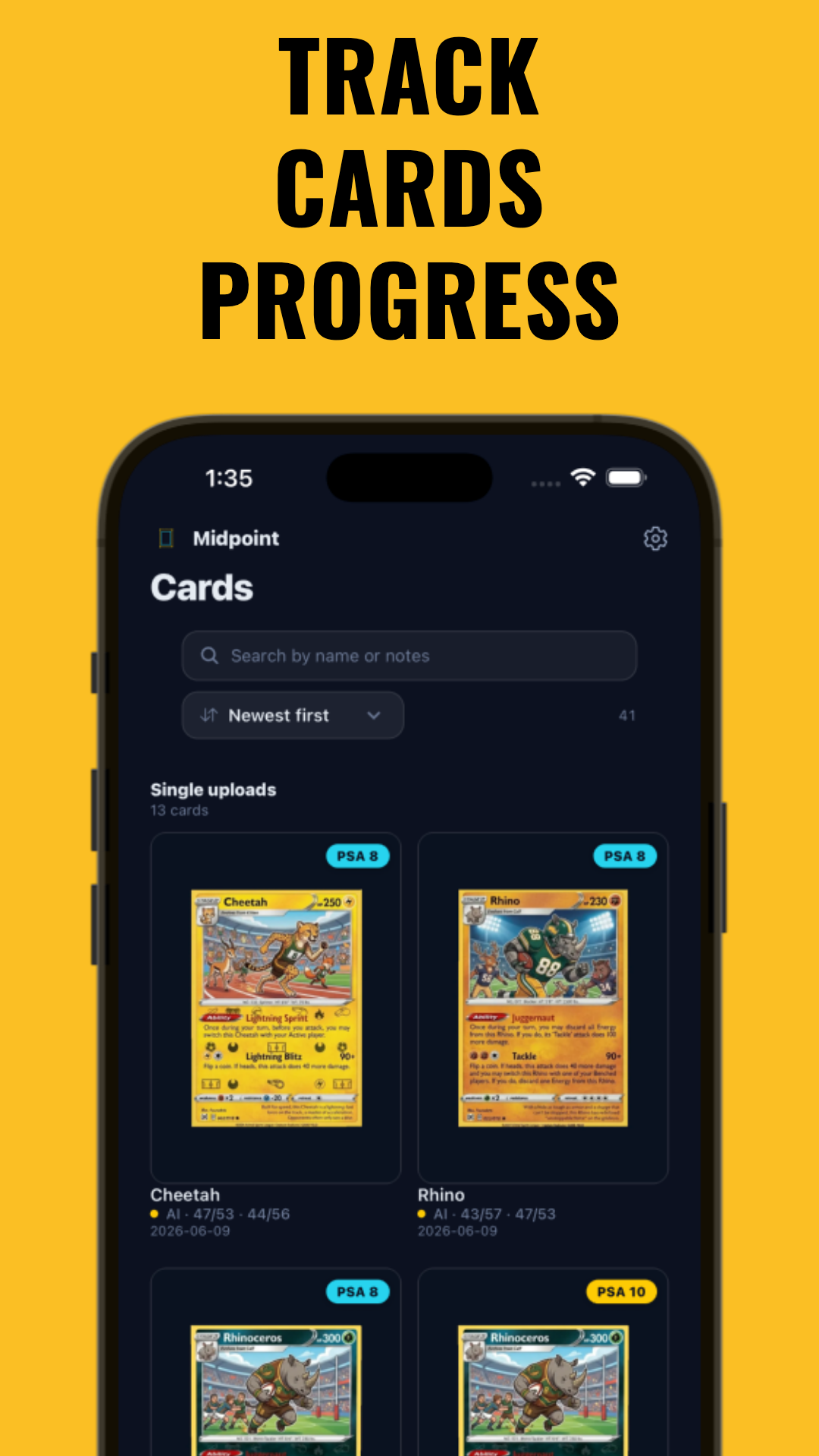
Modern apps like Midpoint let you estimate PSA, BGS, CGC, or TAG grades before you pay to submit—potentially saving time and money.
Scarcity and Population Reports
Scarcity—how many copies exist at each grade—is a major driver of price. PSA’s population report, for example, shows how many of each card have been graded at each tier (10, 9, 8, etc.).
- Low population: Fewer high-grade copies can mean more competition and higher prices.
- High population: More supply, which can limit appreciation.
Always check population data and recent sales before investing. For a deep dive into how grading influences value and insurance, see Card Grade Impact on Insurance Value: The Ultimate Guide.
Pre-Grading and Centering Tools
Before submitting cards, use digital tools or apps to assess centering and condition. Even a slight centering flaw can drop a card from a PSA 10 to a PSA 8, reducing value significantly. For a detailed breakdown, see How Centering Impacts Card Value: A Detailed Guide or learn how to pre-grade your card at home.
Section 5: Portfolio Strategy — Tracking, Cataloging, and Selling
How to Track a Card Collection
Serious collectors often treat their card collection like a portfolio—tracking value, documenting purchases, and making informed decisions. A modern card portfolio tracker app lets you:
- Catalog each card with grade, set, serial number, and purchase price
- Monitor collection value over time (daily, weekly, monthly trends)
- Compare raw vs. graded values using a card lookup tool
- Make informed decisions on when to sell cards from a collection
Midpoint offers collection value tracking, AI grading estimates, and easy bulk uploads to organize your card portfolio in one app.
How to Organize a Card Collection
- Sort by sport/TCG, set, year, and player/character
- Group by grade or value tier (e.g., $100+, $1,000+)
- Label and digitize with high-quality scans/photos
- Keep digital and hard copy records for insurance and tax purposes
For advanced collectors, digitizing and cataloging every card (including grade, population, and purchase details) is essential for tracking growth and minimizing loss.
How to Insure a Card Collection
Once your collection is worth several thousand dollars or more, specialty insurance is recommended. Insurers typically require a detailed inventory, including:
- Photos and scans of each card
- Purchase receipts and grading certificates
- Up-to-date value estimates (from recent sales, eBay, or a card collection app)
Graded cards are easier to insure, as their condition and authenticity are independently verified. For more on this topic, read our guide to card grade impact on insurance value.
When and How to Sell Cards
- Monitor market trends and recent sales (e.g., via eBay, Goldin, PWCC)
- Sell graded cards for maximum trust and liquidity
- Avoid panic selling after hype spikes; wait for stable demand
- Consider auction vs. fixed price based on rarity and competition
Apps like Midpoint can help you decide which cards to grade, hold, or sell based on real-time value tracking.
Section 6: Trading Cards vs. Stocks and Other Alternative Assets
Comparing Risk and Return
Unlike stocks or mutual funds, trading cards don’t generate cash flow (no dividends or interest). Returns depend entirely on price appreciation and your ability to sell at the right time. While some blue-chip cards have outperformed traditional assets over specific periods, the overall market is small and illiquid by comparison.
- Stocks: Highly liquid, regulated, generally lower volatility
- Trading cards: High volatility, less liquidity, unregulated market
Alternative Investments: Pros and Cons
- Pros: Low correlation to stocks/bonds, potential for outsized gains, enjoyment value
- Cons: High transaction costs, insurance/storage needs, no guaranteed returns
Portfolio Allocation and Expert Guidance
Many financial advisors suggest allocating only a small portion (such as 5-10%) of your portfolio to alternatives like trading cards. Diversify within your collection (across sports/TCG, years, and grades) and never invest money you can’t afford to lose.
For a technical look at how AI and digital grading tools are transforming the analysis of card centering and value, see AI-Focused Comparison: How AI Transforms Card Centering Analysis.
Conclusion
Are trading cards a good investment? The answer depends on your goals, knowledge, and risk tolerance. With careful research, portfolio tracking, and an eye for grading and scarcity, cards can be a viable alternative asset. But the market is speculative and volatile—never invest more than you can afford to lose, and always use tools to track, catalog, and protect your collection.
Apps like Midpoint make it easier to organize, value, and digitally grade your trading cards, helping you treat your collection like a true portfolio. Whether you’re a hobbyist or an investor, the best results come from blending passion with smart, data-driven decisions.
FAQ
Q: Are trading cards a good investment or just a collectible hobby?
A: Trading cards can be both. For some, they’re a nostalgic hobby; for others, a speculative investment. Cards with strong demand, scarcity, and high grades tend to appreciate most, but the market is volatile—never invest more than you can afford to lose.
Q: Which trading cards are the best investment right now?
A: Historically, rookie cards of star athletes, iconic vintage sets, and first editions of popular TCGs (like Pokémon Base Set) have offered strong upside. Sealed product can also hold long-term value. Always research population reports and recent sales before buying, and remember that past performance does not guarantee future results.
Q: Do graded cards hold value better than raw cards?
A: Professionally graded cards (by PSA, BGS, CGC, etc.) are generally more liquid, trusted, and command higher prices. Grading authenticates the card’s condition, which is critical for investment value.
Q: Are Pokémon cards a better investment than sports cards?
A: Pokémon cards have shown strong appreciation due to global popularity and nostalgia, but sports cards also offer upside—especially for legendary players. Both markets are volatile and require careful research.
Q: How do I know if a trading card is rare or valuable?
A: Check population reports (e.g., PSA), research recent sold listings, and look for key indicators: first edition, rookie status, iconic sets, and high grades. Scarcity and demand drive value. Card collection apps like Midpoint can help you track rarity and value.
Q: What trading cards should I avoid buying as an investment?
A: Avoid mass-produced cards from the "junk wax" era (late 1980s–1990s), cards with poor condition, and ungraded modern base cards. Also be wary of fakes and cards with high population counts and little demand.
Free to start
Try the Midpoint app
Grade any card from a photo, see its raw and PSA 10 value, and track what your collection is worth — free.
Get it on iPhoneGet it on Android


