Centering Requirements for Rookie Cards: The Ultimate Guide
Learn centering requirements for rookie cards, including PSA, BGS, and TCG standards. Master grading for sports, Pokemon, MTG, and more with expert tips.

Estimated reading time: 14 min
Key Takeaways
- Centering is a critical factor in rookie card grading, with strict requirements for PSA, BGS, and TCGs.
- Different card types—sports, Pokemon, MTG, One Piece, and vintage—have unique centering standards.
- Precise measurement tools, like Midpoint, and manual methods help collectors verify centering before grading.
- Front and back centering rules differ; the back is often held to different standards.
- Understanding centering ratios like 50/50, 55/45, and 60/40 is essential for grading success.
Table of Contents
- Section 1: Why Centering Matters for Rookie Cards
- Section 2: PSA, BGS, and CGC Centering Standards Explained
- Section 3: Measuring Centering—Tools and Techniques
- Section 4: Card Type Deep Dive—Sports, Pokemon, MTG, and More
- Section 5: Front vs. Back Centering—Why the Back Is Stricter
- Section 6: Visual Examples of Centering Ratios
- Section 7: Centering and Grading Outcomes (by Grade Tier)
- Section 8: Common Mistakes and Pro Tips for Assessing Centering
- Conclusion
- FAQ
Section 1: Why Centering Matters for Rookie Cards
The Impact on Card Value
Centering refers to how evenly the printed image appears within the borders of a trading card. For rookie cards—whether sports, Pokemon, MTG, or One Piece—centering can make the difference between an average and a top-tier grade. Miscentering is immediately visible, detracting from a card’s aesthetic appeal and, crucially, its market value.
- Collectors and investors often pay premiums for well-centered cards.
- Iconic rookie cards like the 1986 Fleer Michael Jordan or vintage Charizards can command higher prices in PSA 10 or BGS 9.5 grades, both of which require near-perfect centering.
Population Reports and Eye Appeal
High grades are less common for cards with tough centering standards, especially vintage issues. Population reports show that many low-population rookie cards do not achieve top grades due to centering flaws. Eye appeal—often driven by centering—plays a major role in insurance value and liquidity, as explored in this guide on card grade impact and insurance value.
Centering as a Grading Gatekeeper
Even if a card is flawless otherwise, off-center printing can cap its grade. This is why collectors use tools like Midpoint to estimate centering before investing in professional grading fees.
Section 2: PSA, BGS, and CGC Centering Standards Explained
PSA Centering Requirements for Rookie Cards
PSA’s grading standards are well-documented and strict, especially for high grades. For a modern or vintage rookie card to receive a PSA 10 (“Gem Mint”), centering must be:
- Front: 55/45 or better on all sides
- Back: 75/25 or better on all sides
For iconic rookie cards, such as the 1986 Fleer Michael Jordan, these standards are applied rigorously. A slight deviation (e.g., 60/40 front) can bump a PSA 10 down to a PSA 9.
BGS (Beckett) Centering Standards
BGS is also stringent and uses subgrades, including a dedicated centering subgrade. For a BGS 10 (“Pristine”):
- Front: 50/50 required—essentially perfect.
- Back: 60/40 or better.
BGS 9.5 (“Gem Mint”) allows up to 55/45 front and 65/35 back. This makes BGS stricter than PSA for front centering at the highest grade.
CGC and Other Grading Companies
CGC, popular for Pokemon and TCGs, generally follows PSA’s centering tolerances, but with its own nuances. TAG and SGC also have published standards, often mirroring PSA’s but with subtle differences. For a deep dive on grading scale differences, see this grading scale comparison.
Section 3: Measuring Centering—Tools and Techniques
Manual Methods: Rulers and Border Ratios
The classic way to assess card centering is to measure the borders with a millimeter ruler or calipers. To calculate the centering ratio:
- Measure the left and right (or top and bottom) borders in millimeters.
- Add both measurements for the total width (or height).
- Divide each border by the total to get a percentage.
Example: Left border = 2mm, right border = 3mm. Total width = 5mm. Ratio is 40/60.
Digital Tools and Centering Calculators
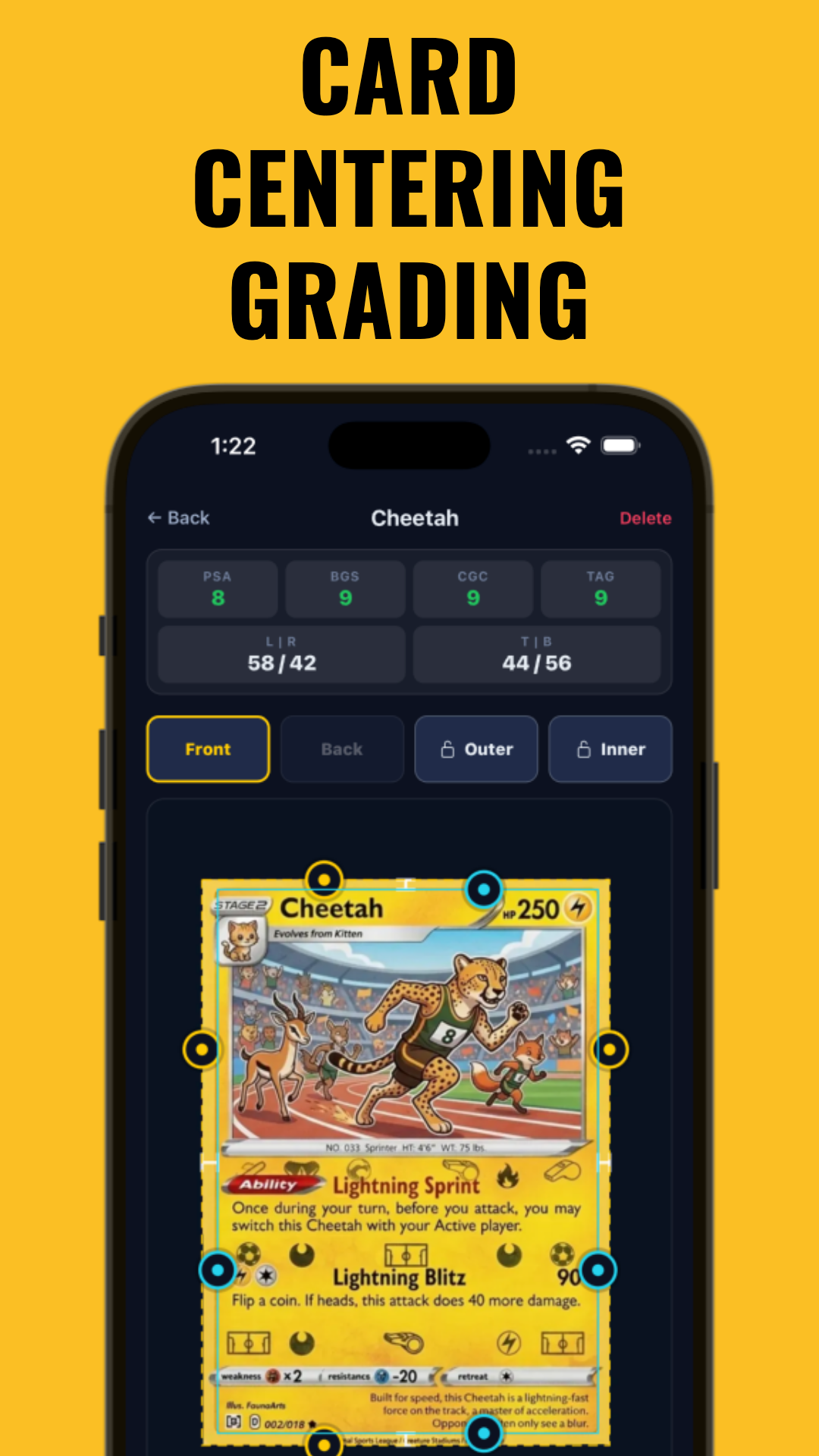
Modern collectors increasingly use digital solutions. Midpoint’s free centering calculator allows you to upload a scan or photo and instantly receive centering estimates for PSA, BGS, CGC, and TAG standards. This removes human error and guesswork, saving time and money before sending cards for grading.
Pre-Grading and Bulk Analysis
For large collections, batch tools and AI-driven software can be helpful. They can process multiple cards, flagging those that meet PSA 10 or BGS 9.5 centering requirements. For step-by-step instructions, see this guide on pre-grading your card.
Section 4: Card Type Deep Dive—Sports, Pokemon, MTG, and More
Sports Card Centering (Vintage and Modern)
Sports card centering is important for both vintage and modern issues. Vintage cards—such as 1952 Topps baseball or early basketball rookies—often left the factory with poor centering due to printing limitations. Modern print runs fare better, but grading companies do not relax standards for older cards.
- Iconic rookies (e.g., Michael Jordan, Mickey Mantle) are often downgraded for subtle centering flaws.
- Vintage card centering of 60/40 front can mean the difference between a PSA 8 and PSA 9.
Pokemon Card Centering
Pokemon card centering has become a hot topic as the hobby has matured. PSA and CGC require 55/45 or better for a Gem Mint 10 front, and 75/25 or better on the back. Back centering Pokemon cards is particularly scrutinized, since off-center backs (often with thicker yellow borders) are common.
- Japanese Pokemon cards tend to be better centered than English counterparts.
- Back centering Pokemon cards is a common reason for submissions to fall short of a PSA 10.
MTG, Yu-Gi-Oh, and One Piece Card Centering
Magic: The Gathering and Yu-Gi-Oh cards have distinct layouts, but grading companies apply similar standards. MTG card centering for a Gem Mint is typically 55/45 or better, front and back. One Piece card centering, as a newer TCG, is held to similar ratios, but print quality can vary depending on set.
- TCG collectors should check both front and back centering with equal care.
- Some sets (e.g., early Yu-Gi-Oh) are known for miscuts and centering issues.
Internal Resources for Deeper Card-Type Guides
For in-depth, card-type-specific tips, see our related guides:
- How Centering Impacts Card Value: A Detailed Guide
- Card Centering Tool: Accurate Card Grading Estimates
Section 5: Front vs. Back Centering—Why the Back Is Stricter
Front Centering: The Eye Test
The front of a rookie card is what most collectors and buyers notice first. Grading companies allow slightly more leeway here: PSA 10 requires 55/45 or better; BGS Pristine requires 50/50. The idea is that minor off-centering is less distracting on the front, provided it’s not severe.
Back Centering: Higher Expectations
The back of the card is held to different requirements—75/25 for PSA 10, 60/40 for BGS 10. The back often has larger, more uniform borders, making flaws more visible. Grading companies aim to ensure that cards look balanced from every angle.
- Poor back centering can disqualify a card from the highest grade, even if the front is perfect.
- Back centering issues are particularly important for Pokemon, TCGs, and certain vintage sets.
Iconic Example: Michael Jordan Fleer Rookie
The 1986 Fleer Michael Jordan rookie is a textbook case. Many otherwise mint copies exhibit 60/40 or even 65/35 centering, especially on the back. As a result, true PSA 10s are rare and carry a major premium. Collectors should always check both sides before submitting for grading.
Section 6: Visual Examples of Centering Ratios
Understanding Centering Percentages
Centering ratios are expressed as the percentage of the border on each side. The closer to 50/50, the better. Here’s what the most common ratios look like:
- 50/50: Perfect centering; equal borders on both sides.
- 55/45: Slightly thicker border on one side; still qualifies for PSA 10 (front).
- 60/40: Noticeable difference; typically PSA 9 for front, PSA 10 for back (depending on company).
- 65/35: Clear off-centering; too wide for PSA 10 front, but may be acceptable for lower grades or back centering in some standards.
Visualizing the Ratios
Imagine a standard trading card (63mm x 88mm):
- 50/50: Both left and right borders measure 3mm each.
- 60/40: One border is 2mm, the other is 3mm (on a 5mm total border width).
If you’re unsure, upload a card scan to a centering calculator to visualize these ratios before submission.
When Is Off-Center "Too Off"?
For PSA or BGS 10, anything beyond 55/45 (front) or 75/25 (back) is too off-center. For CGC and most TCGs, 60/40 is the upper limit for high grades, but always check the latest company standards.
Section 7: Centering and Grading Outcomes (by Grade Tier)
How Centering Affects PSA, BGS, and CGC Grades
Grading companies use centering as a gatekeeper for high grades. Here’s how centering requirements affect outcomes:
- PSA 10: 55/45 or better front, 75/25 back.
- BGS 10: 50/50 front, 60/40 back.
- CGC 10: ~55/45 front and back.
Any deviation from these can result in a downgrade to PSA 9, BGS 9, or CGC 9—often a significant drop in value for key rookie cards.
Lower Grades and Centering Forgiveness
For mid-tier grades (PSA 8, BGS 8.5), centering allowances expand to 65/35 or even 70/30. Cards with severe miscentering (80/20 or worse) may still receive a 6 or 7 if other factors are strong.
Card Type and Grading Nuances
Sports card centering is judged strictly on vintage rookies, where factory cuts were inconsistent. For Pokemon, back centering is often the stumbling block for Gem Mint. MTG and One Piece card centering is also important due to the high demand for pristine examples in competitive play and collecting.
Section 8: Common Mistakes and Pro Tips for Assessing Centering
Common Mistakes in Centering Evaluation
- Using only photos or scans without reference measurements—camera angles can distort border ratios.
- Measuring only the front and ignoring back centering requirements.
- Assuming newer cards are always perfectly centered (print runs still produce variations).
Pro Tips for Accurate Centering Judgement
- Always use a ruler or verified digital tool to measure borders to the nearest millimeter.
- Check both horizontal (left/right) and vertical (top/bottom) centering on both sides of the card.
- For TCGs, be aware that some sets have known centering issues; research print runs when possible.
- Use batch tools to pre-screen large submissions, saving money on grading fees.
Leveraging Technology
AI-powered tools, like those detailed in this AI-focused comparison, can assist with centering analysis, especially when used with high-resolution scans. The Midpoint app streamlines this process, helping you identify strong PSA 10 candidates based on centering.
Conclusion
Centering is one of the most important—and unforgiving—criteria in grading rookie cards across sports, Pokemon, MTG, Yu-Gi-Oh, and One Piece. Knowing the precise centering requirements for rookie cards by company and card type can save you disappointment and money. Use both manual and digital tools to check borders before submission, and always verify both front and back centering. For deeper insights and estimation tools, try the free resources at Midpoint before you submit your next rookie card for grading.
FAQ
Q: What is considered good centering on a rookie card?
A: Good centering for rookie cards generally means 55/45 or better on the front and 75/25 on the back for PSA 10. For BGS 10, front centering must be 50/50 and back 60/40. These standards apply to sports, Pokemon, MTG, and other TCGs, though slight variations exist by company.
Q: What centering does a PSA 10 rookie card need?
A: A PSA 10 rookie card requires centering of at least 55/45 on the front and 75/25 on the back. Anything outside these ratios will likely result in a lower grade.
Q: How do you measure card centering accurately?
A: Measure each border (left/right and top/bottom) with a ruler or calipers in millimeters, then calculate the ratio. Digital tools like Midpoint’s free centering calculator can provide instant, accurate measurements from scans or photos.
Q: Is 60/40 centering good enough for a rookie card PSA 10?
A: 60/40 centering is typically not good enough for a PSA 10 front (55/45 is the limit), but it can be acceptable for the back (75/25). For most companies, 60/40 will result in a PSA 9 or lower on the front.
Q: What is the back centering requirement for rookie cards?
A: For PSA 10, rookie cards must have back centering of 75/25 or better. BGS 10 requires 60/40 or better. Back centering is often considered important because flaws are more visible.
Q: How strict is BGS centering compared with PSA for rookie cards?
A: BGS is stricter for the highest grades (BGS 10 requires 50/50 front), while PSA allows up to 55/45. For subgrades, BGS weights centering as a separate category, which can cap the overall grade even if other aspects are perfect.
Free to start
Try the Midpoint app
Grade any card from a photo, see its raw and PSA 10 value, and track what your collection is worth — free.
Get it on iPhoneGet it on Android