BGS 10 Requirements: The Definitive Guide to Achieving Top Grading
Discover precise BGS 10 requirements including centering, corners, edges, surfaces, and subgrades to get your card graded Black Label 10.


Estimated reading time: 15 min
Key Takeaways
- BGS 10 requires nearly perfect subgrades in centering, corners, edges, and surface for a Pristine grade.
- Black Label 10 demands even stricter centering and flawless aesthetics than standard BGS 10.
- Centering tolerances for BGS 10 differ from PSA and require precise measurement.
- Understanding common reasons a card might receive a 9.5 instead of 10 helps collectors target submission-worthy cards.
- Modern cards with clean print runs and sharp edges can realistically achieve BGS 10 with careful handling.
Table of Contents
- Section 1: What Are BGS 10 Requirements?
- Section 2: Centering Standards for BGS 10 and Black Label 10
- Section 3: Corners, Edges, and Surface Requirements
- Section 4: Subgrade Combinations Needed to Earn BGS 10
- Section 5: Comparing BGS 10 to PSA and Other Grading Companies
- Section 6: Common Reasons Cards Fail BGS 10 and Drop to 9.5
- Section 7: Modern Cards That Can Achieve BGS 10
- Conclusion
- FAQ
Section 1: What Are BGS 10 Requirements?
Understanding BGS 10 Grading
Beckett Grading Services (BGS) defines a BGS 10 as a "Pristine" card condition—one that is virtually flawless to the naked eye and under 10x magnification. Achieving a BGS 10 is considered the pinnacle for collectors, representing an elite level of card preservation that relatively few cards attain.
To earn this grade, a card must excel across four critical subgrades: centering, corners, edges, and surface. Each is evaluated meticulously, and the overall grade reflects a weighted combination of these factors. A BGS 10 card essentially has near-perfect aesthetics and structural integrity, meaning any imperfections are so minor they are almost imperceptible even under magnification.
Key Grading Components
- Centering: The balance of the image on the card front and back, measured as the ratio of borders on each side.
- Corners: The sharpness and condition of the card’s corners, which should be crisp and free of fraying, rounding, or dents.
- Edges: Clean, smooth edges without chipping, whitening, or indentations, maintaining the original print color.
- Surface: The card’s front and back surfaces, including gloss, print quality, and absence of scratches, stains, or other blemishes.
Importance of Each Subgrade
BGS employs a weighting system, where surface and corners generally carry slightly more influence on the final grade than centering and edges. This reflects the practical impact these areas have on visual appeal and card durability. For example, a card with perfect centering but minor surface scratches typically won't receive a BGS 10. Conversely, a card with pristine surface and corners but slightly off perfect centering may still qualify.
Because these assessments can be subjective and subtle, collectors benefit from using objective tools to pre-analyze their cards. Advanced apps like Midpoint provide precise measurement and AI-assisted analysis for centering and surface condition, enabling informed submission decisions and helping avoid grading fees on cards unlikely to achieve 10s.
Section 2: Centering Standards for BGS 10 and Black Label 10
BGS 10 Centering Requirements
Centering is widely considered one of the most challenging subgrades to perfect for BGS 10. The tolerance is tight but not absolute perfection. Specifically, BGS 10 centering on the front typically requires a ratio between 55/45 and 60/40. This means the borders measured on opposing sides of the card’s front image generally should not deviate more than about 5-10% from perfect centering.
For the back of the card, the centering tolerance is usually more lenient—often up to 65/35. This is because back centering is often less critical due to lower visual impact and varying back designs. However, excessive off-centering on the back can still prevent a BGS 10.
For example, a card with a front border measuring 2.5mm on one side and 2.0mm on the opposite side would have a centering ratio of roughly 55.5/44.5, which may qualify for BGS 10 front centering. Differences beyond about 3mm may risk dropping the grade.
Black Label 10 Centering Requirements
Black Label 10 is reserved for the absolute elite cards that exhibit exceptional centering and aesthetics beyond standard BGS 10. The front centering ratio required is usually 60/40 or better, with many Black Label cards approaching or exceeding 62/38. This tighter tolerance means the card's image is visually balanced to an even greater degree, with borders nearly identical in size.
The back centering for Black Label 10 is similarly strict, commonly requiring 65/35 or better. Beyond numerical ratios, Black Label graders also consider visual balance and eye appeal, meaning cards with perfectly measurable centering but less appealing overall presentation might not earn Black Label.
Because of these exacting standards, Black Label 10 cards are much rarer and command significant premiums. Many cards that achieve a standard BGS 10 fail to meet the Black Label centering bar.
Measuring Centering Accurately
Accurate centering measurement can be challenging without proper tools. Traditional methods using rulers or visual estimation are prone to error, especially when dealing with millimeter differences.
Tools like the Midpoint centering calculator enable collectors to upload high-resolution images and calculate centering ratios precisely. This tool measures the borders pixel-by-pixel, providing exact percentage ratios for front and back centering. For instance, a card image processed through Midpoint might return a front centering of 58.5/41.5 and back centering of 63/37, helping the collector decide if the card fits BGS 10 criteria.
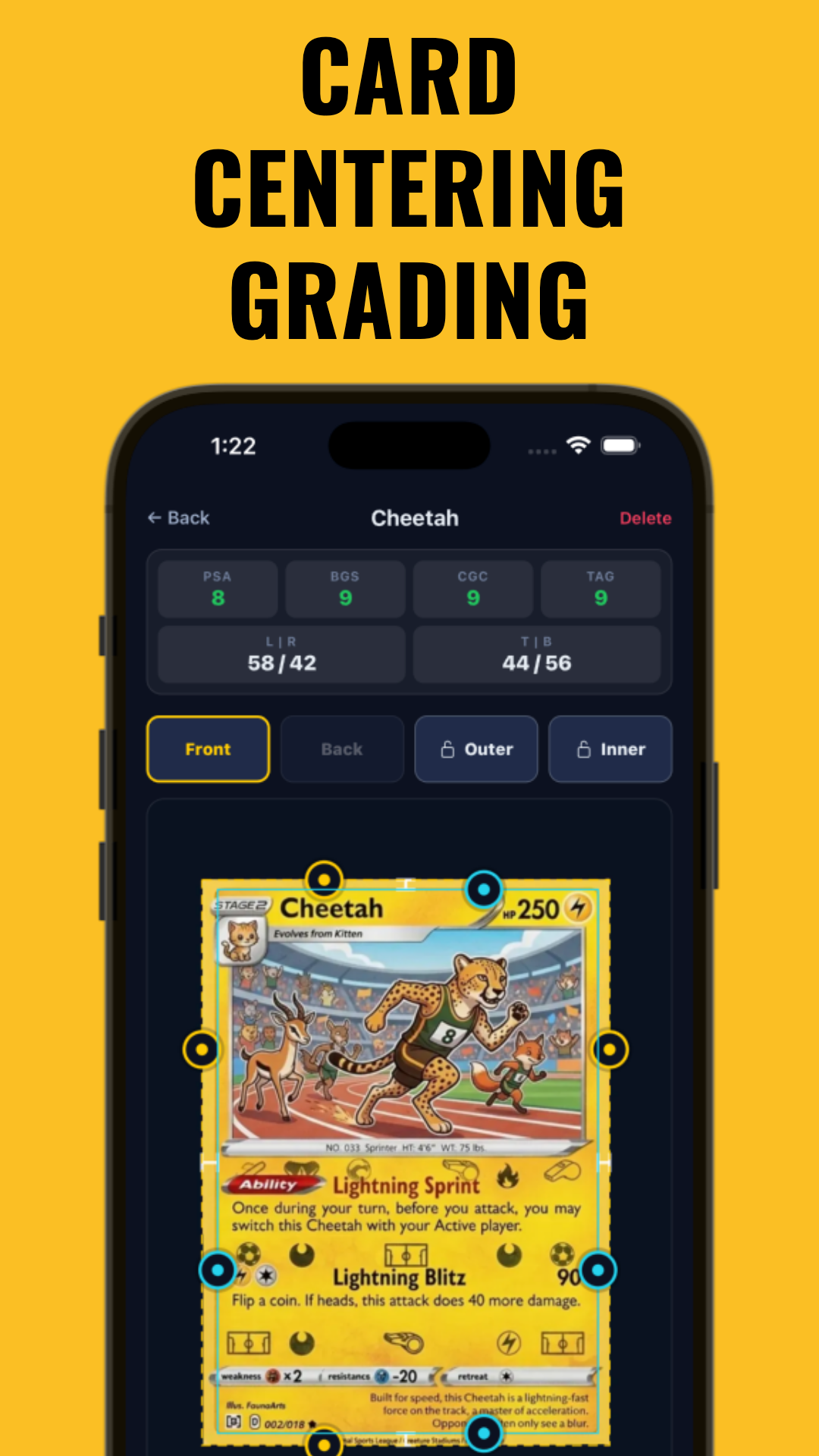
Midpoint app interface for measuring card centering precisely.
Additionally, Midpoint’s AI-powered analysis can flag visual centering issues that might not be obvious from numbers alone, such as optical illusions from design elements affecting perceived balance.
Section 3: Corners, Edges, and Surface Requirements
Corners: The Sharpness Factor
For BGS 10, corners must be essentially pristine under 10x magnification, exhibiting razor-sharp edges without rounding, fraying, or dents. Corners are one of the most common reasons cards fail to achieve BGS 10, as even tiny imperfections are heavily penalized.
- Cards should show no bends, folds, or softness that would indicate handling damage.
- Whitening is generally unacceptable; the white core of the card should not be exposed.
- All four corners should be consistent in sharpness, as uneven corners can be a red flag.
For example, a card with three perfect corners but one with slight rounding or a tiny nick will almost always receive a corner subgrade below 10, which can prevent an overall BGS 10.
Inspecting corners with a loupe or magnifier before submission, and comparing against known BGS 10 benchmark cards, can help collectors identify borderline issues.
Edges: Clean and Uniform
Edges on a BGS 10 card must be clean with no chipping, whitening, indentations, or surface breaks. The edges should maintain the original print color and show no signs of wear or handling damage.
- Edges should be smooth and consistent, with no thickness variations or rough spots.
- Any signs of color loss or fading along edges, such as white specks or exposed card stock, will result in a lower edge grade.
- Indentations or surface breaks caused by mishandling or manufacturing defects are scrutinized heavily.
For example, a card with a tiny chip on an edge corner might receive a 9 or 9.5 edge subgrade, even if other subgrades are perfect.
Surface: Flawless Front and Back
The surface subgrade is often the most critical and challenging to perfect. BGS 10 surface demands include:
- Glossy, clean surfaces free of scratches, scuffs, stains, or dirt.
- Good print registration, meaning the image is aligned with no obvious misprints or color shifts.
- No print defects such as misaligned ink, print spots, or discoloration.
- Absence of dents, indentations, or surface texture anomalies.
Surface imperfections are a frequent cause of grade reduction from 10 to 9.5 or lower. Even subtle gloss loss or micro scratches visible under 10x magnification can affect grading.
Midpoint’s AI surface analysis tool can scan high-res images to detect these imperfections, highlighting areas of concern before submission. For example, a card might appear flawless to the naked eye but reveal micro scratches or print spots under magnification, which can be caught early with such tools.
Section 4: Subgrade Combinations Needed to Earn BGS 10
How Subgrades Combine for the Overall Grade
BGS uses a weighted formula that combines the four subgrades—centering, corners, edges, and surface—into the overall numerical grade. While the exact formula is proprietary, it is generally understood that surface and corners carry slightly more weight.
To achieve an overall BGS 10, all subgrades typically must be at least 9.5 or higher, with the majority being perfect 10s. A single subgrade lower than 9.5 usually drops the overall grade to 9.5 or lower.
- Most BGS 10 cards feature at least three subgrades at 10, with the fourth at 9.5.
- Any subgrade at 9 or below will exclude the card from overall 10 consideration.
- Because of the weighting, a 9.5 in surface or corners generally has more impact than a 9.5 in centering or edges.
Example Subgrade Combinations for BGS 10
- Centering 9.5, Corners 10, Edges 10, Surface 10 — often sufficient to earn a BGS 10 overall, as the heavier weighted corners and surface are perfect.
- Centering 10, Corners 9.5, Edges 10, Surface 10 — still qualifies for BGS 10, though some might see this as borderline depending on the perceived severity of corner imperfections.
- Centering 10, Corners 10, Edges 9.5, Surface 10 — usually acceptable but edges subgrade is less weighted, so minor edge flaws may be tolerated.
- Any subgrade below 9.5 almost always results in a 9.5 overall or lower.
Black Label 10 Subgrade Expectations
Black Label 10 demands perfection—each subgrade must be a 10 without exception. This means no 9.5s or lower in centering, corners, edges, or surface. The card must be flawless in every measurable aspect. This exacting standard justifies the premium prices and rarity of Black Label 10 cards.
For collectors, this means submitting a card for Black Label requires meticulous pre-grading and careful handling to ensure no minuscule flaws exist. Even the slightest corner softness or centering deviation can disqualify a card from Black Label 10.
Section 5: Comparing BGS 10 to PSA and Other Grading Companies
BGS vs PSA Centering Tolerances
PSA 10 standards are generally considered more stringent in centering than BGS 10, often requiring front and back centering ratios of 55/45 or better. PSA’s approach tends to be more symmetrical, demanding near-perfect centering on both sides, with little tolerance for deviation.
BGS 10 allows slightly more leniency, especially on the back centering, making it possible for cards with minor off-centering on the back to achieve a BGS 10 but only a PSA 9.5. This difference results in some cards being graded differently by the two services despite similar physical condition.
Difference in Subgrade Presentation
One of BGS’s unique features is its detailed subgrading system that provides four separate grades for centering, corners, edges, and surface. This transparency allows collectors to understand exactly where a card excels or falls short.
In contrast, PSA provides a single overall grade without subgrades, which can obscure specific flaws or strengths. Collectors may find BGS subgrades helpful in evaluating cards before purchase or submission.
Other companies like CGC and TAG also use subgrading but their tolerance levels and weighting differ. CGC, for example, often has stricter surface grading, while TAG’s methodology varies notably in centering evaluation.
What Makes BGS Black Label Unique?
The Black Label designation is exclusive to BGS and represents the elite of elite cards—those with nearly flawless centering and perfect aesthetics. Black Label is a tier above standard BGS 10 and even PSA Gem Mint 10 in terms of rarity and quality.
Black Label cards often command premium market prices due to their scarcity and the prestige associated with the designation. For collectors, owning a Black Label 10 is akin to holding a "holy grail" specimen.
For a deeper dive into grading scales, see our detailed guide on Grading Scale Differences by Company.
Section 6: Common Reasons Cards Fail BGS 10 and Drop to 9.5
Centering Outside Acceptable Range
Even minor centering deviations beyond the 60/40 front or 65/35 back thresholds can cause a card to receive 9.5 instead of 10. This is especially impactful for Black Label submissions, where tighter tolerances are enforced.
For instance, a card with front centering of 58/42 passes for BGS 10 but one at 62/38 may be borderline or fail Black Label 10.
Minor Corner or Edge Wear
Corners and edges are extremely sensitive grading areas. Visible rounding, whitening, tiny nicks, or softness under 10x magnification are common reasons for grade reduction. Even if the flaw is only perceptible under magnification, it can lower subgrades and overall grade.
For example, a faint crease on a corner that is only visible under magnification may cause corners to drop to 9.5 or lower.
Surface Imperfections
Surface flaws are a frequent cause of the pristine grade not being awarded. These include scratches, scuffs, dirt, print spots, stains, or any loss of gloss. Even subtle imperfections can prevent a BGS 10, as surface is heavily weighted.
Print registration errors such as misaligned ink or color shifts also impact surface grading adversely.
Subgrade Drops Below 9.5
A single subgrade below 9.5 almost always drops the overall grade to 9.5 or less. For example, a card with corners 10, edges 10, surface 9, and centering 10 would not qualify for BGS 10.
How to Minimize Risk
- Use precision tools like Midpoint to measure centering and detect surface issues before submission.
- Handle cards with clean hands, using sleeves and top loaders to avoid introducing wear.
- Submit only cards with known clean print runs and sharp corners, preferably modern cards produced under controlled conditions.
- Consider pre-grading with experienced collectors or professional services to gauge the card’s prospects.
- Inspect cards under 10x magnification carefully, checking for subtle flaws.
Section 7: Modern Cards That Can Achieve BGS 10
Highly Collectible Sports Cards
Modern sports cards, particularly from premium brands like Topps Chrome, Panini Prizm, and Bowman, are good candidates for BGS 10 grading. These cards benefit from advanced printing technology, quality-controlled production runs, and sharp designs.
For example, a 2023 Topps Chrome rookie card with precise centering, flawless edges, and a glossy surface has a realistic chance of achieving BGS 10 if handled carefully from the moment of purchase.
Popular Non-Sports Cards
Modern non-sports cards such as Pokémon, Magic: The Gathering, and Yu-Gi-Oh are also contenders for BGS 10. These cards often have clean print runs, solid card stock, and minimal surface texture variation, which helps in achieving pristine surface grades.
For instance, a first edition Pokémon card from a recent set stored in a sleeve and top loader immediately after opening can maintain the sharp corners and clean surface necessary for BGS 10.
Factors Increasing BGS 10 Likelihood
- Limited print runs: Cards produced in smaller quantities may receive greater quality control, reducing defects.
- Protective storage: Immediate placement in penny sleeves, semi-rigid holders, and top loaders protects edges and corners.
- Simpler designs: Cards with solid borders and minimal intricate patterns tend to grade better, as complex designs can mask centering and surface issues.
- High-quality print technology: Modern cards printed with advanced offset or digital printing methods generally exhibit consistent color and registration, helping surface grades.
For collectors preparing cards for grading, our detailed guide on How to Pre-Grade Your Card offers step-by-step advice including:
- Examining cards under 10x magnification for flaws.
- Photographing cards to analyze centering with tools like Midpoint.
- Properly handling and packaging cards to avoid damage during shipping.
- Understanding grading company guidelines and customer service tips.
Conclusion
Understanding the BGS 10 requirements is vital for collectors aiming to achieve the highest card grades. From tight centering tolerances to flawless corners, edges, and surfaces, every detail counts in the grading process. The distinction between standard BGS 10 and Black Label 10 lies in the latter’s even more rigorous centering and perfect subgrades, setting a high standard for card perfection.
Utilizing advanced tools like Midpoint to measure centering and analyze surface quality before submission can save collectors significant time, money, and frustration. Knowing common reasons why cards drop to 9.5 helps collectors identify and select candidates with the best chance of earning a pristine grade.
Modern cards with sharp edges, clean print runs, and careful handling are among the best bets for BGS 10 success. By mastering these requirements and preparing carefully, you can maximize your collection's value and enjoy top-tier grading results that stand out in the market.
FAQ
Q: What are the exact requirements for a BGS 10 card?
A: A BGS 10 requires near-perfect subgrades in centering (approximately 60/40 front, 65/35 back), sharp corners with no fraying, clean edges free from chipping or whitening, and a surface free from noticeable scratches or print defects. Most subgrades must be 9.5 or higher, with the majority at 10.
Q: What is the difference between BGS 10 and Black Label BGS 10?
A: Black Label BGS 10 is a superior designation requiring perfect 10 subgrades in all categories, especially stricter centering (often better than 60/40 front). It signifies "Gem Mint" condition and is rarer and generally more valuable than standard BGS 10.
Q: Does BGS 10 require perfect centering?
A: BGS 10 requires very tight centering—usually up to 60/40 on the front and 65/35 on the back. While not perfectly centered, it must be visually balanced with minimal deviation. Black Label 10 demands even stricter centering.
Q: How many 10 subgrades do you need for BGS 10?
A: Typically, you need at least three subgrades at 10 and the fourth at 9.5 or higher to achieve a BGS 10 overall. Any subgrade below 9.5 usually drops the overall grade to 9.5.
Q: What centering ratio is needed for BGS 10 on the front and back?
A: Approximately 60/40 front centering ratio and 65/35 on the back are generally required for BGS 10. Black Label 10 often demands better than 60/40 front centering.
Q: Why would a card get a 9.5 instead of a BGS 10?
A: Common reasons include centering slightly outside tolerance, minor corner or edge wear, surface imperfections like scratches or stains, or any subgrade falling below 9.5. These small flaws prevent the card from earning a pristine 10.
Free to start
Try the Midpoint app
Grade any card from a photo, see its raw and PSA 10 value, and track what your collection is worth — free.
Get it on iPhoneGet it on Android