Centering and Print Lines on Trading Cards: The Complete Guide
Learn how centering and print lines impact trading card grading. Covers Pokemon, sports, MTG, One Piece, manual measurement, and PSA/BGS/CGC standards.

Estimated reading time: 14 min
Key Takeaways
- Card centering and print lines are important factors in determining trading card grades and value.
- Grading standards for centering vary by card type—Pokemon, sports, Magic, One Piece, and vintage cards each have unique quirks.
- Manual measurement and digital tools can provide centering estimates before grading submission.
- Print lines are factory defects that can influence grades, but their impact depends on severity and grading company criteria.
- Using an app like Midpoint may help collectors avoid unexpected grading outcomes.
Table of Contents
- Section 1: What Is Card Centering? Why It Matters
- Section 2: How to Measure Centering—Manual and Digital Methods
- Section 3: Centering Tolerances and Grading Standards (PSA, BGS, CGC)
- Section 4: Print Lines—Origins, Types, and Impact on Grades
- Section 5: Card Type Deep Dive—Pokemon, Sports, MTG, Vintage, One Piece
- Section 6: Visual Examples: 55/45, 60/40, 70/30 Centering
- Section 7: Tools, Apps, and Overlays for Accurate Centering
- Section 8: Print Lines in the Real World—Pricing and Collecting
- Conclusion
- FAQ
Section 1: What Is Card Centering? Why It Matters
Definition of Centering
Card centering refers to the alignment of a card’s printed image relative to its physical borders. In trading cards—Pokemon, sports, Magic: The Gathering (MTG), One Piece, and vintage—centering measures how evenly the front and back artwork is positioned between the card's edges. Perfect centering means the image is exactly equidistant from all sides.
Why Centering Is Crucial in Grading
Centering is one of the four main factors in professional card grading, alongside corners, edges, and surface. Major grading companies like PSA, BGS, CGC, and TAG assign significant weight to centering. Poor centering can drop a card from a Gem Mint 10 to a Mint 9 or lower, even if all other aspects are flawless.
- Gem Mint cards require precise centering within tight tolerances (e.g., 55/45 or better on the front).
- Collectors often pay premiums for well-centered cards, especially in vintage card centering where misalignments were more common.
Centering and Card Value
Cards with off-center printing are generally less desirable, even in otherwise strong condition. For example, a detailed guide on centering and value notes that poorly centered cards can sell for significantly less than centered equivalents. This makes accurate pre-grading important for maximizing returns or making informed purchases.
Section 2: How to Measure Centering—Manual and Digital Methods
Manual Measurement: Rulers and Calipers
Traditionally, collectors use a millimeter ruler or digital calipers to measure border thickness on all sides. For front centering, measure the left and right borders (and top/bottom for vertical centering). Calculate the centering ratio using:
- Formula: (Smaller Border ÷ Larger Border) × 100 = Centering Percentage
For example, if the left border is 2 mm and the right is 3 mm: (2 ÷ 3) × 100 = 66.7%. This would be considered 67/33 centering.
Digital Tools and Overlays
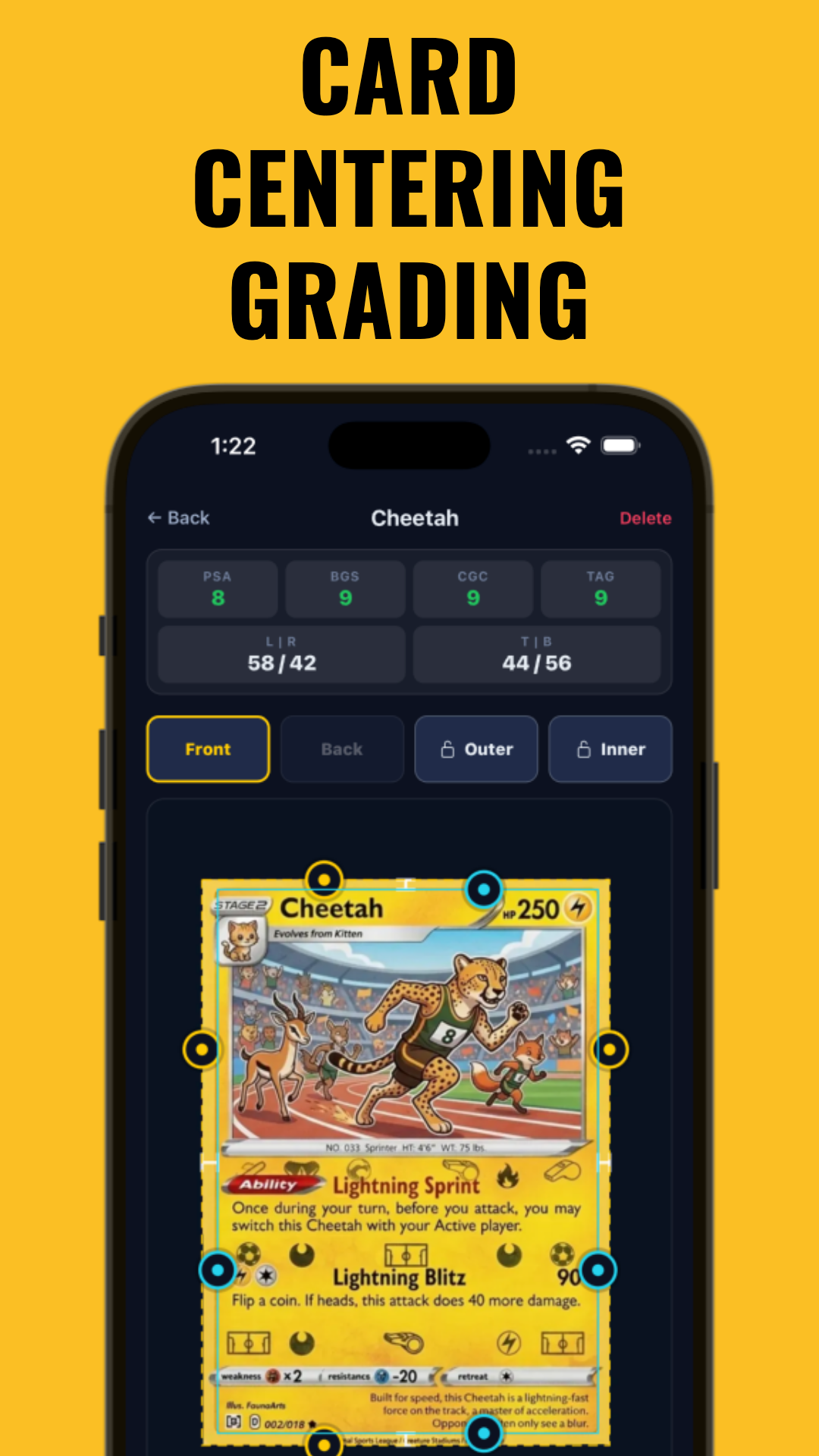
Modern collectors increasingly rely on digital solutions. Apps like Midpoint and free online centering calculators use edge detection and overlays for more precise, repeatable results. These tools analyze scans or photos to determine centering to fractions of a millimeter, helping to reduce human error.
- Upload a card image or scan.
- The app detects edges and calculates centering percentages for each side.
- Overlays visually highlight off-center areas, making it easier to assess at a glance.
Why Accuracy Matters
Small centering differences can move a card across grading thresholds, impacting both grade and value. Digital methods can help ensure consistency, especially when sending multiple cards for grading. For step-by-step instructions, see the pre-grading guide.
Section 3: Centering Tolerances and Grading Standards (PSA, BGS, CGC)
Front and Back Centering Requirements
Each grading company sets specific centering tolerances for each grade. These usually differ for the card’s front and back, since the back is often given more leeway.
- PSA 10 (Gem Mint): Front 55/45 or better, Back 75/25 or better
- BGS 10 (Pristine): Front 50/50 to 55/45, Back 60/40
- CGC 10 (Pristine): Front 55/45, Back 75/25
- Grades decline (9, 8, etc.) as centering drifts further from perfect
For back centering pokemon cards, even a well-centered front can be held back by an off-center back image. This is important for collectors seeking Gem Mint grades in Pokemon, sports, and other TCGs.
Understanding the Ratios
A centering ratio of 60/40 means one border is 60% the width of the combined left and right (or top/bottom), and the other is 40%. Companies use these ratios to set clear grading cutoffs. For more on how grading scales differ, see the grading scale guide.
Vintage Cards and Tolerance
Vintage card centering (pre-1980s) is typically less precise due to older printing methods. Some grading companies may show more leniency for vintage issues, especially for iconic rookie cards. However, extremely off-center cards still struggle to achieve top grades or values, as explained in the rookie card centering guide.
Section 4: Print Lines—Origins, Types, and Impact on Grades
What Are Print Lines?
Print lines are thin, usually straight streaks on a card’s surface caused by imperfections in the printing process. Unlike scratches or handling damage, print lines originate at the factory, often from printer rollers or debris during manufacturing. They may appear horizontal, vertical, or even diagonal, depending on the print run.
Identifying Print Lines
- Appear as faint or shiny lines under direct light
- Most visible on dark or holofoil backgrounds (e.g., Pokemon holos, Topps chrome)
- Don’t penetrate the card stock—are surface-level only
Print lines are distinct from scratches, but can be mistaken for them by new collectors.
How Print Lines Affect Grades
Grading companies generally classify print lines as factory defects, not post-production damage. Their impact on grades varies:
- Minor print lines may be allowed on PSA 10s if subtle and not distracting.
- Obvious, multiple, or severe print lines usually cap a card at PSA 9 or lower.
- Some companies (BGS, CGC) may be stricter about surface flaws, including print lines.
For more on print line grading, see the card centering and grading estimates guide.
Section 5: Card Type Deep Dive—Pokemon, Sports, MTG, Vintage, One Piece
Pokemon Card Centering
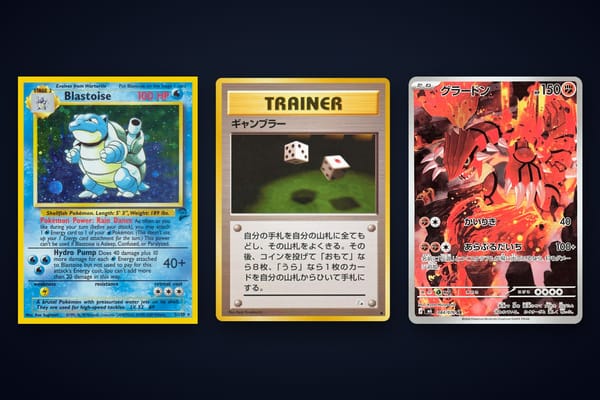
Pokemon cards use colored borders as centering references. Grading companies check both front and back centering pokemon cards—back centering is especially known for being off, even on pack-fresh cards. Print lines are common on holographic areas, and a single severe print line can drop a card from PSA 10 to PSA 9.
- Front: Yellow border centering, measured on all four sides
- Back: Blue border, prone to larger print shifts
Sports Card Centering
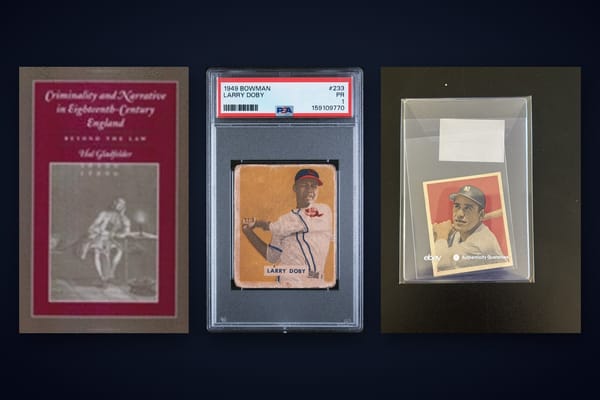
Sports cards (baseball, basketball, etc.) often have sharp white or colored borders. Sports card centering is important for rookie cards and vintage issues. Reference points include team logos, player images, and border lines. Misaligned borders are especially penalized in iconic sets like 1986 Fleer basketball or 1952 Topps baseball.
- Front: Player image and design elements as centering guides
- Back: Stat box and text placement
MTG, One Piece, and Yu-Gi-Oh Card Centering
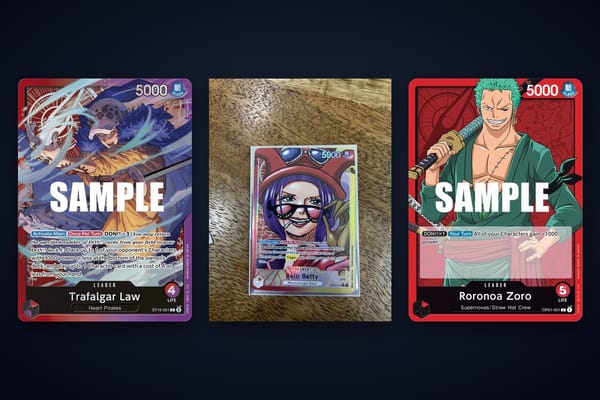
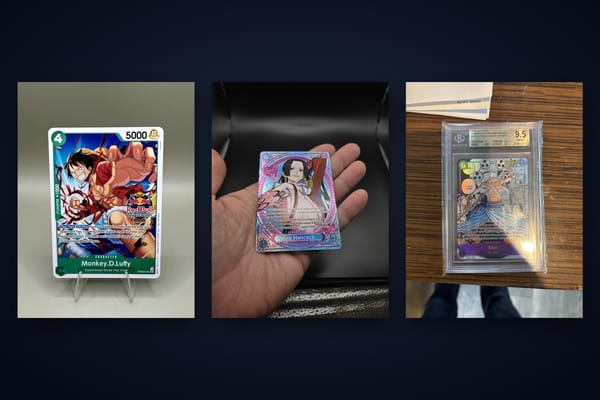
MTG card centering uses the colored frame and artwork box as reference. Early Magic sets (Alpha, Beta) are known for poor centering, so even a 70/30 card can be valued by collectors. One Piece card centering is similar, with colored borders and design elements as guides. Yu-Gi-Oh cards have thin borders, making even small shifts very noticeable.
- Front: Frame and art box alignment
- Back: Logo and border position
Vintage Card Centering
Vintage cards (pre-1980s) were often cut with less precision. Collectors and graders expect some variability, but extreme miscuts (e.g., 80/20 or worse) will always impact grade and desirability. Print lines can be present but are generally less scrutinized than on modern shiny cards.
Summary Table: Centering Challenges by Card Type
- Pokemon: Both front and back matter; print lines common on holos
- Sports: Border color and sharpness highlight centering
- MTG/One Piece: Early sets have more tolerance due to factory issues
- Vintage: More lenient, but extreme cases penalized
Section 6: Visual Examples: 55/45, 60/40, 70/30 Centering
Understanding Centering Ratios
Grading companies use centering ratios (e.g., 60/40) to quantify border alignment. Here’s what these ratios look like in practice:
- 55/45: Slightly off-center, but visually close to perfect. Meets Gem Mint requirements for most modern cards.
- 60/40: Noticeably off-center, but still within the Mint 9 threshold. One border appears thicker.
- 70/30: Clearly off-center, with one border much wider than the other. Usually grades PSA 8 or lower.
Visualizing the Differences
Imagine a Pokemon card with a yellow border:
- 55/45: Both left and right borders look nearly identical to the naked eye.
- 60/40: One side is noticeably wider—e.g., 2 mm on the left, 3 mm on the right.
- 70/30: Lopsided appearance, such as 1.5 mm on one side and 3.5 mm on the other.
Reference Points by Set
Different card types have unique reference points:
- Sports cards: Player image, border color, team logo
- Pokemon: Yellow/blue border
- MTG/One Piece: Art box, frame lines
Why Visual Consistency Matters
Buyers often notice off-center cards, even if the difference is only 1 mm. This makes precise measurement and digital overlays helpful for both collectors and sellers.
Section 7: Tools, Apps, and Overlays for Accurate Centering
Manual Tools: Rulers, Calipers, Loupe
Basic tools like millimeter rulers and calipers remain useful for quick checks. A jeweler’s loupe can help spot minor border differences, but manual methods are prone to user error, especially with glossy or dark-bordered cards.
Apps and Digital Tools
Apps like Midpoint and the free centering calculator enable more precise, repeatable measurement. These tools use edge detection for accuracy down to fractions of a millimeter. Features include:
- Upload or scan card images
- Automatic border detection
- Grading company-specific tolerance estimates (PSA, BGS, CGC, TAG)
- Batch processing for large collections
For a discussion of digital centering analysis, see this AI comparison guide.
Using Overlays and Templates
Printable overlays or digital templates help visualize centering by providing reference lines matching grading standards (e.g., 60/40 overlays). Overlays are especially useful for vintage card centering, where border thickness can vary due to print shifts or miscuts.
Why Digital Is the New Standard
With grading fees rising, accurate pre-grading is increasingly important. Digital tools can help minimize surprises and assist collectors in submitting only the best cards. For insurance, resale, or trading, demonstrating precise centering can be valuable, as discussed in the card insurance value guide.
Section 8: Print Lines in the Real World—Pricing and Collecting
Why Print Lines Happen and Can’t Be Removed
Print lines are a byproduct of high-speed printing. They result from minor debris, roller marks, or ink inconsistencies. Unlike scratches or post-pack damage, print lines are embedded during production and are generally impossible to remove without damaging the card. Attempts to buff or polish print lines constitute alteration and will void grading eligibility.
Grading and Market Impact
- Minor print lines may be tolerated at PSA 10 if nearly invisible.
- Obvious or multiple print lines usually cap a card at PSA 9 or lower.
- Buyers may pay less for cards with visible print lines, especially on premium holofoil or rookie cards.
Price reductions for print lines vary by rarity, set, and collector demand. For example, a rare vintage Pokemon holo with a faint print line might still command a premium, while a modern card with the same flaw may drop in value.
Print Lines vs. Other Defects
It’s important to distinguish print lines from scratches, dents, or stains:
- Print lines: Factory defect, runs in straight lines, visible under angled light
- Scratches: Caused by handling, can cross in random directions
- Surface dimples or dents: Physical depressions, not lines
Grading companies use loupes and angled lighting to spot and classify print lines. Sellers should always disclose print lines in listings to avoid disputes.
Collectors’ Perspective
Some collectors tolerate print lines, especially if a card is otherwise flawless or rare. Others avoid them entirely. Understanding grading standards and market preferences helps buyers and sellers set realistic expectations when trading or submitting cards.
Conclusion
Centering and print lines are two of the most misunderstood yet important factors in trading card grading. Whether you collect Pokemon, sports, Magic, One Piece, or vintage cards, understanding how centering is measured—and how print lines are judged—can help you avoid disappointment. Manual methods work, but digital tools like Midpoint provide quick centering analysis and grading estimates, helping you make more informed decisions before paying for professional grading. Mastering these details can help you maximize card value, avoid costly surprises, and collect with confidence.
FAQ
Q: How do you measure card centering accurately?
A: Use a millimeter ruler or digital calipers to measure border thickness on all sides. Calculate the centering percentage using the formula: (Smaller Border ÷ Larger Border) × 100. For best accuracy, use a digital tool or app that analyzes card images and provides centering ratios, such as Midpoint.
Q: What is considered good centering on a trading card?
A: Good centering generally means a ratio of 55/45 or better on the card front and 75/25 or better on the back for Gem Mint (PSA 10, BGS 10, CGC 10) grades. Mint 9 grades usually require at least 60/40 front centering.
Q: Do print lines lower a card grade?
A: Print lines are considered factory defects. Minor print lines may be allowed on Gem Mint cards if barely visible, but multiple or obvious print lines typically limit a card to Mint 9 or lower.
Q: Can a card still get a PSA 10 with print lines?
A: It’s possible if the print line is faint and not distracting. However, severe or multiple print lines will cap the grade at PSA 9 or below. Each card is assessed on a case-by-case basis.
Q: What does 60/40 centering mean on a card?
A: 60/40 centering means the printed image is shifted such that one border is 60% of the total width and the other is 40%. This is the cutoff for Mint 9 grades at most grading companies.
Q: Are print lines factory defects or damage from handling?
A: Print lines are factory defects caused during the manufacturing process. They are not the result of handling and cannot be removed without damaging the card.
Free to start
Try the Midpoint app
Grade any card from a photo, see its raw and PSA 10 value, and track what your collection is worth — free.
Get it on iPhoneGet it on Android