Edge Centering in Card Grading: How to Measure and Why It Matters
Discover what edge centering means in card grading, how to measure it accurately, and its impact on your card’s grade and value.

Estimated reading time: 15 min
Key Takeaways
- Edge centering is an important aspect of trading card grading that can affect value and appeal, influencing both the visual balance and collector interest.
- Centering is measured by comparing borders on the front and back, often expressed as ratios like 50/50 or 60/40, representing the proportional distribution of the image within the card edges.
- Different grading companies and card types may have varying tolerances for centering, with vintage cards often having more lenient standards compared to modern cards.
- Accurate centering measurement tools, like an edge centering tool, can help collectors pre-grade cards more confidently, potentially minimizing costly grading submission errors.
- Centering impacts grade alongside edges, corners, and surface, but each factor is weighed differently depending on the grading company and card type.
Table of Contents
- Section 1: What is Edge Centering in Card Grading?
- Section 2: How to Measure Centering on the Front of a Card
- Section 3: Measuring Centering on the Back of a Card
- Section 4: Common Centering Standards and Ratios Explained
- Section 5: Impact of Centering on Overall Grade and Eye Appeal
- Section 6: How to Check Centering at Home Using Tools
- Section 7: Variations in Centering Tolerance by Card Type and Grading Company
- Section 8: Differentiating Edge Wear from Centering in Grading
- Conclusion
- FAQ
Section 1: What is Edge Centering in Card Grading?
Defining Edge Centering
Edge centering describes the alignment of the printed image within the borders of a trading card. In card grading, it refers to how evenly the image is centered between the card's edges — top, bottom, left, and right. Proper edge centering means the image is symmetrically placed, creating balanced white or colored borders on all sides. For example, a card with a 50/50 centering ratio has the image approximately aligned, with nearly equal border widths on opposite sides.
Why Edge Centering Matters
Centering is one of the four main grading criteria alongside edges, corners, and surface condition. A card with perfect corners and surface but poor centering may receive a lower overall grade. This is because off-centering can detract from the card’s visual appeal and collector desirability. High-grade cards typically have well-centered images with minimal deviation, which can enhance their market value. For instance, a vintage sports card off-centered beyond 60/40 is often downgraded, regardless of other attributes.
Edge Centering vs. Edge Wear
It's important to distinguish edge centering from edge wear. Edge centering is about the image’s placement relative to the card borders, while edge wear refers to physical damage like fraying, whitening, or chipping along the edges. Both affect grading but are assessed separately. You can have perfect centering but poor edge condition, or vice versa. For example, a card might have 50/50 centering but exhibit edge whitening from handling, which would negatively impact its grade.
Section 2: How to Measure Centering on the Front of a Card
Step-by-Step Front Centering Measurement
Measuring front centering involves comparing the distances from the image to each edge. The standard process is:
- Place the card on a flat surface with good, even lighting to avoid shadows that can obscure edges.
- Measure the width of the borders on the left and right edges using a precision millimeter ruler or digital caliper.
- Measure the height of the borders at the top and bottom edges in the same way.
- Calculate the centering ratios by dividing the smaller border length by the larger one for both horizontal and vertical directions. This yields a decimal or percentage representing how centered the image is.
For example, if the left border is 4mm and the right border is 3mm, the horizontal centering ratio is 3 / 4 = 0.75, or 75%. Similarly, if the top border is 2.5mm and bottom border is 2mm, vertical centering is 2 / 2.5 = 0.8, or 80%. These ratios can be expressed as 75/80 centering.
Tools for Accurate Measurement
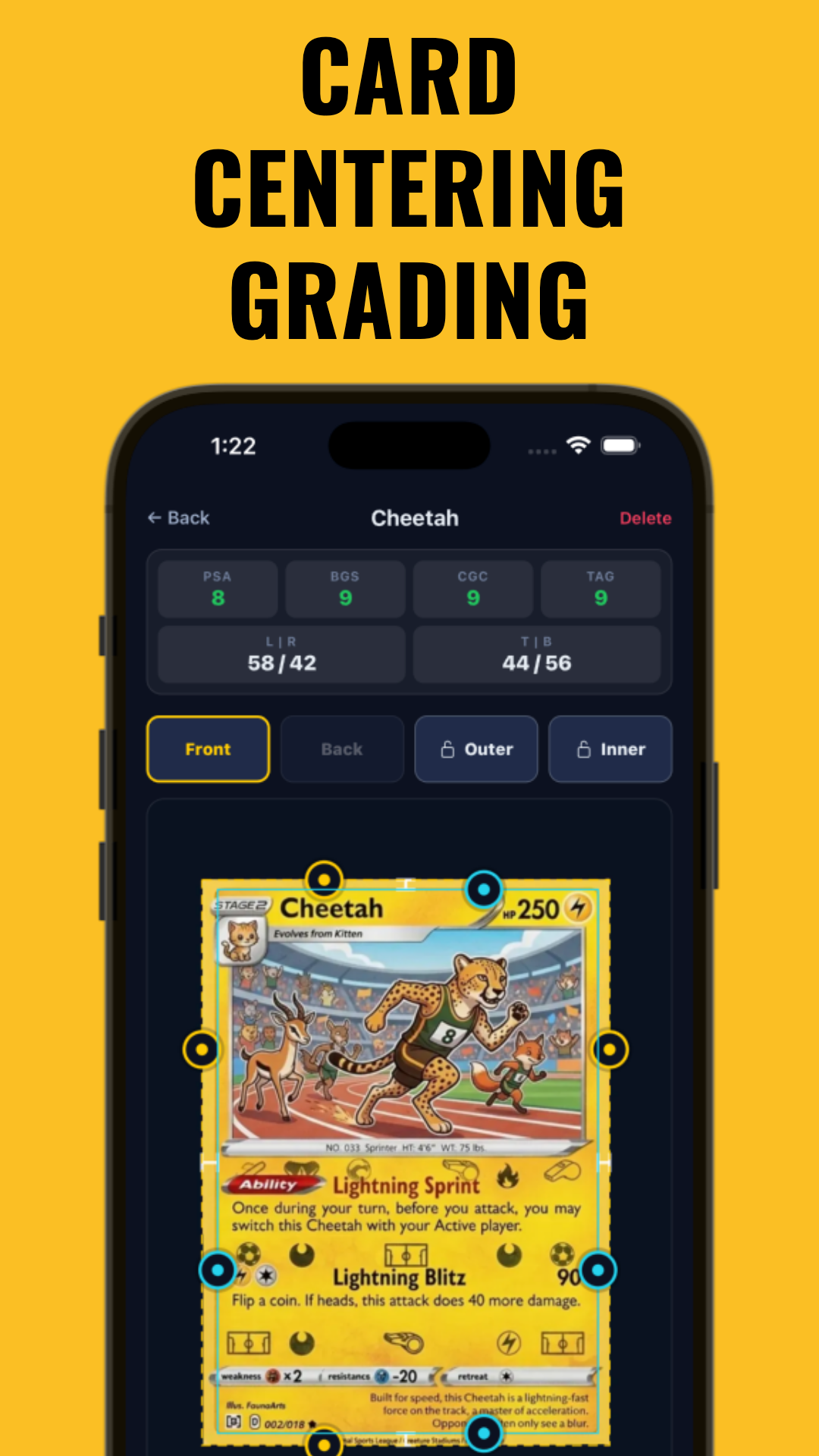
Using a millimeter ruler provides basic accuracy, but for precision, an edge centering tool or a digital centering calculator may be preferable. These tools analyze the image and borders, measuring down to fractions of a millimeter and automatically calculating centering ratios. Some apps provide estimates based on your measurements. For example, the Midpoint app allows uploading a card photo, then uses AI to detect edges and calculate centering metrics. For more on measuring centering precisely, see our Card Centering: The Definitive Guide for Grading and Collectors.
Common Measurement Challenges
Uneven lighting, card warping, or indistinct borders can make manual measurements tricky. Cards with colored or patterned borders also require careful observation to determine the true image edges, as the border color can blend with the image. Digital tools with AI-based edge detection can help identify border lines, even on cards with complex border designs or shadows. Additionally, worn or faded edges may obscure the true borders, requiring collectors to estimate carefully or use magnification tools.
Section 3: Measuring Centering on the Back of a Card
Why Back Centering is Evaluated
Many grading companies assess centering on both the front and back of a card. While the front centering is usually the primary focus, back centering can also impact the overall grade, especially for vintage and sports cards where printing and cutting inconsistencies were more common. Uneven back centering can indicate poor manufacturing or trimming, which may detract from the card’s perceived quality. For example, a 1950s baseball card with a severely off-centered back might be graded lower, even if the front is well-centered.
Measuring Back Centering
The process mirrors front measurement: compare the size of borders along all four edges on the back. For cards with plain backs, this is straightforward — measure the white or colored borders around the printed area. For cards with text or designs, identify the main printed area and measure the whitespace or border around it. Some cards feature asymmetrical back designs, requiring careful determination of the printed region’s edges. Consistency in measurement technique is key—collectors should measure at multiple points if borders are uneven to get an accurate average.
Impact of Back Centering on Grade
Some grading companies weigh back centering less heavily than front centering, but significant off-centering on the back can still reduce the final grade. For example, PSA may allow a slightly wider tolerance on back centering for some card types but penalizes extreme off-centering. Cards with back centering worse than 70/30 may be downgraded even if front centering is excellent. This is because back centering can affect the overall perception of card quality.
Section 4: Common Centering Standards and Ratios Explained
Understanding Centering Ratios
Centering is expressed as horizontal and vertical ratios, for example, 50/50, 55/45, 60/40, or 70/30. These ratios indicate the percentage split of the image between the two edges:
- 50/50: Near-perfect centering where the image is approximately centered, with nearly equal borders on both sides. This is rare and highly valued.
- 55/45: Slight off-centering but generally considered excellent and often meets top grading standards.
- 60/40: Noticeable off-centering, acceptable for mid-grade cards but often limits the highest grades.
- 70/30 or worse: Poor centering, often a grade-limiting flaw that can significantly reduce value.
These ratios are applied independently for horizontal and vertical centering. For instance, a card may have 55/45 horizontal and 60/40 vertical centering, which is typically acceptable but may not achieve the highest grade.
Grading Company Standards
Different grading companies have thresholds for acceptable centering ratios in their top grades. For example:
- PSA: For a PSA 10 Gem Mint, front centering is generally expected to be approximately 55/45 or better, with some allowance for vintage cards. Cards with centering worse than 60/40 are usually not eligible for PSA 10.
- BGS: Beckett Grading Services may have slightly wider tolerance but still require strong centering for high subgrades. For example, BGS may allow up to 65/35 centering for a 9.5 grade in some cases.
- CGC: Their grading follows similar standards but can vary by card type; modern cards often require tighter centering than older ones.
Examples of Centering Grades
A card graded PSA 10 with 55/45 centering is considered near-perfect in visual balance and highly sought after by collectors. In contrast, a card with 60/40 centering might receive a PSA 9 or lower, even if edges and surface are flawless, demonstrating how centering impacts the final grade. Understanding these standards helps collectors set realistic expectations before submitting cards for grading, potentially avoiding costly surprises. For more on grading standards and inspection, see our Card Condition: The Complete Guide to Grading, Inspection, and Value.
Section 5: Impact of Centering on Overall Grade and Eye Appeal
Centering’s Weight in Grading
Centering is one of the four main grading criteria, but its weight varies by company. PSA, for example, often treats centering as a critical factor limiting top grades, especially with modern cards. BGS and CGC consider centering important but balance it with corners, edges, and surface condition. For instance, a BGS 9.5 grade may allow slightly more centering variance compared to PSA’s stricter requirements. This weighting influences how collectors prioritize card flaws when submitting for grading.
Effects on Eye Appeal
Cards with poor centering can look visually unbalanced or off-putting, reducing their desirability. Even collectors without a rigorous grading background may notice a card that looks "crooked" or uneven, which affects emotional appeal. This, in turn, can impact market demand and price. For example, a 70/30 centered card may sell for less than a similar card with 55/45 centering due to diminished eye appeal.
Trade-Offs with Other Grading Aspects
A card with perfect edges, corners, and surface but poor centering may not achieve a top grade. Conversely, a card with excellent centering but minor surface flaws could receive a higher grade. Understanding these trade-offs helps collectors prioritize which flaws to accept. For example, some collectors may prefer a card with 55/45 centering and minor edge wear over a perfectly centered card with surface scratches, depending on their collecting goals.
Section 6: How to Check Centering at Home Using Tools
Using a Physical Ruler
Manual measurement with a millimeter ruler is the simplest method. Measure borders on each side carefully and calculate ratios. While inexpensive, this method requires patience, a steady hand, and good lighting. Multiple measurements may be necessary to ensure accuracy, especially if card edges are uneven or slightly warped.
Edge Centering Tools and Apps
Digital edge centering tools, like the Midpoint app, use AI to measure centering precisely. Simply upload a card image, and the tool calculates front and back centering ratios, helping you estimate grading scores. This can help avoid costly grading mistakes by identifying potentially grade-limiting off-centering, saving both time and money. Additionally, some apps allow batch uploads to analyze multiple cards at once, streamlining collection evaluation.
Benefits of Digital Centering Calculators
- Millimeter-level accuracy reduces human error.
- Instant front and back centering ratios provide immediate feedback.
- Integration with AI grading estimates offers comprehensive pre-grade analysis.
- Ability to track and compare multiple cards over time aids in collection management.
- Helps decide which cards to submit for professional grading, optimizing submission costs.
Section 7: Variations in Centering Tolerance by Card Type and Grading Company
Card Type and Era Differences
Vintage cards often have wider centering tolerances due to manufacturing limitations of the time, such as manual cutting and printing inconsistencies. Grading companies may allow more leniency with older cards, recognizing these historical constraints. For example, a 1950s Topps baseball card with 60/40 centering might still achieve a high grade. Conversely, modern cards, manufactured with precise machinery, are generally expected to have near-perfect centering, often 55/45 or better. For detailed insights on centering by card type, see Card Centering by Type: The Complete Guide for Pokemon, Sports, and More.
Grading Company Specifics
PSA is known for strict centering requirements in top grades, especially for modern and sports cards, emphasizing near-perfect balance. BGS may allow slightly more off-centering, especially for vintage cards, but penalizes heavily if extreme. CGC grading standards are similar but have nuances based on card series and type, sometimes factoring in card design. For example, CGC may account for unique border patterns in trading card games, adjusting centering expectations accordingly.
Examples
- A modern Pokémon card aiming for PSA 10 generally requires about 55/45 or better centering to qualify.
- Vintage baseball cards graded by BGS might be accepted with 60/40 centering ratios while still earning high grades.
- Magic: The Gathering cards may have unique grading considerations due to card design variations such as borders, holographic foils, and text placement, influencing centering expectations.
Section 8: Differentiating Edge Wear from Centering in Grading
What is Edge Wear?
Edge wear refers to physical damage along the card edges such as whitening, fraying, dings, or chipping. This is separate from centering but often occurs alongside it. Edge wear lowers the card’s grade by damaging the card’s structural integrity and visual appeal. For example, a card with perfect centering but visible edge whitening from repeated handling will receive a lower grade.
How Edge Wear Affects Grading
Even a perfectly centered card with visible edge wear may not earn a top grade. The grading companies assess edges independently, and severe wear can drop a card’s grade by one or more points. For example, a PSA 10 candidate might be downgraded to PSA 9.5 or lower due to edge wear, despite flawless centering. Edge wear tends to be more noticeable in high-grade submissions and is scrutinized closely.
Using Tools to Identify Edge Wear vs. Centering
Digital grading tools like Midpoint analyze both centering and edge condition. The app’s surface and edge detection algorithms highlight wear areas, helping collectors understand if their card’s grade is limited by centering or edge flaws. This clarity can aid in deciding whether to submit the card for professional grading or to attempt restoration. For example, Midpoint may flag a card as having 55/45 centering but visible edge whitening that could limit the grade, helping collectors avoid surprises.
Conclusion
Edge centering is an important factor in the grading and valuation of trading cards. Understanding how to measure centering correctly, recognizing common standards, and differentiating it from edge wear equips collectors to make informed decisions. Using precise edge centering tools, such as the AI-powered Midpoint app, can allow collectors to pre-grade cards, potentially save on costly submissions, and better understand their collection’s value. Whether evaluating vintage baseball cards or modern Pokémon cards, mastering edge centering measurement is a useful skill for card collecting.
For more detailed guidance on grading and centering, check out the comprehensive Card Centering Tool: Accurate Card Grading Estimates post and explore Midpoint’s capabilities at Midpoint.
FAQ
Q: What is edge centering in card grading?
A: Edge centering refers to how well the card’s printed image is aligned within the borders on all sides. It measures the symmetry of the image placement relative to the card edges, which is a key factor in grading. Good centering enhances visual appeal and can affect the card's grade.
Q: How do you measure centering on a sports card?
A: You measure the width of the borders on the left and right sides and the top and bottom, then calculate ratios comparing the smaller border to the larger one. This can be done with a ruler or digital edge centering tools for greater accuracy. Consistent lighting and multiple measurements improve accuracy.
Q: What centering ratio is needed for a PSA 10 or other top grade?
A: For PSA 10 Gem Mint, front centering generally needs to be about 55/45 or better. Other grading companies have similar but sometimes slightly different tolerances depending on card type and era. Vintage cards may have slightly looser standards.
Q: How much does centering matter compared with edges, corners, and surface?
A: Centering is often a critical factor limiting top grades, especially for PSA. However, edges, corners, and surface are also important. A flaw in any one area can reduce the overall grade, but centering is particularly influential in eye appeal and collector demand.
Q: Can you grade a card with off-centering but perfect edges?
A: Yes, a card with perfect edges but poor centering can still be graded, but its overall grade will likely be lower because centering is a major factor. The card’s grade reflects the combined condition of all aspects.
Q: How do grading companies calculate front and back centering?
A: They measure the borders on all four edges on both front and back, then express centering as horizontal and vertical ratios. These ratios determine how balanced the image is within the card borders and affect final grading decisions.
Free to start
Try the Midpoint app
Grade any card from a photo, see its raw and PSA 10 value, and track what your collection is worth — free.
Get it on iPhoneGet it on Android