How to Spot Off Center Magic Cards: The Complete How-To Guide
Learn how to spot off center Magic cards, Pokémon cards, and more. Step-by-step guide for checking centering and grading value in TCGs and sports cards.

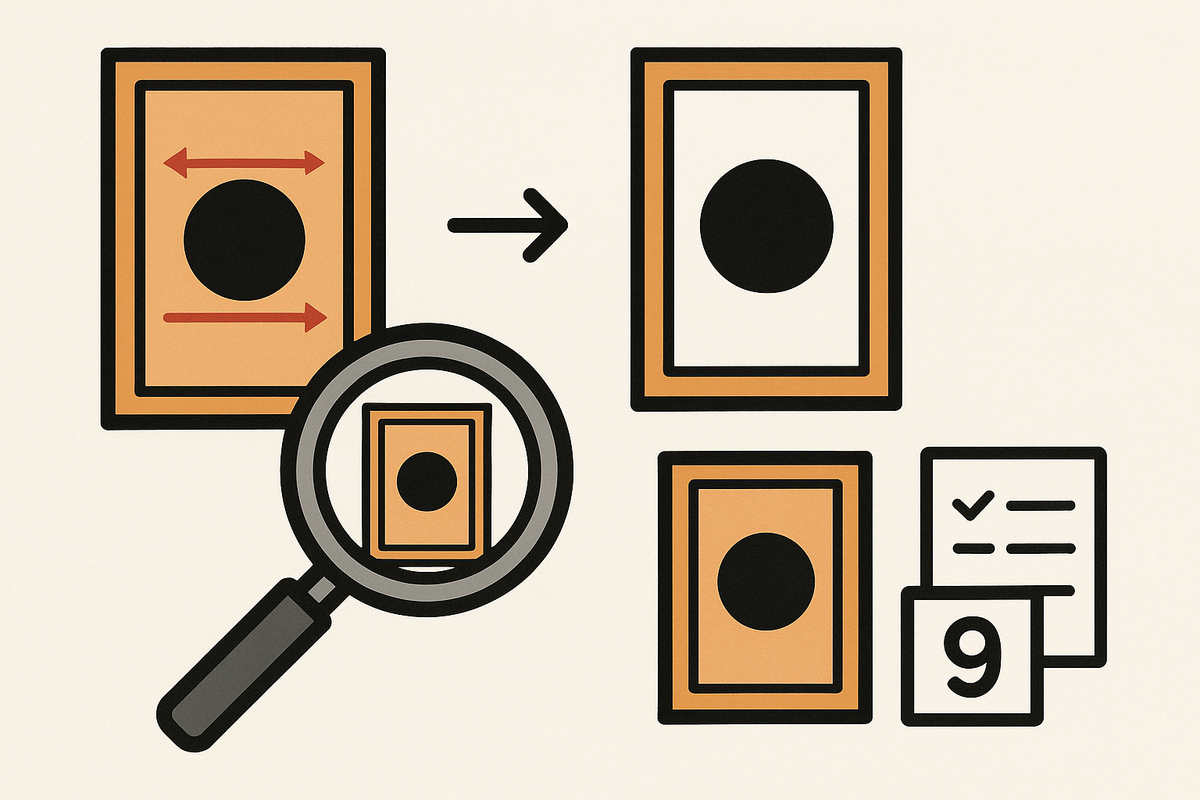
Estimated reading time: 9 min
Key Takeaways
- Spotting off center Magic cards is important for grading and value.
- Visual and precise measurement methods both matter for TCGs and sports cards.
- Front and back centering are judged separately by PSA, CGC, and others.
- Off-center cards can affect grade, value, and even collectability.
- Tools like Midpoint can make centering checks easier and more accurate.
If you've ever wondered how to spot off center Magic cards—or Pokémon, sports, Yu-Gi-Oh, or One Piece cards—you're not alone. Centering is a core part of how card grading companies like PSA, BGS, and CGC assign grades. Even small differences in card border width can mean the difference between a "Gem Mint" and a lower grade. This guide breaks down what off-centering is, how to spot it reliably, and why it matters for collectors and investors across all major trading card games and sports card types.
Step 1: Understand What Counts as Off Center vs Miscut
Before you start checking borders, it's important to know the difference between an off center card and a miscut. An off center card has uneven borders—one side is noticeably thicker than the other, but the entire print is still fully on the card. A miscut card means the print is so far off the intended position that you see part of another card, missing text, or the card is shifted beyond the border.
- Off center: Uneven left-right or top-bottom borders, but all content present.
- Miscut: Card design is cut off or shows part of another card; registration marks or alignment dots may be visible.
- Off-centering can lower the grade, while miscuts might be considered error cards and can be collectible.
This distinction is generally consistent across Magic (MTG), Pokémon, sports cards, One Piece, Yu-Gi-Oh, and vintage cards.
Step 2: Visually Inspect Borders (Left-Right & Top-Bottom)
Start by examining the card under good lighting. Place the card on a flat, neutral background. Look closely at the left, right, top, and bottom borders on the front—and then on the back. For Magic and Pokémon, border width is often most obvious on the front, while for sports cards, both sides matter equally.
- Squint Test: Hold the card at arm’s length and squint; imbalances in border width pop out.
- Compare to a Known-Centered Card: Place your card beside a confirmed centered card for reference.
- Use even, indirect lighting and avoid shadows or glare.
This quick check is useful for initial sorting, especially when buying online or reviewing lots.
Step 3: Measure Centering with Ruler, Caliper, or App
Visual inspection is helpful, but professional grading requires precise measurements. For the most accurate results, use a millimeter ruler, digital caliper, or a dedicated card centering app like Midpoint. Here's how to do it:
- Measure each border: Left, right, top, and bottom. Record the width in millimeters.
- Calculate centering ratios: Many grading companies use a ratio (e.g., 60/40 means one border is 60% of the total, the other 40%).
- Use a centering calculator: Enter your measurements for instant PSA, CGC, or BGS centering estimates with the free centering calculator from Midpoint.
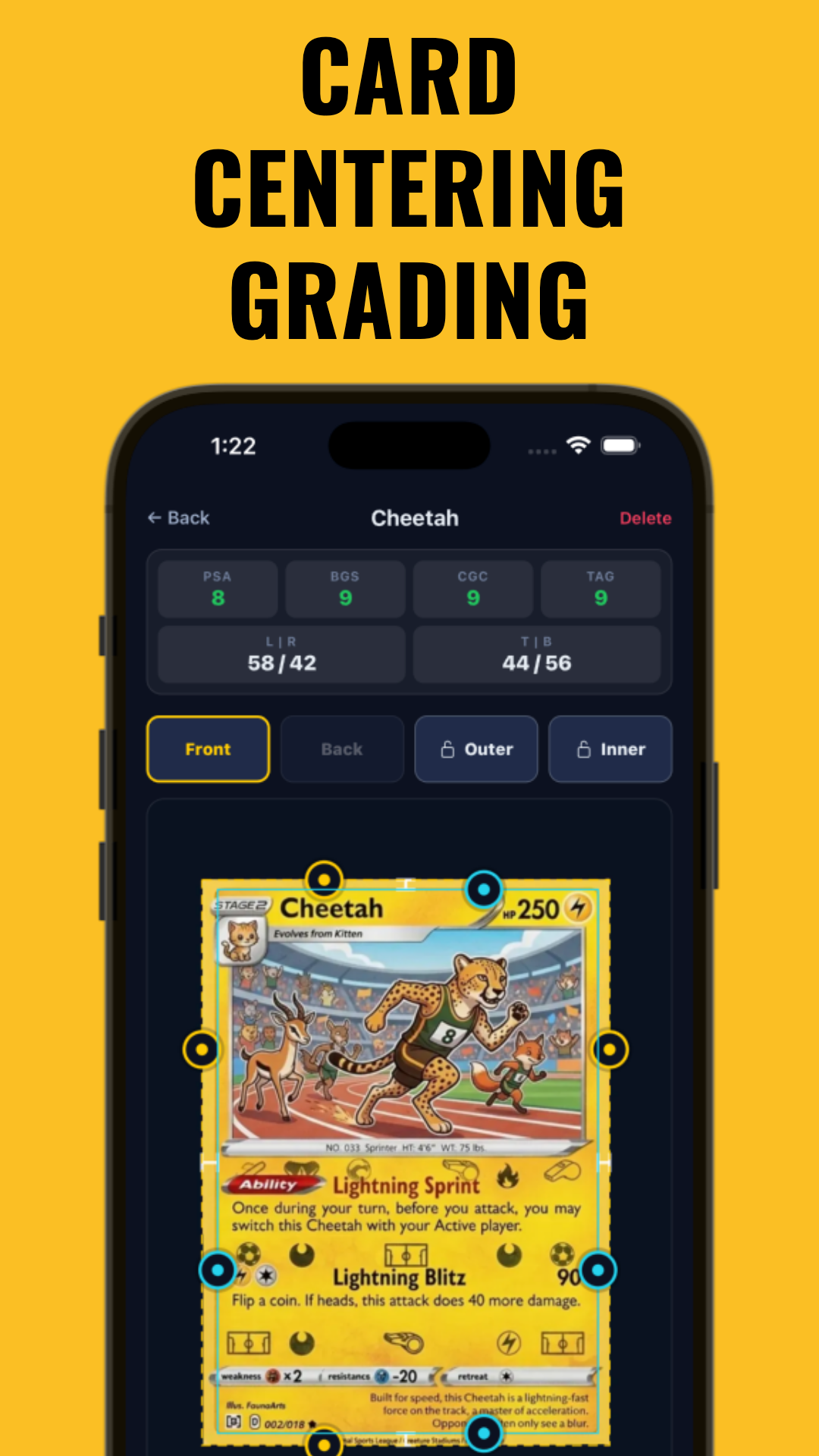
Apps can help reduce human error and are especially useful when pre-grading cards for submission. To see how AI is changing the game, check this AI-focused comparison.
Step 4: Check Front and Back Centering
Both sides matter! PSA, CGC, and BGS all judge front and back centering, but the front is usually weighted more. For example, a Magic or Pokémon card might have 60/40 centering on the front and 75/25 on the back and still get a high grade, but severe back off-centering can lower the overall grade.
- Front centering: Look for balanced frame around artwork and text box.
- Back centering: Check the colored border and placement of logos/text (especially important on Pokémon and vintage sports cards).
- Back centering Pokémon and sports cards is a common reason for grade deductions.
For more detail on how centering affects value, see this guide on centering and card value.
Step 5: Identify Alignment Dots, Registration Marks, and Print Defects
Sometimes, what looks like off-centering is actually a print defect, alignment mark, or even a sign of a counterfeit card.
- Alignment dots: Small colored dots near the border—common on some older Magic and Pokémon cards, especially on miscuts.
- Registration marks: Printing guides visible when the card is miscut or severely off-center.
- Print defects: Ink bleeding, missing color, or blurry text may indicate a print error or counterfeit.
Alignment dots themselves do not affect centering grade but can help identify true miscuts or authentic print runs. Learn more about grading standards and company differences in this post.
Step 6: Score Centering According to Grading Standards
Each grading company has its own thresholds for what's considered "centered." For example:
- PSA 10: 55/45 or better front, 75/25 or better back
- CGC Pristine: 50/50 to 55/45 front, 60/40 back
- BGS 9.5: 55/45 or better front, 60/40 back
Sports cards and vintage card centering often have looser requirements. Modern Pokémon, Magic, and One Piece cards are generally held to stricter standards. For how grading affects insurance and value, see this insurance value guide.
Step 7: Evaluate Collectibility and Value of Off-Center Cards
Most off-center cards are worth less, but not always. Some collectors prize severe miscuts or off-center errors as oddities, especially in older sets or low-population cards. For standard cards, however, off-centering usually means a lower grade and less value.
- "Error" cards (miscuts, extreme off-centering) can be collectible, especially for vintage cards.
- For most modern TCG and sports cards, centered examples tend to fetch higher prices and are easier to sell or insure.
Read more about low population card grading in this comprehensive guide.
Step 8: Avoid Common Pitfalls & Spot Fakes
Counterfeiters sometimes intentionally print off-center cards to mimic errors or hide flaws. Be wary of cards with inconsistent borders and other red flags:
- Compare with legitimate examples from trusted sources.
- Check for correct card stock, print texture, and alignment dots as described above.
- If in doubt, use a grading tool or seek a professional opinion.
For extra confidence, try the step-by-step pre-grading guide.
Tips & Common Mistakes
- Always measure both front and back centering—don't rely on just the front.
- Lighting matters: Use even, natural light for photo or visual checks.
- Don't confuse print defects or registration marks with off-centering alone.
- Remember, some vintage card sets are known for poor centering—research set norms before judging harshly.
- Use digital tools like Midpoint for consistent, error-free measurement.
Conclusion
Spotting off center Magic cards (or Pokémon, sports, and One Piece cards) is important for anyone looking to maximize value, whether submitting for grading or buying online. With practice, a ruler or app, and an understanding of grading standards, you can more confidently evaluate centering and make smarter collecting decisions. To streamline the process and estimate grades before spending money on submissions, try Midpoint—a way to measure and compare centering across all your cards.
FAQ
- How can you tell if a Magic card is off-center or just a miscut?
Off-center cards have uneven borders but all artwork and text are present. Miscuts are so off that part of the print is missing or another card is visible, sometimes with alignment dots or registration marks. - What is the easiest way to check Magic card centering at home?
Use a millimeter ruler or a card centering app like Midpoint. Measure all four borders and compare the ratios to grading standards for the most accurate results. - Do off-center Magic cards lower the grade?
Generally, yes. Most grading companies heavily factor in centering. Even a small off-center shift can mean the difference between a PSA 10 and 9 or lower. - Are off-center Magic cards worth more or less?
Usually less, since centered cards are more desirable and grade higher. However, extreme off-centering or miscuts can be sought after as error cards by some collectors. - How do you spot fake Magic cards that look off-center?
Watch for inconsistent borders, incorrect texture, blurry print, or fake alignment dots. Compare with real examples and use a tool for precise measurement if unsure. - What counts as an alignment dot on a Magic card?
Alignment dots are small colored circles near the card edge, used in the printing process. They often appear on miscut cards and don't affect centering grade, but can help indicate authenticity.
Free to start
Try the Midpoint app
Grade any card from a photo, see its raw and PSA 10 value, and track what your collection is worth — free.
Get it on iPhoneGet it on Android