
How CGC Determines Centering Grades: Complete Guide for Collectors
Learn how CGC determines centering grades for trading cards. Discover precise criteria, measurement tips, and how to estimate your card's grade before submission.


Estimated reading time: 13 min
Key Takeaways
- CGC uses strict, measurable centering standards for grading trading cards, impacting overall grade and value.
- Understanding CGC’s centering criteria helps you pre-grade and avoid costly surprises with professional submissions.
- Midpoint and similar digital tools can estimate centering grades before you spend on grading fees.
- Accurate measurement is crucial: even small centering shifts can reduce a card's grade tier.
- Centering requirements differ between front and back; know the cutoffs for top grades.
Table of Contents
- Section 1: Understanding CGC Centering Grades
- Section 2: CGC’s Centering Standards and Tolerances
- Section 3: The Measurement Process—How CGC Evaluates Centering
- Section 4: The Impact of Centering on Final Card Grades
- Section 5: Tools and Techniques for Measuring Centering Like CGC
- Section 6: How to Estimate Your CGC Centering Grade at Home
- Conclusion
- FAQ
Section 1: Understanding CGC Centering Grades
What Does 'Centering' Mean in Card Grading?
Centering refers to how evenly the printed area of a trading card is positioned within its borders. Imagine a card with artwork, colored frames, and sometimes stats or text printed inside a white or colored border. Perfect centering means the borders on all four sides—top, bottom, left, and right—are equal or nearly so, giving the card a balanced, symmetrical look. Off-center cards are those where one or more borders are visibly thicker or thinner. This imbalance can occur due to misalignment during the card’s cutting or printing process, and it’s common in both vintage and modern cards. Centering is one of the four main subgrades in card grading (alongside corners, edges, and surface), and it’s highly visible to the naked eye, making it especially important to collectors and investors.
Why Is Centering So Important?
- Visual Appeal: Evenly-centered cards look more attractive and balanced in a collection or display. Human perception is particularly sensitive to symmetry, so a perfectly centered card creates an immediate impression of quality and care in manufacturing. In high-end collections, cards with perfect or near-perfect centering often stand out visually even before any other flaws are noticed.
- Value Driver: Poor centering can significantly lower a card’s value, even if other aspects (corners, surface, edges) are flawless. For example, two cards with identical grades on corners, surface, and edges can have noticeably different market prices if one has 50/50 centering and the other is 75/25. In some cases, a single centering subgrade can drive a substantial price difference for especially rare or desirable cards.
- Grade Limiter: In many cases, centering is the single subgrade that caps the overall grade a card can achieve. For instance, a card with perfect corners, edges, and surface but with centering outside the tolerance for a Gem Mint (9.5) grade will be limited to a lower overall grade, like Mint (9) or lower. This is why centering is often the first thing experienced collectors evaluate before submitting cards for grading.
CGC’s Place Among Grading Companies
Certified Guaranty Company (CGC) is a trading card grading service, especially known for grading Pokémon, sports, and TCG cards. Founded in 2000, CGC has built a reputation for transparency, consistency, and a scientific approach to grading. Their centering criteria are considered rigorous and transparent, making it possible for collectors to predict centering grades if they know what to look for. CGC’s detailed online population reports and published grading standards make it easier for submitters to understand how their cards will be evaluated, which is particularly valuable in a hobby where minor differences can mean major changes in value.
Section 2: CGC’s Centering Standards and Tolerances
The Published Standards
CGC provides explicit centering standards for their main grading tiers. These requirements are based on the ratio of the narrowest border to the widest border, both for the front and the back of the card. The ratios are typically expressed as percentages, such as "55/45 or better" for certain grades. These standards are published on CGC’s website and appear on their grading guides and submission forms, providing submitters with clear benchmarks before sending in their cards.
- Front Centering: The ratio of the narrowest to widest border, measured in percent. For example, if the narrowest border is 2mm and the widest is 4mm, the centering ratio is 2/4 = 50%. This ratio is compared to CGC’s published cutoffs for each grade.
- Back Centering: Usually more lenient, given less weight in the final grade. The back is less visible when cards are displayed, so grading companies allow for more variation here. The ratios for the back are always more generous than the front, reflecting this difference in importance.
CGC Centering Guidelines by Grade
- CGC 10 (Pristine): 50/50 on the front; 60/40 or better on the back. This means each border on the front must be nearly identical, and the back can have up to a 60/40 split between narrowest and widest side.
- CGC 9.5 (Gem Mint): 55/45 or better front; 65/35 back. The front can be slightly off but still must appear nearly perfect to the naked eye.
- CGC 9 (Mint): 60/40 or better front; 70/30 back. This allows for some visible but not severe off-centering.
- CGC 8.5 (NM-MT+): 65/35 or better front; 75/25 back. At this level, off-centering is more noticeable but not extreme.
- CGC 8 (NM-MT): 70/30 or better front; 80/20 back. Borders may be uneven but not so much as to be distracting or unsightly.
These cutoffs mean that even a slight deviation from perfect centering can cost a card a full grade or more. For example, a card with 56/44 centering on the front would not qualify for a Pristine 10, but could receive a 9.5. The front centering is much stricter than the back, as it's more visible and impactful, especially for display purposes. Such precise standards encourage careful examination before submission.
Why These Tolerances Matter
- Objectivity: Tolerances reduce subjectivity between different graders. By using precise measurements, CGC aims to ensure that two graders evaluating the same card will likely reach the same centering subgrade, reducing disputes and increasing confidence in the grading process.
- Consistency: Collectors can trust that two cards with similar centering will receive similar grades. This consistency is important for maintaining the integrity of the graded card market, allowing buyers and sellers to transact confidently based on the grade assigned by CGC.
- Transparency: By clearly publishing these tolerances, CGC allows submitters to pre-grade their cards and set realistic expectations. This reduces disappointment and surprises upon receiving graded cards back from the company.
Section 3: The Measurement Process—How CGC Evaluates Centering
Step-by-Step Measurement
CGC graders use a consistent process to evaluate centering. This process is designed to help ensure objectivity and repeatability, even with cards featuring complex designs or non-standard borders. Here’s how the process typically unfolds:
- Visual Inspection: Graders first visually inspect the card for obvious off-centering. Cards with severe centering issues can often be identified at a glance, but for borderline cases, precise measurement is always performed.
- Measuring Borders: Using precision tools, such as millimeter rulers or digital overlays, graders measure the distance from the card’s edge to the start of the printed area (artwork or colored frame) on all four sides. Measuring is typically done to the nearest 0.1 mm for accuracy. For cards with irregular or colored frames, graders are trained to identify the correct reference points.
- Record Measurements: The grader records the narrowest and widest border measurements. For example, if the top border is 2.2mm, the bottom is 3.0mm, left is 2.4mm, and right is 2.3mm, the narrowest border is top (2.2mm), the widest is bottom (3.0mm).
- Calculate Ratio: The centering ratio is calculated as (narrowest border ÷ widest border) × 100. This result is then compared to CGC’s published cutoffs for each grade tier.
- Repeat for Back: The process is repeated for the back of the card, using the same methodology but comparing to more lenient standards.
Example Calculation
Suppose a card’s top border is 2mm and its bottom border is 3mm. The centering ratio is 2/3 × 100 = 66.7%. If the left and right borders are 2.5mm each, then the card is slightly off-center vertically but not horizontally. The lowest ratio (vertical in this case) is what counts for grading. So this card would fall into the 65/35 range, which is typically eligible for a CGC 8.5 (NM-MT+) but not higher. If the card’s back had borders of 2.8mm and 3.0mm, that’s roughly 93%, easily within all back centering tolerances. However, since the front is off, the overall grade will be limited accordingly.
Another example: If a card’s front left and right borders measure 2mm and 2.5mm, and top and bottom are both 2.2mm, the worst ratio is 2/2.5 = 80%. This would not qualify for even a CGC 8, as the minimum for that grade is 70/30 or 70%. Cards with centering below this threshold would receive a lower grade or possibly be designated as "OC" (off-center) in extreme cases.
Measurement Tools
- Physical Rulers: Used for quick checks but can introduce parallax errors if the ruler isn’t perfectly aligned with the card or if viewed at an angle. They are best used in well-lit environments with flat, glare-free surfaces.
- Digital Tools: Apps like Midpoint use enhanced edge detection and overlays for accurate, repeatable measurements. These tools can identify borders and measure distances in pixels, converting them to mm based on card dimensions. Digital tools are especially useful for cards with intricate designs or when measuring large quantities.
- Custom Gauges: Some collectors and dealers use transparent acrylic gauges printed with grid lines to quickly assess centering. These are less precise than digital methods but can be helpful for batch sorting cards before submission.
Section 4: The Impact of Centering on Final Card Grades
How Subgrades Work at CGC
CGC employs a subgrade system, scoring centering, corners, surface, and edges separately on a 10-point scale, often in 0.5 increments. The lowest subgrade typically determines the maximum possible overall grade, making centering a frequent grade limiter. For example, if you have subgrades of 10 for corners, surface, and edges, but centering is 8.5, the highest overall grade your card can achieve is 8.5, unless the difference between subgrades is less than a full point, in which case CGC may use half-point increments for the final grade. This system is designed to reward "well-balanced" cards but penalize cards with a single major flaw, such as poor centering.
- Example: If your card is perfect in all areas but centering is 70/30, the highest grade possible may be a CGC 8 (NM-MT). This means that even if your card is otherwise flawless, centering alone can limit its value and desirability, especially for high-end collectors who seek only the top grades.
Market Impact of Centering Grades
- Collectors and buyers often pay premiums for cards graded CGC 9.5 or 10, which require strict centering. For example, a modern Pokémon card graded CGC 10 with perfect centering may sell for significantly more than an identical card graded CGC 9 due to centering alone.
- Cards with sub-70/30 centering can lose a substantial portion of their potential market value compared to perfectly centered examples. For vintage cards, buyers may be more forgiving, but significant off-centering will still result in noticeable price reductions. The difference in realized auction prices for the same card in different centering grades can be significant, especially for iconic cards like 1st Edition Charizards or rookie sports cards.
- Off-center cards are often harder to sell, remain longer in inventory, or must be discounted to attract buyers, especially in higher-end card markets where visual perfection is expected.
Comparison to Other Graders
CGC’s centering tolerances are similar to PSA and BGS, but slight differences exist in how strict each company is at the highest grade tiers. For instance, PSA’s Gem Mint 10 allows for 55/45 front centering, while CGC’s Pristine 10 requires 50/50, a more stringent standard. BGS (Beckett Grading Services) uses similar numeric ratios, but their subgrade weighting can differ, with centering sometimes weighted less if the card is otherwise flawless. For a deeper analysis of grading company differences, see this detailed comparison of card grading estimates. Knowing these differences can help you decide where to submit your card for grading based on its centering.
Section 5: Tools and Techniques for Measuring Centering Like CGC
Manual Methods
Traditional collectors often use a millimeter ruler or a centering gauge. The process involves:
- Measuring all four borders from the card edge to the colored frame or artwork edge. Consistency is crucial: always measure from the same reference point on each side of the card, especially for cards with thick or decorative borders.
- Recording the narrowest and widest measurements, then calculating the ratio by dividing the smaller by the larger and multiplying by 100.
- Comparing the result to CGC’s published standards. For cards where the difference is small, repeat measurements to reduce error. It can help to measure each side multiple times or have a second person check your work.
This method can be accurate with practice but is prone to human error or misreading. Parallax (viewing at an angle), uneven lighting, or slight variations in where you start or end your measurement can all lead to inaccurate results. For high-value submissions, double-checking your work is highly recommended.
Digital and AI-Powered Tools
Modern technology, including apps like Midpoint, leverages computer vision and AI to automate the centering analysis:
- Upload a scan or high-quality photo of your card. Scanning is preferred for the highest accuracy, but a well-lit, glare-free smartphone photo will suffice for most purposes.
- The tool detects card edges and artwork boundaries automatically, using edge detection algorithms trained on card images. This removes the guesswork from finding the correct reference points, even for cards with complex or non-standard designs.
- Instantly calculates centering ratios for front and back, matching CGC grading standards. Many tools also provide a visual report showing the measured borders and calculated ratios, making it easy to see where your card stands.
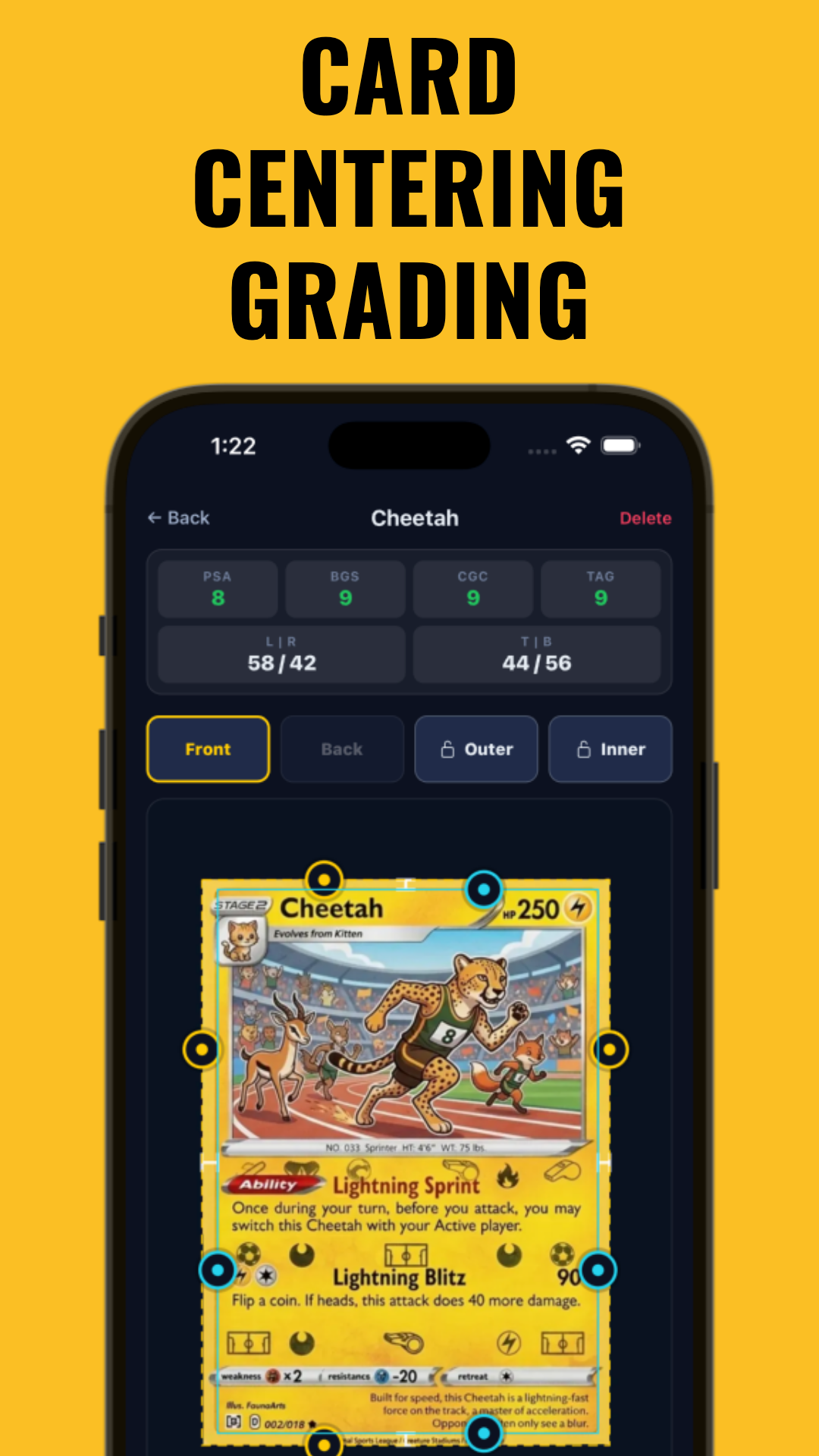
Advantages of Digital Analysis
- Reduces measurement bias and human error. By using algorithms to analyze each border, digital tools help ensure repeatable, objective results regardless of user experience.
- Provides a report you can use to predict your card’s possible centering subgrade, which is especially useful when deciding which cards to submit for professional grading.
- Saves time, especially when pre-grading multiple cards for submission. For dealers or collectors with dozens or hundreds of cards, digital tools can process batches quickly, flagging only those with centering issues for closer inspection.
- Works for all card types, including modern, vintage, sports, and TCG cards, by adjusting for standard card sizes and aspect ratios.
Section 6: How to Estimate Your CGC Centering Grade at Home
Step 1: Prepare Your Card
- Use a clean, well-lit surface to avoid shadows or glare in photos. Natural daylight or a diffuse LED lamp works best. Avoid direct overhead light that can cast harsh reflections.
- Place the card flat and align it perpendicular to the camera or scanner. For best results, use a scanning bed or a tripod to keep the camera steady and parallel to the card surface.
- Clean the card gently with a microfiber cloth to remove dust and fingerprints, which can interfere with digital measurement tools and reduce image quality.
Step 2: Measure Carefully
- For manual measurement, use a high-quality millimeter ruler. Place the ruler flush with the card's edge and read each measurement at eye level to avoid parallax. For cards with intricate borders, use a magnifying glass or jeweler’s loupe for greater accuracy.
- For digital measurement, upload your image to a card centering app like Midpoint. Make sure the image is in focus, with the entire card visible and no cropping. Most apps will guide you through the process, highlighting detected borders and providing instant feedback.
- Always measure both the top/bottom and left/right borders. Some cards have known print shifts that affect only one axis, so both directions must be checked separately.
Step 3: Calculate Your Ratios
- Front: Measure top, bottom, left, and right borders. Write down each value, then identify the smallest and largest borders. Divide the smallest by the largest and multiply by 100 to get the centering percentage. For example, borders of 2.0mm, 2.5mm, 2.1mm, and 2.3mm give a lowest of 2.0mm and highest of 2.5mm, so 2.0/2.5 x 100 = 80%.
- Back: Repeat the process for the back of the card. The same method applies, but remember that CGC’s back centering standards are more forgiving. For example, a back with 2.5mm and 3.3mm borders would be 2.5/3.3 x 100 = 75.8%, which meets the threshold for an 8.5 grade or higher.
- For cards with colored or patterned borders, measure from the outer edge to the first solid line or color change that marks the printed area. For cards with "full bleed" designs, use the artwork or text as reference points, and consult grading guides for specific card sets if needed.
Step 4: Match Your Results to CGC Standards
- Compare your calculated ratios to the CGC tolerances listed above. If your front centering is 55/45 or better and back is at least 65/35, your card could be eligible for a CGC 9.5 or higher, assuming other subgrades are strong.
- If your card’s front centering is 58/42, it’s eligible for CGC 9.5 or below, not 10. Cards with 70/30 front centering are likely limited to a CGC 8 (NM-MT) or lower.
- It's important to note that even if your card just barely meets a cutoff (e.g., 60/40 for a Mint 9), any small measurement error could push it into the next lower grade. When in doubt, round down or re-measure with a different tool.
Step 5: Consider Pre-Grading
If you’re preparing a submission, accurate pre-grading can save time and money. Many collectors use tools like Midpoint as a first pass to screen out cards unlikely to achieve top centering subgrades. This approach is especially valuable for bulk submissions, where grading fees add up quickly. For a hands-on guide, see our step-by-step pre-grading tutorial and this in-depth measurement guide for more tips.
Remember, centering is just one component of the final grade. However, since it is often the grade limiter, being meticulous with your centering evaluation can dramatically improve your submission success rate and maximize your return on grading fees. If you’re unsure, consider consulting with experienced collectors or submitting only your best-centered cards for the highest grades.
Conclusion
Understanding how CGC determines centering grades is important for anyone looking to maximize card value and avoid costly grading surprises. By knowing the precise standards, measuring accurately, and leveraging tools like Midpoint, collectors can make informed submission decisions—saving money and increasing the odds of high grades. Whether prepping a single card or an entire collection, centering is a key factor you can control.
With the growing popularity of trading card investing, the ability to predict grades and submit only your best cards is more important than ever. Pre-grading your cards—especially for centering—helps you prioritize submissions, manage expectations, and avoid disappointment. Digital tools like Midpoint provide a practical way to analyze centering quickly and objectively, reducing human error and giving you the confidence to submit cards with the highest chance of achieving premium grades.
As grading standards continue to evolve and the market matures, mastering the skill of evaluating centering will remain a fundamental edge for collectors, dealers, and investors alike. For more tools and resources, visit Midpoint or explore our guides on advanced card grading techniques. With knowledge, precision, and the right technology, you’ll maximize your collection’s value and enjoyment for years to come.
FAQ
Q: How strict is CGC on centering compared to PSA or BGS?
A: CGC’s centering standards are similar to PSA and BGS, but they publish clear percentage tolerances for each grade tier. At the highest levels (9.5 and 10), their requirements are very strict, often matching or slightly exceeding those of other grading companies. For instance, CGC’s Pristine 10 requires true 50/50 centering on the front, whereas PSA’s Gem Mint 10 allows for 55/45. This means cards that just miss a 10 at CGC might still achieve a 10 at PSA or BGS, but all three companies are rigorous for high grades. If you are targeting top market value and have a perfectly centered card, it will be competitive across all major grading companies.
Q: What’s the easiest way to check if my card meets CGC’s centering requirements?
A: The simplest method is to use a digital tool like Midpoint, which automatically measures and compares your card’s centering to CGC’s published standards. These tools use edge detection to find the narrowest and widest borders and do the math for you. Manual measurement with a ruler works but is less precise—especially for cards with non-standard borders or artwork that is difficult to interpret. For high-value cards, digital analysis is recommended to minimize surprises.
Q: Does CGC weigh front and back centering equally?
A: No. CGC’s grading formula gives more weight to the front centering. Back centering is judged by more forgiving standards and has less impact on the overall grade, especially for premium tiers. For example, a card with near-perfect front centering and a back at the lower end of the tolerance can still achieve a high grade, but a card with poor front centering cannot. This reflects the fact that collectors display and view cards from the front.
Q: Can bad centering alone drop my card’s grade?
A: Yes. If your card’s centering falls outside the grade tier’s published tolerance, it can limit the maximum grade, even if corners, edges, and surface are flawless. For example, a card with 70/30 front centering cannot receive a grade higher than CGC 8, regardless of the other subgrades. This is why centering is often the make-or-break factor for high-end submissions.
Q: Are there ways to improve a card’s centering?
A: No. Centering is determined during the printing and cutting process and cannot be improved post-production. Accurate pre-grading is the best way to manage expectations before submitting for grading. If you want better-centered cards, the only option is to acquire additional copies and select the best example for submission. Some collectors "crack and resubmit" cards to different grading companies hoping for a better centering evaluation, but the actual centering cannot be changed after manufacture.
Free to start
Try the Midpoint app
Grade any card from a photo, see its raw and PSA 10 value, and track what your collection is worth — free.
Get it on iPhoneGet it on Android