How to Know What Grade a Card Will Get: Your Definitive Guide
Learn how to know what grade a card will get with expert tips on grading factors, PSA vs BGS, and using AI tools like Midpoint for accurate estimates.


Estimated reading time: 12 min
Key Takeaways
- Understand the four main grading factors: centering, corners, edges, and surface.
- Learn the differences between PSA, BGS, CGC, and TAG grading scales and fees.
- Use AI-powered tools like Midpoint to digitally pre-grade and estimate card value.
- Know when a card may be worth grading based on condition and market value.
- Follow a thorough pre-submission checklist to help maximize your card’s grade and value.
Getting your trading cards professionally graded can potentially increase their value and desirability, but how do you know what grade a card might receive before submitting it? This guide covers how card grading generally works, what graders typically look for, the differences between major grading companies, and how to use modern card grading apps like Midpoint to estimate your card’s grade quickly.
Step 1: Understanding How Card Grading Works
Card grading is the process of evaluating a trading card's condition using standardized criteria, then assigning it a numeric grade, usually on a 1 to 10 scale. This grade helps buyers and sellers understand the card’s quality and value in the marketplace.
The four main grading factors that professional graders assess are:
- Centering: How well the card’s image is centered within its borders.
- Corners: The sharpness and condition of the four corners.
- Edges: The smoothness and wear along the edges of the card.
- Surface: The card’s front and back surfaces, checking for scratches, stains, whitening, creases, or dents.
Each factor impacts the overall grade differently, with centering often considered critical for top grades like PSA 10 (Gem Mint).
Step 2: Learn the 1–10 Grading Scale and PSA vs BGS vs CGC
Most grading companies use a 1–10 scale, where 10 is "Gem Mint" and 1 is "Poor." However, grading nuances differ:
- PSA (Professional Sports Authenticator): Uses a 1–10 scale focused on overall card condition. PSA 10 is Gem Mint, generally prized for near-perfect centering and a flawless surface.
- BGS (Beckett Grading Services): Uses subgrades for centering, corners, edges, and surface, averaging them. BGS 10 is "Pristine," considered a step above Gem Mint.
- CGC (Certified Guaranty Company): Similar to BGS with subgrades and a 1–10 scale, popular for non-sports cards.
- TAG, SGC, and others: Each has unique scales and labels; check their websites for details.
Knowing the differences can help you choose the best grading company for your card type and goals. For a detailed comparison, see Grading Scale Differences by Company: PSA, BGS, CGC & the True Meaning of Top Grades.
Step 3: Inspect Your Card Like a Pro: Lighting, Magnification, Front & Back
Before grading, you should evaluate your card carefully under proper conditions:
- Lighting: Use bright, natural daylight or a daylight-balanced LED lamp to reveal imperfections.
- Magnification: Use a 10x magnifier or jeweler’s loupe to spot minor scratches, surface dents, or print defects.
- Front and Back Inspection: Look for whitening edges, scratches, dents, creases, stains, or any discoloration.
Document flaws and note their severity—minor surface wear can still yield a high grade, but creases or deep scratches usually lower it significantly.
Step 4: Measure Centering Precisely Using Tools and Apps
Centering is often considered one of the most important factors for top grades. PSA’s centering standards for a PSA 10 typically require a centering ratio no worse than 55/45 on the front and 75/25 on the back, though exact thresholds may vary.
Use a card grading tool like Midpoint to measure centering down to the millimeter. Midpoint’s AI-powered centering calculator provides instant digital grading estimates based on your card’s centering, corners, edges, and surface quality.
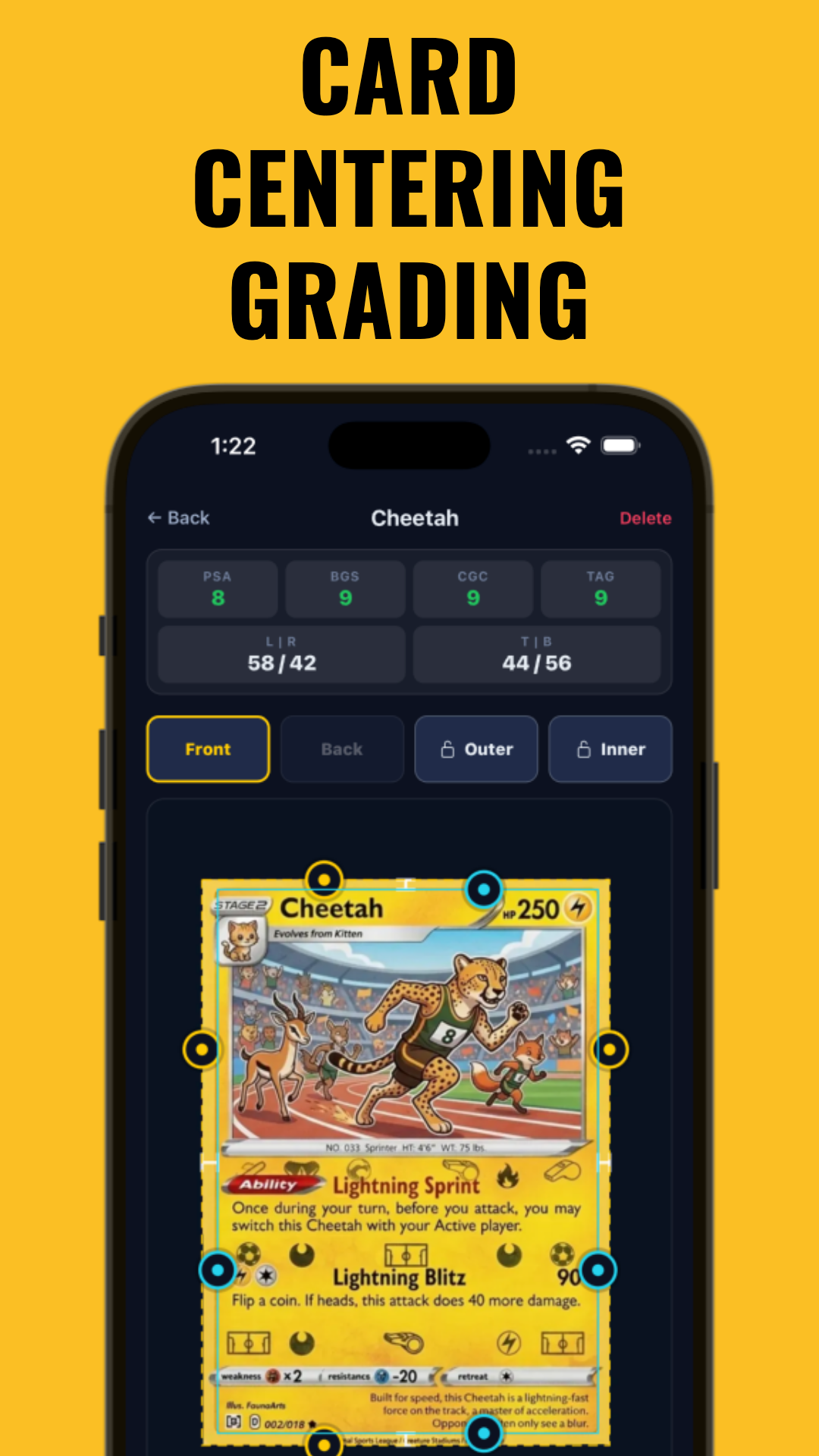
Accurate centering measurement can help you decide if your card is a good PSA 10 candidate or if it’s better suited for a lower grade submission or no grading at all.
Step 5: Evaluate Card Flaws and Their Impact on Grade
Certain flaws tend to hurt a card’s grade more than others:
- Severe creases or dents: Usually cause significant grade reduction.
- Corner wear: Rounded or frayed corners typically lower the grade.
- Edge chipping or whitening: Edges with visible wear generally reduce the score.
- Surface scratches or stains: These flaws affect surface subgrades, impacting overall grade.
Minor imperfections can keep a card in the 8–9 range, but severe defects will push it lower. For example, a card with perfect centering but visible surface scratches might receive a PSA 9 rather than a 10.
Step 6: Decide If Your Card Is Worth Grading
Not every card is worth the cost and wait time of professional grading. Consider these factors:
- Raw card value: Cards worth less than $20–30 rarely justify grading fees, which can start at $20–30 per card.
- Potential grade impact: Cards with obvious flaws or poor centering often don’t benefit from grading.
- Market demand and rarity: High-demand or rare cards can see a value increase with a PSA 10 or BGS 9.5 grade.
Digital grading apps like Midpoint can help simulate your card’s grade and expected market value, so you can make more informed decisions before submitting.
Step 7: Understand Grading Costs and Turnaround Times
Grading costs depend on the service level and turnaround time you choose:
- PSA grading fees: Range from around $20 for economy submissions to $150+ for express turnaround. Prices vary by card value and service tier.
- BGS and CGC: Have similar fee structures, often with additional fees for subgrade details or autograph verification.
- Turnaround times: Can vary from weeks to several months depending on service level and demand.
Always check the official grading company websites for current pricing and submission windows. Learn more about how to submit cards to PSA properly.
Step 8: Use a Pre-Grading Checklist and Tools at Home
Before sending cards in, do a final home evaluation:
- Clean your cards gently with a microfiber cloth to remove dust and fingerprints.
- Measure centering precisely using tools or apps like Midpoint’s free centering calculator (Free Centering Calculator).
- Use a magnifier to spot subtle surface flaws or edge wear.
- Photograph your card clearly for records and insurance.
Following a checklist can reduce surprises and help you submit only cards with strong grading potential.
Tips & Common Mistakes
- Don’t submit cards with obvious defects hoping for a high grade—this can waste money and time.
- Use AI digital grading tools like Midpoint early to avoid costly grading mistakes.
- Understand each company’s grading scale to set realistic expectations.
- Remember vintage and holographic cards often have different grading considerations than modern base cards.
- Keep your cards stored properly to maintain condition—see our guide on How to Store Valuable Cards.
Conclusion
Knowing what grade a card might receive before submitting it can help save you time and money. By understanding how card grading works, inspecting your card carefully, measuring centering precisely, and using AI grading tools like Midpoint, you can gain a clearer perspective in the grading process. This can empower you to confidently submit cards that have strong potential for high grades and maximize your collection’s value.
FAQ
How do I tell if my card is a PSA 10?
A PSA 10 generally requires near-perfect centering (typically 55/45 or better), sharp corners, clean edges, and a flawless surface without scratches, stains, or whitening. Using a grading app like Midpoint can give you an estimate of your card’s PSA 10 potential.
What are the main things graders look at on a card?
Graders focus on four main factors: centering, corners, edges, and surface quality on both front and back. Each impacts the final grade differently.
How centered does a card need to be to grade a 10?
For PSA, an ideal PSA 10 centering ratio is generally no worse than 55/45 on the front and 75/25 on the back. Other companies have similar but slightly different standards.
What flaws lower a card grade the most?
Severe creases, dents, rounded corners, edge chipping, and surface scratches or stains usually reduce a card’s grade significantly.
Is it worth grading my card or should I leave it raw?
Consider the card’s raw value, condition, and market demand. Use digital grading tools to simulate the grade and value before paying grading fees.
How do I check card condition at home before sending it in?
Inspect under bright natural light with a magnifier, measure centering using apps or tools, clean the card gently, and photograph it for records.
Free to start
Try the Midpoint app
Grade any card from a photo, see its raw and PSA 10 value, and track what your collection is worth — free.
Get it on iPhoneGet it on Android