Lamar Jackson Cards Worth Money: A Collector’s Complete Guide
Discover which Lamar Jackson cards are worth money, from rookie card value to PSA 10 grades and rare parallels. Learn what to grade and how to track value.

Estimated reading time: 12 min
Key Takeaways
- Lamar Jackson rookie cards and high-end parallels generally hold the most value for collectors, often commanding premium prices in the secondary market.
- PSA 10 graded cards typically command higher prices than raw versions, sometimes several times the raw card value depending on the card and set.
- Centering, edges, surface, and print run rarity affect card worth; even minor defects can reduce value substantially.
- Digital grading tools like Midpoint can help estimate card grades before costly submissions, providing detailed analysis on centering percentages and condition metrics.
- Recent market trends show demand for National Treasures, Prizm Silver, and Optic Holo cards, with some limited parallels appreciating over time.
Card values — live data from Midpoint's card database, as of 2026-08-30. Prices move; Midpoint refreshes these daily.
| Card | Raw | PSA 10 | Gem premium | |
|---|---|---|---|---|
 |
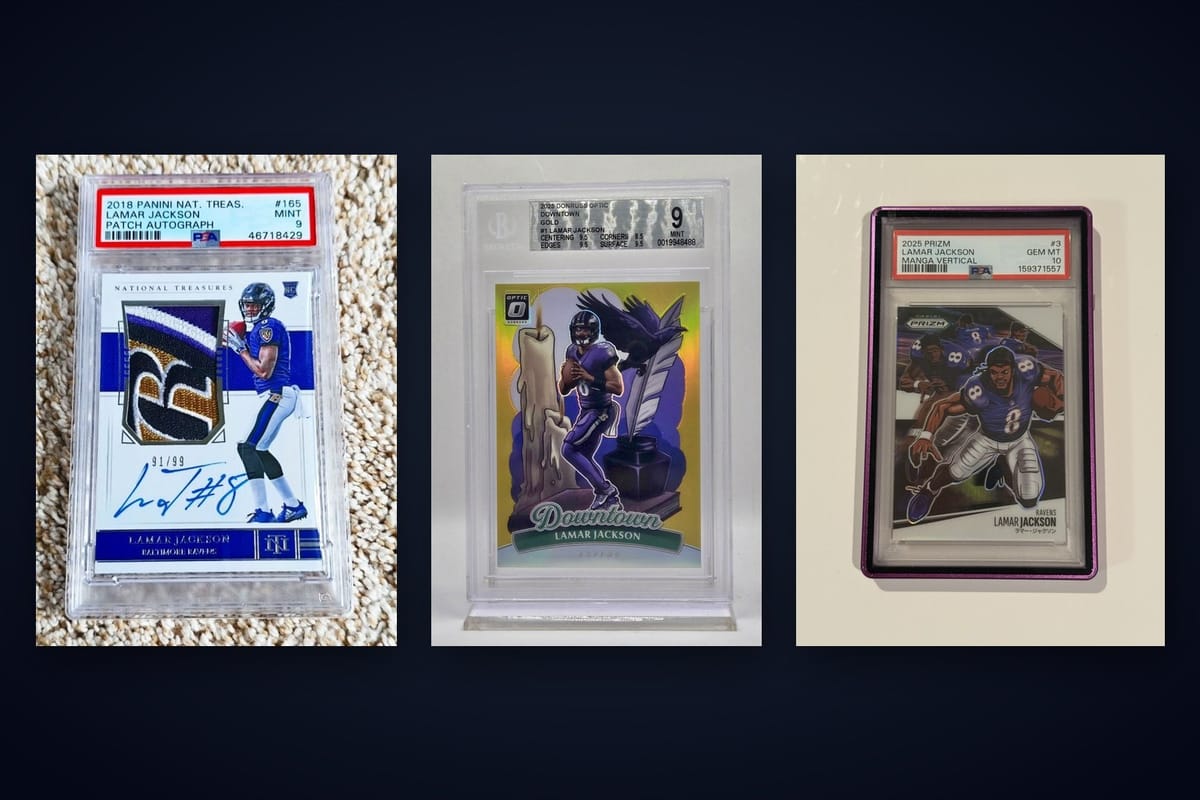
Lamar Jackson #165 2018 National Treasures Patch Autograph |
$9,588 | $41,672 | 4.4× |
![Lamar Jackson [Gold] #1 2025 Panini Donruss Optic Downtown card](https://i.ebayimg.com/images/g/BcIAAeSw9apqUEwJ/s-l500.jpg) |
Lamar Jackson [Gold] #1 2025 Panini Donruss Optic Downtown |
$1,989 | $8,845 | 4.5× |
 |
Lamar Jackson #3 2025 Panini Prizm Manga Vertical |
$2,924 | $5,802 | 2× |
 |
Derrick Henry / Lamar Jackson #6 2025 Panini Prizm Color Blast Dual |
$1,225 | $5,440 | 4.4× |
 |
Lamar Jackson #DT-16 2018 Donruss Optic Downtown |
$1,478 | $5,173 | 3.5× |
![Lamar Jackson [Black Pandora] #1 2024 Panini Donruss Optic Downtown card](https://i.ebayimg.com/images/g/VS8AAeSwqqJqEJcl/s-l500.jpg) |
Lamar Jackson [Black Pandora] #1 2024 Panini Donruss Optic Downtown |
$1,935 | $5,029 | 2.6× |
 |
Lamar Jackson #44 2025 Panini Absolute Kaboom Vertical |
$1,948 | $4,610 | 2.4× |
![Lamar Jackson [Silver Prizm] #212 2018 Panini Prizm card](https://i.ebayimg.com/images/g/C5MAAeSwiqJopm8s/s-l500.jpg) |
Lamar Jackson [Silver Prizm] #212 2018 Panini Prizm |
$32.45 | $3,302 | 101.8× |
 |
Lamar Jackson #DT-6 2020 Panini Donruss Optic Downtown |
$692.01 | $2,575 | 3.7× |
 |
Lamar Jackson #112 2018 Panini Contenders Rookie Ticket |
$900.00 | $2,150 | 2.4× |
 |
Lamar Jackson #1 2024 Clearly Donruss Downtown |
$523.50 | $2,118 | 4.1× |
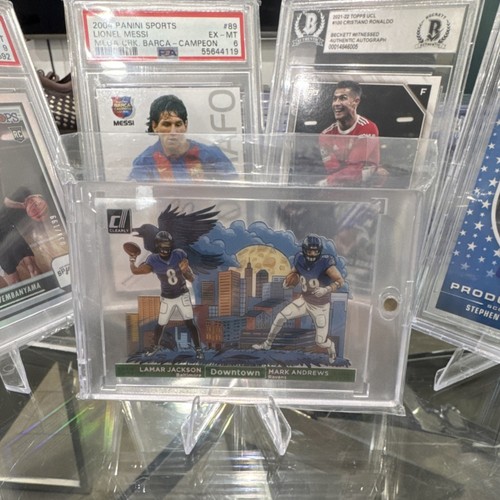 |
Mark Andrews / Lamar Jackson #8 2024 Clearly Donruss Downtown Duos |
$400.00 | $1,579 | 4× |
Look up any card's current raw and graded value in Midpoint — and get an estimated grade before you pay to submit.
Table of Contents
- Section 1: Understanding Lamar Jackson Rookie Card Value
- Section 2: Base Cards, Parallels, Inserts, and Autographs Explained
- Section 3: PSA 10 vs Raw Card Values: What Collectors Pay
- Section 4: The High-End Chase Cards Driving Market Prices
- Section 5: How Condition and Centering Impact Lamar Jackson Card Worth
- Section 6: Best Years and Sets for Lamar Jackson Cards
- Section 7: Selling and Buying Lamar Jackson Cards: Marketplaces and Trends
Conclusion
FAQ
Section 1: Understanding Lamar Jackson Rookie Card Value
What Defines a Rookie Card?
A Lamar Jackson rookie card is typically defined as a card issued during his first NFL season, which is 2018 for Jackson. This includes cards from manufacturers such as Panini and Donruss that released sets in 2018 bearing his rookie designation. Rookie cards are generally identified by designations on the card front or back, often marked with "RC" logos. These cards are considered important to a player’s card value since they capture the player as they enter the professional stage, making them desirable to collectors who focus on career beginnings.
Why Are Lamar Jackson Rookie Cards Worth Money?
The value of Lamar Jackson rookie cards stems from several factors. His on-field success as an MVP-winning quarterback makes his rookie cards more collectible since they represent a star athlete's emergence. His dynamic play style — combining rushing ability with passing skills — appeals to a broad fan base, boosting demand. Scarcity also plays a role: certain print runs or parallels were produced in limited quantities, increasing rarity. Finally, the collecting community’s enthusiasm around Lamar Jackson, especially during peak performance seasons, supports prices as collectors seek to acquire or hold onto these early cards.
Key Rookie Card Examples to Know
- 2018 Panini Prizm Lamar Jackson Rookie Card: This base rookie card is widely collected. It features a clean design and is often found in PSA 10 grades that can command strong prices. Its appeal is due to the popularity of the Panini Prizm line and the card’s balance of accessibility and value.
- 2018 Panini National Treasures Rookie Autograph: Considered a high-end card, this insert features on-card autographs, premium patch swatches, and low serial numbering (often numbered to 99 or fewer). When graded PSA 10, these cards can reach high prices due to their scarcity and premium features.
- 2018 Donruss Optic Holo Rookie: A parallel with holographic effects and moderate rarity, this card appeals to collectors who want a visually striking version of the rookie card without the extreme price tag of National Treasures.
| Card Name | Raw Value | PSA 10 Value |
|---|---|---|
| 2018 Panini Prizm Base | $40 | $350 |
| 2018 National Treasures Rookie Auto | $500 | $3,200 |
| 2018 Donruss Optic Holo | $70 | $600 |
These values fluctuate with market conditions, but the multipliers between raw and PSA 10 grades often demonstrate the premium placed on condition and certification.
Section 2: Base Cards, Parallels, Inserts, and Autographs Explained
Base Cards
Base cards represent the core set of cards produced in any given release. For Lamar Jackson, his base cards from 2018 Panini Prizm and Donruss Optic are among the most common. While these cards are accessible and easier to find, their value is largely driven by condition and rookie status. Collectors often view base cards as the entry point into collecting a player's cards, but they typically command lower prices compared to parallels or autographed versions.
Parallels
Parallels are alternative versions of base cards that feature distinct design elements such as colored borders, foil embossing, or special finishes. These variations are produced in limited quantities, often serial numbered, which increases their rarity and desirability. Examples include:
- Prizm Silver: These cards have a reflective silver finish with a more limited print run than base cards, often serial numbered to 999 or fewer. This enhances scarcity and collector interest.
- Optic Holo: Featuring holographic foil that creates a prismatic effect, these parallels are visually appealing and typically produced in lower numbers, adding to their collectibility.
- Color Blast: Among the rarest parallels, Color Blast cards feature unique color schemes and are often serial numbered under 100, making them sought after by collectors.
Collectors often target parallels for their blend of rarity and eye-catching designs. The scarcity of these parallels means they can command higher prices than base cards in similar condition.
Inserts and Chase Cards
Inserts are special cards randomly inserted into packs to add variety and chase appeal. These often feature unique themes, designs, or player highlights. Chase cards refer to particularly rare inserts such as Super Short Prints (SSPs), which are printed in limited quantities — sometimes fewer than 50 copies. Numbered parallels, which are serial numbered on the card front or back, also fall under chase cards. These are typically the most valuable cards in a set due to their scarcity.
Autographed Cards
Autographed cards add a significant premium to a player's card value. Lamar Jackson autograph cards are prized especially when sourced from premium sets like National Treasures or Contenders. On-card autographs, as opposed to sticker autos, are generally more desirable because they are signed directly on the card surface. When combined with low serial numbers or patch swatches, autograph cards can increase in value. For example, a National Treasures rookie autograph numbered /25 graded PSA 10 can sell for several thousand dollars, reflecting both rarity and player popularity.
Section 3: PSA 10 vs Raw Card Values: What Collectors Pay
The PSA Grading Scale and Its Impact
Professional Sports Authenticator (PSA) grades cards on a scale from 1 to 10, with 10 representing Gem Mint condition — nearly perfect centering, sharp corners, clean edges, and flawless surface. Cards graded PSA 10 are considered premium examples and are highly sought after by collectors and investors. The difference between a raw (ungraded) card and a PSA 10 can be significant, often multiplying the card’s market value several times over.
Price Comparison: Raw vs PSA 10
- 2018 Panini Prizm Base: Raw versions typically average $40 but PSA 10 graded cards can fetch around $350, which is nearly 9 times the raw value. This premium reflects both condition and the trust buyers place in professional grading.
- 2018 National Treasures Rookie Auto: Raw cards usually sell for about $500; however, PSA 10 examples have sold for upwards of $3,200, a more than 6x increase. The rarity and premium nature of this set amplify grading premiums.
- 2018 Donruss Optic Holo: Raw cards are in the $70 range, while PSA 10 graded versions can command $600 or more, nearly 8.5 times the raw value.
Why Grade Your Cards?
Grading serves multiple purposes:
- Authentication: Confirms the card is genuine, which is crucial for autographed and high-value cards.
- Condition Certification: Establishes a standardized condition grade, reducing buyer uncertainty.
- Marketability: PSA-graded cards often have better liquidity and attract more buyers.
- Price Premium: PSA 10 cards can command significant price increases over raw cards.
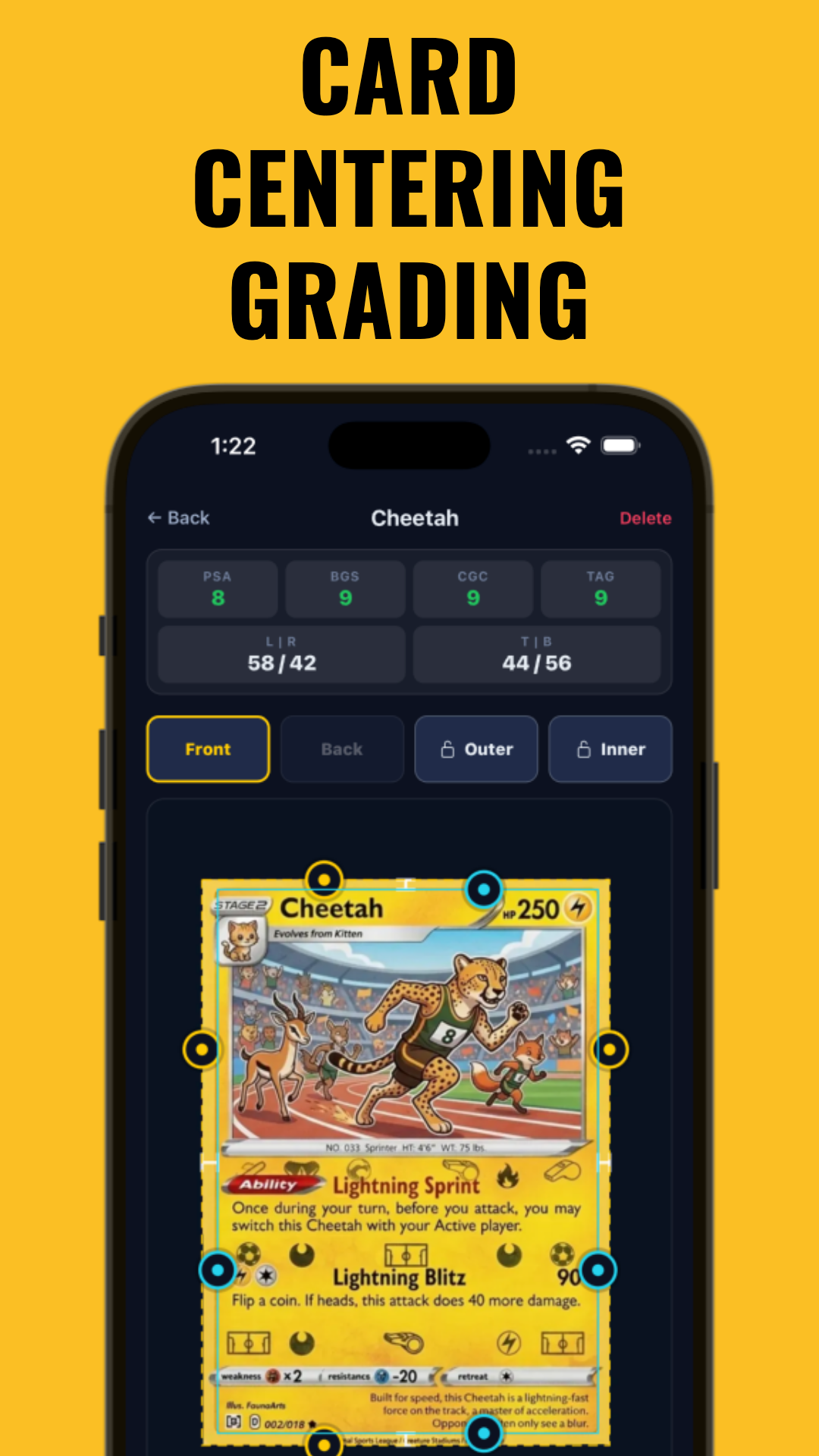
However, grading fees can be costly, especially for high-value cards. Digital tools like Midpoint help by providing AI-based estimates of centering, corners, edges, and surface condition. This allows collectors to pre-assess which Lamar Jackson cards are strong candidates for grading, reducing the risk of submitting cards that may receive lower than expected grades.
For more insights on how grading affects card value, see our detailed guide on Card Grade Impact on Insurance Value.
Section 4: The High-End Chase Cards Driving Market Prices
National Treasures Cards
National Treasures is recognized as one of the most prestigious football card sets. It features premium designs, on-card autographs, and low print runs, sometimes as low as single digits for rare parallels. Lamar Jackson’s National Treasures rookie autographs typically include patch swatches from game-worn jerseys, enhancing their appeal. Limited serial numbering, such as cards numbered to 10 or less, can cause certain cards to fetch prices well beyond several thousand dollars in PSA 10 condition. The set’s prestige and scarcity make it a key driver in the Lamar Jackson card market.
Panini Prizm Silver and Optic Holo
Prizm Silver parallels are notable for their mirror-like silver finish and serial numbering, often capped at 999 or fewer cards. Their scarcity relative to base cards and striking visual appeal make them sought-after. Optic Holo parallels feature holographic foiling that gives a prismatic effect, increasing desirability. Both types of parallels frequently see price appreciation, especially in near-mint or gem mint condition. Collectors often chase PSA 10 graded versions of these parallels, where prices can be higher compared to raw examples.
Color Blast and SSP Parallels
Color Blast parallels are among the rarest, often printed in runs below 50 or even as limited as 10 copies. Super Short Prints (SSPs) are similarly scarce and highly collectible. For example, a Lamar Jackson Color Blast parallel numbered to 25 or less can command prices several times higher than a base rookie card. These cards are typically targeted by serious collectors and investors due to their rarity and potential long-term value growth.
Understanding rarity indicators such as serial numbering, population reports from grading companies, and print run data is helpful for identifying cards likely to hold or increase value. Low-population PSA 10 cards and numbered parallels tend to hold or increase value more reliably than more common cards.
Section 5: How Condition and Centering Impact Lamar Jackson Card Worth
Condition Components: Centering, Corners, Edges, Surface
Collectors and grading companies evaluate cards based on four primary condition factors that collectively determine the card’s grade:
- Centering: The alignment of the card’s image within its borders. Ideal centering is close to 50/50 horizontally and vertically. Even a 55/45 split can affect grading, with centering beyond 60/40 generally considered poor.
- Corners: The sharpness and wear on all four corners. Rounded or frayed corners reduce grade.
- Edges: The cleanliness and smoothness of the card edges, with nicks or chipping negatively impacting grade.
- Surface: The card’s face and back, inspected for scratches, stains, print defects, or whitening.
Centering’s Role in Value
Centering is often the most difficult factor to perfect and has significant influence on grading outcomes. Cards with centering close to perfect (e.g., 50/50 or 55/45) are more likely to achieve PSA 10 grades. For example, a 2018 Panini Prizm Lamar Jackson card with centering of 70/30 may receive a PSA 9 or 8, which can diminish value by a notable percentage. Conversely, a card with near-perfect centering can command prices multiple times higher than one with off-center imagery.
Because centering is a nuanced factor, collectors often use precise digital tools to measure it before submission.
Using Digital Tools for Pre-Grading
Midpoint provides an AI-powered centering measurement tool that analyzes the card image, calculating exact percentages for horizontal and vertical centering. It also evaluates corners, edges, and surface defects using machine learning models trained on thousands of graded cards. This allows collectors to receive a detailed condition breakdown and an estimated PSA grade prediction.
Using these digital tools can reduce the risk of overpaying grading fees or submitting cards unlikely to receive top grades. For instance, if Midpoint indicates a centering of 65/35, a collector may opt to hold or sell raw rather than submit, avoiding grading costs. Conversely, a card with 50/50 centering and clean edges is an excellent candidate for grading.
Learn how AI is transforming grading accuracy in our post AI-Focused Comparison.
Section 6: Best Years and Sets for Lamar Jackson Cards
2018: The Definitive Rookie Year
The 2018 season is the definitive rookie year for Lamar Jackson and the most valuable for his cards. This year’s sets include foundational base cards, high-end rookies, and coveted autograph inserts. Cards from 2018 carry intrinsic value due to their rookie designation and historical significance. Collectors prioritizing value and long-term appreciation typically target 2018 rookie cards over subsequent releases.
2025 and Newer Releases
While newer sets from 2025 onward may feature Lamar Jackson cards, these usually have lower value unless they are limited parallels, autographed chase cards, or special inserts. The market generally discounts post-rookie cards unless they offer unique features or are from high-end sets. For example, a 2025 Panini National Treasures Lamar Jackson autograph parallel numbered /25 could gain value, but a base 2025 card will generally not match rookie year pricing.
Sets to Watch
- Panini National Treasures (2018 rookies): The premier high-end set with limited print runs and premium features.
- Panini Prizm: Popular base and parallel cards, with extensive chase variants.
- Donruss Optic: Offers a mix of base, parallels, and inserts with strong chase appeal.
- Panini Contenders rookie autographs: Known for affordable autograph options with solid collector interest.
Focusing on these sets increases the likelihood of acquiring Lamar Jackson cards with strong market demand and appreciation potential.
Section 7: Selling and Buying Lamar Jackson Cards: Marketplaces and Trends
Where to Buy and Sell
The primary marketplace for buying and selling Lamar Jackson cards is eBay, which offers a broad range of cards from raw to graded examples. Specialized marketplaces like COMC, StockX, and sports card forums also provide platforms for buying and selling. Local card shows and hobby shops can be valuable for in-person transactions and networking with collectors. Regardless of venue, comparing active listings with completed sales on platforms like eBay is essential for understanding real market prices rather than inflated asking prices.
Market Trends as of 2026-08-30
Recent sales data show sustained demand for PSA 10 graded Lamar Jackson rookie cards, with National Treasures autographed versions and Panini Prizm Silver parallels leading price appreciation. Raw cards have experienced price increases but remain significantly less liquid and lower in price. The market appears resilient despite broader economic fluctuations, reflecting Lamar Jackson’s continued popularity and the rarity of high-grade examples.
Tips for Sellers
- Use digital grading tools like Midpoint to estimate your card's grade accurately and set realistic price expectations before listing.
- Include high-resolution images in listings that clearly display centering, corners, edges, and surface condition to build buyer confidence.
- Highlight rarity indicators such as serial numbers, autograph status, and grading certification prominently.
- Consider professional grading for high-condition cards to maximize sale price and marketability.
- Be patient and monitor market trends to time sales for peak demand.
For collectors looking to preserve card condition and value, see our Ultimate Collector’s Guide to Storage covering best practices for sleeves, top loaders, and climate-controlled storage.
Conclusion
Lamar Jackson cards with notable value are primarily concentrated among his 2018 rookie year releases, high-end parallels, and autographed chase cards. Understanding the differences between base cards, parallels, inserts, and autograph versions is essential for identifying valuable cards. PSA 10 grading often amplifies card values, making condition — particularly centering — a critical factor in pricing. Tools like Midpoint provide AI-driven digital grading estimates that help collectors evaluate centering, corners, edges, and surface before committing to professional grading. Staying current with market trends and focusing on premium sets such as National Treasures and Panini Prizm can help collectors maximize portfolio value over time, whether buying, selling, or holding cards.
FAQ
Q: What Lamar Jackson rookie cards are worth the most money?
A: The most valuable Lamar Jackson rookie cards generally come from the 2018 Panini National Treasures set, especially autographed versions with low serial numbers (e.g., /10 or less). These cards often sell for thousands of dollars in PSA 10 condition. Following that, Panini Prizm base rookie cards graded PSA 10 command strong prices, typically in the $300-$400 range.
Q: How much is a Lamar Jackson rookie card worth ungraded vs graded PSA 10?
A: As of 2026-08-30, a raw 2018 Panini Prizm rookie card is worth around $40, while a PSA 10 graded copy can command $350 or more. High-end cards like National Treasures autographs see larger multipliers, with PSA 10 graded examples selling for over $3,000 compared to raw values near $500.
Q: Are Lamar Jackson autographed cards worth more than base cards?
A: Yes, autographed Lamar Jackson cards typically have higher value than base cards, particularly when graded PSA 10 and from premium sets such as National Treasures or Contenders. On-card autographs with low serial numbers can increase card value by several times over non-autographed versions.
Q: Which Lamar Jackson parallel cards are rarest and most valuable?
A: The rarest and most valuable Lamar Jackson parallels include Prizm Silver, Optic Holo, and Color Blast cards, especially those that are serial numbered or classified as Super Short Prints (SSPs). These parallels often have print runs under 100 copies, increasing scarcity and price.
Q: How do I know if my Lamar Jackson card is worth grading or selling raw?
A: Use digital grading tools like Midpoint to evaluate your card’s centering, corners, edges, and surface condition. Cards with near-perfect centering (close to 50/50), sharp corners, clean edges, and flawless surfaces are good candidates for professional grading. Cards with visible wear or off-centering may have better value sold raw.
Q: What is the current market price for Lamar Jackson cards?
A: Prices vary widely by card type, set, and grade. As of 2026-08-30, PSA 10 rookie cards range from about $350 for base Prizm to over $3,000 for premium autographed National Treasures cards. Raw cards typically sell for a fraction of graded prices but have been appreciating over time.
Free to start
Try the Midpoint app
Grade any card from a photo, see its raw and PSA 10 value, and track what your collection is worth — free.
Get it on iPhoneGet it on Android