MTG Centering Best Practices: Your Complete Guide to Perfect Card Borders
Discover MTG centering best practices to improve card appearance, grading value, and gameplay fairness. Learn how centering affects your Magic cards.

Estimated reading time: 8 minutes
Key Takeaways
- Centering defines border balance on Magic cards, impacting fairness, aesthetics, and grading value.
- Accurate measurement uses rulers, calipers, or mobile apps to calculate border ratios against PSA, BGS, and CGC tolerances.
- In-play tips include opaque sleeves, consistent card orientation, and double-sleeving high-value or off-center cards.
- Proper storage—upright boxes, top-loaders, cool/dry environments—protects centering integrity over time.
- Leverage tools like the Card Centering Tool and dedicated apps for pre-grade analysis.
Table of Contents
- Introduction to MTG Centering Best Practices
- Background and Context of MTG Centering Best Practices
- Detailed Discussion on MTG Centering Best Practices
- Best Practices for Achieving Optimal Card Centering
- Practical Examples and Case Studies
- Visual Aids and Comparison Charts
- Conclusion: MTG Centering Best Practices
- Additional Resources for MTG Centering Best Practices
- FAQ
Introduction to MTG Centering Best Practices
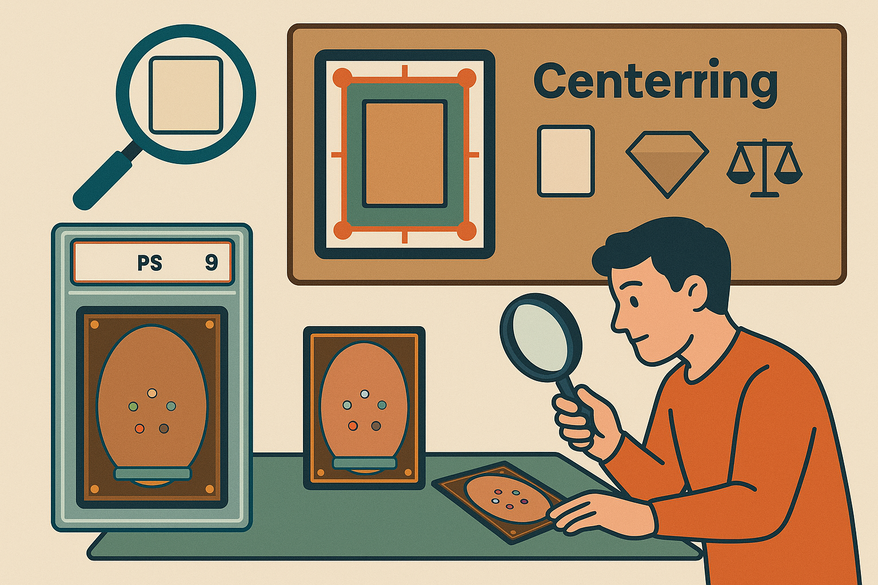
In Magic: The Gathering, centering describes how evenly the printed frame and artwork are positioned within a card’s physical borders. Well-centered cards have balanced edges that look equal on all sides. Centering matters for three big reasons: gameplay fairness, collector appeal, and professional grading value.
- Fair play: miscentered backs can mark cards in tournament use.
- Aesthetics: collectors seek cards with balanced borders.
- Grading: even surface-perfect cards drop in grade when off-center.
This guide covers the full scope of MTG centering best practices for play, storage, and grading.
Background and Context of MTG Centering Best Practices
Centering in TCGs is measured by border ratios like 50/50, 60/40, or 70/30.
- Perfect 50/50 centering means equal border widths on opposite sides.
- A 60/40 split shows one side 60% of total border width, the other 40%.
Early MTG print runs and older trading cards often had cutting and registration flaws. These miscuts made off-center cards common. As grading services rose, centering became a key subgrade. Poor centering caps even flawless cards at lower grades.
- PSA Gem Mint 10 front centering: about 55/45–60/40. Back centering: around 75/25. See PSA 10 Centering Requirements: What You Need to Know Before Submitting.
- ACE Grading uses a 1–10 centering score; splits worse than 60/40 front fall below Gem Mint.
Detailed Discussion on MTG Centering Best Practices
How Centring Is Measured
- Measure each border in millimeters with a ruler, calipers, or overlay tool.
- Calculate left–right and top–bottom ratios (e.g., 2 mm vs. 3 mm = 40/60). For manual and app-based methods, see How to Measure Card Centering: A Step-by-Step Guide for Collectors.
- Compare to grading tolerances (PSA 10 front ≤ 60/40).
Gameplay Impact
- Off-center backs may peek out through sleeves, marking cards in competitive play.
- Uniform sleeve orientation hides minor border shifts and avoids judge warnings.
Common Miscentering Issues
- Off-center front art or frame.
- Skewed (slightly rotated) prints causing uneven corner gaps.
- Miscuts showing portions of adjacent cards.
Best Practices for Achieving Optimal Card Centering: MTG Centering Best Practices
You cannot change a card’s original centering, but you can present and protect your cards so they look their best.
In-Play Guidelines
- Use opaque, solid-back sleeves to hide minor back-centering differences.
- Double-sleeve high-value or off-center cards to reduce shifting.
- Insert all cards in the same orientation (art face up, top edge first).
- Shuffle and view your deck from multiple angles; replace any “tells.”
- Refresh worn sleeves to avoid sleeve distortion making borders look uneven.
Collection & Storage Recommendations
- Immediately sleeve valuable pulls, then store in top-loaders or semi-rigid holders.
- Store cards upright in deck boxes that aren’t too tight or loose.
- Keep cards in a cool, dry environment to prevent warping. For more on how environmental conditions can affect your cards, see how heat and environmental conditions impact card grading.
- Pre-sleeve grading candidates in penny sleeves + semi-rigid holders for protection.
Tools & Techniques
- Physical centering tool (e.g., Legends Card Grading Tool) to overlay measurements in mm.
- Mobile apps (Card Centering Calculator) for auto-ratio computation and grade estimates.
- Manual caliper + math method for DIY evaluation of centering splits.
- Compare centering tolerances across major graders with PSA vs BGS vs CGC: PSA vs BGS vs CGC Centering Tolerances Compared.
For the most precise pre-grade centering analysis, try the Card Centering Tool, a web app that automatically measures left–right and top–bottom ratios on both sides and flags PSA, BGS, and CGC tolerances before submission. Below is a quick preview of how it works:
Practical Examples and Case Studies of MTG Centering Best Practices
Well-Centered vs. Slightly Off-Center vs. Heavily Miscentered
- 50/50 perfect center: equal border widths on left/right and top/bottom.
- 60/40 slight off-center: minor thickness difference; may still earn Gem Mint.
- 80/20 heavy miscut: one border very thin, the other very thick; grade and play issues.
MTG Staple Comparison
Dual Land copy A vs. copy B showing border variance and grade impact. Veteran collector insight: only submit cards where both axes ≤55/45 for a shot at PSA 10.
These cases show why MTG centering best practices help you pick the right cards for play and grading. If you want to understand how centering standards differ between PSA, BGS, CGC, SGC, and TAG, check out this comparison of card grading centering standards. For a broader look at how centering is evaluated across different card types, including Pokémon and sports cards, see Card Centering by Type: The Complete Guide for Pokemon, Sports, and More.
Visual Aids and Comparison Charts for MTG Centering Best Practices
Diagram Suggestions
- Front-of-card template annotated with perfect and off-center measurements.
- Back-of-card centering graphic showing the MTG logo shift.
- Border ratio overlays: 50/50, 55/45, 60/40, 70/30 side by side.
Grading Threshold Comparison Chart
| Aspect | Collector Target | Gem Mint Front Tolerance | Back Tolerance |
|---|---|---|---|
| Border Ratio | ~50/50 | ~55/45–60/40 | ~75/25 |
| Visual Impression | Equal borders | Slight, not obvious | More variance |
| Grading Impact | Max grade slot | Eligible for PSA 10 | Looser rules |
Methods Comparison Table
| Method | Use Case | Pros | Cons |
|---|---|---|---|
| Visual check by eye | Quick deck/collection scan | Fast, no tools | Subjective |
| Ruler/calipers | Pre-grading evaluate key cards | Affordable, precise enough | Requires math |
| Plastic centering tool | Batch grading prep | Simple readout, grading-oriented | Tool purchase needed |
| Mobile app | Hybrid collectors/grader | Automated, threshold hints | Needs clear photo, phone |
Conclusion: MTG Centering Best Practices
Centering matters for fair play, card appearance, and grading value. Miscentered cards can be marked in tournaments, appear less premium, and earn lower grades even if perfect in other ways.
- Use consistent, opaque sleeves and double-sleeve off-center cards.
- Store cards upright, in sleeves or top-loaders, in cool, dry places.
- Pre-screen centering with tools or apps before grading submissions.
- Compare copies and apply a “check centering first” rule.
Apply these practices to keep your MTG cards looking and playing their best. Share your own tips and experiences in the comments below!
Additional Resources for MTG Centering Best Practices
- Cardgrade’s centering guide for fundamentals
- ACE Grading centering explanation
- PSA visual centering thresholds
- Card Centering Calculator app (Google Play)
- Card Centering Calculator app (App Store)
- Tutorial on centering tools (YouTube)
FAQ
- What is centering in MTG cards?
Centering refers to how evenly the printed frame, artwork, and borders are positioned on a Magic card. Perfect centering has equal border widths on opposite sides. - Why does centering matter for grading?
Grading services use centering as a subgrade; off-center cards often receive lower overall grades even if they’re in mint condition. For a comprehensive overview, see Card Centering: The Definitive Guide for Grading and Collectors. - How can I measure my card’s centering?
Use a ruler or calipers to measure border thickness in millimeters, calculate ratios, or use a mobile app like the Card Centering Calculator to automate the process. - Can I improve my card’s centering appearance?
While you cannot alter the printed centering, you can hide minor discrepancies by using opaque sleeves, consistent orientation, and double-sleeving off-center cards. - Which tools are best for pre-grade centering checks?
Consider the physical Legends Card Grading Tool overlay, manual calipers, or the web-based Card Centering Tool for the most precise analysis.
Free to start
Try the Midpoint app
Grade any card from a photo, see its raw and PSA 10 value, and track what your collection is worth — free.
Get it on iPhoneGet it on Android