
Winterspell Lorcana Cards Value Guide: Raw, Graded & Chase Cards (2026)
Discover Winterspell Lorcana cards value: price guide, most valuable cards, grading tips, and set EV. Master the 2026 Winterspell market with expert insights.

Estimated reading time: 15 min
Key Takeaways
- The Winterspell Lorcana set’s total market cap is influenced by high-value singles and chase cards, especially in graded PSA 10 condition.
- Raw vs graded values can vary by large multiples, creating both opportunities and risks for grading submissions.
- Iconic and Enchanted cards such as Pocahontas, Moana, Elsa, and Tod are among the highest in the price guide.
- Set expected value (EV) and sealed box prices are affected by a few ultra-premium hits and collector demand.
- Live price tracking is important—Winterspell Lorcana prices can be volatile, with recent 30-day swings reported as high as +63% and -63%.
Card values — live data from Midpoint's card database, as of 2026-08-09. Prices move; Midpoint refreshes these daily.
| Card | Raw | PSA 10 | Gem premium | |
|---|---|---|---|---|
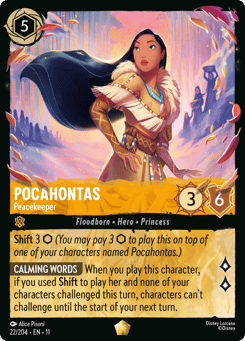 |
Pocahontas #22/204 Winterspell (2026) |
$32.97 | $4,419 | 134× |
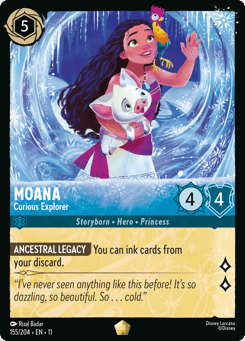 |
Moana #155/204 Winterspell (2026) |
$14.59 | $4,151 | 284.5× |
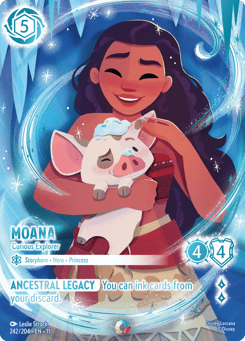 |
Moana #242/204 Winterspell (2026) |
$1,123 | $3,247 | 2.9× |
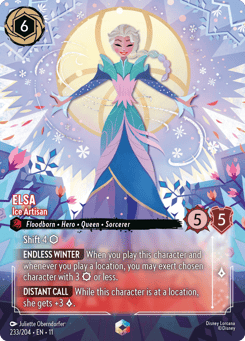 |
Elsa #233/204 Winterspell (2026) |
$855.20 | $2,486 | 2.9× |
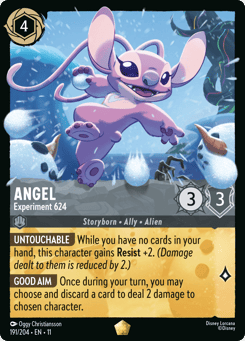 |
Angel #191/204 Winterspell (2026) |
$45.43 | $2,178 | 47.9× |
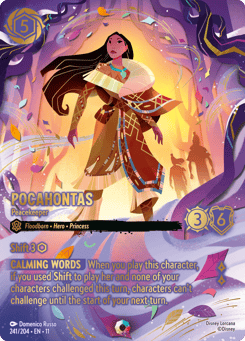 |
Pocahontas #241/204 Winterspell (2026) |
$969.18 | $2,133 | 2.2× |
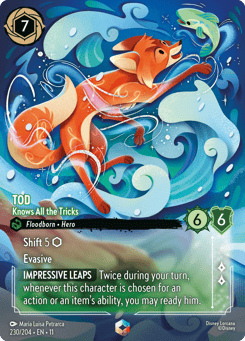 |
Tod #230/204 Winterspell (2026) |
$158.50 | $2,099 | 13.2× |
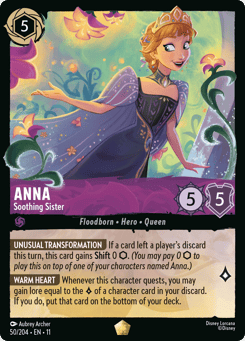 |
Anna #50/204 Winterspell (2026) |
$4.00 | $1,397 | 349.2× |
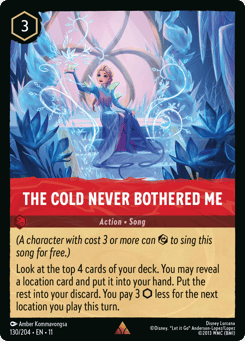 |
The Cold Never Bothered Me #130/204 Winterspell (2026) |
$0.46 | $1,254 | 2726.1× |
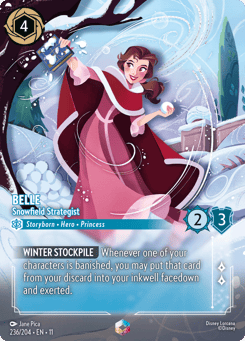 |
Belle #236/204 Winterspell (2026) |
$268.22 | $1,233 | 4.6× |
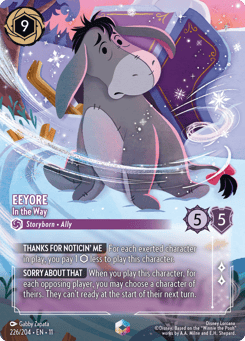 |
Eeyore #226/204 Winterspell (2026) |
$712.03 | $1,211 | 1.7× |
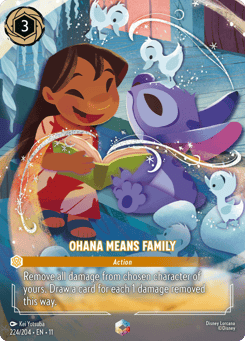 |
Ohana Means Family #224/204 Winterspell (2026) |
$389.00 | $1,154 | 3× |
Look up any card's current raw and graded value in Midpoint — and get an estimated grade before you pay to submit.
Table of Contents
- Section 1: Understanding Winterspell Lorcana Cards Value
- Section 2: Most Valuable Winterspell Lorcana Cards by Rarity
- Section 3: Chase Cards, Enchanted & Collector-Grade Hits
- Section 4: Winterspell Price Guide – Raw vs Graded Values
- Section 5: Grading Opportunities & Gem Premium Explained
- Section 6: Budget Singles, Playable Cards & Set EV
- Conclusion
- FAQ
Section 1: Understanding Winterspell Lorcana Cards Value
What Drives Value in Winterspell Lorcana?
The winterspell lorcana cards value is shaped by a combination of rarity, character popularity, competitive playability, and collector demand. Unlike earlier sets, Winterspell (2026) features a mix of classic Disney icons and new chase variants that have contributed to both raw and graded prices reaching notable highs.
- Raw card value: What a card sells for ungraded on the open market; quick to fluctuate and sensitive to print quality. For instance, a raw Moana #242/204 has reportedly sold for over $1,000, but a small increase in supply or a dip in demand can send that price swinging by hundreds of dollars in just weeks.
- Graded card value (e.g. PSA 10): The premium buyers pay for cards certified to be in ‘gem mint’ condition—often many times higher than raw. For Winterspell, this is especially visible on cards like Pocahontas #22/204, where the PSA 10 price has been reported over $4,000, compared to around $33 for an ungraded copy.
- Gem premium: The multiple by which a pristine graded card exceeds its raw counterpart, e.g. a 100x or 200x jump. High gem premiums suggest a scarcity of perfect copies and a willingness among collectors to pay top dollar for the best.
Winterspell Set Market Cap & Recent Price Trends
As of 2026-08-09, the total Winterspell Lorcana set market cap appears to be heavily concentrated in the top dozen chase cards. Price action is volatile: Moana #242/204 reportedly increased +63.5% in 30 days (raw $1,123), while Belle #236/204 declined -41.7% (raw $268.22). Live tracking is important for anyone actively buying, selling, or grading cards. The market can change rapidly, with price swings sometimes triggered by a single high-profile sale or a sudden influx of graded cards returning from PSA or BGS. For instance, a PSA 10 Elsa #233/204 increased in value after a major collector posted a public buy, only to see a correction weeks later as more supply hit the market.
Understanding these trends means watching not only the headline cards but also the second and third tier of chase singles. These can sometimes see even sharper swings, as with Eeyore #226/204, whose PSA 10 price reportedly dropped by more than 60% in a month due to a batch of high-grade cards entering the market all at once. Conversely, cards with fewer new PSA 10s appearing may remain strong—often seeing stable or rising prices even as overall set EV fluctuates.
How to Use This Guide
This article covers every major aspect collectors and players care about:
- The most valuable Winterspell cards—raw and PSA 10 values, including context on why certain cards command higher premiums
- Which cards are worth grading for a gem premium, with real numbers and risk analysis
- Price guide tables and rarity breakdowns, to help you prioritize purchases, trades, and grading submissions
- Set expected value (EV) for sealed product buyers, so you know the realistic odds before cracking a box
- Internal links to advanced grading and centering guides, for those looking to maximize their grading results
For a hands-on approach to measuring centering or estimating PSA/BGS/CGC grades in real time, check out Midpoint, a card collector app. Midpoint's tools include visual overlays for centering, AI-powered grade predictions, and a portfolio tracker that updates daily, which can assist whether you're prepping for grading or managing a large collection.

Section 2: Most Valuable Winterspell Lorcana Cards by Rarity
Iconic, Legendary, Enchanted, and Epic Rarities
The Winterspell 2026 set includes multiple rarity tiers—Iconic, Enchanted, Epic, and Legendary. Most value appears to be concentrated in Iconic and Enchanted cards, with collector-grade foils and alternate arts commanding significant premiums. For example, out of the top 15 most valuable singles, most are either Enchanted or Iconic, with only a handful of Legendary or Epic cards among the highest prices. This concentration of value is a notable trait of Winterspell compared to previous Lorcana sets, where value was more evenly distributed.
- Pocahontas #22/204 (Iconic): raw $32.97, PSA 10 $4,419
- Moana #242/204 (Enchanted): raw $1,123, PSA 10 $3,247
- Elsa #233/204 (Enchanted): raw $855.20, PSA 10 $2,486
- Belle #236/204 (Legendary): raw $268.22, PSA 10 $1,233
It’s worth noting that Epic cards, while often playable in the competitive scene, rarely approach the top values unless paired with popular characters or highly limited printings. For collectors, Iconic and Enchanted foils—especially those with alternate art—are generally considered the most desirable cards of the set.
What Makes a Card a Top-Tier Value Play?
The biggest drivers of Winterspell Lorcana cards value by rarity are:
- Low print runs on Enchanted and Iconic cards, sometimes with relatively few copies in PSA 10. For example, when the population report for Moana #242/204 (Enchanted, PSA 10) showed fewer than 30 copies, prices reportedly spiked.
- Popular characters (Moana, Elsa, Pocahontas). Collectors often pay premiums for beloved Disney IP, and even lesser-playable cards with strong character appeal can outperform pure meta staples.
- Collector-only alternate art and foil variants, which are sometimes only available through special boxes or as chase pulls at low odds (e.g., 1:60 packs or rarer).
- Strong demand for PSA/BGS/CGC 10s (gem mint), since collectors want the best and competitive players may seek out pristine copies for major tournaments.
For a detailed breakdown of how grading standards differ by company, see this grading scale comparison. Understanding differences in how PSA, BGS, and CGC grade surface, centering, and edges can mean the difference between a $100 card and a $4,000 card.
The Role of Alternate Art & Foil Printings
Alternate art and foil printings of Iconic and Enchanted cards often outsell their regular counterparts by 2–5x, especially when graded. For example, the alternate art Moana #242/204 (Enchanted) is among the highest-value pulls in the set. Many collectors pursue the alternate art versions for their master sets, driving up demand and establishing these variants as the "trophy cards" of Winterspell. Notably, these versions tend to have lower print runs and stricter quality control issues, leading to even greater scarcity in high grades. This scarcity translates directly into higher gem premiums and makes pre-grading and centering analysis important for maximizing returns.
Another contributing factor is the distribution method: some alternate art or foil variants are only available as case incentives or event promos, which can put them out of reach for most box-openers and thus further concentrate value.
Section 3: Chase Cards, Enchanted & Collector-Grade Hits
Top Chase Cards in Winterspell (2026)
The chase card landscape is led by a handful of Enchanted and Iconic cards, with significant premiums for perfect grading. Notable examples include:
- Pocahontas #22/204: Gem premium of 134x (PSA 10 $4,419 vs raw $32.97). This card’s popularity comes from both its scarcity and its cultural resonance, as Pocahontas has a devoted fan base among Disney collectors.
- Moana #242/204: Raw $1,123, PSA 10 $3,247 (30-day change +63.5%). Moana’s popularity in both the film and the competitive Lorcana scene means this card is sought after by collectors and players alike.
- Tod #230/204: Raw $158.50, PSA 10 $2,099 (13.2x gem premium). While not as iconic as Moana or Elsa, Tod’s unique artwork and limited Enchanted print run have made it a notable card for set collectors.
- The Cold Never Bothered Me #130/204: Reported gem premium in the set at 2,726x (raw $0.46, PSA 10 $1,254). This is an example of how a seemingly common card can become a grading opportunity if perfect copies are elusive.
These chase cards are often the centerpiece of sealed box EV calculations and are a major reason why sealed Winterspell product can command a premium over retail. In recent months, the presence of one or more of these cards in a case has been enough to make or break the financial outcome of a group box break.
Collector-Grade Hits Worth Grading
Cards with low raw prices but high PSA 10 values are often considered grading candidates. For example:
- Anna #50/204: raw $4.00, PSA 10 $1,397 (349.2x gem premium). Finding a perfectly centered and flawless Anna is rare, which is why the gem premium is so high. Many raw copies have centering or surface flaws that make PSA 9 or lower the norm.
- Angel #191/204: raw $45.43, PSA 10 $2,178 (47.9x gem premium). The demand for Lilo & Stitch characters remains high, and Angel’s low population in PSA 10 keeps prices elevated. Even minor flaws can dramatically reduce the graded value, so careful pre-screening is essential.
These cards may offer outsized returns if you can source near-perfect raw copies and use tools like Midpoint’s Free Centering Calculator to pre-screen for grading. For example, using Midpoint, you might discover that only a small percentage of Anna cards are centered well enough to have a real shot at PSA 10, making each successful gem submission a notable win. Some graders will buy small stacks of these cards, cherry-pick the best, and resell the remainder to recoup costs.
It is also common to see lower-value cards increase in price after a prominent YouTuber or influencer highlights their grading journey, which can briefly inflate the gem premium. Keeping an eye on population reports and social media buzz can help you time your grading submissions for maximum effect.
Enchanted Cards: Collector Hype and Value
Enchanted cards (Moana #242/204, Elsa #233/204) have become the set’s ultimate collector magnets. Their values can spike or dip by 40%+ in a single month, so tracking live market data is important for buyers, sellers, and graders alike. This volatility is partly driven by the unpredictable nature of supply—one major auction or a sudden influx of graded copies can move the market overnight.
For example, the Enchanted Elsa reportedly experienced a 41% drop after a batch of raw copies hit the market post-tournament, only to rebound weeks later as collectors scrambled to complete master sets. The best strategy is to set up price alerts or use a portfolio tracker, like the one in the Midpoint app, to stay ahead of sudden moves. Some collectors set buy and sell targets in advance to manage risk.
Enchanted cards also tend to have unique foil treatments and security features, making them both visually striking and more challenging to grade. This adds to their allure and keeps gem rates low, supporting high premiums for the best examples.
Section 4: Winterspell Price Guide – Raw vs Graded Values
Making Sense of the Winterspell Price Guide Table
The Winterspell Lorcana cards value can be better understood when you compare raw and graded (PSA 10) prices side-by-side. As of 2026-08-09, here are some notable examples:
- Moana #155/204: raw $14.59, PSA 10 $4,151 (gem premium 284.5x). This is an example of a playable card with significant grading upside; the raw price is accessible, but perfect copies command a much higher premium.
- Pocahontas #241/204: raw $969.18, PSA 10 $2,133 (2.2x). Here, the relatively low gem premium suggests more consistent print quality or a larger supply of mint copies, but the absolute prices remain high due to character demand.
- Eeyore #226/204: raw $712.03, PSA 10 $1,211 (1.7x, but -63.2% in 30 days!). The sharp decline highlights the importance of timing; bulk grading returns can flood the market and depress prices quickly.
The gap between raw and PSA 10 values is not only a measure of grading opportunity, but also of population scarcity—cards that are hard to gem see higher premiums. For those seeking to play the grading arbitrage game, focusing on cards with the widest raw-to-PSA 10 spreads is generally the best bet. However, it’s crucial to account for grading costs, shipping, and the risk of receiving a lower grade.
Raw vs Graded: Risk/Reward Analysis
- Ultra-high gem premiums (Anna, The Cold Never Bothered Me) may signal few gems exist, and grading is risky but can be lucrative. If you can consistently identify near-perfect raw copies, your expected profit per submission can be high, but the odds are rarely in your favor without careful pre-grading.
- Low gem premiums (Moana #242/204, Elsa #233/204) suggest more gem candidates exist or demand is spread across both raw and graded. In these cases, the market may be more efficient, and opportunities for outsized profit are smaller.
- Recent price swings (e.g. Elsa -40.9%, Eeyore -63.2%) caution against chasing cards in a downtrend without up-to-date data. Always check the latest sold listings and population reports before making a buy or grading decision.
For more on how centering and surface flaws impact these values, see our centering value guide. Even a card that looks flawless in-hand can have subtle centering or print defects invisible without magnification or a digital overlay, which is why expert graders rely on tools like Midpoint to minimize costly errors.
Price Differences by Printing, Foil, and Alternate Art
Not all copies of a card are created equal. Alternate art and foil printings, especially Enchanted and Iconic variants, can fetch 2–5x the price of a standard version. For instance, a standard Elsa #233/204 might be valued at $800 raw, but the alternate art foil could command $2,000 or more, especially in PSA 10. Tracking listings carefully is vital for an accurate Winterspell price guide. Always verify which version is being sold or graded, as even small differences in set number or foil pattern can have a huge impact on value.
Some alternate art cards also feature unique serial numbering or holographic stamps, further distinguishing them from mass-market versions. These markers are often tracked in population reports and can become focal points for high-end collectors, driving up auction prices and influencing the overall perceived value of the set.
Section 5: Grading Opportunities & Gem Premium Explained
What is Gem Premium and Why Does it Matter?
The gem premium is the multiplier between a card’s raw price and its value as a PSA 10 (or BGS/CGC 10). The higher the premium, the greater the incentive to grade—with Anna #50/204 and The Cold Never Bothered Me #130/204 demonstrating 349.2x and 2,726.1x multipliers, respectively. For collectors and flippers alike, understanding which cards have the widest gem premium is key to maximizing returns. However, high gem premiums also reflect a card that is very hard to find in perfect condition.
- High gem premium = low supply of gem-mint copies and high collector demand. These cards reward those with sharp grading skills and patience, as submitting a truly flawless copy can net significant profit.
- Low gem premium = either easier-to-gem cards or saturated supply of perfects. Sometimes, the difference is due to the card’s design: cards with dark borders or foil-heavy surfaces are harder to gem, while those with lighter designs or better print quality see more PSA 10s and thus lower premiums.
Which Winterspell Cards Are Worth Grading?
- Cards with large gem premiums and iconic characters: Anna, Pocahontas, Angel. These cards are both emotionally resonant and financially rewarding when graded well.
- Chase Enchanted/alternate arts with strong raw value: Moana #242/204, Elsa #233/204. Even if the gem premium is lower, the absolute value of a PSA 10 is still extremely high.
- Cards with recent positive price momentum: Moana #242/204 (+63.5%). Grading cards in an uptrend can maximize your upside, but beware of sudden market corrections.
Always pre-grade your cards before submitting. Use digital tools to assess centering, corners, edges, and surface. See this step-by-step pre-grading guide for best practices. For example, the Midpoint app allows you to overlay a digital centering grid on your card’s photo, instantly flagging any off-center issues that could cost you a gem grade. Combine this with a magnifier for edge and surface inspection to further reduce your risk.
Raw vs Graded: When to Submit
- Submit if card is clean, well-centered, and high-value in PSA 10. For example, if the gem premium is over 100x and your copy looks flawless, the risk may be justified even with grading fees of $30–50 per card.
- Avoid grading if print quality is poor or gem premium is low. Cards with visible whitening, off-centering, or surface scratches are unlikely to grade higher than PSA 8–9, which often sell for only a small premium over raw.
- Calculate grading cost vs expected value—Midpoint can help estimate before you pay $30+ for grading. For instance, if your expected gem rate is 1 in 10, and a PSA 10 sells for $1,000 while raw is $10, you can model your average return and decide if the risk is worthwhile.
For details on how AI can assist your pre-grading accuracy, read our AI-focused centering analysis comparison. The best graders combine their own experience with digital tools, maximizing both speed and accuracy in the high-stakes world of Lorcana grading.
Additionally, keep in mind that grading turnaround times can impact your profit. If you time your submissions right (for example, just before a major set rotation or tournament), you can benefit from increased demand as new meta decks emerge or collectors rush to complete their sets. Conversely, sending cards for grading during a market lull can mean waiting months only to see your newly returned PSA 10s compete with a flood of other submissions.
Section 6: Budget Singles, Playable Cards & Set EV
Budget-Friendly Winterspell Singles
Not every high-value card is out of reach. Some cards offer strong playability or collector appeal at more affordable prices:
- Anna #50/204: raw $4.00, PSA 10 $1,397 (potential upside if you can grade a gem). This card is popular in certain deck archetypes and is also a fan favorite, providing both competitive and collector appeal.
- The Cold Never Bothered Me #130/204: raw $0.46, PSA 10 $1,254 (notable value-to-upside ratio). The low raw price makes it accessible for bulk buyers, and the high gem premium means even a single PSA 10 can pay for dozens of raw attempts.
- Moana #155/204: raw $14.59, PSA 10 $4,151 (playable and collectible). This card sees play in top-tier decks and is also sought after for full-art collections, making it a dual threat for value seekers.
Other budget singles to watch include commons and uncommons that see heavy competitive play—these may not have huge gem premiums, but they are in constant demand for tournament decks and can be sold quickly at smaller margins. For example, cards with strong synergy in new meta decks can see sudden price spikes after major events, rewarding those who buy in early.
For players, collecting playsets of these budget singles is a cost-effective way to stay competitive while still having a chance at grading upside if you come across an exceptionally clean copy.
Set Expected Value (EV) and Sealed Box Worth
Winterspell’s set EV is heavily influenced by the chance of pulling a few high-value cards (Moana #242/204, Elsa #233/204, Pocahontas #22/204). Sealed boxes are priced based on these chase odds—but most packs contain lower-value singles, so EV is heavily skewed by luck.
- Top 5 cards reportedly account for over 70% of set’s total market cap. This concentration means that the majority of packs opened will not break even in value, and only those lucky enough to hit a true chase card will see a significant return.
- Opening sealed product is high risk/high reward for value chasers. While some box breakers do profit, most rely on selling bulk singles or opening in quantity to smooth out variance. For casual buyers, opening a box is more about the experience than guaranteed profit.
For example, if the average box contains just one Iconic or Enchanted card, and most of the value is tied to a handful of these hits, your expected return per box is highly volatile. Advanced buyers will often use live EV trackers to compare sealed box prices against current singles values before making a purchase.
Some collectors prefer to buy singles directly rather than gamble on sealed product, particularly when chasing specific cards for master sets or grading. This approach minimizes risk but removes the thrill of the "big hit."
Tracking Market-Price Movements
Live tracking is important. Cards like Eeyore #226/204 reportedly dropped -63.2% in 30 days; Moana #242/204 rose +63.5%. Use tools that update daily for pricing accuracy, such as the Midpoint app’s portfolio tracker. These tools can help you identify trends, spot bargains, and avoid buying into a downtrend. For instance, many experienced collectors set alerts for price drops of 20% or more, allowing them to scoop up undervalued cards before the rest of the market reacts.
To see how grading impacts the insurable value of your collection, check out this guide on insurance and card grades. Properly graded cards are typically easier to insure and can command higher payouts in the event of a claim, making accurate tracking and documentation an important part of high-value collections.
For those looking to maximize returns, it’s also wise to follow major auction sites, social media groups, and Discord channels where high-end Lorcana sales are discussed. Price transparency is improving, but off-eBay deals and private sales can still move the market, especially for low-population chase cards.
Conclusion
The Winterspell Lorcana set is a collector’s opportunity and a grader’s challenge. With large raw-to-PSA 10 price gaps and notable price swings, understanding the Winterspell Lorcana cards value involves both opportunity and risk. Chase cards like Moana #242/204, Elsa #233/204, and Pocahontas #22/204 are central to the set’s market cap, while budget-friendly singles may offer hidden grading upside.
Whether you’re buying, selling, or grading, always rely on live price tracking and digital pre-grading tools. The Midpoint app is one way to measure centering, estimate PSA/BGS/CGC grades, and track your collection’s value over time in the fast-moving Lorcana market. As the set matures and more population data becomes available, further shifts in both raw and graded prices are possible—staying informed is your best defense against market volatility and your best path to maximizing value, whether as a collector, player, or investor.
In summary, Winterspell rewards those who do their homework: analyze the gem premiums, use digital tools to pre-grade, monitor live prices, and stay disciplined in your purchasing and grading strategies. The set’s volatility offers both risk and reward—mastering the tools and trends will help you build a collection that stands the test of time.
FAQ
Q: What are the most valuable Winterspell Lorcana cards right now?
A: As of 2026-08-09, the most valuable cards are Moana #242/204 (raw $1,123, PSA 10 $3,247), Elsa #233/204 (raw $855.20, PSA 10 $2,486), Pocahontas #22/204 (raw $32.97, PSA 10 $4,419), and Angel #191/204 (raw $45.43, PSA 10 $2,178). Chase Enchanted and Iconic cards are among the top values.
Q: How much is the Winterspell set worth overall?
A: The total market cap is heavily concentrated in the top 10-12 chase cards. The set’s value fluctuates, but the five most valuable singles reportedly account for over 70% of the set’s total worth as of 2026-08-09.
Q: Which Winterspell cards are worth grading?
A: Cards with large gem premiums and iconic characters—like Anna #50/204, Angel #191/204, Pocahontas #22/204, and The Cold Never Bothered Me #130/204—are often considered grading candidates if you can find near-perfect copies.
Q: What are the chase cards in Winterspell?
A: Top chase cards include Moana #242/204 (Enchanted), Elsa #233/204 (Enchanted), Pocahontas #22/204 (Iconic), Angel #191/204, and Tod #230/204. These cards have some of the highest raw and graded values and are sought-after by collectors.
Q: Are Winterspell Enchanted cards valuable?
A: Yes—Enchanted cards like Moana #242/204 and Elsa #233/204 are among the set’s most expensive, both raw and graded. They also experience significant price swings, so live tracking is important.
Q: Where can I find a Winterspell Lorcana price guide?
A: The most up-to-date Winterspell Lorcana price guide is available in collector apps like Midpoint, which tracks live market prices for raw and graded cards, and offers grading tools for maximizing value.
Free to start
Try the Midpoint app
Grade any card from a photo, see its raw and PSA 10 value, and track what your collection is worth — free.
Get it on iPhoneGet it on Android


