1955 Topps Baseball Cards Value: Ultimate Price Guide & Grading Tips
Discover the 1955 Topps baseball cards value, top rookies, grading impact, and which cards are worth submitting for grading in this detailed guide.

Estimated reading time: 15 min
Key Takeaways
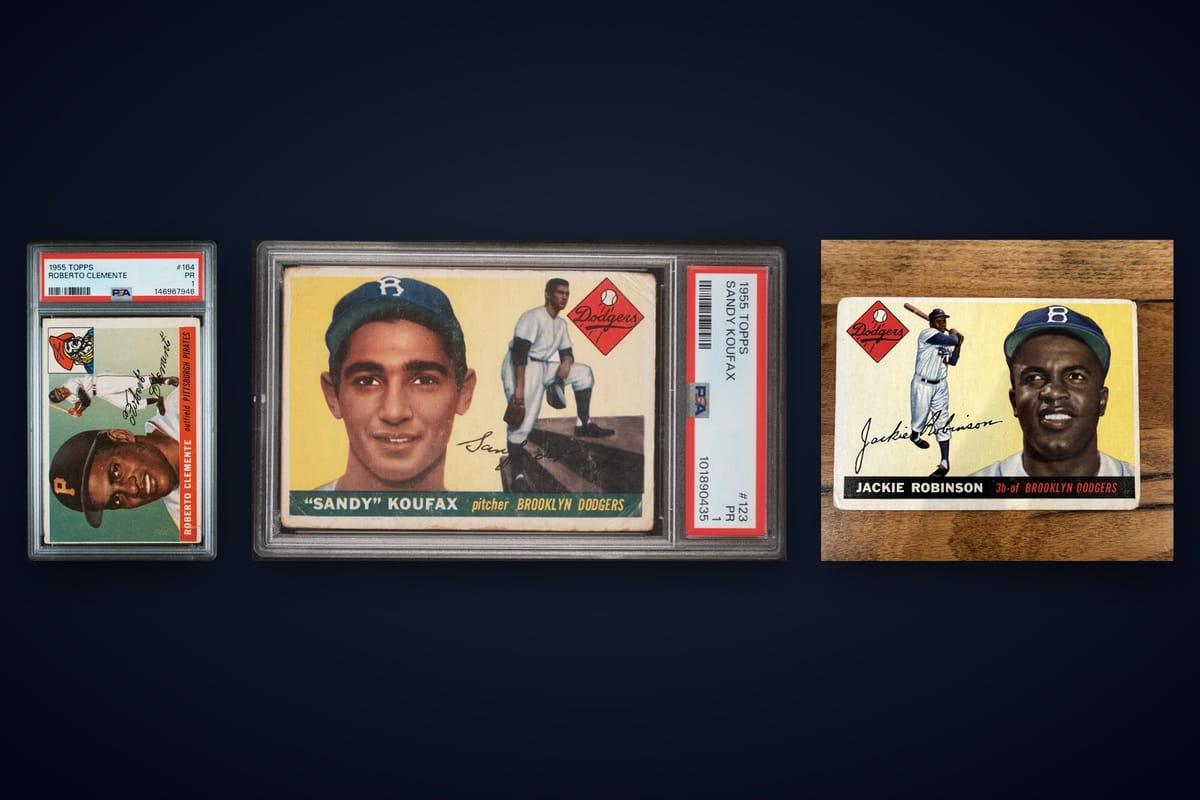
- The 1955 Topps set features 206 cards with iconic rookies like Roberto Clemente (#164) and Sandy Koufax (#123), arranged in three distinct series with varying rarity.
- Values vary widely from common cards priced under $5 raw to high-grade graded stars worth significantly more, emphasizing the importance of condition and grading.
- Centering is critical; many 1955 Topps cards suffer from off-centering which is a primary reason cards lose value and drop in grade.
- High-number series cards (#161–210) are scarcer and often more valuable, especially in top condition, with some cards never officially issued, adding to collectibility nuances.
- Using tools like Midpoint’s AI grading and precise centering measurement helps collectors make informed decisions on which cards to grade and maximize their collection’s value.
Card values — live data from Midpoint's card database, as of 2026-11-01. Prices move; Midpoint refreshes these daily.
| Card | Raw | PSA 10 | Gem premium | |
|---|---|---|---|---|
 |
Roberto Clemente #164 1955 Topps |
$2,039 | $697,500 | 342× |
 |
Sandy Koufax #123 1955 Topps |
$729.30 | $377,411 | 517.5× |
 |
Jackie Robinson #50 1955 Topps |
$514.80 | $278,160 | 540.3× |
 |
Willie Mays #194 1955 Topps |
$257.88 | $72,420 | 280.8× |
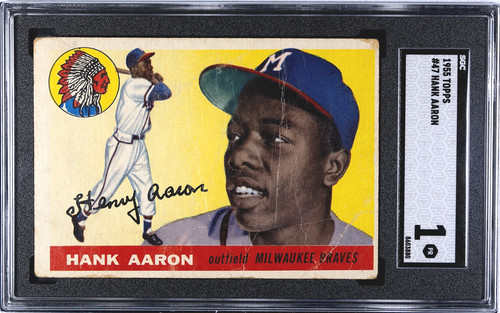 |
Hank Aaron #47 1955 Topps |
$318.71 | $70,014 | 219.7× |
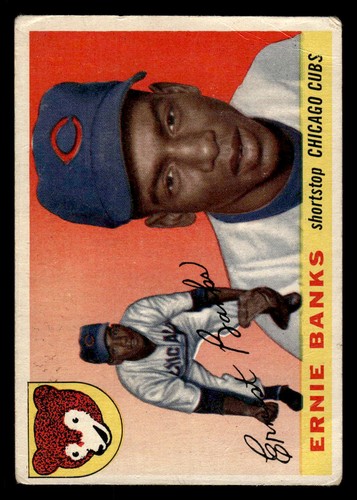 |
Ernie Banks #28 1955 Topps |
$117.05 | $49,227 | 420.6× |
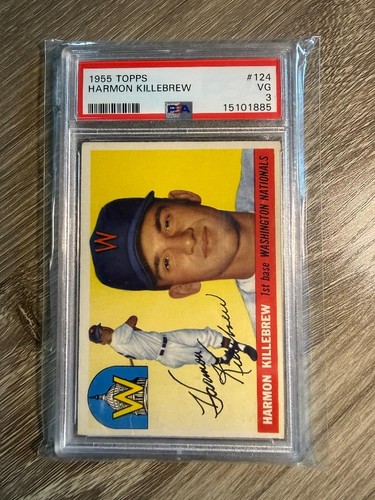 |
Harmon Killebrew #124 1955 Topps |
$193.34 | $42,377 | 219.2× |
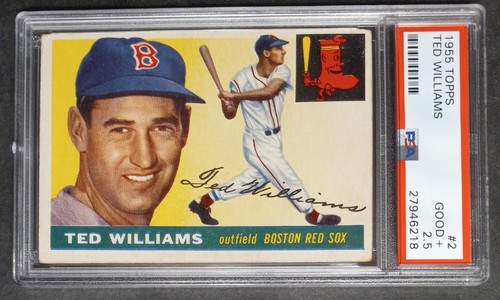 |
Ted Williams #2 1955 Topps |
$168.63 | $37,675 | 223.4× |
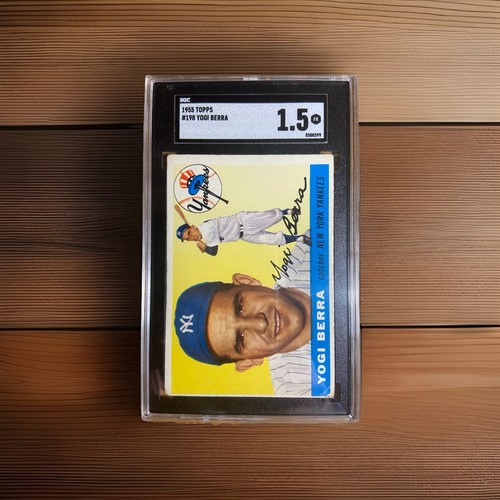 |
Yogi Berra #198 1955 Topps |
$111.34 | $30,240 | 271.6× |
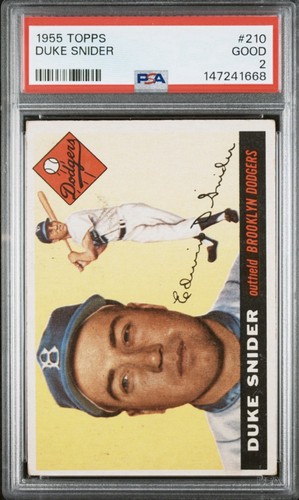 |
Duke Snider #210 1955 Topps |
$63.01 | $23,760 | 377.1× |
 |
Al Kaline #4 1955 Topps |
$72.50 | $23,214 | 320.2× |
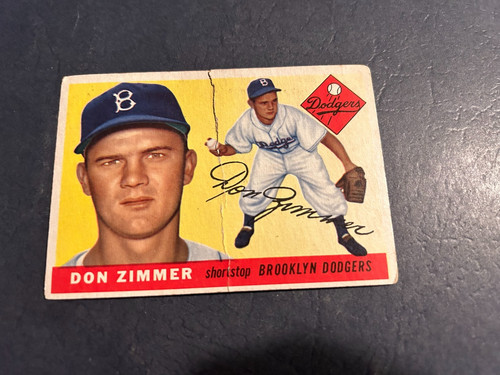 |
Don Zimmer #92 1955 Topps |
$20.00 | $18,300 | 915× |
Look up any card's current raw and graded value in Midpoint — and get an estimated grade before you pay to submit.
Table of Contents
- Section 1: Overview of the 1955 Topps Baseball Card Set
- Section 2: The Most Valuable 1955 Topps Cards and Key Rookies
- Section 3: Understanding 1955 Topps Card Condition and Grading
- Section 4: 1955 Topps Price Guide – Raw vs Graded Values
- Section 5: Which 1955 Topps Cards Are Worth Grading?
- Section 6: How to Use Midpoint to Maximize Your 1955 Topps Collection Value
Conclusion
FAQ
Section 1: Overview of the 1955 Topps Baseball Card Set
Set Composition and Design
The 1955 Topps baseball card set is considered one of the notable post-war baseball card series, appreciated by collectors for its star players, design, and condition challenges. The set comprises a total of 206 cards, divided into three series: a low-number series (#1–150), a middle series (#151–160), and a high-number series (#161–210). This division was part of Topps’ release strategy.
The cards are horizontally oriented, measuring approximately 2-5/8" by 3-3/4", differing from the vertical format used in earlier Topps sets. This layout allowed for larger player photos and a design featuring a white border, player name in bold colors, and biographical stats on the back.
Within the high-number series, four card numbers (#195, #198, #199, and #204) were reportedly never officially issued, creating gaps noted by collectors. These unissued cards add complexity to completing the set and affect perceived rarity.
The set includes numerous Hall of Famers and legendary players, such as Roberto Clemente (#164), Sandy Koufax (#123), Jackie Robinson (#50), and Ted Williams (#2), which contribute to the set’s desirability.
Card Numbering and Series Breakdown
- Low-number series (#1–150): Constitutes the majority of the set and includes many common player cards. These cards were more widely distributed and generally less scarce.
- Middle series (#151–160): A smaller subset containing several notable players, often overlooked but containing some sought-after cards.
- High-number series (#161–210): The rarest subset of the set, often found in fewer quantities. This series contains some valuable cards, including key rookie cards like Roberto Clemente (#164) and Willie Mays (#194). The unissued card numbers add to the challenge of completing this series.
Set Popularity and Collectibility
The 1955 Topps set’s popularity comes from its iconic players, horizontal design, and historical context. However, print quality and centering issues make finding high-grade examples challenging, especially in the high-number series where cards were printed in lower quantities and often show off-centering.
Collectors value the set for its nostalgic appeal and inclusion of rookie cards of future Hall of Famers. The difficulty in locating well-centered, sharp-cornered cards in excellent condition contributes to higher prices and demand.
In the high-number series, high-grade cards often command premiums over their low-number counterparts, reflecting scarcity and collector preference for condition.

Section 2: The Most Valuable 1955 Topps Cards and Key Rookies
Roberto Clemente Rookie Card (#164)
Roberto Clemente’s rookie card (#164) is widely regarded as a key card in the 1955 Topps set. Its value is influenced by Clemente’s Hall of Fame career and legacy. Ungraded copies generally sell in a range depending on condition, centering, and surface quality.
High-grade examples, such as PSA 10 (Gem Mint), can command significantly higher prices, sometimes reaching into the tens of thousands of dollars, particularly for cards with excellent centering and condition. This highlights the importance of grading and condition.
Off-centering is common for this card, and even minor deviations can impact value. PSA 10 graded copies are relatively scarce, often leading to competitive bidding in auctions.
Sandy Koufax Rookie Card (#123)
Sandy Koufax’s 1955 Topps rookie card (#123) is also highly sought after due to Koufax’s legendary pitching career. Raw Koufax cards typically trade within a range influenced by condition factors such as centering and surface wear.
Top-tier graded cards, especially PSA 10s, can reach high prices, though exact figures vary. Koufax’s card is known for off-centering issues, limiting the number of gem mint submissions.
Collectors aiming for high-grade Koufax cards should look for near-perfect centering, sharp corners, and clean surfaces, often requiring multiple candidates to find a gem mint.
Other Key Stars and Hall of Famers
- Jackie Robinson (#50): A historically significant card, raw values vary, with PSA 10 copies commanding higher prices. Centering and surface condition are important due to the card’s age.
- Ted Williams (#2): Values vary widely depending on condition and grading. Centering is a key factor.
- Willie Mays (#194): Raw values start at moderate levels, increasing substantially for PSA 10 condition. As a high-number card, scarcity affects pricing.
- Hank Aaron (#155): Typically valued higher in top PSA grades, Aaron’s card is a key piece for collectors.
- Harmon Killebrew (#124): Values vary, with PSA 10 examples fetching higher prices. Killebrew remains collectible.
The scarcity of high-grade examples of these stars, especially within the high-number series, contributes to price premiums. Securing these rookies and stars in top condition is often a focus for collectors.
Section 3: Understanding 1955 Topps Card Condition and Grading
Importance of Centering
Centering is generally considered one of the most important grading factors for 1955 Topps cards, often more critical than corners or surface due to printing inconsistencies. Many cards exhibit off-centering beyond thresholds for top grades.
Centering is measured as the ratio of border widths on opposite sides, ideally close to 50/50 horizontally and vertically. For example, a card with 55% left border and 45% right border is considered well-centered, while a 65/35 split may limit the grade.
Midpoint’s card centering tool provides precise measurements, helping collectors identify cards that meet or nearly meet centering requirements before grading.
Because centering heavily influences grade, even cards with excellent corners and surfaces can receive mid-grade scores if off-center. Conversely, cards with slightly less-than-perfect corners but excellent centering can achieve higher grades.
Other Condition Factors
- Corners: Sharp, square corners free from rounding or chipping are important. Many 1955 Topps cards show wear due to age and handling.
- Surface: Cards may have print defects, color variations, minor stains, or gum residue on the back. Gum stains, from adhesive backing, are common and can reduce value, especially if visible or causing warping.
- Edges: Clean edges without chipping, fraying, or denting are needed for top grades. Edge wear is common from handling or storage.
- Creases and Alterations: Creases, bends, or attempts to clean or alter cards typically result in low grades or rejection by grading companies.
Grading Company Differences
PSA, Beckett Grading Services (BGS), Certified Guaranty Company (CGC), and TAG all grade 1955 Topps cards but have differences in grading criteria and subgrading emphasis.
PSA is known for strict centering standards and tends to grade centering more conservatively than BGS. BGS provides subgrades for centering, corners, edges, and surface, allowing collectors to see detailed strengths and weaknesses. For example, a BGS 9 card might have a centering subgrade of 8.5 but corners at 9.5.
CGC and TAG also offer grading with their own nuances. CGC is noted for consistency and speed, while TAG emphasizes detailed surface analysis.
Choosing a grading company depends on the card, collecting goals, and market preferences. For more details, see our grading scale differences guide.
Section 4: 1955 Topps Price Guide – Raw vs Graded Values
Common Cards Pricing
Most 1955 Topps cards are common and abundant. These typically sell for under $5 raw due to availability. However, condition can increase value, with well-centered, graded PSA 10 commons sometimes reaching $20 to $50.
For example, a well-centered, corner-perfect card of a common player such as #20 (Billy Martin) can fetch a premium if graded gem mint, illustrating the value of evaluating commons for grading potential.
High-Number Commons and Scarce Cards
The high-number series (#161–210) cards are scarcer than low- and mid-number cards. Cards in this series often command higher prices, especially if well preserved.
For instance, card #194 (Willie Mays) raw values start at moderate levels, while PSA 10 graded cards can command significantly higher prices. This difference reflects scarcity combined with condition.
Other high-number cards, like #164 (Clemente) and #155 (Hank Aaron), show similar trends where raw prices are modest but increase substantially in gem mint grades.
Rookie and Star Cards Price Range
Key rookie cards and star players represent the highest value portion of the set, with prices reflecting player stature and condition. Roberto Clemente’s rookie card (#164) in raw condition can range broadly, with PSA 10 examples commanding much higher prices.
Sandy Koufax (#123) similarly ranges from raw to high-grade prices. High-grade versions of other stars like Jackie Robinson (#50), Ted Williams (#2), and Willie Mays (#194) also command premiums.
These values fluctuate with market demand but consistently show the importance of grading and condition.
Complete Set Values
Complete 1955 Topps sets vary widely in price depending on condition and completeness. Ungraded sets in decent condition typically range in the low thousands. Complete sets graded PSA 8 or higher can fetch significantly higher prices, especially when including high-grade star rookies.
The challenge in assembling a high-grade complete set lies in the scarcity of high-number series cards in excellent condition and securing key rookies and stars. Collectors often pay premiums for sets including PSA 9 or 10 graded versions of Clemente, Koufax, Mays, and Aaron.
These sets are prized by serious collectors and investors and represent a significant commitment in time and capital.
Section 5: Which 1955 Topps Cards Are Worth Grading?
Cards Most Worth Submitting for Grading
Since grading fees typically start around $30 and increase with declared value or turnaround speed, selecting cards with realistic potential for high grades is important to maximize return. Cards worth grading include those with potential to reach PSA 8 or higher, such as:
- Roberto Clemente rookie (#164): Even PSA 7 or 8 grades can be valuable.
- Sandy Koufax rookie (#123): Cards with excellent centering and clean surfaces can command strong prices.
- High-number series stars like Willie Mays (#194) and Hank Aaron (#155), where scarcity and condition affect prices.
- Key Hall of Famers such as Jackie Robinson (#50) and Ted Williams (#2), whose cards have collector demand.
Some commons with exceptional centering and condition may also be worth grading, especially for complete set submissions or aiming for a PSA 10 set.
Using AI Tools to Pre-Grade and Assess Centering
Midpoint’s AI grading and centering measurement tool provides estimates of PSA, BGS, CGC, and TAG grades by analyzing images of a card's front and back. It evaluates centering, corners, edges, and surface, helping collectors identify cards with gem potential.
For example, a Clemente rookie card with flawless corners and surface but a centering ratio of 65/35 might only project a PSA 6 or 7, possibly not justifying grading fees. Conversely, a card with 52/48 centering and minor corner wear might project PSA 8 or 9, making grading worthwhile.
Using Midpoint can reduce the risk of costly grading submissions for cards unlikely to reach top grades and help prioritize cards for professional grading.
Cards Typically Not Worth Grading
- Commons with visible wear such as rounded corners, creases, or surface scratches.
- Cards with gum stains or surface defects likely to result in grades below PSA 7, where value uplift is limited.
- Off-center cards with centering beyond PSA’s acceptable limits, rarely achieving high grades.
- Cards with edge chipping, discoloration, or creases visible without close inspection.
These cards are often better sold raw or kept in personal collections unless sentimental value outweighs financial considerations.
Section 6: How to Use Midpoint to Maximize Your 1955 Topps Collection Value
Instant Digital Grading Estimates
Midpoint offers collectors AI-driven grading estimates simulating PSA, BGS, CGC, and TAG scales. Collectors upload clear images of their cards’ fronts and backs. The system analyzes centering, corner sharpness, edge condition, and surface quality.
This feedback helps collectors understand likely grade outcomes without the cost or wait of professional grading, supporting informed decisions on grading submissions or selling raw.
Precise Centering Measurement
Centering greatly impacts 1955 Topps card value. Midpoint’s centering calculator measures border widths precisely, providing exact centering percentages horizontally and vertically.
For example, a card with left and right borders of 0.25" and 0.23" respectively would have approximately 52/48 centering, an ideal range for PSA 9 or 10 grades. Cards beyond 60/40 centering are unlikely to achieve top grades.
Understanding these measurements can save collectors money by avoiding grading off-center cards. More on centering’s impact is available in our guide: How Centering Impacts Card Value.
Portfolio Tracking and Market Values
Midpoint tracks market values of over 250,000 cards, including all 1955 Topps cards, enabling collectors to monitor collection value over time. The platform aggregates recent sales, auction results, and pricing trends for up-to-date valuations.
This allows users to observe price fluctuations, identify trends, and make data-driven decisions about buying, selling, or holding cards.
Additional Resources and Guides
Midpoint offers resources such as our ultimate guide to storing valuable cards. Proper storage includes acid-free sleeves, rigid holders, controlled environments, and minimizing light and handling to preserve condition.
Combining Midpoint’s AI grading tools with good storage and market knowledge helps collectors preserve and enhance collection value over time.
By leveraging Midpoint’s AI grading alongside condition assessment and market insights, collectors can better maximize the value of their 1955 Topps baseball card collections and avoid costly grading errors.
Conclusion
The 1955 Topps baseball card set remains a key vintage collecting series, featuring iconic rookies and stars that can command premiums when preserved in high-grade condition. Understanding condition nuances, especially centering, is essential to realizing value potential.
Using tools like Midpoint’s AI grading and centering measurement helps collectors save time and money by identifying which cards are worth grading. Whether building a raw collection or investing in graded cards, this guide and the Midpoint app offer valuable insights and resources.
Explore Midpoint’s capabilities to enhance your 1955 Topps collecting experience at Midpoint.
FAQ
Q: How much is a 1955 Topps baseball card worth?
A: Values vary widely depending on the card and condition. Common cards may be worth under $5 raw, while key rookies like Roberto Clemente (#164) can range from several hundred dollars raw to significantly higher prices graded PSA 10. Condition, centering, and grading all influence value.
Q: What is the value of a 1955 Topps Roberto Clemente rookie card?
A: Ungraded Clemente rookie cards typically sell within a range depending on condition, with PSA 10 graded copies commanding substantially higher prices. Cards with excellent centering and clean surfaces fetch the highest values.
Q: How much is a 1955 Topps Sandy Koufax rookie card worth?
A: Sandy Koufax rookie cards generally range from moderate raw prices to higher amounts in PSA 10 condition, reflecting premiums for top-grade examples. Off-centering is common, limiting gem mint copies.
Q: What are the most valuable 1955 Topps baseball cards?
A: The most valuable include rookie cards of Roberto Clemente (#164) and Sandy Koufax (#123), along with stars like Jackie Robinson (#50), Ted Williams (#2), Willie Mays (#194), and Hank Aaron (#155). High-number series cards tend to be more valuable due to scarcity.
Q: How much is a complete set of 1955 Topps baseball cards worth?
A: Complete sets vary widely in price depending on condition and grading, with ungraded sets in the low thousands and high-grade PSA 8+ sets fetching significantly more, especially if including high-grade star rookies.
Q: Are 1955 Topps baseball cards rare?
A: While many cards exist in circulation, high-grade examples are less common due to centering issues and print quality, especially in the high-number series. This scarcity makes certain cards more valuable to collectors.
Free to start
Try the Midpoint app
Grade any card from a photo, see its raw and PSA 10 value, and track what your collection is worth — free.
Get it on iPhoneGet it on Android