1958 Parkhurst Hockey Cards Value: Raw vs Graded Guide
1958 Parkhurst hockey cards value explained: top cards, raw vs graded gaps, PSA 10 premiums, errors, and which cards are worth grading before you submit.

Estimated reading time: 11 min
Key Takeaways
- 1958 Parkhurst hockey cards value is driven by three things: the player (Canadiens legends lead), the grade, and centering and print quality on a notoriously hard-to-grade vintage issue.
- The gap between raw and high-grade copies is the single most important number in this set. Check it card by card before paying to submit.
- Star cards like Maurice Richard, Jacques Plante, Henri Richard, and Bobby Hull are the most valuable 1958 Parkhurst cards to search for, but check each one's set year and rookie status.
- Cards worth grading are those where the expected graded value, after fees, clearly beats the raw price. Pre-grade centering and condition first.
- Always verify authenticity, trimming, and variations (including the Johnny Bower variation some collectors mention, which you should confirm against a reputable checklist) before you buy or sell.
Card values — live data from Midpoint's card database, as of 2026-11-22. Prices move; Midpoint refreshes these daily.
| Card | Raw | PSA 10 | Gem premium | |
|---|---|---|---|---|
 |
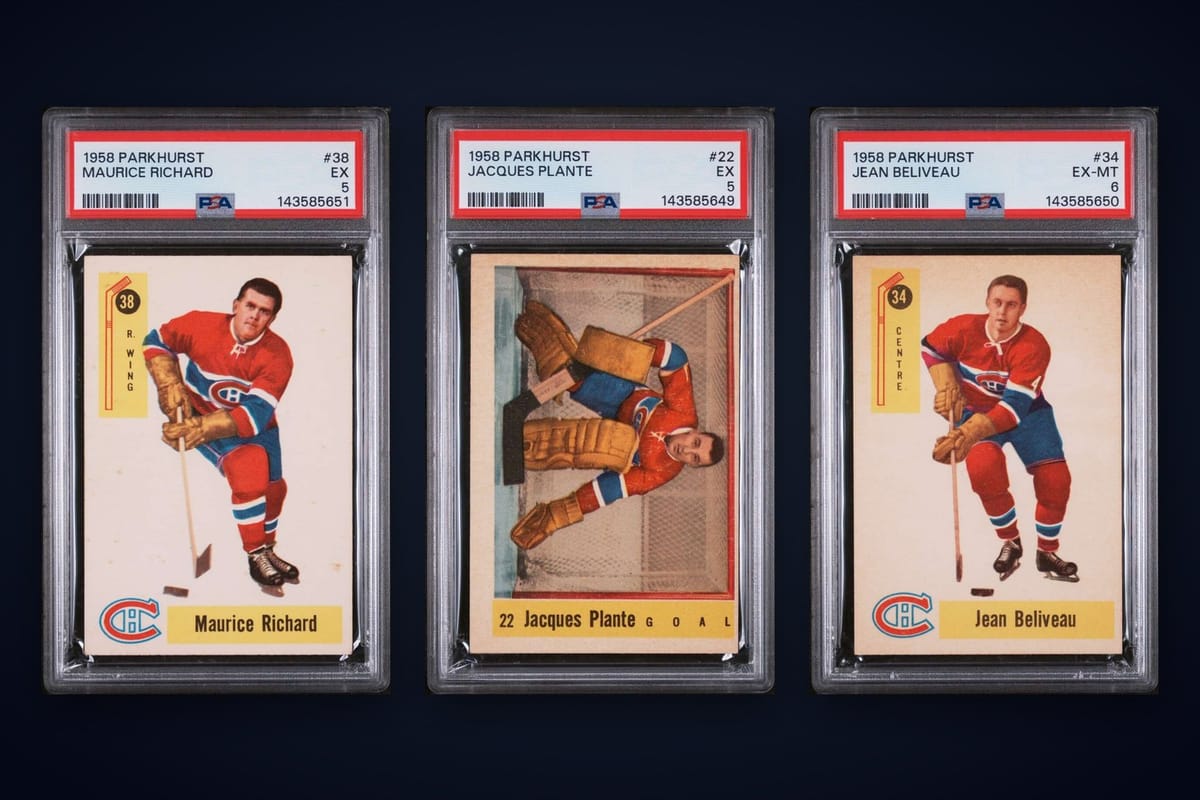
Maurice Richard #38 1958 Parkhurst |
$160.52 | $39,638 | 246.9× |
 |
Jacques Plante #22 1958 Parkhurst |
$45.13 | $9,060 | 200.8× |
 |
Jean Beliveau #34 1958 Parkhurst |
$44.44 | $9,006 | 202.7× |
 |
Henri Richard #2 1958 Parkhurst |
$43.03 | $8,661 | 201.3× |
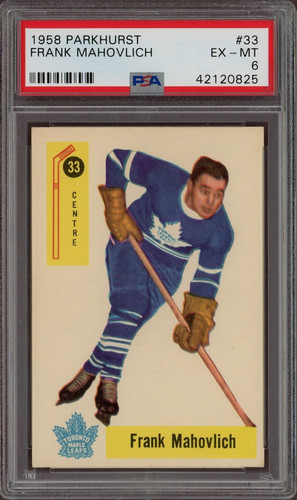 |
Frank Mahovlich #33 1958 Parkhurst |
$34.10 | $8,293 | 243.2× |
 |
Doug Harvey #49 1958 Parkhurst |
$33.56 | $6,764 | 201.5× |
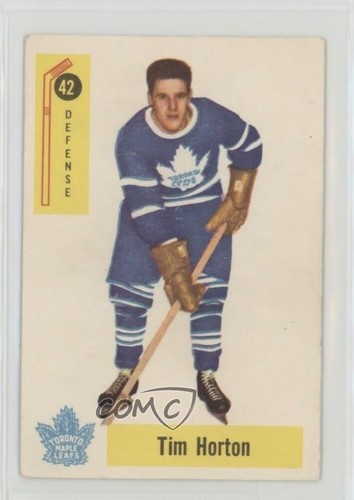 |
Tim Horton #42 1958 Parkhurst |
$34.18 | $6,747 | 197.4× |
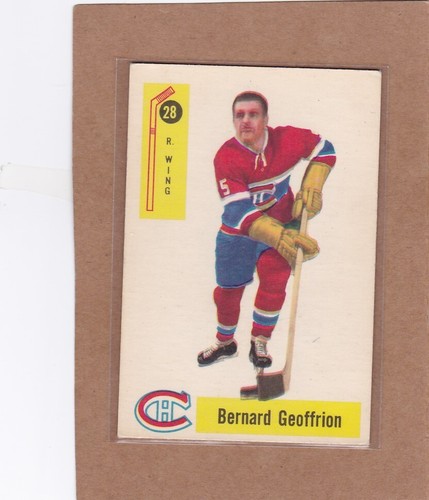 |
Boom Boom Geoffrion #28 1958 Parkhurst |
$32.17 | $6,485 | 201.6× |
 |
Plante Catches [A Shot] #26 1958 Parkhurst |
$18.30 | $4,555 | 248.9× |
 |
Charlie Hodge #17 1958 Parkhurst |
$18.86 | $3,814 | 202.2× |
 |
Ralph Backstrom #16 1958 Parkhurst |
$18.58 | $3,791 | 204× |
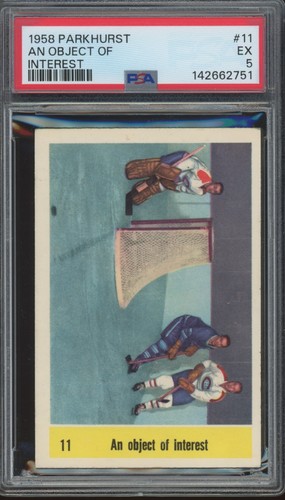 |
An Object of [Interest] #11 1958 Parkhurst |
$22.87 | $3,562 | 155.7× |
Look up any card's current raw and graded value in Midpoint — and get an estimated grade before you pay to submit.
Table of Contents
- Section 1: The 1958 Parkhurst Hockey Set and What Drives Value
- Section 2: Most Valuable 1958 Parkhurst Cards
- Section 3: Raw vs Graded Value and the PSA 10 Premium
- Section 4: How Condition Affects a 1958 Parkhurst Price
- Section 5: Which 1958 Parkhurst Cards Are Worth Grading
- Section 6: Errors, Variations, and Spotting Fakes
- Section 7: Population, Auction Trends, and Tracking Prices
- Conclusion
- FAQ
Section 1: The 1958 Parkhurst Hockey Set and What Drives Value
If you are researching 1958 Parkhurst hockey cards value, start with the context. Parkhurst was the dominant Canadian hockey card brand of the 1950s and early 1960s, and its late-1950s issues were sold in wax packs with a stick of gum, in the heart of the Original Six era. Montreal was in the middle of a dynasty, and the set leans heavily on that star power.
The prices in the data table in this post come from Midpoint's own database and are dated as of 2026-11-22. I do not quote individual dollar figures in the text so that nothing here goes stale. Use the table, or look up any card in the app, for current raw and graded numbers.
Set design and what to look for
Parkhurst cards of this period use a portrait-style color image on a simple border, with the player name and team printed on the front and a short biography on the back. Printing from this era was uneven, so you will often see:
- Off-center borders, often worse on one axis.
- Soft or fuzzy print, with slight registration drift between colors.
- Wax and gum staining on card edges and backs.
- Rough-cut edges that make corners look worse than they are.
These quirks help explain why a pretty example is worth so much more than an average one.
Checklist and card count
Confirm the exact card count and numbering against a trusted checklist (a graded-card registry or a printed catalog) rather than a random listing. Hockey sets span two calendar years, and sellers often mix up 1957-58, 1958-59, and 1959-60 issues, or confuse Parkhurst with Topps. A misidentified year or brand is a common reason a card sells for the wrong price.
The three value drivers
- Player: Hall of Famers and Canadiens stars command the premium.
- Condition: a one-grade jump can multiply the price.
- Scarcity at grade: a 1950s card that survives in sharp condition is far rarer than the print run suggests.
Section 2: Most Valuable 1958 Parkhurst Cards
When collectors ask for the most valuable 1958 Parkhurst cards, they are almost always talking about a short list of names. Here is how to think about each one, and how to check the numbers in the table in this post.
Maurice "Rocket" Richard
Richard is the face of hockey collecting. His cards carry a cultural premium that goes beyond stats: he was the first player to score 50 goals in a season, and he remains a national icon in Canada. A Richard card from this set is typically the first one buyers chase, and it tends to sell quickly. His rookie card is a much earlier issue, so this is a star card, not a rookie.
Jacques Plante
Plante is the goalie who made the mask mainstream and a cornerstone of the Canadiens dynasty. Goalie cards with a clear image and strong centering are popular, and the Plante is often a close second to the Richard on a collector's wish list.
Henri Richard and Bobby Hull
Henri Richard, "the Pocket Rocket," won more Stanley Cups as a player than anyone in history, which keeps demand steady. Bobby Hull is one of the most recognizable stars in hockey history. His rookie is generally attributed to the 1958-59 Topps issue, so treat any Parkhurst Hull as a star card and confirm the set year before paying a rookie-level price.
Other cards that move the market
- Other Hall of Fame Canadiens, Maple Leafs, Red Wings, and Bruins stars.
- Key goalies and captains.
- Error and variation cards, such as the Johnny Bower variation discussed in Section 6.
Tip: a high-grade card of a lesser player can occasionally rival a low-grade star, because a hard-to-find grade is a value driver on its own. Always compare grade-for-grade.
Section 3: Raw vs Graded Value and the PSA 10 Premium
The core idea behind any 1958 Parkhurst price guide is the gem-premium gap: the difference between what a raw copy sells for and what the same card sells for in a high-grade slab. In vintage hockey, that gap is typically large, because most surviving copies were handled, stored in shoeboxes, and printed with imperfect centering.
Why the 1958 Parkhurst PSA 10 value is so extreme
A 1958 Parkhurst PSA 10 value is hard to pin down because very few cards from this era earn a perfect grade, and when one comes to market it is a one-off event. Treat any PSA 10 comp as a data point, not a rule. A single sale can reflect a bidding war between two registry collectors rather than a stable market price.
Instead, anchor on the more liquid grades, such as PSA 5 through PSA 8, where there are enough sales to see a pattern. You can see how those numbers compare for individual cards in the table in this post, as of 2026-11-22.
Grading companies compared
- PSA: the market leader for vintage hockey, and generally the highest resale premium.
- SGC: well respected for vintage, with a strong following among pre-war and 1950s collectors.
- CGC: a newer entrant for sports cards that is gaining acceptance, though often priced a bit below PSA on resale.
- BGS: known for subgrades, which can help or hurt on a card with rough cuts and weak centering.
The grade labels do not mean the same thing across companies. Our guide to grading scale differences by company explains how a 9 or a 10 differs, which matters when you compare comps across slabs.
How to read a price gap
Divide the graded price by the raw price. If a PSA 7 is a small multiple of raw, grading rarely pays. If it is a large multiple, grading becomes worth a closer look. Section 5 turns that into a decision rule.
Section 4: How Condition Affects a 1958 Parkhurst Price
Grading comes down to a handful of physical traits. On a 1950s Parkhurst, each one has its own quirks.
Centering
Centering is the left-right and top-bottom balance of the borders. PSA's published standard for a Gem Mint 10 allows roughly 55/45 to 60/40 on the front and about 75/25 on the back, while lower grades allow progressively worse ratios. Parkhurst's printing practices mean many cards miss those numbers by a wide margin, so a well-centered copy gets a premium. Our deep dive on how centering impacts card value covers the trade-offs in detail.
You can measure centering yourself with the free centering calculator before you decide anything else.

Corners, edges, and surface
- Corners: soft or rounded corners are a common reason a card misses a grade.
- Edges: chipping along the borders shows up especially on darker backgrounds.
- Surface: scratches, gloss loss, print dots, and wax stains all count.
- Print quality: registration problems and fuzzy images can cap the grade regardless of handling.
Creases, stains, and trimming
A crease generally limits a card to a low numeric grade. Stains from wax or gum reduce eye appeal. The biggest value killer is trimming: shaving a card's edges to improve its borders or corners. Grading companies will typically refuse to grade a trimmed card or label it as altered, and the card's value drops sharply. Compare the card's size to a known genuine copy if the edges look suspiciously sharp.
Section 5: Which 1958 Parkhurst Cards Are Worth Grading
Not every card deserves a slab. The question of 1958 Parkhurst cards worth grading comes down to simple arithmetic and an honest condition check.
The break-even test
Use this formula for any card:
- Expected graded value = the price at the grade you realistically expect, not the best case.
- Total cost = raw value + grading fee + shipping + insurance + any authentication or turnaround upcharge.
- Submit only if the expected graded value clearly beats the total cost, with a cushion for a lower-than-expected grade.
Fees vary by company, service tier, and declared value, and they rise for higher-value cards, so low-value cards rarely justify the cost. Check current fee schedules and the raw and graded figures in the table in this post (as of 2026-11-22) to run the numbers.
Cards that usually make sense
- Star cards (Richard, Plante, Henri Richard) where even a mid-grade slab adds meaningful value and authentication protects the buyer.
- Cards with sharp corners, clean surfaces, and centering that looks near 60/40 or better.
- Cards you plan to sell, since a slab increases buyer confidence.
Cards to leave raw
- Creased, stained, or heavily rounded commons.
- Cards with obvious trimming or alteration concerns.
- Low-value cards where fees would eat most of the upside.
Pre-grade before you pay
Do a careful pre-grade with a loupe, bright light, and a centering measurement. Our step-by-step pre-grading guide walks through it. In Midpoint, you can measure centering and get an estimated PSA, BGS, CGC, and TAG grade from a photo, so you can decide before spending on a submission.
Section 6: Errors, Variations, and Spotting Fakes
Vintage hockey sets include print quirks and occasional errors, and they can add or subtract value depending on demand. Authenticity matters just as much.
Errors and variations
Some collectors mention a Johnny Bower name variation, but you should confirm the details (which set, which card, and what the variation is) against a reputable checklist or population report before relying on it. Error cards can command a premium when the variation is documented and collectors actively chase it, but a premium is not automatic. Before paying extra:
- Check the variation against a reputable checklist or population report.
- Look for graded examples labeled with the variation.
- Compare sold prices of the error against the standard card at the same grade.
Reprints and alterations
Reprints, tribute sets, and later reissues can be mistaken for originals. Warning signs include:
- Glossy, modern-looking card stock instead of the period's thicker, duller stock.
- Crisp, digital-looking print without the dot pattern of old printing.
- Card dimensions that are off from a known genuine copy.
- Backs with the wrong tone, wrong text, or wrong layout for the year.
Alterations include trimming, recoloring borders, and pressing out creases. Look for unnaturally clean edges, uneven border colors, or surface sheen that does not match the rest of the card.
Misidentified years
Many cards are listed under the wrong season, since cards from adjacent seasons, or from Parkhurst and Topps, can look similar at a glance. Compare the card number, the back text, and the design details against a checklist. If you are not sure, third-party grading provides both authentication and identification.
When in doubt, buy graded, buy from a seller with return rights, or ask for high-resolution photos of the front, back, and edges before you commit.
Section 7: Population, Auction Trends, and Tracking Prices
Value is a function of price and scarcity. To judge both, use population reports and recent sales.
Using population reports
Population reports from grading companies show how many copies of a card have been graded at each level. For 1950s hockey, a few patterns often hold:
- Most graded copies tend to cluster in the middle grades.
- Top grades are very thin, and that scarcity helps create the steep gem premium.
- A card with a small total population can have unpredictable sale prices.
If you are weighing a scarce card, our guide to grading low population cards explains how to read the numbers without overpaying for rarity.
Reading auction trends
Recent auction results are the best evidence of what the market will pay. Follow these rules:
- Compare sales for the same card, the same grade, and the same grading company.
- Look at several sales, not one headline result.
- Ignore outliers caused by a rare variation, an unusually pretty copy, or a registry bidding war.
- Account for fees: the buyer's premium raises what the buyer pays, and the seller's fee lowers what the seller nets.
Hockey vintage prices can rise and fall with the broader sports-card market and with attention on key Canadiens players. Treat any single sale as a snapshot, not a forecast.
Tracking and protecting your cards
Once you own a card, track its value over time in a portfolio so you notice when the market moves. Midpoint's portfolio tracking shows your collection's value across raw and graded prices. If you hold valuable vintage, store it correctly, using our guide to storing valuable cards to avoid humidity, bending, and surface wear that can erase value.
Conclusion
The 1958 Parkhurst hockey cards value picture comes down to a short list of stars, a steep premium for strong condition, and a set where printing quirks make great copies scarce. The most valuable 1958 Parkhurst cards are typically the Canadiens legends and key Hall of Famers, but the real money is made or lost in the gap between raw and graded.
Before you submit anything, check current raw and graded prices (the table in this post is as of 2026-11-22), measure centering, inspect corners and surface, and rule out trimming or reprints. Then run the break-even math. Submit the cards where the numbers clearly work, and keep the rest raw.
If you want a faster way to decide, try Midpoint to measure centering and get an estimated grade before you pay for grading.
FAQ
Q: What is the most valuable 1958 Parkhurst hockey card?
A: Collectors generally point to the Canadiens superstars, led by Maurice Richard, followed by Jacques Plante and Henri Richard. The exact ranking depends on the grade and current sales, so check the table in this post or look up each card in Midpoint for current figures.
Q: How much is a 1958 Parkhurst Maurice Richard card worth?
A: It depends heavily on condition. Raw copies sell for far less than graded ones, and the price climbs steeply with each grade. See the data table in this post (as of 2026-11-22) for the raw and graded figures.
Q: What are 1958-59 Parkhurst hockey cards worth ungraded?
A: Ungraded value ranges widely. Commons are modest, stars are far higher, and the condition of an individual card (centering, corners, surface, stains) can shift the price a lot. First confirm the card's exact season and brand, then compare it against recent raw sales for the same player.
Q: How much is a PSA 10 1958 Parkhurst card worth?
A: A PSA 10 from this era is extremely scarce, so there are few comparable sales and any one result can be an outlier. Use more liquid grades like PSA 5-8 as a baseline, and check current data before you rely on a PSA 10 figure.
Q: Which 1958 Parkhurst hockey cards are rookie cards?
A: Many of the biggest names in this set did not debut here. Maurice Richard's, Jacques Plante's, and Henri Richard's rookies are earlier issues, and Bobby Hull's rookie is generally attributed to 1958-59 Topps. Verify each card against a checklist.
Q: How can I tell if my 1958 Parkhurst hockey card is rare or valuable?
A: Identify the player and exact set year, check for documented variations (such as the Johnny Bower variation some collectors mention), assess centering, corners, and surface, and compare against graded sales and population data. Midpoint can measure centering and estimate a grade to help you decide whether grading is worthwhile.
Free to start
Try the Midpoint app
Grade any card from a photo, see its raw and PSA 10 value, and track what your collection is worth — free.
Get it on iPhoneGet it on Android