1958 Parkhurst PSA 9 vs PSA 10 Value: Is a 10 Worth It?
1958 Parkhurst PSA 9 vs PSA 10 value: how to calculate the PSA 10 premium, which cards jump most, and when a PSA 9 is the smarter buy.

Estimated reading time: 8 min
Key Takeaways
- The 1958 Parkhurst PSA 9 vs PSA 10 value gap is driven by scarcity and centering. Vintage Parkhurst cards were often cut and printed with limited precision, so true Gem Mint copies can be hard to find.
- Measure the PSA 10 premium three ways: dollar difference, percentage premium, and PSA 10-to-PSA 9 multiple. The values table on this page (as of 2026-11-22) lets you run all three card by card.
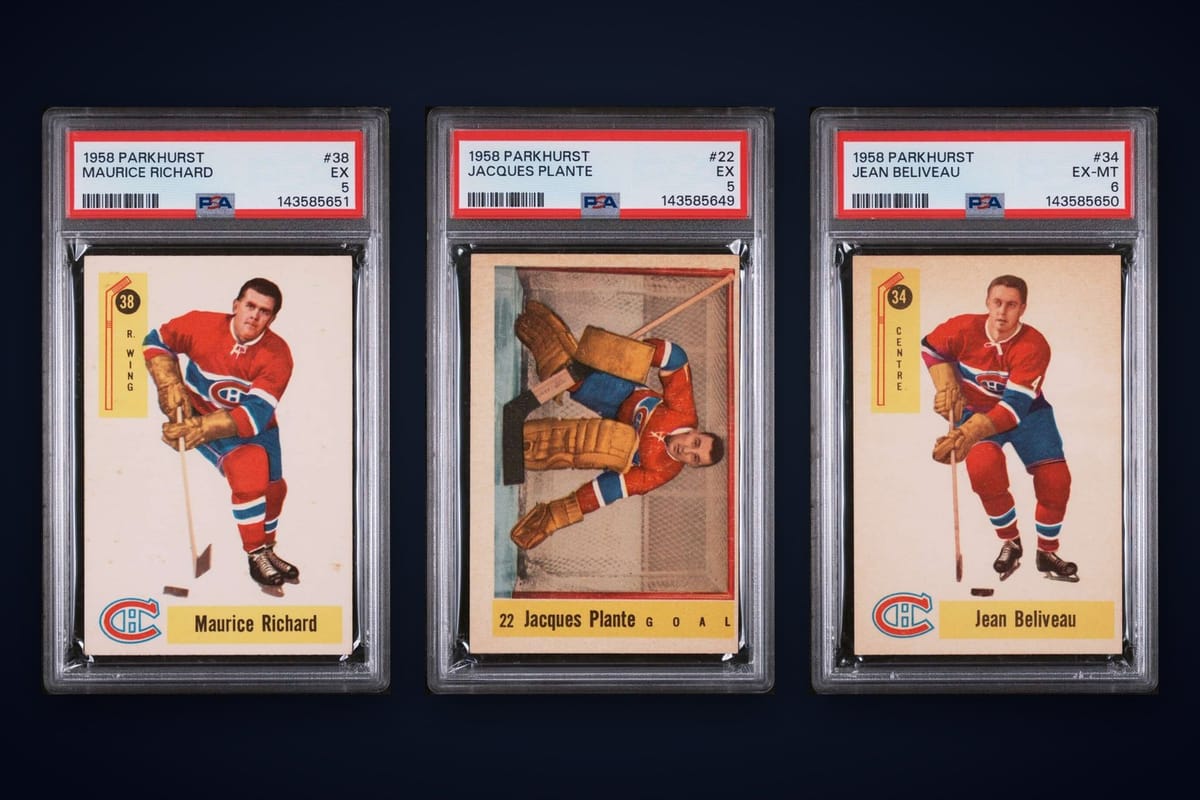
- The biggest 9-to-10 jumps often come on star Hall of Fame cards, such as Maurice Richard and Jacques Plante, where buyers compete for the best copy.
- Bottom line: buy the PSA 9 if you want the card, the look and a sensible price. Pay the PSA 10 premium only for a short-list star card, a registry-style set, or an eye-appealing slab you plan to hold long term.
This guide compares 1958 Parkhurst hockey cards in PSA 9 (Mint) and PSA 10 (Gem Mint). It covers the price gap, why it exists, and whether the extra money is worth it. The quick answer: the PSA 10 premium on 1958 Parkhurst is often steep, but a clean PSA 9 is usually the better value unless you are chasing the single best copy of a key card.
One note on data: every price figure on this page comes from the Midpoint database and is dated as of 2026-11-22. Vintage hockey sells infrequently, so treat each value as a snapshot rather than a guarantee.
Card values — live data from Midpoint's card database, as of 2026-11-22. Prices move; Midpoint refreshes these daily.
| Card | Raw | PSA 10 | Gem premium | |
|---|---|---|---|---|
 |
Maurice Richard #38 1958 Parkhurst |
$160.52 | $39,638 | 246.9× |
 |
Jacques Plante #22 1958 Parkhurst |
$45.13 | $9,060 | 200.8× |
 |
Jean Beliveau #34 1958 Parkhurst |
$44.44 | $9,006 | 202.7× |
 |
Henri Richard #2 1958 Parkhurst |
$43.03 | $8,661 | 201.3× |
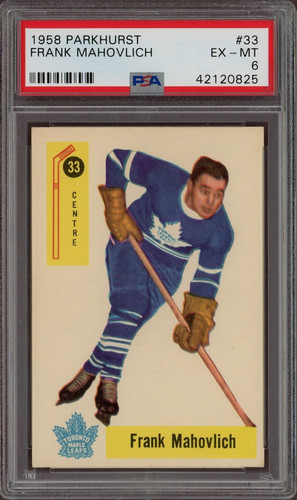 |
Frank Mahovlich #33 1958 Parkhurst |
$34.10 | $8,293 | 243.2× |
 |
Doug Harvey #49 1958 Parkhurst |
$33.56 | $6,764 | 201.5× |
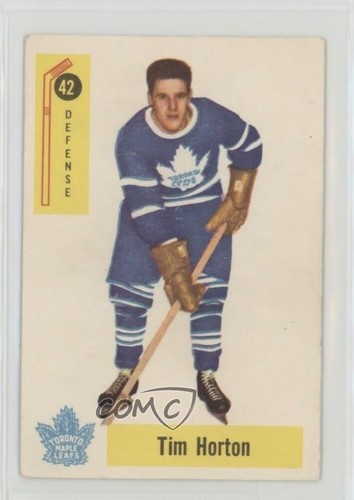 |
Tim Horton #42 1958 Parkhurst |
$34.18 | $6,747 | 197.4× |
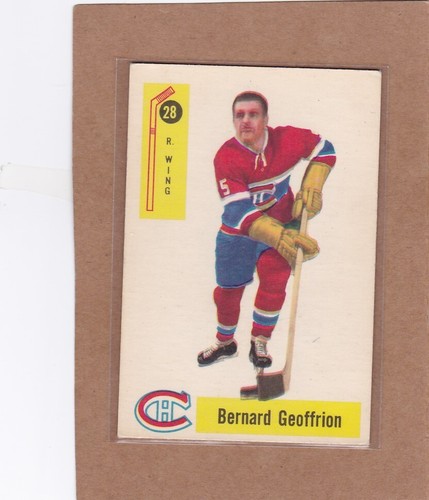 |
Boom Boom Geoffrion #28 1958 Parkhurst |
$32.17 | $6,485 | 201.6× |
 |
Plante Catches [A Shot] #26 1958 Parkhurst |
$18.30 | $4,555 | 248.9× |
 |
Charlie Hodge #17 1958 Parkhurst |
$18.86 | $3,814 | 202.2× |
 |
Ralph Backstrom #16 1958 Parkhurst |
$18.58 | $3,791 | 204× |
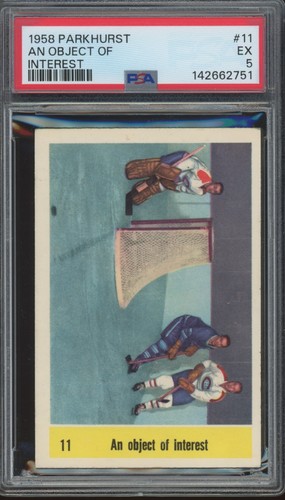 |
An Object of [Interest] #11 1958 Parkhurst |
$22.87 | $3,562 | 155.7× |
Look up any card's current raw and graded value in Midpoint — and get an estimated grade before you pay to submit.
Quick Comparison: PSA 9 vs PSA 10 on 1958 Parkhurst
| Dimension | PSA 9 (Mint) | PSA 10 (Gem Mint) |
|---|---|---|
| Front centering (PSA standard) | 60/40 or better | 55/45 or better |
| Back centering (PSA standard) | 90/10 or better | 75/25 or better |
| Corners, edges, surface | One minor flaw allowed | Essentially flawless to the eye |
| Print defects (snow, roller marks, focus) | Minor ones can still pass | Very little tolerance |
| Typical supply | Scarce | Scarcer; check the population report for each card |
| Price behavior | More sales, easier to compare | Thin sales, large swings between results |
| Best for | Collectors who want a great-looking card | Condition-census chasers and long-term holders |
How to Calculate the 1958 Parkhurst PSA 10 Premium
Collectors often say "a 10 is worth way more than a 9" without saying how much more. Three simple calculations give you the real picture. Use the values table on this page and run them for any card.
- Dollar difference: PSA 10 value minus PSA 9 value. This is the actual extra cash you pay.
- Percentage premium: (PSA 10 minus PSA 9) divided by PSA 9, times 100. This shows how much extra you pay relative to the 9.
- Multiple: PSA 10 divided by PSA 9. A 3x multiple means the 10 costs three times the 9, which is a 200% premium.
Each lens tells you something different. A big dollar gap on an expensive card may be a modest percentage. A small dollar gap on a cheaper card can be a huge multiple. For the PSA 9 vs PSA 10 price difference on a 1958 Parkhurst, the multiple is usually the best way to judge whether the premium is reasonable for that specific card.
Also check whether the value rests on one sale or several. A PSA 10 figure built on a single transaction can reflect one motivated bidder on one day. Treat those cards cautiously and look for sale dates, venue and number of sales before you trust the gap.
What Separates a PSA 9 from a PSA 10
PSA grades on centering, corners, edges and surface. Overall eye appeal also shapes how buyers see a card. On 1958 Parkhurst, each factor can work against the card.
Centering
PSA's published standards allow 55/45 or better on the front for a Gem Mint 10 and 60/40 for a Mint 9. That sounds like a small difference, but vintage Parkhurst was often cut and printed with limited precision. Many cards that look fine to the naked eye drift past 60/40 once measured. If you want to see where a card stands, the free centering calculator gives you the ratios in seconds, and our guide on how centering impacts card value explains why it moves prices so much.
Corners and edges
Cards from this era were commonly handled, stacked and stored in rubber bands or shoeboxes, and their stock can show wear easily. A PSA 10 needs sharp corners and clean edges. A 9 can tolerate a single minor flaw, such as a faint touch of wear or slight edge roughness.
Surface and print defects
Print dots, focus softness, roller marks and gloss loss all matter. On a card from this era, a PSA 10 surface is a rare thing. Because print quality of the era could be inconsistent, some cards may be held back from a 10 by the printing, not by anything the owner did.
Eye appeal and qualifiers
Two cards with the same grade can look very different in hand. Strong color, bold borders and good registration can push a 9 close to the 10 in buyer perception. Qualifiers on some slabs, such as OC (off-center), can also reduce what buyers will pay. Always check the slab label and the images, not just the number. For a deeper look at how the major companies define their top grades, see our breakdown of grading scale differences by company.
Which 1958 Parkhurst Cards Have the Biggest 9-to-10 Jump?
The gap is not uniform across the set. Three things can push it up on a given card.
- Player demand: Hall of Fame stars such as Maurice Richard and Jacques Plante attract the most bidders. When two serious collectors want the single best copy, the PSA 10 can leave the PSA 9 far behind.
- Condition sensitivity: Cards with dark borders, bold color fields or tricky registration show flaws more easily. That can make high grades rarer and the top-grade premium bigger.
- Population: If the PSA 10 population is tiny, there may be very few copies for buyers to chase. If a card has many PSA 9s but almost no 10s, the premium may reflect that imbalance.
Use the table on this page to compare the multiple for Richard, Plante and the other star cards listed. Cards with the highest PSA 10-to-PSA 9 multiple are often the ones where centering decides everything: a copy that lands at 55/45 instead of 60/40 can be worth a multiple of its neighbor.
On commons and lesser players the picture is usually calmer. The dollar difference may be smaller, and a PSA 9 is often plenty for a set builder.
Check the population report
PSA's population report shows how many copies of each card are in each grade. A big gap between 9s and 10s tells you how scarce a Gem Mint copy really is. Keep in mind that populations count graded cards only, not every copy in existence. Our guide to grading low population cards covers how to read those numbers sensibly.
Raw vs Graded: Is Grading a 1958 Parkhurst Worth It?
This is the core of 1958 Parkhurst grading value. Grading pays off only when the expected graded value, after fees, beats what the raw card would sell for. For this set the math depends on the card and your honest read of its condition.
- Likely 7 or 8: grading may still help, as authentication and a slab make a vintage card easier to sell. But the upside is limited.
- Likely 9: grading is usually worthwhile. A PSA 9 opens up the buyer pool that pays for certified Mint.
- Possible 10: grading can pay off, but only when centering is clearly within PSA's 55/45 front and 75/25 back limits and the surface is clean.
Before you pay, pre-grade the card step by step. Check centering first, since it is the factor you can measure objectively. The Midpoint app also gives an estimated PSA, BGS, CGC and TAG grade from centering, corners, edges and surface, so you know the odds before you submit.

Remember the costs: grading fees, shipping, insurance and the selling fees you pay later. Authentication is part of the value too. A PSA slab indicates the card has been authenticated, which matters on vintage cards where trimming and alteration are real concerns.
Vintage Market Factors That Move the Gap
The 1958 Parkhurst PSA 9 vs PSA 10 value is not a fixed number. Several market factors can widen or shrink it.
- Low sales volume: Some PSA 10 cards sell rarely. One strong sale can reset the perceived value, and long gaps between sales mean the data goes stale.
- Auction timing and venue: A well-promoted auction with several bidders can bring a different result than a quiet listing or a private sale.
- Buyer demand: Registry collectors and investors are often willing to pay more for the top grade, while many hobbyists stop at a PSA 8 or 9.
- Transaction fees: Seller fees and buyer's premiums change what a sale price really means. Compare like with like.
- Price volatility: Thin markets swing. A value as of 2026-11-22 is a snapshot, so recheck before you buy or sell.
If you hold more than a few of these, tracking helps. Midpoint's portfolio tracking shows your collection's value over time. Protect high-grade pieces properly as well; our guide to storing valuable cards covers it.
Which Should You Choose?
Buy the PSA 9 if
- You want a strong-looking 1958 Parkhurst star card without paying the Gem Mint multiple.
- You are building a set and want consistent, affordable slabs.
- The PSA 10 value for that card rests on only one or two sales.
- You value liquidity: PSA 9s tend to be easier to price and resell.
Pay for the PSA 10 if
- The card is a short-list star such as Maurice Richard or Jacques Plante and you want the top of the census.
- You are a registry collector or a long-term holder who cares about rank.
- The slab has excellent eye appeal and the multiple is justified by a very low population.
Submit a raw card if
- Centering measures within 55/45 on the front and 75/25 on the back, and corners, edges and surface look clean under good light.
- The expected graded value, after fees, clearly beats the raw sale price.
Not sure where your card falls? Measure it first with Midpoint, which is free on iOS and Android, and look up raw vs graded values before you commit to a submission.
FAQ
How much is a 1958 Parkhurst card worth in PSA 9?
It depends heavily on the card. Star Hall of Fame cards such as Maurice Richard and Jacques Plante sit well above commons. The exact PSA 9 value for each card is in the values table on this page, as of 2026-11-22. Because vintage hockey trades infrequently, recheck recent sales before you buy.
How much is a 1958 Parkhurst card worth in PSA 10?
A PSA 10 is typically worth meaningfully more than a PSA 9, and often far more on stars. See the PSA 10 column in the values table (as of 2026-11-22) for each card. Treat figures based on a single sale cautiously.
How much more is a PSA 10 1958 Parkhurst card worth than a PSA 9?
Calculate it three ways: PSA 10 minus PSA 9 for the dollar gap, the difference divided by the PSA 9 value for the percentage premium, and PSA 10 divided by PSA 9 for the multiple. The multiple is usually the clearest sign of how much extra a Gem Mint copy commands on that card.
What is the most valuable 1958 Parkhurst hockey card?
Star Hall of Fame cards lead the set, with Maurice Richard and Jacques Plante among the names collectors watch most closely. Check the values table for the current ranking by PSA 9 and PSA 10 value.
Why is a PSA 10 1958 Parkhurst card worth so much more than a PSA 9?
Scarcity and tolerance. PSA 10 needs front centering of 55/45 or better, plus sharp corners, clean edges and a clean surface. Vintage Parkhurst cards were often cut and printed with limited precision and are now decades old, so few copies qualify. Collectors competing for the top-graded copy push the price up.
Is it worth grading a 1958 Parkhurst card if it might receive a PSA 9 or PSA 10?
Often yes, if your pre-grade is honest. Measure centering, inspect corners, edges and surface, and compare the expected graded value minus fees against the raw value. A likely PSA 9 usually justifies grading. A possible PSA 10 can too, but only if the centering is clearly within PSA's limits.
Free to start
Try the Midpoint app
Grade any card from a photo, see its raw and PSA 10 value, and track what your collection is worth — free.
Get it on iPhoneGet it on Android