1960 Topps Baseball Cards Value: Raw vs Graded Guide
1960 Topps baseball cards value explained: top cards, rookies, gem-premium gap, condition factors and which cards are worth grading before you submit.

Estimated reading time: 11 min
Key Takeaways
- 1960 Topps baseball cards value depends on three things: player, card number (the high series is scarcer), and condition. The gap between raw and graded prices widens sharply at the top grades.
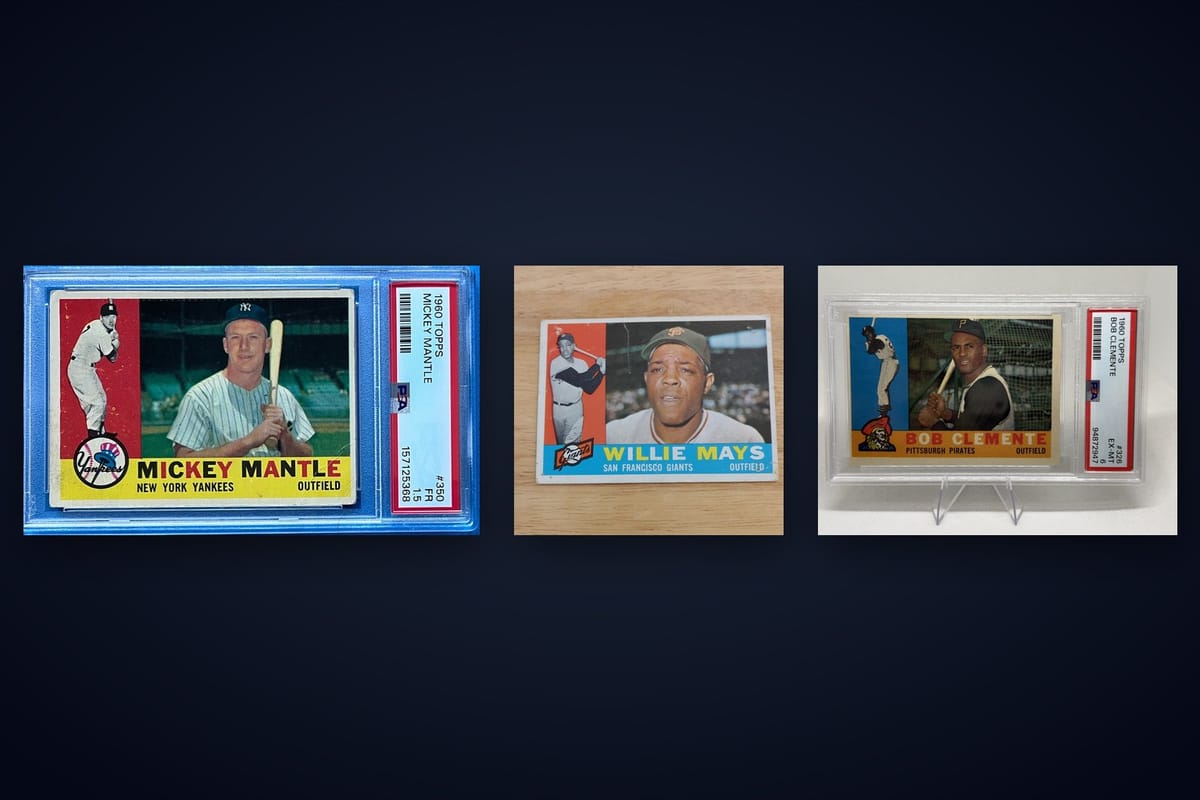
- The cards collectors chase first are Mantle #350, Aaron #300, Mays #200, Yastrzemski #148 (rookie), and Clemente #326, along with rookies like McCovey #316.
- Centering and gum or wax staining can decide many 1960 Topps grades, so check them before you pay a grading fee.
- Use sold prices, not asking prices. A 1960 Topps price guide is a starting estimate, and the median of recent completed sales is the better benchmark.
- Grading pays off mainly for stars and sharp, well-centered high-number cards. For most commons, the fee can exceed any value gain.
Card values — live data from Midpoint's card database, as of 2026-11-22. Prices move; Midpoint refreshes these daily.
| Card | Raw | PSA 10 | Gem premium | |
|---|---|---|---|---|
 |
Mickey Mantle #350 1960 Topps |
$412.05 | $285,480 | 692.8× |
 |
Willie Mays #200 1960 Topps |
$105.91 | $31,926 | 301.4× |
 |
Bob Clemente #326 1960 Topps |
$99.33 | $31,735 | 319.5× |
 |
Carl Yastrzemski [Rookie Star] #148 1960 Topps |
$134.25 | $25,220 | 187.9× |
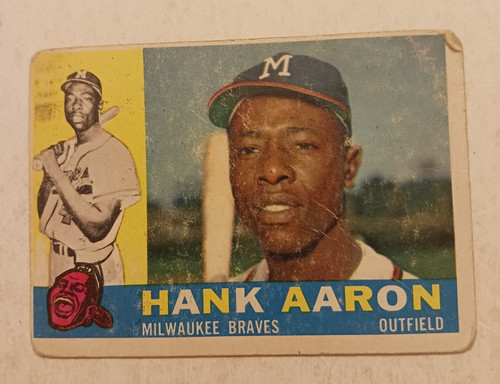 |
Hank Aaron #300 1960 Topps |
$127.23 | $22,088 | 173.6× |
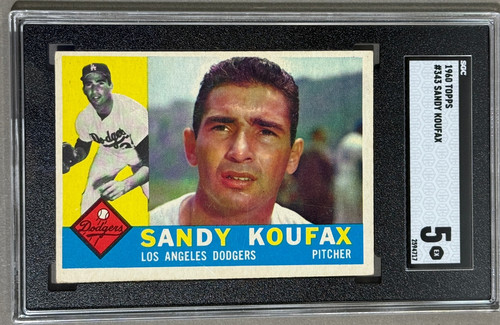 |
Sandy Koufax #343 1960 Topps |
$85.76 | $19,724 | 230× |
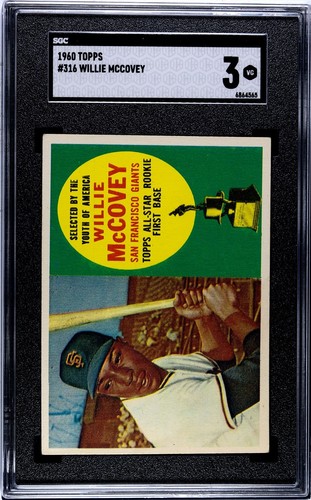 |
Willie McCovey #316 1960 Topps |
$74.91 | $15,728 | 210× |
 |
Hank Aaron [All Star] #566 1960 Topps |
$82.64 | $14,464 | 175× |
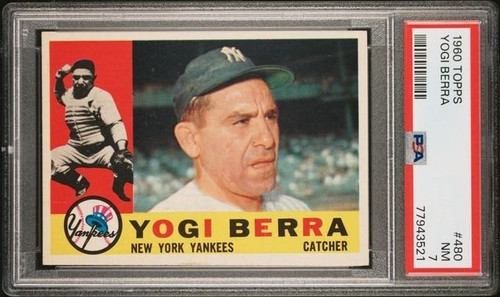 |
Yogi Berra #480 1960 Topps |
$65.00 | $14,274 | 219.6× |
 |
Willie Mays [All Star] #564 1960 Topps |
$71.56 | $12,885 | 180.1× |
 |
Roger Maris #377 1960 Topps |
$52.39 | $9,135 | 174.4× |
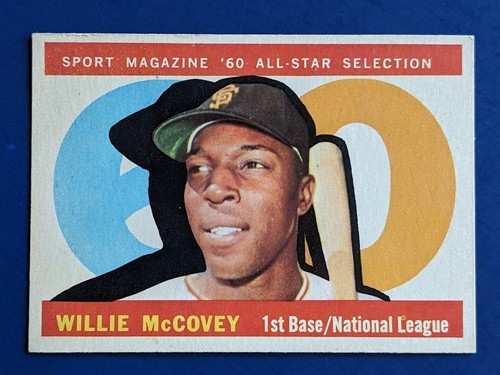 |
Willie McCovey [All Star] #554 1960 Topps |
$52.94 | $9,115 | 172.2× |
Look up any card's current raw and graded value in Midpoint — and get an estimated grade before you pay to submit.
Table of Contents
- Section 1: The 1960 Topps Set at a Glance
- Section 2: How to Read a 1960 Topps Price Guide (Raw vs Graded)
- Section 3: The Most Valuable 1960 Topps Cards
- Section 4: 1960 Topps Rookie Cards and Rookie Stars
- Section 5: What Condition Does to 1960 Topps Values
- Section 6: Variations, High Numbers and Scarce Issues
- Section 7: Are 1960 Topps Cards Worth Grading, and How to Sell Them
- Conclusion
- FAQ
Section 1: The 1960 Topps Set at a Glance
If you are searching for 1960 Topps baseball cards value, start with what the set is. It is one of the most recognizable designs in vintage baseball: 572 cards, a horizontal layout, and a large color portrait paired with a smaller action or secondary shot. The design makes each card feel different from the vertical sets that came before it.
Set structure and checklist basics
The checklist runs from #1 to #572. Cards were released in series over the season, so the later numbers were produced and distributed differently from the early ones. Collectors treat the high numbers, #507-572, as their own tier because they are generally harder to find in top condition.
Major groupings you will see on a checklist:
- Base player cards for regulars, stars, and role players.
- Rookie Stars cards, some of which pair multiple prospects on one card.
- Manager, coach and team cards, which are usually inexpensive but condition-sensitive.
- All-Star and thrill-style subsets that feature established stars.
- Checklist cards, which can carry a premium when unmarked.
Why this set holds collector interest
Several factors keep demand steady. The set has Hall of Famers at their peak, plus rookies who became legends. The design photographs well, which matters in online auctions. The set is also completable for patient collectors, who can build it in lower grades and upgrade over time.
A table of lookup data from Midpoint's database, with values as of 2026-11-22, follows this section. Use it as a snapshot, then compare it against recent sold listings for any card you plan to buy or sell. For checking a specific card number in your own collection, Midpoint lets you look up raw and graded values across more than 1.5 million cards.
Section 2: How to Read a 1960 Topps Price Guide (Raw vs Graded)
A 1960 Topps price guide is useful, but only if you know what it is measuring. Guides often blend sales, dealer asks, and algorithms. They lag fast-moving markets, and they cannot see the specific copy in your hand.
Asking prices versus completed sales
This is a common mistake in vintage pricing. An asking price is a hope; a completed sale is a fact.
- Asking prices are inflated by sellers who can wait. They tell you the ceiling, not the market.
- Completed sales show what buyers paid. Look at several, not one.
- Median sale price is more reliable than the average, because one outlier auction can skew an average badly.
- Sale range (low to high) tells you how much condition and eye appeal swing the result.
Raw versus graded values
A raw card has no third-party opinion on condition, so buyers discount it for uncertainty. A graded card from PSA, SGC, or BVG removes much of that doubt, and the price reflects it. The same card can sell for very different amounts depending on the number on the holder.
The key concept is the gem-premium gap: the jump in price between a good grade and a top grade. For 1960 Topps, this gap tends to be large because few copies survive in top condition. A card that grades PSA 7 and a card that grades PSA 9 can be separated by a multiple, not a small percentage. That is why 1960 Topps PSA 10 value is often a different conversation from everything below it. A true gem is extremely rare for a 65-plus-year-old cardboard issue, so when one sells, the price can be dramatic.
A simple pricing routine
- Identify the exact card number and any variation.
- Pull the last several completed sales in the same grade and grading company.
- Adjust for centering and eye appeal, since two same-grade cards rarely sell for the same price.
- Cross-check against a lookup tool, such as the data in the table above, dated 2026-11-22.
Section 3: The Most Valuable 1960 Topps Cards
When collectors ask about the most valuable 1960 Topps cards, the answer starts with a short list of superstars. Value follows player stature, card number, and survival rate.
The headline cards
- Mickey Mantle #350. Mantle is the market's anchor in almost every vintage set, and this card is the one most buyers want from 1960. Demand is deep across every grade.
- Hank Aaron #300. A round-number card for an all-time great, with strong demand and steep premiums for sharp, centered copies.
- Willie Mays #200. Another round-number card for a player with a loyal collector base. Mays and Mantle pair naturally in want lists.
- Carl Yastrzemski #148. His rookie card, which gets its own section below.
- Roberto Clemente #326. A Pittsburgh icon whose cards have steady, global demand.
Other Hall of Famers and All-Stars in the set trade at meaningful premiums to commons, but they generally sit a tier below these names. For exact figures, use the table above (values as of 2026-11-22), then confirm with recent sales.
What separates a Mantle from a common in value
Even a low-grade Mantle often outsells a high-grade common. That is a basic rule of vintage value: the player sets the floor, and condition sets the multiple on top of it. A star in poor condition can still outprice a mid-tier player in mint.
Do not ignore the supporting cast
The collectors who build sets pay attention to the whole checklist. Semi-star cards, strong team cards, and unmarked checklists can see real demand when they are well-centered and clean. If you hold a stack of 1960 commons, sort for sharp corners, clean surfaces, and decent centering first. Those are the cards with any chance of earning a premium.
Section 4: 1960 Topps Rookie Cards and Rookie Stars
Rookie cards are where long-term demand concentrates. The 1960 set includes several that collectors prioritize, and each is priced on its own curve.
Carl Yastrzemski #148
Yaz's 1960 Topps card is his rookie card and one of the set's premier non-Mantle pieces. Because he was a Hall of Famer with a long Red Sox career, demand comes from both vintage collectors and Boston loyalists. Expect a strong gem-premium gap here, as with other key rookies.
Willie McCovey #316
McCovey's rookie is another cornerstone. Hall of Fame status and a recognizable name make it a desirable raw and graded piece. Rookies like this sell on centering and eye appeal as much as on the grade label.
Frank Howard and other Rookie Stars
Frank Howard is a well-known name among the set's early-career players, and the multi-player Rookie Stars cards often feature lesser-known prospects alongside future names. Check each one individually. A card of two forgotten players is usually priced close to a common, while a card that includes a future Hall of Famer or franchise name is not.
How to price rookies
- Check whether the player is the featured rookie or a supporting name on a shared card.
- Compare sales from the same grading company. A PSA holder and an SGC or BVG holder do not always sell for the same amount.
- Watch for corner wear and print flaws, which are visible on these cards and drive buyer pricing.
Rookie premiums are generally larger at higher grades, which is exactly why it helps to pre-assess condition before you submit. Our guide on how to pre-grade your card walks through the process step by step.
Section 5: What Condition Does to 1960 Topps Values
For 1960 Topps, condition is not a detail. After the player name, it is the main driver of price. A single grade can change a result substantially, so understanding what graders look for is a direct way to estimate value.
Centering
1960 Topps cards often have uneven borders, so centering is a persistent problem. A card with a sharp image but visibly lopsided borders can lose a grade or more, or sell at a discount even if the holder number is strong. Measuring the left-right and top-bottom ratios is the fastest way to filter your pile. We cover this in depth in how centering impacts card value.
Corners, edges and surface
- Corners: Soft or rounded corners are common on vintage cards and pull grades down quickly.
- Edges: Chipping on the border shows easily against dark areas of the design.
- Surface: Scratches, scuffs, and loss of gloss are visible under angled light.
- Print defects: Print dots, missed ink, and registration problems can appear on otherwise clean cards.
Gum stains, wax stains and creases
These cards were packaged with gum in wax packs, so staining is a recognized problem on vintage cards. Wax and gum stains lower grades and sale prices. Creases are worse: a visible crease generally caps a card well below the top grades, and many grading services treat heavy creasing as a major defect. Trimming and alteration are separate issues, and graders will reject altered cards.
Condition checklist before you buy or submit
- Measure centering on front and back.
- Inspect all four corners under magnification.
- Tilt the card in light to find surface scratches and stains.
- Check edges for chips and signs of trimming.
Storage matters too, since vintage cardboard can keep degrading if it is handled or stored poorly. See our guide to how to store valuable cards to protect what you have.
Section 6: Variations, High Numbers and Scarce Issues
The 1960 Topps set has a few quirks that affect value. Knowing them helps you avoid overpaying and helps you spot cards that deserve a second look.
White-back versus gray-back cards
Collectors discuss differences in card-back stock for 1960 Topps, commonly described as white-back versus gray-back. The back color can matter to specialists, and in some cases a scarcer back variety may carry a premium. Because the details are specific to individual cards, verify any claimed variation against a reputable reference and recent sold comparisons rather than trusting a seller's description alone.
High-number scarcity (#507-572)
The final run of the set is notable. High-number cards are generally considered scarcer, especially in sharp condition, and they tend to carry a premium over equivalent early-number cards. That effect shows up in both raw and graded markets. A well-centered, clean high-number card is often a better grading candidate than a mid-number common, even if the player is not a household name.
Checklists, team cards and uncut panels
- Checklist cards: Unmarked copies are typically preferred over marked ones.
- Team cards: Often overlooked, but sharp copies can be tougher to find than they appear.
- Uncut panels and sheets: These are collectible oddities. They are priced individually and are not comparable with single cards, so treat them as separate items needing specialist comparison.
Spotting problem cards
Be cautious with anything priced far below the market for a key star. Reprints, trimmed cards, and altered corners all exist in the vintage hobby. Match the card number, typeface, and back design against a trusted checklist. For expensive cards, buy already graded, or submit for authentication before you resell. Understanding how different companies describe top grades also helps, as covered in our breakdown of grading scale differences by company.
Section 7: Are 1960 Topps Cards Worth Grading, and How to Sell Them
Whether 1960 Topps cards are worth grading comes down to simple math: expected graded value minus raw value, minus fees and shipping, and weighted by the chance of landing the grade you need.
When grading makes sense
- Star cards (Mantle, Aaron, Mays, Clemente, Yaz, McCovey) where even a mid grade adds buyer confidence and liquidity.
- High-number cards with clean surfaces and good centering.
- Cards you plan to sell on a major auction platform, where graded cards often attract more bidders.
When to skip it
For common cards with soft corners, off-center borders, or stains, the grading fee (which varies by company and service level, and is often tens of dollars per card before shipping and insurance) can exceed the uplift. Bulk-grading low-end commons rarely pays unless they are unusually sharp.
Estimate the grade first
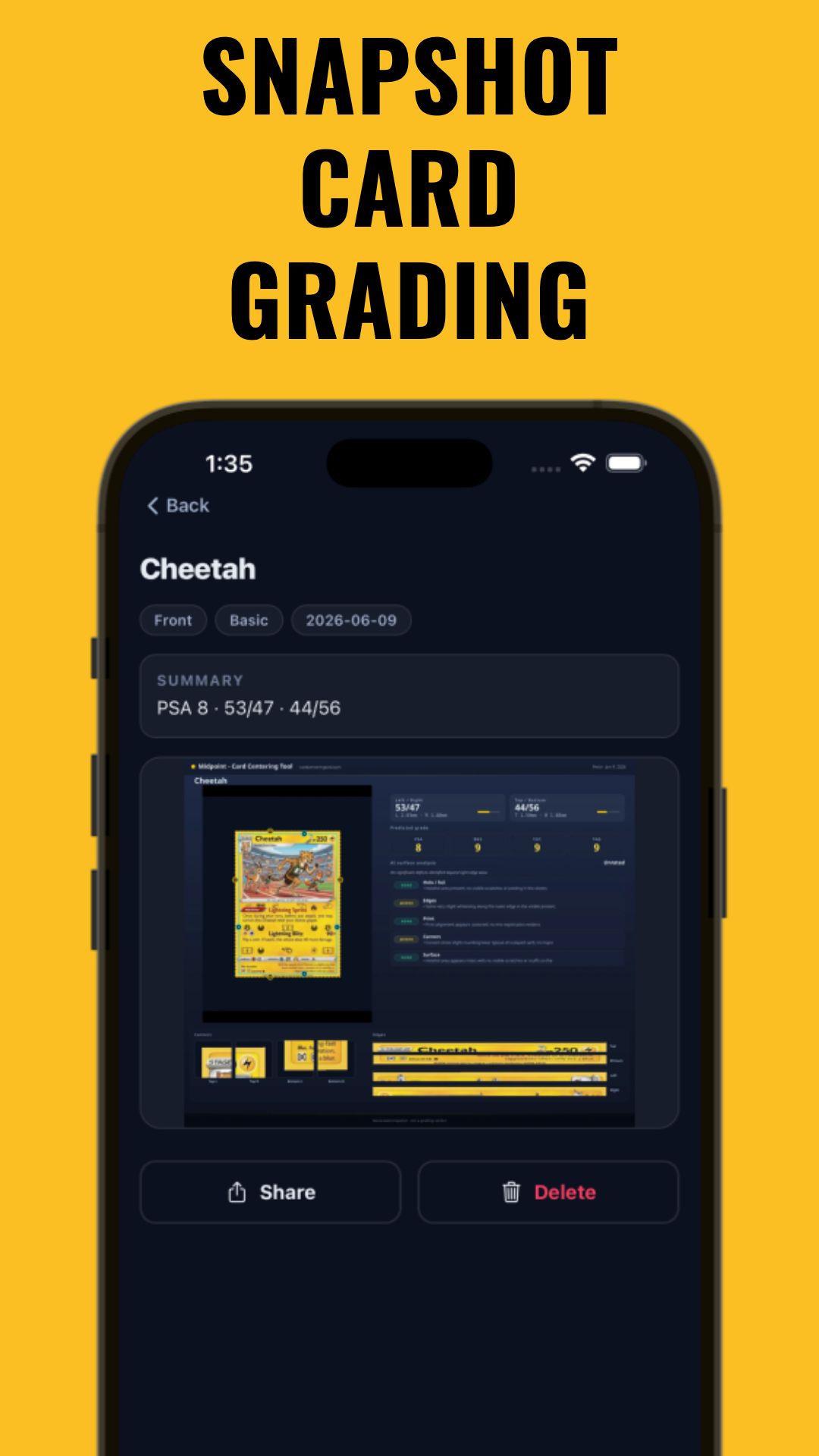
Before you submit, estimate where the card will land. Midpoint measures centering and gives instant PSA, BGS, CGC, and TAG estimates from centering, corners, edges, and surface, so you can decide if a card clears your cost threshold. You can also try the free centering calculator for a quick check.
Selling after you grade
- Check completed sales for the same card and grade before setting a price.
- Use clear, well-lit photos of the front, back, and holder.
- Choose auction format for key stars where demand is strong, or fixed price when you can wait.
- Insure graded cards in transit, and see card grade impact on insurance value for how grade affects coverage.
Finally, track what you own. A portfolio view of your collection's value over time shows which cards are gaining and which are stalling, which helps with sell-or-hold decisions.
Conclusion
1960 Topps baseball cards value comes down to a clear hierarchy: the player first, then the card number and scarcity, then condition. Mantle #350, Aaron #300, Mays #200, Yastrzemski #148, and Clemente #326 anchor the market. Rookies like McCovey #316 and high-number cards add depth, and the gem-premium gap makes top grades dramatically more valuable than the middle of the pack.
Use completed sales rather than asking prices, check centering and surface before you spend on grading, and be selective about which cards deserve a holder. To measure centering, estimate PSA, BGS, CGC, and TAG grades, and track your collection, try Midpoint, free on iOS and Android.
FAQ
Q: How much are 1960 Topps baseball cards worth?
A: It varies widely. Commons in low grades are inexpensive, while stars and key rookies in high grades can be worth far more. Condition, centering, and card number drive the difference. Check recent completed sales and Midpoint's card lookup (data as of 2026-11-22) for the exact card and grade.
Q: What is the most valuable 1960 Topps baseball card?
A: Mickey Mantle #350 is generally the headline card, with Hank Aaron #300, Willie Mays #200, Carl Yastrzemski #148, and Roberto Clemente #326 among the other top names in collector demand.
Q: How much is a 1960 Topps Mickey Mantle #350 worth?
A: Value depends heavily on grade and centering. Even lower-grade copies carry strong demand, while high-grade copies sell at a large premium. Compare recent sold prices in the same grade and grading company rather than relying on asking prices.
Q: What is a 1960 Topps Hank Aaron #300 worth?
A: It is one of the set's most sought-after cards. Price depends on grade, centering, and surface, and the gap between mid-grade and top-grade copies is large. Check completed sales for the exact grade you own.
Q: How much is a 1960 Topps Carl Yastrzemski rookie card worth?
A: Yaz's #148 is a key rookie card, and its value rises sharply with grade and eye appeal. Look at recent PSA, SGC, and BVG sales for comparable copies before pricing.
Q: Are 1960 Topps baseball cards worth getting graded?
A: Often yes for stars, key rookies, and clean high-number cards, since grading adds trust and can raise resale value. For commons with off-center borders, stains, or soft corners, the fee usually exceeds the gain. Estimate the grade first.
Free to start
Try the Midpoint app
Grade any card from a photo, see its raw and PSA 10 value, and track what your collection is worth — free.
Get it on iPhoneGet it on Android