1996 Finest Basketball Cards Value: Which Cards to Grade
1996 Finest basketball cards value guide: Jordan, Kobe and Iverson rookies, Refractors, coating, PSA 10 gem premiums and which cards are worth grading.

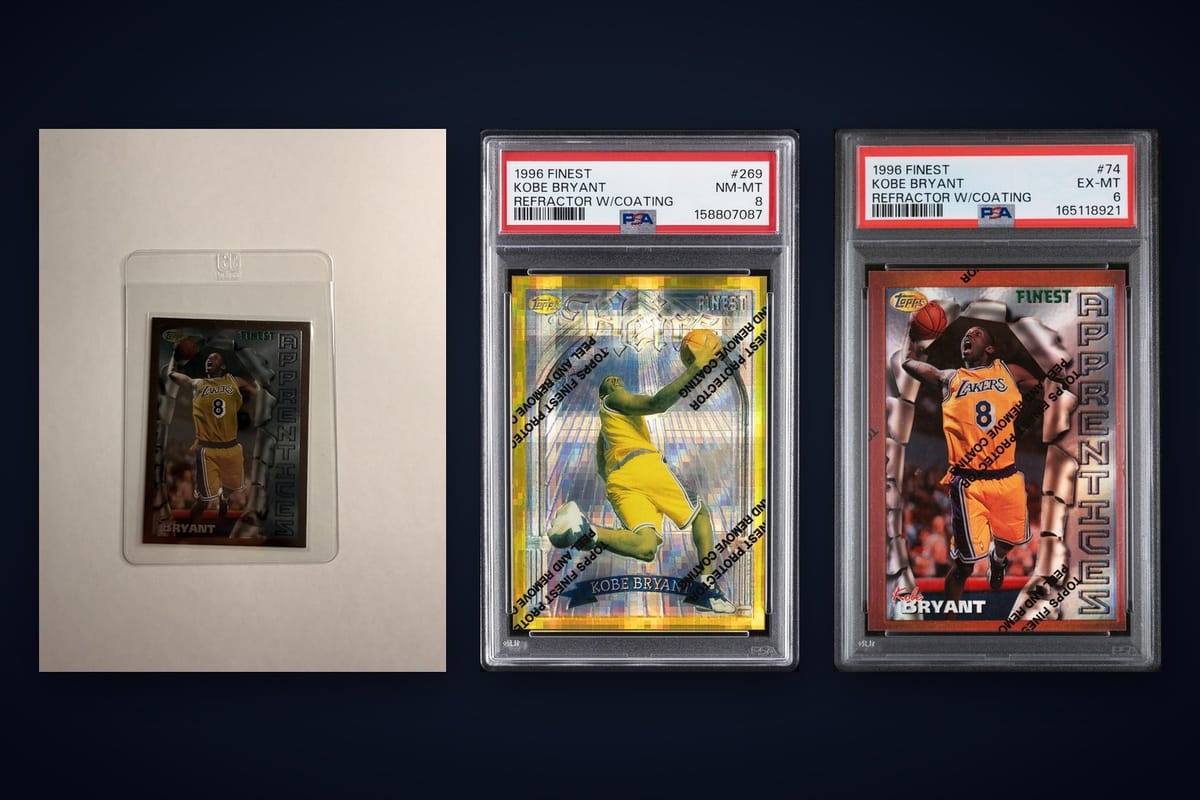
Estimated reading time: 11 min
Key Takeaways
- 1996 Finest basketball cards value depends on card number, tier (Bronze, Silver, Gold), Refractor or base, coating status and grade. Never price a card from the set name alone.
- The most valuable 1996 Finest cards are the Michael Jordan (#50, #291), Kobe Bryant (#74) and Allen Iverson (#69, #280) cards, along with their Refractor versions.
- The gap between raw, PSA 8, PSA 9 and PSA 10 is the real story. This set punishes soft corners, chipped edges and off-center fronts, so gem copies carry a large premium.
- Only submit cards where the graded premium clearly exceeds grading fees plus the risk of a PSA 7 or 8. Pre-grade centering first.
Card values — live data from Midpoint's card database, as of 2026-11-15. Prices move; Midpoint refreshes these daily.
| Card | Raw | PSA 10 | Gem premium | |
|---|---|---|---|---|
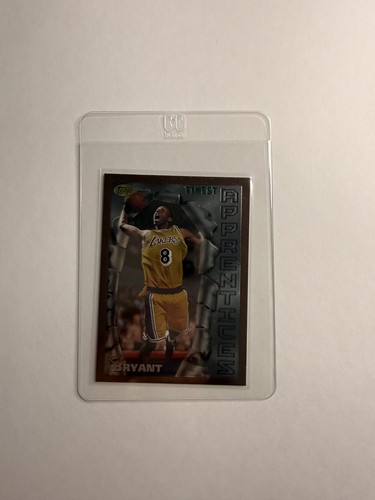 |
Kobe Bryant [Refractor] #74 1996 Finest |
$225.00 | $35,500 | 157.8× |
 |
Kobe Bryant [Refractor w Coating] #269 1996 Finest |
$4,000 | $31,112 | 7.8× |
 |
Kobe Bryant [Refractor w Coating] #74 1996 Finest |
$615.03 | $22,200 | 36.1× |
|
Kobe Bryant [Refractor] #269 1996 Finest |
$6,500 | $20,354 | 3.1× |
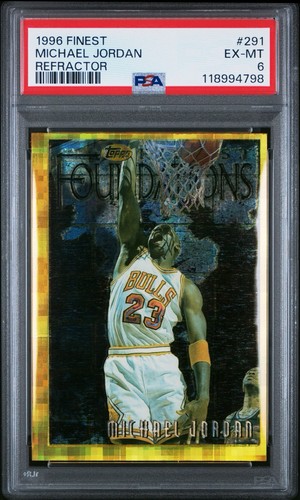 |
Michael Jordan [Refractor] #291 1996 Finest |
$2,600 | $18,850 | 7.3× |
 |
Michael Jordan [Refractor] #127 1996 Finest |
$770.00 | $9,291 | 12.1× |
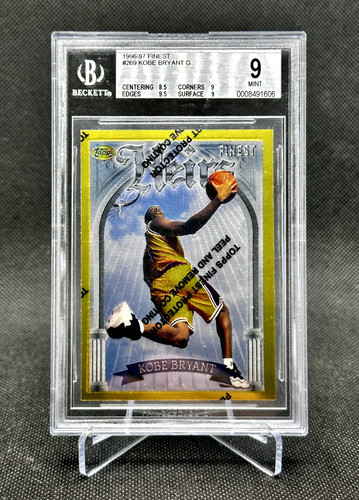 |
Kobe Bryant #269 1996 Finest |
$1,212 | $8,988 | 7.4× |
 |
Michael Jordan [Refractor] #50 1996 Finest |
$95.00 | $8,314 | 87.5× |
 |
Shaquille O'Neal [Refractor] #146 1996 Finest |
$439.14 | $6,976 | 15.9× |
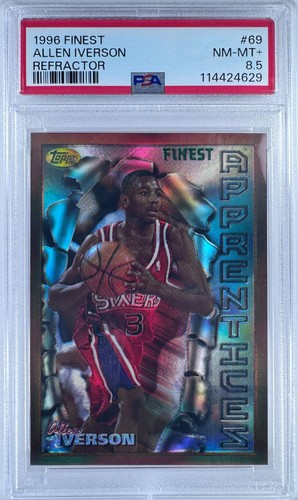 |
Allen Iverson [Refractor] #69 1996 Finest |
$262.75 | $6,200 | 23.6× |
 |
Michael Jordan #291 1996 Finest |
$823.39 | $5,816 | 7.1× |
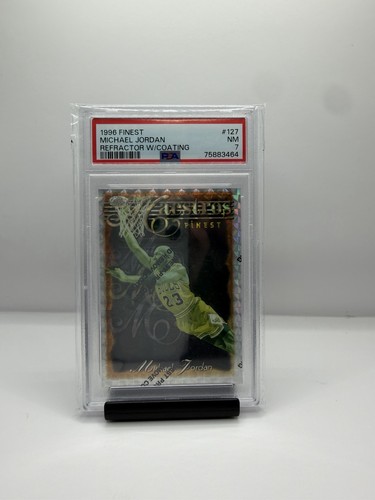 |
Michael Jordan [Refractor w Coating] #127 1996 Finest |
$621.50 | $5,500 | 8.9× |
Look up any card's current raw and graded value in Midpoint — and get an estimated grade before you pay to submit.
Table of Contents
- Section 1: The 1996-97 Topps Finest Set at a Glance
- Section 2: A 1996 Finest Price Guide Framework
- Section 3: Michael Jordan Cards (#50 and #291)
- Section 4: Kobe Bryant and Allen Iverson Rookies
- Section 5: Refractors, Coating and Premium Parallels
- Section 6: Condition, Centering and the PSA 10 Gem Premium
- Section 7: Which 1996 Finest Cards Are Worth Grading
- Conclusion
- FAQ
Section 1: The 1996-97 Topps Finest Set at a Glance
If you are researching 1996 Finest basketball cards value, start with what makes this set unusual. It is one of the most famous rookie-class sets of the 1990s, with the Kobe Bryant, Allen Iverson, Steve Nash and Ray Allen rookies sitting alongside Michael Jordan in his Bulls prime.
It is also a physically fragile set, which is why high grades are hard to find.
The 291-card checklist and tier system
The base set runs 291 cards and is organized into Bronze, Silver and Gold tiers. Tier can affect how scarce a given card is within the set, and scarcity feeds into price. However, tier is not a reliable shortcut to value: some of the most in-demand cards, such as key rookies, are not necessarily in the scarcest tier. Always check the specific card.
- Bronze: the bulk of the checklist, including most commons and role players.
- Silver: a smaller step up in scarcity.
- Gold: the scarcest tier of the base set.
Why Finest cards are condition-sensitive
Finest used a chromium-style stock and a protective coating over the front. The metallic finish shows every flaw. Edge chipping, corner dings, print lines and surface scratches are all easy to spot, and centering problems are common.
That is why graders see so many cards that miss gem mint. It is also why the premium for a clean copy is so large.
How to use the data table
The data table below this section lists specific cards with raw and graded values from Midpoint's database, as of 2026-11-15. Use it as a starting point for the cards discussed here. Then confirm against recent sold listings, not asking prices, before buying or submitting.
Section 2: A 1996 Finest Price Guide Framework
A useful 1996 Finest price guide does not give one number per card. It gives a ladder: raw, PSA 8, PSA 9 and PSA 10, split by card number and by variation. Here is how to read that ladder.
Match the exact card, not just the player
Each key player has more than one card in the set. Jordan, for example, appears at #50 and #291, and those are not priced the same. Iverson has #69 and #280. Always confirm the card number before you compare prices.
Then confirm the variation:
- Base card (coated or with the coating removed)
- Refractor with coating
- Refractor without coating
- Any scarcer or premium parallel
Use sold data, not asking prices
Asking prices on 1990s basketball stars are often aspirational. The reliable signals are:
- Completed eBay sales for the same card number and grade
- Auction house results for high-end copies
- Marketplace sold histories, with outliers removed
For thin markets such as Refractors or PSA 10 copies, a single sale can move the average. Look at several sales across months, not one headline number.
Read the ladder as a ratio
Rather than memorizing dollar amounts, learn the ratios between rungs. Ask:
- How much more is a PSA 9 than a PSA 8?
- How much more is a PSA 10 than a PSA 9?
- How does raw compare with PSA 8?
On a card where PSA 10 is many multiples of PSA 9, you are paying for rarity of the top grade. On a card where the rungs are close, grading rarely pays. For the specific figures on each rung, see the data table (as of 2026-11-15). A Midpoint card lookup shows raw versus graded values side by side, which makes this ladder easy to check.
Section 3: Michael Jordan Cards (#50 and #291)
Michael Jordan is the gravity well of this set. Even in a class stacked with rookies, Jordan cards remain among the most valuable 1996 Finest cards because demand for Jordan is constant across generations of collectors.
Jordan #50: the main base card
Card #50 is the Jordan most collectors think of first. Prices vary by version, so check each of these separately:
- Base with coating intact
- Base with coating removed
- Refractor versions
A coated copy that is sharp and well-centered tends to command the strongest graded prices. The Refractor version of the same card is a different market altogether.
Jordan #291: the late-checklist card
Card #291 is the final number in the set and carries its own demand and its own comparable sales. Do not use #50 comps to price #291, or the reverse. They have different supply, different pop reports and different buyer pools.
What to watch on Jordan copies
- Surface: the chromium finish shows hairlines and print defects readily.
- Edges: chipping along the border is a common reason a good-looking card misses a 9 or 10.
- Centering: check both left/right and top/bottom. Learn the thresholds in how centering impacts card value.
Because Jordan prices are high at every rung, even a ladder step from PSA 8 to PSA 9 can mean a meaningful jump. That makes grading Jordan Finest worth a serious look when the card is clean. It also makes a bad submission expensive, because a PSA 6 or 7 on a card you could have sold raw for a similar amount is a lost fee. Check the data table for current Jordan values as of 2026-11-15.
Section 4: Kobe Bryant and Allen Iverson Rookies
The two rookies that define this set for most buyers are Kobe Bryant and Allen Iverson. Both have strong, steady demand and both typically show a pronounced gem-premium gap between PSA 9 and PSA 10.
Kobe Bryant #74 rookie
The Kobe #74 is the headline rookie for this set. It is a card that often produces some of the biggest high-grade sales. Price discovery works like this:
- Base #74: the volume card, with the widest set of sold comps.
- Refractor #74: a much thinner market where single sales set the tone.
- Coated versus uncoated: keep these apart when comparing.
When you see a record-type Kobe sale, check the grade, the variation and the date before assuming it applies to your card.
Allen Iverson #69 and #280
Iverson has two cards that collectors track: #69 and #280. As with Jordan, treat them as separate markets. Refractor and coating variations exist for Iverson as well, so the same discipline applies: match number, version and grade.
Iverson often trades below Jordan and Kobe at the top, but strong demand for 1996 draft class rookies keeps gem copies sought after.
Other names worth a look
The 1996 class is deep. Rookie cards of Steve Nash and Ray Allen, and other stars from that draft, add demand beyond the big three. These usually sit below the headline cards, and may offer better value if you are buying to hold, though that depends on current prices and condition.
For specific figures on the Kobe and Iverson entries, refer to the table as of 2026-11-15. A Midpoint lookup covers over 1.5 million cards if you want to check the rest of your stack.
Section 5: Refractors, Coating and Premium Parallels
The Refractor is where this set gets complicated, and where expensive mistakes are made. Are 1996 Topps Finest Refractors valuable? Generally yes, since they are scarcer than base cards. But only if you identify them correctly.
Standard Refractor versus Refractor with coating
Collectors distinguish between:
- Refractor with coating: the protective film is still on the card.
- Refractor without coating: the film has been removed, which many collectors do to reveal the finish.
These can price differently, and grading companies may note the distinction. Always find comps for the same version you hold.
Scarce and premium parallels
Beyond the standard Refractor, some parallels may be scarcer still. They trade rarely, so a single sale may be your only data point. Treat those prices as ranges, not exact values.
How to spot a Refractor
- Tilt test: under a light, a Refractor shows a rainbow-like shimmer that a base card does not.
- Back of the card: check the card back for any designation that differs from base.
- Compare against a known base copy: side-by-side, the difference in finish is obvious.
Why Refractors are pre-grade candidates
Refractor surfaces are unforgiving. Any scratch or roller mark is magnified. Before paying fees, examine the surface under angled light and measure centering. The free centering calculator can quickly tell you whether the borders are even.
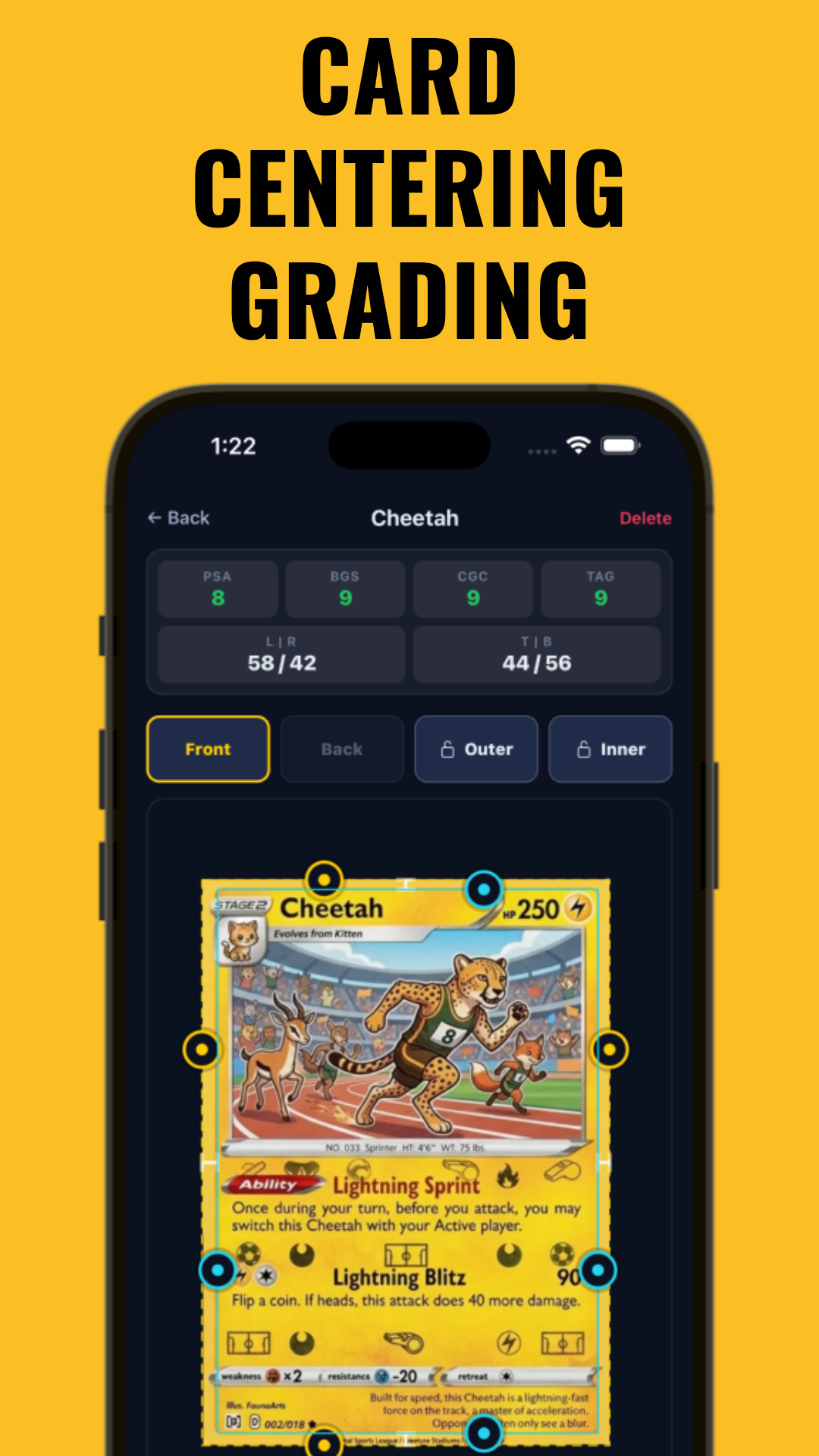
Because the Refractor ladder often has a wide raw-to-graded gap, these can be high-return submissions, and high-risk ones.
Section 6: Condition, Centering and the PSA 10 Gem Premium
The core reason 1996 Finest PSA 10 value is so far above lower grades is simple: the set is hard to grade well. A PSA 10 is not just a good card. It is a card that survived thirty years with a clean surface, sharp corners, intact edges and acceptable centering.
The four grading factors
- Centering: how evenly the image sits within the borders. Off-center fronts are a frequent reason for a 9 instead of a 10.
- Corners: soft or dinged corners come from handling and old storage.
- Edges: the chromium stock chips visibly, especially on dark borders.
- Surface: scratches, print lines, coating damage and peeling film.
Coating problems
The protective coating can bubble, lift, scratch or be removed unevenly. A card with damaged coating may grade lower than the same card with the coating cleanly removed. That makes coating status something to inspect closely, not to assume.
Understanding the gem premium gap
The gem premium is the price difference between PSA 9 and PSA 10. In this set it is often significant for star cards, because few copies reach the top grade. Compare population against price: a thin PSA 10 population helps explain a larger premium. For help interpreting that, see card grading for low population cards.
Know the scales
A PSA 10 is not the same thing as a BGS 10 or a CGC 10. Check grading scale differences by company before you compare prices across slabs. Buyers of 1990s basketball strongly favor PSA, which usually commands the most liquid market for these cards.
Section 7: Which 1996 Finest Cards Are Worth Grading
Not every Finest card justifies a submission. The question behind 1996 Finest cards worth grading is whether the expected graded value, after fees and risk, beats the raw price.
A simple grading decision framework
- Look up the ladder: raw, PSA 8, PSA 9, PSA 10 for your exact card and version.
- Pre-grade honestly: check centering, corners, edges and surface.
- Estimate likely outcomes: a realistic spread, not a best case.
- Subtract fees and shipping: include any tier surcharge for higher-value cards.
- Submit only if the odds-weighted result beats selling raw.
Stars and Refractors usually clear this bar if the card is clean. Commons usually do not, because even a PSA 10 may not cover the fee. Our guide to how to pre-grade your card walks through the inspection step by step. Midpoint can also estimate PSA, BGS, CGC and TAG grades from centering, corners, edges and surface before you pay to submit.
How to identify authentic cards
Counterfeits exist for high-value cards, so buy carefully:
- Compare print quality, font and card back against a known authentic copy.
- Be suspicious of Refractors with unusual shimmer or inconsistent card stock.
- Prefer already-graded cards from reputable companies for big purchases.
- Avoid listings with stock photos or no clear back image.
Protect and track what you own
Once graded or kept raw, store carefully. See how to store valuable cards so condition does not slip. Track your holdings over time to see how values move.
Conclusion
1996 Finest basketball cards value comes down to precision. Identify the exact card number, the tier, the variation and the coating status. Then compare the ladder from raw to PSA 10 using recent sold data.
Jordan #50 and #291, Kobe #74 and Iverson #69 and #280 anchor the market, with Refractor versions at the top end. The gem-premium gap between PSA 9 and PSA 10 explains why careful pre-grading matters. Check the data table above for figures as of 2026-11-15, measure centering before you submit, and only pay for grading when the numbers support it. You can start with Midpoint, which is free on iOS and Android.
FAQ
Q: How much are 1996-97 Topps Finest basketball cards worth?
A: It varies enormously. Commons are usually low-value even in high grades, while star cards like Jordan, Kobe Bryant and Allen Iverson, and especially their Refractors, can be worth far more. Check the data table in this post (as of 2026-11-15) and recent sold listings for your exact card number and grade.
Q: What is the most valuable 1996 Finest basketball card?
A: The top of the market is generally made up of the Kobe Bryant #74 rookie, Michael Jordan cards (#50 and #291) and their Refractor versions, especially in PSA 10. The exact leader depends on version and the latest sale.
Q: How much is a 1996 Topps Finest Kobe Bryant rookie card worth?
A: The #74 rookie ranges widely by grade and variation. Base copies, coated or uncoated, and Refractors sit in different price bands, and high-grade copies command a large premium. See the table for values as of 2026-11-15.
Q: How much is a 1996 Finest Michael Jordan card worth?
A: It depends on whether it is #50 or #291, whether it is a base card or Refractor, and the grade. Compare sold results for the exact card number and PSA grade rather than a generic Jordan price.
Q: Are 1996 Topps Finest Refractor basketball cards valuable?
A: Generally yes. Refractors are scarcer than base cards and typically carry a notable premium, particularly for stars. Coated and uncoated versions can price differently, so match your version to the comp.
Q: Should I get my 1996 Finest basketball cards graded?
A: Grade star cards and Refractors that look clean, with good centering, sharp corners, intact edges and a clean surface. Skip commons where the fee would exceed the likely graded premium. Pre-grading with a tool like Midpoint helps you decide before paying.
Free to start
Try the Midpoint app
Grade any card from a photo, see its raw and PSA 10 value, and track what your collection is worth — free.
Get it on iPhoneGet it on Android