1996 Topps Chrome Basketball Cards Value: Raw vs PSA 10
1996 Topps Chrome basketball cards value guide: Kobe base vs Refractor, Iverson, Jordan, inserts, PSA 10 premiums, and which cards are worth grading.

Estimated reading time: 11 min
Key Takeaways
- 1996 Topps Chrome basketball cards value depends on three things: which card it is, whether it is a base Chrome or a Refractor, and the grade.
- The Kobe Bryant #138 base card and the #138 Refractor are completely different price tiers. Confirm which one you hold before you quote a value.
- The gap between a raw card and a PSA 10 is widest on rookies and star Refractors, so those are where grading pays off most.
- Use sold listings, not asking prices, and match the exact card number and grade.
- Pre-grade centering and surface first. Many Chrome cards fail on edges, print lines or off-center borders.
Card values — live data from Midpoint's card database, as of 2026-11-15. Prices move; Midpoint refreshes these daily.
| Card | Raw | PSA 10 | Gem premium | |
|---|---|---|---|---|
 |
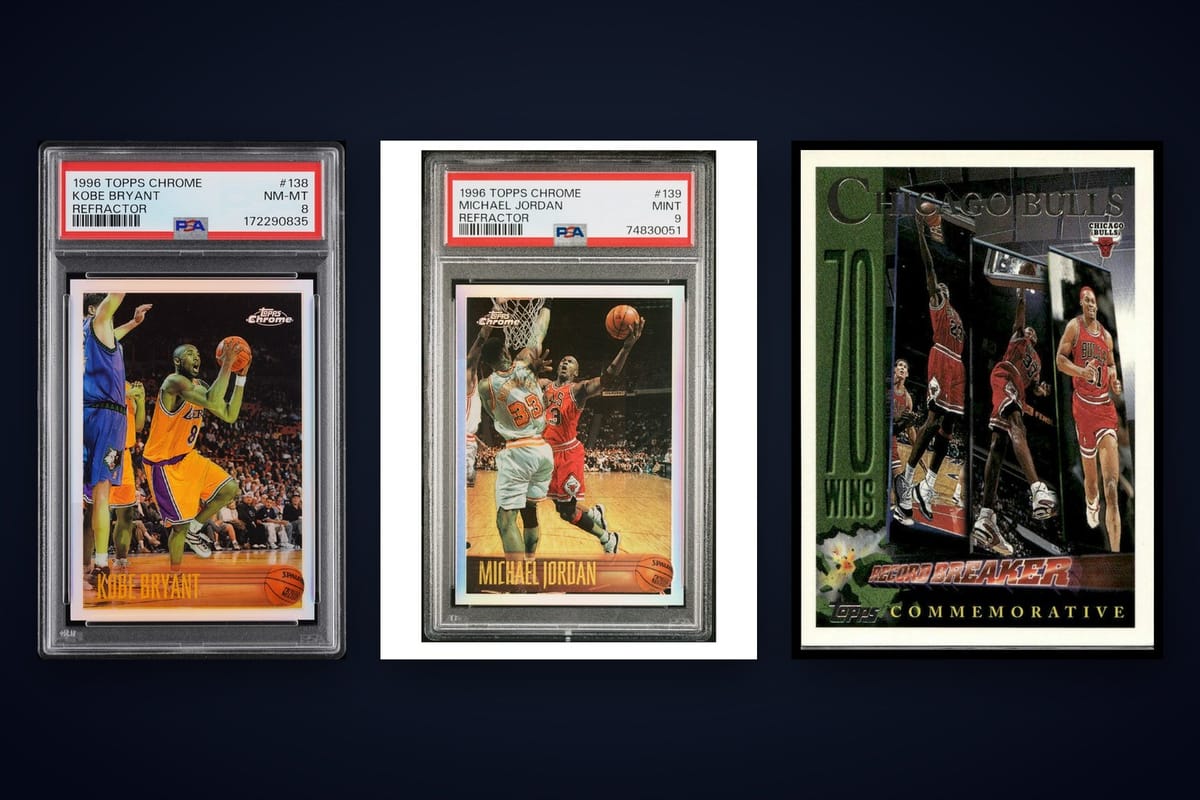
Kobe Bryant [Refractor] #138 1996 Topps Chrome |
$21,737 | $90,426 | 4.2× |
 |
Michael Jordan [Refractor] #139 1996 Topps Chrome |
$5,000 | $25,100 | 5× |
 |
Chicago Bulls 72 Wins [Refractor] #72 1996 Topps Chrome |
$633.50 | $16,600 | 26.2× |
 |
Kobe Bryant #138 1996 Topps Chrome |
$1,556 | $16,093 | 10.3× |
 |
Allen Iverson [Refractor] #171 1996 Topps Chrome |
$1,710 | $12,210 | 7.1× |
 |
Vitaly Potapenko [Refractor] #172 1996 Topps Chrome |
$18.74 | $3,516 | 187.6× |
 |
Vin Baker [Refractor] #25 1996 Topps Chrome |
$20.00 | $2,940 | 147× |
 |
Scottie Pippen [Refractor] #33 1996 Topps Chrome |
$147.63 | $2,862 | 19.4× |
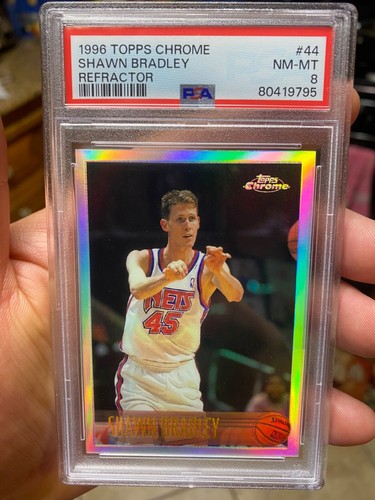 |
Shawn Bradley [Refractor] #44 1996 Topps Chrome |
$12.83 | $2,800 | 218.2× |
 |
Sharone Wright [Refractor] #84 1996 Topps Chrome |
$19.99 | $2,605 | 130.3× |
 |
Michael Jordan #139 1996 Topps Chrome |
$256.39 | $2,550 | 10× |
 |
Mitch Richmond [Refractor] #23 1996 Topps Chrome |
$17.90 | $2,500 | 139.7× |
Look up any card's current raw and graded value in Midpoint — and get an estimated grade before you pay to submit.
Table of Contents
- Section 1: The 1996-97 Topps Chrome Set at a Glance
- Section 2: Kobe Bryant #138, Base Card vs Refractor
- Section 3: The Most Valuable 1996 Topps Chrome Cards Beyond Kobe
- Section 4: Inserts, Parallels and Sealed Product Values
- Section 5: Grading, Population and the PSA 10 Premium
- Section 6: Which 1996 Topps Chrome Cards Are Worth Grading?
- Section 7: Identifying Refractors and Selling for the Best Price
- Conclusion
- FAQ
Section 1: The 1996-97 Topps Chrome Set at a Glance
If you are researching 1996 Topps Chrome basketball cards value, start with what the set is. The 1996-97 Topps Chrome release is a chromium-stock reprint of the main Topps basketball checklist. It is one of the most important basketball sets of the 1990s, mainly because of its rookie class.
What is in the set
- A 220-card base set printed on glossy chromium stock.
- Refractor parallels of the base cards, with a rainbow-like sheen when tilted under light.
- Insert sets, including Season's Best, ProFiles and YouthQuake.
- The exact number of insert and parallel variations depends on how a source groups them.
Descriptions of original pack and box configurations vary between sources. Always check the pack or box photo in a sealed listing rather than relying on a seller's description.
Why this set matters
The checklist includes rookies of Kobe Bryant (#138), Allen Iverson (#171), Steve Nash (#182) and Ray Allen (#212). It also features Michael Jordan (#139) and veterans such as Hakeem Olajuwon. Few other 1990s sets pair a Hall of Fame rookie class with a Jordan card on chrome stock.
How to read the price data
The table that follows this section lists raw and graded values from the Midpoint database as of 2026-11-15. Treat it as a 1996 Topps Chrome price guide snapshot. Card prices move, so use it to see how cards rank against each other. I do not repeat the whole table in prose, and I do not quote figures that are not in it.
For any card, compare three columns: raw, PSA 9 and PSA 10. The distance between them tells you whether grading makes sense, and the sections below show how to read it.
Section 2: Kobe Bryant #138, Base Card vs Refractor
The Kobe Bryant rookie is the card most people mean when they search this set. It is also the most commonly misidentified, because two very different cards share the number 138.
The base Chrome card
The standard Kobe #138 is a regular Chrome card, not a Refractor. It is the more accessible rookie and sells in far greater numbers. It is a legitimate Kobe rookie from a respected set, but it sits well below the Refractor in value.
Its value is driven by grade. In raw condition, the price reflects a card that may have edge chipping, print lines or off-center borders. At higher grades, collectors pay a meaningful premium for a clean, centered copy.
The #138 Refractor
The Refractor version is the key card. It is substantially more valuable than the base card at every grade tier. Refractors are scarcer, and demand for a Kobe Bryant Refractor rookie has stayed strong among basketball collectors.
The table after Section 1 shows the current spread as of 2026-11-15. Look at how the Refractor compares with the base card in the same grade column. That gap is the most important number in this guide.
Mistakes that cost sellers money
- Listing a base card as a Refractor (or the reverse). Buyers check, and returns follow.
- Comparing across grades. A raw sale is not a comp for a PSA 10.
- Using asking prices. Only completed sales show what the market pays.
- Ignoring centering. A PSA 9 with strong centering can sell better than a weaker copy in the same slab.
Before you buy or list any Kobe, check the card number, the finish and the set name on the card back. Section 7 explains how to verify a Refractor.
Section 3: The Most Valuable 1996 Topps Chrome Cards Beyond Kobe
Kobe leads the set, but he is not the only card that matters. The most valuable 1996 Topps Chrome cards are mostly Hall of Fame names, and their Refractors typically command the biggest premiums.
Key Refractors and stars
- Michael Jordan #139: Jordan is the market's evergreen name. His Chrome card benefits from steady demand that does not depend on a rookie narrative.
- Allen Iverson #171: A rookie of a Hall of Fame guard with a loyal collector base. His Refractor is generally considered one of the set's strongest after Kobe.
- Steve Nash #182: A two-time MVP rookie. Demand has grown as collectors appreciate his career.
- Ray Allen #212: A Hall of Fame shooter whose rookie Refractor is a solid, steady seller.
- Hakeem Olajuwon: A veteran star in the checklist. His cards are cheaper than rookies but can be attractive buys in high grade.
Rookie vs veteran pricing
Rookies carry a premium because collectors treat them as the definitive first card. Veteran cards, even of legends, usually sell for less. The exception is Michael Jordan, whose name keeps even a non-rookie card in demand.
How to rank cards for your own collection
Use the database table for the as-of 2026-11-15 spread, then rank cards on three questions:
- Is it a rookie or a Hall of Fame name?
- Is it a Refractor or a base card?
- How large is the gap between raw and PSA 10?
A card that answers yes to the first two and shows a large PSA 10 gap is a strong grading candidate. A common base card of a role player usually is not, because the graded premium rarely covers the fees. Section 6 puts this into a simple calculation.
Section 4: Inserts, Parallels and Sealed Product Values
The inserts are the least understood part of this set. They are a good way to collect big names at lower prices, but they follow different rules from the base cards.
Season's Best, ProFiles and YouthQuake
The three main insert sets work like this:
- Season's Best: Honors top performers. It leans toward established stars.
- ProFiles: Features established players. These tend to be a niche collector item.
- YouthQuake: Spotlights young players. It is often the most sought-after of the three because it features future stars, though demand varies by player.
For card-by-card value, look up each card by name and insert set in the database rather than assuming from the player. A Kobe or Iverson insert will outsell a role player's insert in the same set, but only a sold-listing check tells you by how much.
Pack, box and sealed demand
Sealed 1990s basketball is a market of its own. Sealed packs and boxes sell on the possibility of pulling a Kobe or Iverson Refractor. Three cautions apply:
- Verify authenticity. Resealed packs and boxes exist in vintage sealed product.
- Check the configuration. Pack counts and odds differ between sources, so rely on the listing photos and any authentication, not on a claim.
- Compare to singles. A sealed box has to be worth more than the singles you could expect from it, plus the premium for the sealed state.
Parallel and insert cautions
Chrome insert cards can be prone to surface scratches. Refractor inserts, where present, add another layer to check. If you want to submit one, treat it as a separate pricing question from the base set.
Section 5: Grading, Population and the PSA 10 Premium
The 1996 Topps Chrome PSA 10 value is where this set gets interesting. Chrome cards are glossy and high-contrast, so flaws show up clearly. That can make true gem mint copies harder to find than you might expect.
Why PSA 10s are hard in this set
- Centering: Chrome borders on 1990s cards are often off-center. Even a small shift can cap a grade.
- Surface: Hairline scratches and print lines are visible on the reflective finish.
- Edges and corners: Chipping is easy to see on the reflective stock.
- Refractor coating: Refractors can show surface wear that a base card might hide.
Because of these issues, the gem premium can be large. In the data table, compare the PSA 9 and PSA 10 columns for the same card. For many cards the PSA 10 sits well above the PSA 9, which is what makes borderline submissions attractive.
Population matters
Check PSA's population report for the exact card number and variant. A high population of PSA 10s tempers the premium, while a low population supports it. For a deeper look at how scarcity changes strategy, see this guide to grading low population cards.
Centering is the first filter
Centering is the quickest flaw to measure and the one collectors can check before paying. Our guide on how centering impacts card value explains why a card with perfect corners can still miss a PSA 10 on border ratios.
Company standards also differ. If you are comparing PSA to BGS, CGC or TAG, read about the grading scale differences by company before choosing where to submit.
Section 6: Which 1996 Topps Chrome Cards Are Worth Grading?
Deciding which 1996 Topps Chrome cards are worth grading comes down to arithmetic, not hope. Grading fees vary by company and service tier, and with shipping and insurance the total is often tens of dollars per card, so the card has to earn that back.
A simple expected-value check
- Look up the card's raw, PSA 9 and PSA 10 values in the database.
- Estimate your odds of each grade honestly, based on centering, corners, edges and surface.
- Multiply each grade's value by its odds, add them up, then subtract the raw value and the grading cost.
- If the result is clearly positive, submit. If it is near zero, sell raw.
This is why Kobe, Iverson, Jordan and the star Refractors are the usual submissions. The graded premium is often large enough to cover the fees even if the card lands at PSA 9. For low-value base cards, the premium often does not.
Pre-grade before you pay
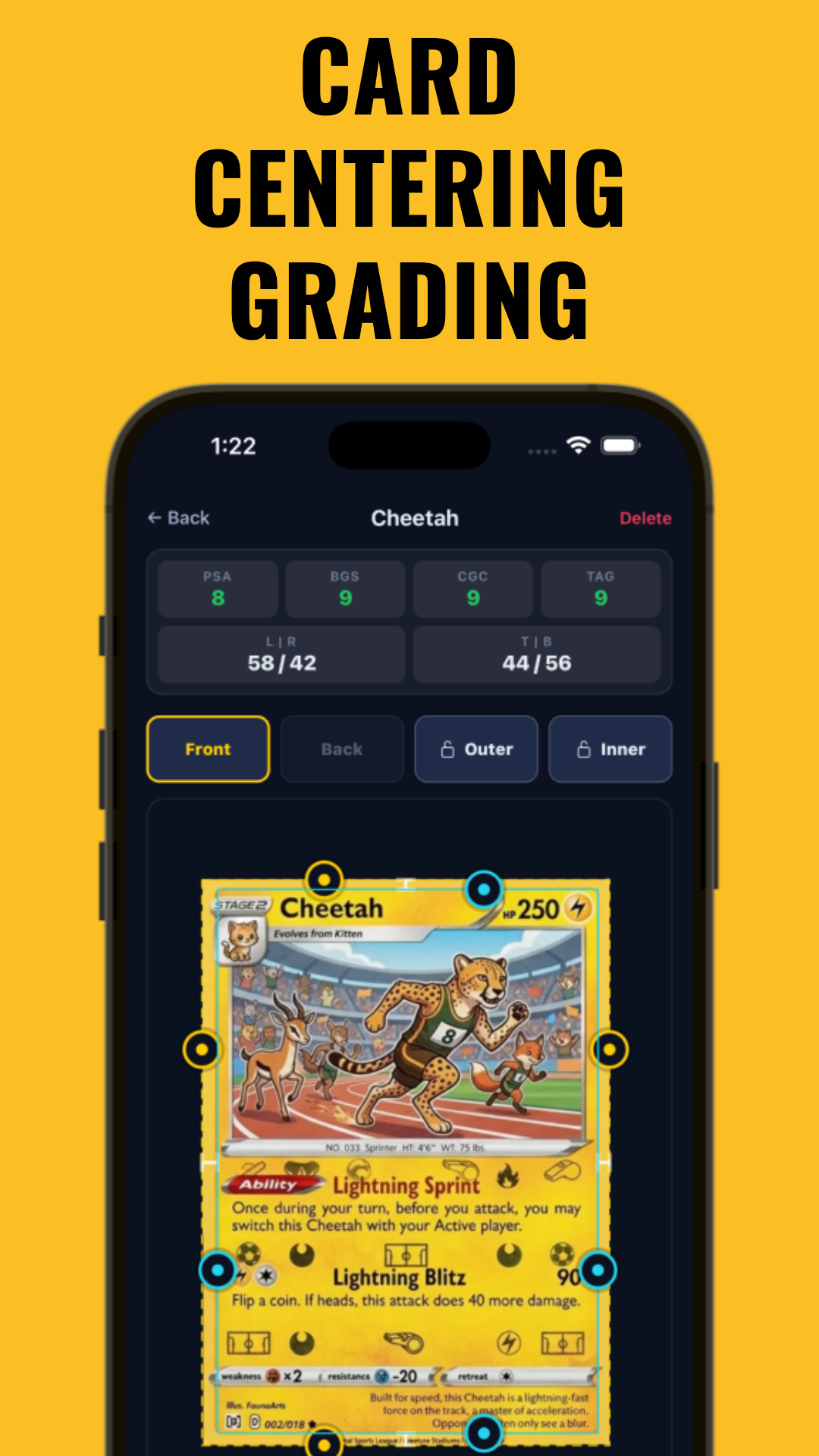
Most submission losses come from cards that never had a shot at a 10. Measuring centering and checking surface first filters those out. Midpoint estimates PSA, BGS, CGC and TAG grades from centering, corners, edges and surface, and it measures centering down to the millimeter. You can also try the free centering calculator for a quick check.
What to do with the results
- Strong centering and clean surface: a good candidate for PSA submission.
- Borderline centering: consider a company with a more forgiving standard, or sell raw.
- Visible print lines or scratches: expect a lower grade and price accordingly.
For the full process, follow how to pre-grade your card before you ship anything.
Section 7: Identifying Refractors and Selling for the Best Price
Knowing what you have and how to sell it is the last piece of the puzzle. Values in this set are only as good as your identification.
How to tell a Refractor from a base Chrome card
- Finish: Tilt the card under a light. A Refractor shows a rainbow-like shimmer that a base Chrome card does not.
- Card number: Confirm the number against the checklist. Kobe's base card and his Refractor share the number #138, so the finish is what tells them apart.
- Set name: Check the card back for Topps Chrome and the 1996-97 season to rule out other Kobe rookies from other sets.
- Compare with a known copy: Match your card against a graded example from a sold listing.
If the identification is uncertain, a grading company will confirm it on the label. That can be worth the fee for a possible Refractor.
Valuing with sold listings
Use completed sales, not asking prices. Filter by exact card number, grade and variant, and look at several recent sales to find a realistic range. Cross-check with the database figures as of 2026-11-15.
Auction vs fixed price
- Auction: Best for high-demand, high-grade cards where bidders compete. Start low and end at a time when buyers are active.
- Fixed price: Best for common grades or when you want control over the price. Be patient and price against recent sold comps.
Good photos of the front, back and corners help, and a graded slab should show the label clearly.
Protect the value
A card that grades well can lose condition in poor storage. Use sleeves, top loaders and a stable environment. Our guide on how to store valuable cards covers the details. If you track a collection, Midpoint can also follow its value over time.
Conclusion
The 1996 Topps Chrome basketball set is a rookie-class set built around Kobe Bryant, Allen Iverson, Steve Nash and Ray Allen, with Michael Jordan as the headline veteran. The most important lesson is that value is layered: the player, then base versus Refractor, then grade.
The Kobe #138 base card and the #138 Refractor are in different price tiers. The PSA 10 premium is largest on rookies and star Refractors, so those are the cards worth considering for submission. Most other base cards are better sold raw.
Before you spend money on grading, look up the card, measure its centering, check the surface and run the expected-value math with real sold data. Midpoint can help you do that before you submit anything.
FAQ
Q: How much is a 1996 Topps Chrome Kobe Bryant rookie card worth?
A: It depends on whether you have the base #138 or the Refractor, and on the grade. The base card is much cheaper than the Refractor. Check the database figures as of 2026-11-15 and compare them against recent sold listings for the exact grade.
Q: What is the value of a 1996 Topps Chrome Kobe Bryant Refractor?
A: The Refractor is substantially more valuable than the base card at every grade, and a PSA 10 commands a large premium over a PSA 9 or a raw copy. Use sold listings for the exact grade, because prices change.
Q: Which 1996-97 Topps Chrome basketball cards are worth money?
A: Kobe Bryant #138, Michael Jordan #139, Allen Iverson #171, Steve Nash #182 and Ray Allen #212 are the key names, with Refractors carrying the biggest premiums. Stars like Hakeem Olajuwon and the YouthQuake inserts can also be worth checking.
Q: How can you tell if a 1996 Topps Chrome card is a Refractor?
A: Tilt it under light for a rainbow-like shimmer, confirm the card number (for Kobe, both the base card and the Refractor are #138), and check the set name on the back. If you are unsure, compare it with a graded example from a sold listing.
Q: Are 1996 Topps Chrome basketball cards rare or valuable ungraded?
A: Most base cards are common and worth modest amounts raw. Star rookies and Refractors can still be valuable ungraded, but condition varies widely, so graded copies often sell for much more.
Q: What is the value of a PSA 10 1996 Topps Chrome basketball card?
A: It varies by player and variant. PSA 10s carry a large premium over PSA 9s, especially for rookies and Refractors. Check the database table as of 2026-11-15 and verify against recent sold listings for the exact card.
Free to start
Try the Midpoint app
Grade any card from a photo, see its raw and PSA 10 value, and track what your collection is worth — free.
Get it on iPhoneGet it on Android