1996 Topps Chrome PSA 9 vs PSA 10 Value: Gap Explained
1996 Topps Chrome PSA 9 vs PSA 10 value: how the PSA 10 premium works, where centering decides the price, and when a PSA 9 is the smarter buy.

Estimated reading time: 8 min
Key Takeaways
- The 1996 Topps Chrome PSA 9 vs PSA 10 value gap is market-driven, not fixed. It changes with every sale, so always price from recent sold comps.
- The PSA 10 premium comes from scarcity plus strict centering and surface standards. Chrome stock shows scratches, print lines and soft corners easily.
- The biggest 9-to-10 jumps tend to land on the most-demanded cards, like the Kobe Bryant #138 rookie, because buyers compete for the top grade.
- Bottom line: for most collectors a PSA 9 is the smarter buy. A PSA 10 only makes sense if you want the best copy, or if you're grading raw cards that already appear strong on centering.
- Measure centering and check surface before you pay to submit. A card that misses the 10 by a hair is worth the 9 price, not the 10 price.
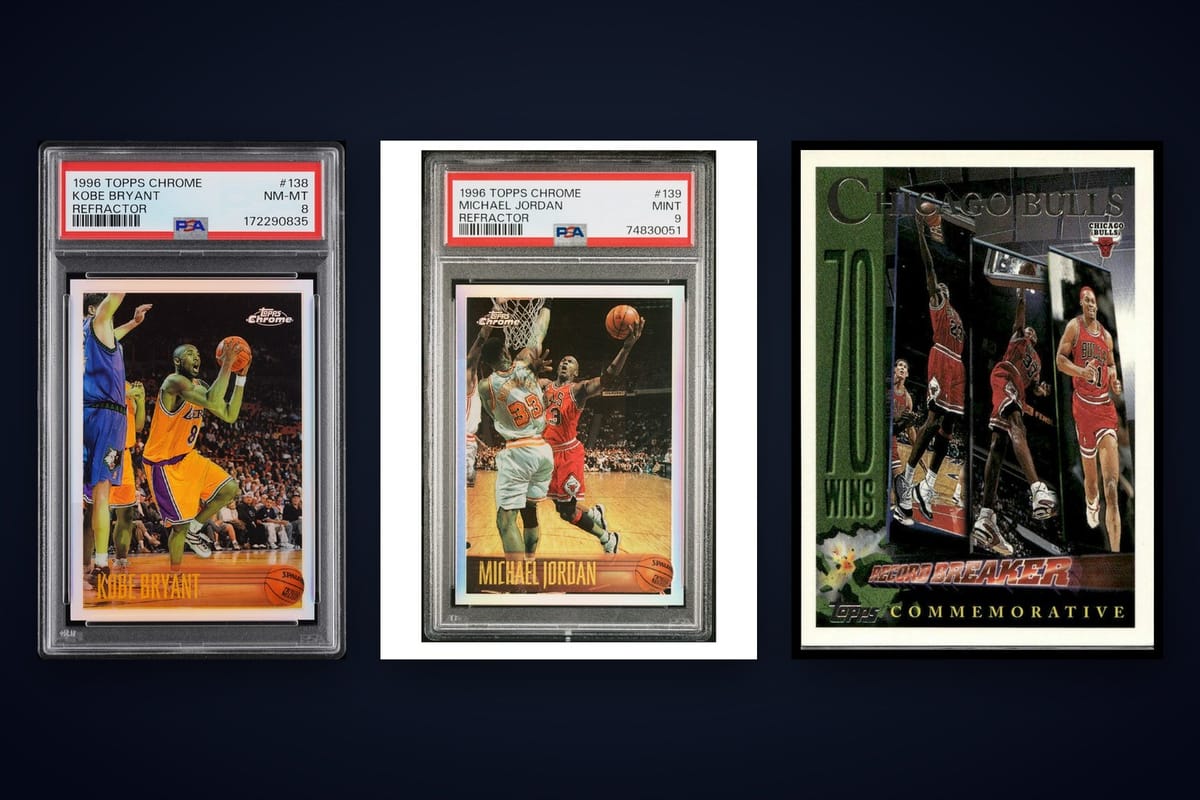
This guide compares a PSA 9 (Mint) and a PSA 10 (Gem Mint) of 1996-97 Topps Chrome basketball cards, with the Kobe Bryant #138 rookie as the anchor. The quick answer: the PSA 10 carries a large premium, but that premium only pays off if you are buying the card for the long term, or if your raw copy has a real shot at a 10. If you're weighing is a PSA 9 worth it for 1996 Topps Chrome, in most cases yes.
One note on numbers. Prices for this set move constantly. Use the card-by-card values table in this guide for the specific PSA 9 and PSA 10 figures, and confirm against live sold listings before you buy or sell.
Card values — live data from Midpoint's card database, as of 2026-11-15. Prices move; Midpoint refreshes these daily.
| Card | Raw | PSA 10 | Gem premium | |
|---|---|---|---|---|
 |
Kobe Bryant [Refractor] #138 1996 Topps Chrome |
$21,737 | $90,426 | 4.2× |
 |
Michael Jordan [Refractor] #139 1996 Topps Chrome |
$5,000 | $25,100 | 5× |
 |
Chicago Bulls 72 Wins [Refractor] #72 1996 Topps Chrome |
$633.50 | $16,600 | 26.2× |
 |
Kobe Bryant #138 1996 Topps Chrome |
$1,556 | $16,093 | 10.3× |
 |
Allen Iverson [Refractor] #171 1996 Topps Chrome |
$1,710 | $12,210 | 7.1× |
 |
Vitaly Potapenko [Refractor] #172 1996 Topps Chrome |
$18.74 | $3,516 | 187.6× |
 |
Vin Baker [Refractor] #25 1996 Topps Chrome |
$20.00 | $2,940 | 147× |
 |
Scottie Pippen [Refractor] #33 1996 Topps Chrome |
$147.63 | $2,862 | 19.4× |
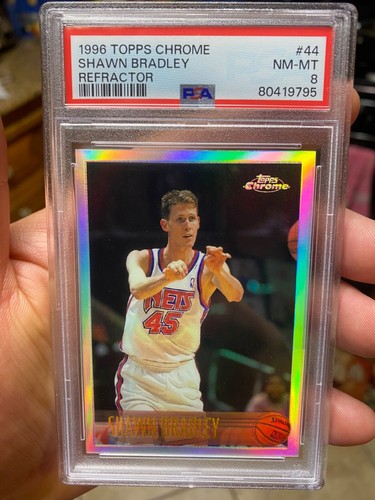 |
Shawn Bradley [Refractor] #44 1996 Topps Chrome |
$12.83 | $2,800 | 218.2× |
 |
Sharone Wright [Refractor] #84 1996 Topps Chrome |
$19.99 | $2,605 | 130.3× |
 |
Michael Jordan #139 1996 Topps Chrome |
$256.39 | $2,550 | 10× |
 |
Mitch Richmond [Refractor] #23 1996 Topps Chrome |
$17.90 | $2,500 | 139.7× |
Look up any card's current raw and graded value in Midpoint — and get an estimated grade before you pay to submit.
Quick Comparison
| Dimension | PSA 9 (Mint) | PSA 10 (Gem Mint) |
|---|---|---|
| PSA's front centering guideline | About 60/40 or better | About 55/45 or better |
| Back centering guideline | About 90/10 or better | About 75/25 or better |
| Tolerance for surface flaws | One minor flaw allowed | Essentially none visible |
| Typical price position | Entry point for a top-condition slab | Premium, often a multiple of the 9 |
| Scarcity | Far more copies than 10s | Fewer copies; check the PSA population report |
| Liquidity | Steady buyers, easier to move | Strong demand, but fewer sales to set the price |
| Price volatility | Lower | Higher; one sale can move the comp |
| Best for | Value-focused collectors and flippers | Registry builders and long-term holders |
PSA 9 vs PSA 10: What the Grades Mean on 1996 Topps Chrome
PSA grades the card as a whole, but on 1996 Topps Chrome two things decide most outcomes: centering and surface.
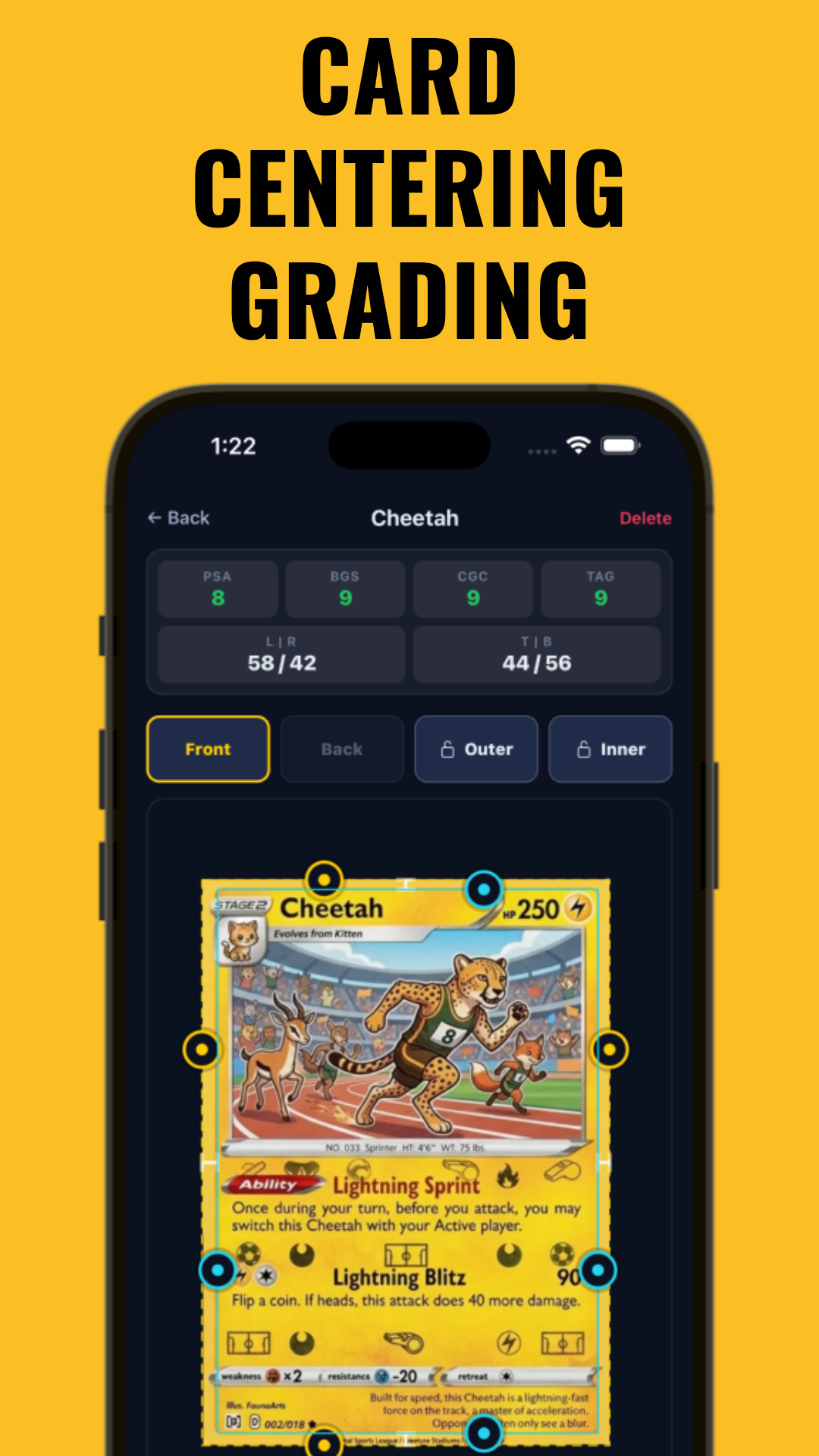
PSA's published standards describe a Gem Mint 10 as having centering around 55/45 on the front and a Mint 9 as allowing roughly 60/40. That 5-point difference sounds small. On a card with thin borders, it can be the difference between a 10 and a 9.
Chrome-specific condition factors
Chrome cards are glossy and reflective, so flaws show up fast:
- Surface scratches and hairlines: often invisible flat, but obvious when tilted under light.
- Print lines: thin lines that came from production. They can cap a card at a 9 even when everything else is perfect.
- Corners: chrome stock can show tiny whitening or chipping at the tips.
- Edges: chipping along the edge shows as a bright contrast against the dark border.
- Centering: the main reason raw copies miss the 10. See how centering impacts card value for the full breakdown.
A PSA 9 can have a single minor flaw, such as slightly off-center borders or a tiny surface mark. A PSA 10 can't. That is why the 1996 Topps Chrome grading value gap is so wide.
How other grades fit in
A PSA 8 (Near Mint-Mint) sits below the 9 and is usually priced well under it. Other companies use different scales. A BGS 9.5 or CGC 10 are not the same as a PSA 10. Read grading scale differences by company before comparing slabs across brands.
The PSA 10 Premium: How to Measure the 1996 Topps Chrome PSA 9 vs PSA 10 Price Difference
The 1996 Topps Chrome PSA 10 premium is easiest to understand as a multiple: PSA 10 price divided by PSA 9 price. A multiple of 2x means the 10 costs double. You can also express it as a percentage: (PSA 10 minus PSA 9) divided by PSA 9.
Here is how to calculate it for any card in the set:
- Pull the last several sold prices for each grade, not just one.
- Take the typical (median) sale price for each grade.
- Divide the PSA 10 figure by the PSA 9 figure.
- Compare that multiple across cards, not just the dollar gap.
The dollar gap tells you how much more you'd pay. The multiple tells you how much the market rewards perfection on that specific card. A high multiple means the 10 is being treated as a trophy. A low multiple means a 9 is already close in desirability.
Expect the largest jumps on the most iconic rookies. The Kobe Bryant #138 is the clearest example in the 1996-97 Topps Chrome set. Other rookie cards from the class, such as Allen Iverson and Steve Nash, are also worth checking, because demand for the top grade is strongest on the biggest names. Role players and commons tend to show much smaller gaps, since few buyers pay up for a 10.
Population, Comps and Price Guides: Where the Real Value Comes From
Population reports and scarcity
PSA publishes a population report showing how many copies of each card have earned each grade. For this set, PSA 9s outnumber PSA 10s, which is a big part of why the 10 commands a premium. Look at the ratio between the two populations, not just the raw counts. A thin PSA 10 population relative to the 9 usually supports a higher multiple.
One caution: population only matters when there's demand. A scarce card nobody wants isn't valuable. For more on this, see card grading for low population cards.
Sold comps vs asking prices vs price guides
- Sold comps (eBay, auction houses): the most reliable evidence of what a card is worth right now.
- Dealer asking prices: often higher than what the card actually sells for. Treat them as a ceiling.
- Price guides: useful as a baseline but they lag the market, especially for volatile cards.
Because PSA 10s of the biggest cards sell less often, one unusually strong or weak sale can distort the picture. Look at a range of sales and note whether a listing included a Best Offer or sold at full price.
Midpoint's card lookup shows raw versus graded values so you can see the PSA 9 and PSA 10 side by side without hunting through listings. You can try Midpoint free on iOS and Android.
Base vs Refractor vs Fakes: Make Sure You're Pricing the Right Card
Before you compare any prices, confirm what you're holding. The Kobe Bryant #138 comes in both a base Topps Chrome version and a Refractor version. They share a card number, but they aren't priced the same way.
- Base Chrome: glossy chrome finish with a mirror-like shine, no rainbow effect.
- Refractor: shows a prismatic, rainbow-like shimmer when you tilt it under light. It is a separate, more valuable version.
A graded slab label should state the variety. Always check it against the card itself. Mixing up a base card and a Refractor is one of the easiest ways to overpay or underprice.
Spotting counterfeits and altered copies
High-value rookies attract fakes. If you're buying raw, or if a slab looks off:
- Use a loupe. Genuine printing shows a consistent dot pattern. Reproductions often look blurry or show a different pattern.
- Compare fonts, logos and colors to a known genuine copy.
- Check the weight and feel of the stock.
- Look for trimmed edges, which can make a card appear better centered. Altered cards are a real risk at the top grades.
- For slabs, verify the cert number on PSA's website and make sure the label and card match.
If anything feels off, walk away. A cheap 9 isn't a deal if it isn't authentic.
Is a PSA 9 Worth It? The Upgrade Math
The question behind most searches is this: is a PSA 9 worth it for 1996 Topps Chrome, or should you chase the 10? Run the numbers on your own situation.
Buying a PSA 9
- You get a top-condition slab at a much lower entry cost than the 10.
- The card is easier to resell, with more buyers and more comps.
- Your downside is smaller if the market cools.
Paying for a PSA 10
- It is the best copy the registry can show, so demand is durable.
- The 10 usually benefits most when the card's popularity grows.
- You pay a large premium for a small visual difference from the 9.
Cracking a 9 to resubmit for a 10
Usually a poor bet. You would need the card to be a true 10 that was missed, and you pay grading fees again with no guarantee. The expected value works like this:
- Chance of a 10 × PSA 10 price
- plus chance of another 9 × PSA 9 price
- minus the grading fee and the risk of a lower grade.
If that total doesn't clearly beat just holding the 9, don't crack it.
Grading a raw copy
This is where the 10 premium can pay off. Measure centering first. Our free centering calculator shows whether a raw card is anywhere near the 55/45 range. Then check surface under angled light. The step-by-step pre-grading guide walks you through it. Midpoint's AI digital grading estimates PSA, BGS, CGC and TAG grades from centering, corners, edges and surface, so you can decide before you pay to submit.
Which Should You Choose?
- You want the best value for your money: buy the PSA 9. You get a high-grade slab without paying the full 10 premium.
- You're building a registry set or a long-term trophy piece: buy the PSA 10, and pay only after checking recent sold comps.
- You're flipping for profit: favor the PSA 9, which is easier to move. Only chase 10s when your purchase price is clearly below recent sales.
- You own a raw copy: measure centering and check the surface first. If it's well-centered and clean, grading may pay off. If not, selling raw or grading for a 9 may make more sense.
- You already hold a PSA 9: keep it. Don't crack it unless you have strong evidence it's a missed 10.
- You care about insurance and storage: a higher grade raises insured value, so see card grade impact on insurance value.
Verdict: for the majority of buyers, the PSA 9 is the smarter purchase. Choose the PSA 10 when you specifically want the top grade and accept paying a premium for it. Track both grades in Midpoint to watch your cards' value over time.
FAQ
How much is a 1996 Topps Chrome Kobe Bryant PSA 9 worth?
It depends on the latest sales, and it changes often. Check recent sold listings for the #138 base card in PSA 9, take the median of several sales, and use the values table in this guide as a reference. Dealer asking prices usually run higher than sold prices.
How much is a 1996 Topps Chrome Kobe Bryant PSA 10 worth?
A PSA 10 sells for a substantial premium over a PSA 9, and the price varies with the market. Because fewer PSA 10s trade, one sale can move the comp, so look at multiple recent sales instead of a single result.
What is the price difference between a PSA 9 and PSA 10 1996 Topps Chrome Kobe Bryant rookie card?
Divide the typical PSA 10 sold price by the typical PSA 9 sold price to get the multiple, or subtract them for the dollar gap. The gap is often widest on the most in-demand card in the set, which is the Kobe Bryant rookie.
Is the 1996 Topps Chrome Kobe Bryant card #138 a Refractor or the base version?
Both exist with the #138 number. The base card has a glossy chrome finish. The Refractor shows a rainbow-like shimmer when tilted under light and is a separate, more valuable version. Check the slab label and the card's finish to be sure.
How many PSA 9 and PSA 10 1996 Topps Chrome Kobe Bryant cards exist?
PSA's population report lists the current counts, and they update as more cards are graded. In general PSA 9s are much more common than PSA 10s, which supports the 10's premium. Check PSA's site for the current numbers.
Is it better to buy a PSA 9 1996 Topps Chrome Kobe Bryant card or invest in a PSA 10?
For most buyers a PSA 9 is the better value: lower cost, easier resale and less risk. A PSA 10 suits collectors who want the top grade and are comfortable paying a premium. Always compare against recent sold comps before deciding.
Free to start
Try the Midpoint app
Grade any card from a photo, see its raw and PSA 10 value, and track what your collection is worth — free.
Get it on iPhoneGet it on Android