
1999 Pokémon Cards Value Guide: What’s Worth Money Today?
Discover the real 1999 Pokémon cards value: which cards are worth the most, PSA 10 prices, set differences, and expert tips for collectors.

Estimated reading time: 12 min
Key Takeaways
- 1999 Pokémon cards value can range from a few dollars to over $400,000, depending on edition, condition, and grading.
- Charizard, Blastoise, and Pikachu are among the most valuable 1999 Pokémon cards, especially in PSA 10 condition.
- Edition type (1st Edition, Shadowless, Unlimited) and card condition are critical to value.
- Graded cards, especially PSA 10 "gem mint," command significant premiums over raw cards.
- Not all 1999 Pokémon cards are worth money—rarity and desirability matter most.
Wondering what your old 1999 Pokémon cards are really worth? The 1999 Pokémon cards value guide below breaks down the most valuable cards, highlights how grading and set editions affect prices, and dispels common misconceptions about which cards are actually worth money. Whether you’re holding a Charizard or a forgotten common, you’ll learn exactly what drives value—and how to spot a hidden gem in your binder. Data is current as of 2026-08-20, based on live sales tracked by Midpoint.

Card values — live data from Midpoint's card database, as of 2026-08-20. Prices move; Midpoint refreshes these daily.
| Card | Raw | PSA 10 | Gem premium | |
|---|---|---|---|---|
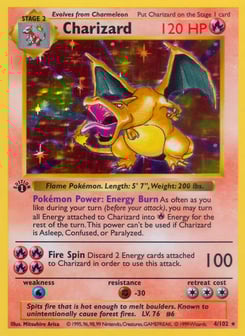 |
Charizard #4/102 Base (1999) |
$2,146 | $414,331 | 193× |
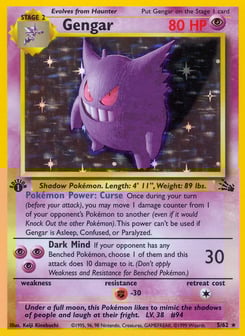 |
Gengar #5/62 Fossil (1999) |
$601.49 | $44,648 | 74.2× |
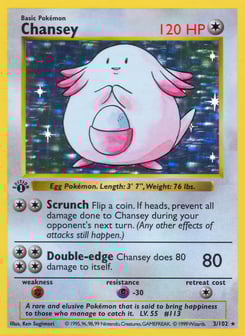 |
Chansey #3/102 Base (1999) |
$400.00 | $44,422 | 111.1× |
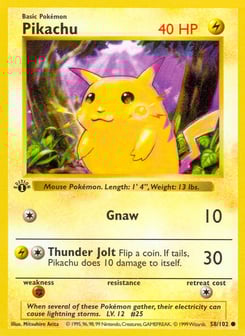 |
Pikachu #58/102 Base (1999) |
$429.98 | $30,007 | 69.8× |
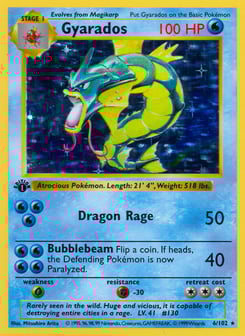 |
Gyarados #6/102 Base (1999) |
$121.74 | $28,420 | 233.5× |
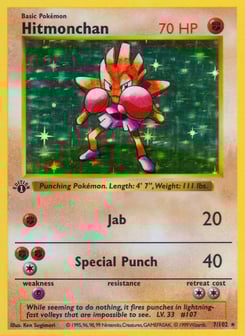 |
Hitmonchan #7/102 Base (1999) |
$254.99 | $25,244 | 99× |
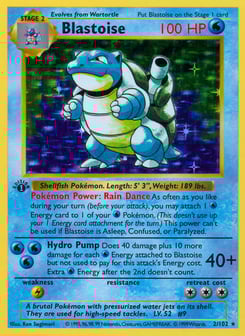 |
Blastoise #2/102 Base (1999) |
$820.00 | $23,943 | 29.2× |
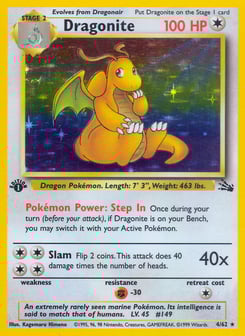 |
Dragonite #4/62 Fossil (1999) |
$461.75 | $20,525 | 44.5× |
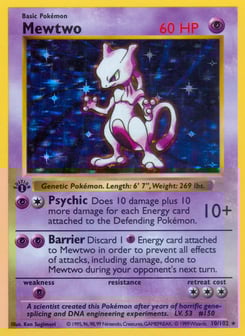 |
Mewtwo #10/102 Base (1999) |
$358.01 | $16,944 | 47.3× |
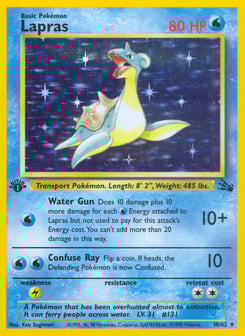 |
Lapras #10/62 Fossil (1999) |
$156.67 | $16,668 | 106.4× |
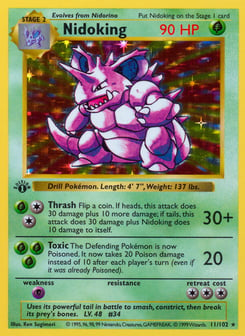 |
Nidoking #11/102 Base (1999) |
$146.41 | $14,741 | 100.7× |
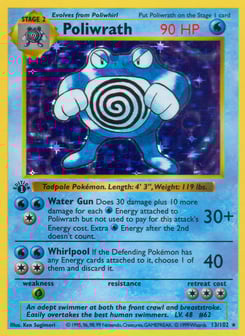 |
Poliwrath #13/102 Base (1999) |
$499.00 | $14,154 | 28.4× |
Look up any card's current raw and graded value in Midpoint — and get an estimated grade before you pay to submit.
1. Understanding 1999 Base Set Print Variants: 1st Edition, Shadowless, Unlimited
The 1999 Base Set—the original U.S. Pokémon release—came in three print variants: 1st Edition, Shadowless, and Unlimited. These differences have a significant impact on 1999 Pokémon cards value.
1st Edition cards have a small black "1" stamp on the left side of the card, just below the Pokémon illustration. They are generally the scarcest and most desirable of the three. Shadowless cards lack the 1st Edition stamp but also don’t have a "shadow" on the right side of the Pokémon portrait box—making them rarer than Unlimited but typically less sought-after than 1st Edition. Unlimited cards have no stamp and include the characteristic shadow.
- 1st Edition cards can command much higher values than Unlimited versions in similar condition.
- Shadowless cards are a sweet spot for value—rarer than Unlimited, but often more affordable than 1st Edition.
- To identify your card’s print, look for the 1st Edition stamp and check for shadows on the portrait box.
2. Most Valuable 1999 Pokémon Cards: Charizard, Blastoise, Pikachu & More
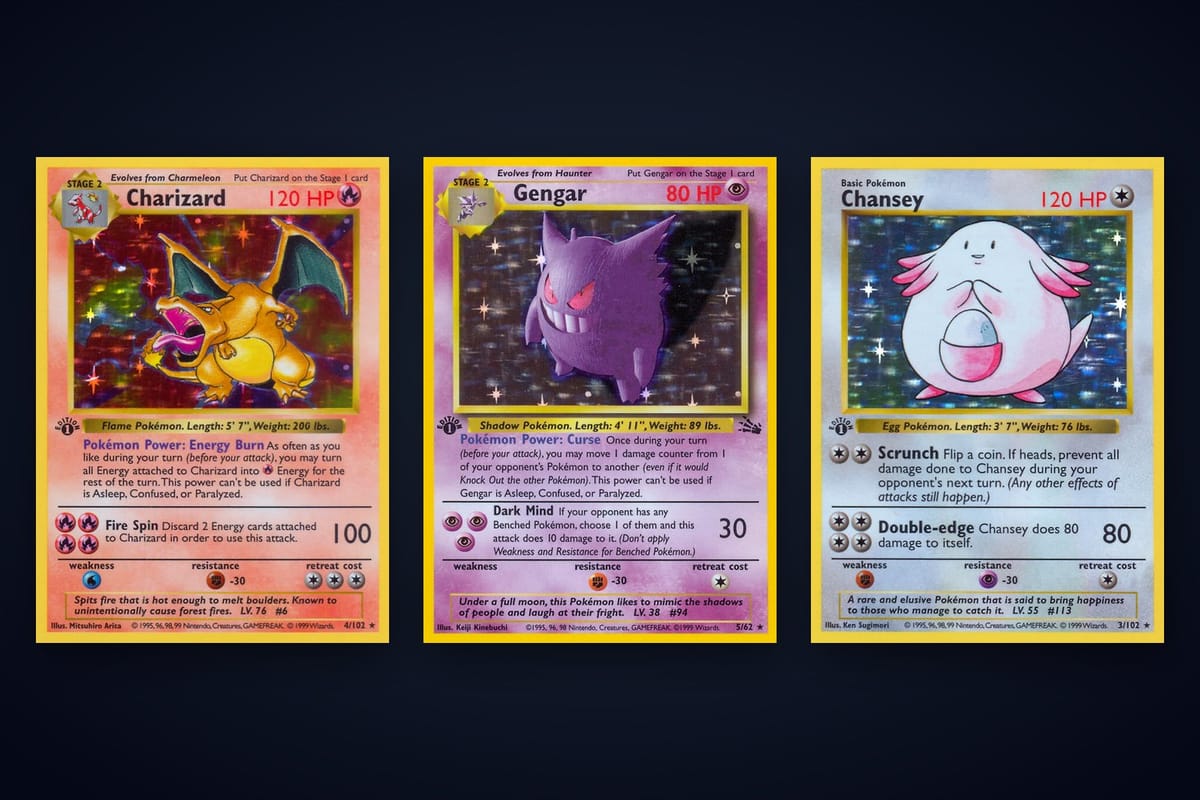
Not all 1999 cards are valuable, but a handful have become true collector icons. The Charizard #4/102 from Base Set is widely considered the most valuable, with a raw price of $2,146 and a reported PSA 10 value of $414,331 as of 2026-08-20. That’s a substantial premium for gem mint condition.
Other notable cards include Blastoise #2/102 (raw: $820, PSA 10: $23,943), Pikachu #58/102 (raw: $429.98, PSA 10: $30,007), and Gengar #5/62 from Fossil (raw: $601.49, PSA 10: $44,648). These cards are highly recognizable and consistently in demand among collectors.
- Charizard, Blastoise, Chansey, Pikachu, and Gengar are among the most valuable 1999 Pokémon cards.
- Even non-holo cards like Pikachu can be “chase” cards in top condition.
- Values can change rapidly—Midpoint tracks live sales so you’re never guessing.
3. How Card Condition & Grading Affect Value: Raw vs PSA/BGS/CGC 10
Condition is critical. The same card can be worth a few hundred dollars raw and tens—or even hundreds—of thousands when graded PSA 10. For example, Chansey #3/102 sells for $400 raw but $44,422 in PSA 10—a significant premium.
Grading by PSA, BGS, or CGC authenticates condition and creates trust for buyers. But achieving a PSA 10 is notoriously tough. Factors include centering, corners, edges, and surface—each must be nearly flawless. Modern tools like Midpoint let you preview your likely grade and assess centering before you pay for grading. Learn more in Card Centering Tool: Accurate Card Grading Estimates.
- Gem mint (PSA 10) cards often sell for many times their raw value.
- Raw cards with visible wear, scratches, or off-centering see much lower prices.
- Always check recent sold listings, not just high asking prices.
4. Price Ranges for Commons, Uncommons, Rares, and Non-Holo Cards
Most 1999 Pokémon cards aren’t worth four or five figures. Commons and uncommons—even in raw near-mint—often fetch only a few dollars. Non-holo rares may reach low hundreds in perfect shape, but only a handful of holos break into the thousands.
The exceptions: special "rookie cards" like Pikachu #58/102 (a common), which in PSA 10 is reported at $30,007. This is the outlier, not the rule. For most, the bulk of 1999 Pokémon cards value is concentrated in top-tier holos and a few iconic non-holos.
- Commons/uncommons: $1–$10 raw, potentially $100–$300 in PSA 10 for top characters.
- Non-holo rares: $10–$100 raw, up to $1,000 in PSA 10 for stars.
- Holos: $100–$2,000+ raw, potentially $10,000–$400,000+ in PSA 10.
5. Full Set Value: What’s a Complete 1999 Base Set Worth?
Complete 1999 Base Set binders are highly sought after by collectors. However, the value depends heavily on condition and edition. A full set of raw Unlimited cards in near-mint might be worth several thousand dollars, while a PSA 10 graded 1st Edition set has been reported to exceed $750,000 (driven by the Charizard, Blastoise, and other key holos).
Most complete sets are a mix of grades. The most valuable sets are those with all cards authenticated at PSA 9 or 10, particularly for the "big three" starters (Charizard, Blastoise, Venusaur) and the iconic holos. For pricing a full set, add up recent sold comps card-by-card, using live data from Midpoint or similar resources.
- Binder sets: Value is dominated by condition of holos.
- PSA 10 sets: Only a handful exist—these command record prices.
- Check comps for each card; don’t rely on single "set value" numbers.
6. How to Identify Valuable 1999 Pokémon Cards
Spotting value starts with basics: look for 1st Edition stamps, Shadowless print, and holofoil cards. Check the lower-right of the illustration box for the shadow (or lack thereof), and the lower left for that crucial "1st Edition" mark. Card numbers (like "4/102" for Charizard) and set symbols (or their absence) help confirm what you have.
Use trusted sources and guides to cross-reference your cards. The Midpoint app, for example, lets you scan and instantly identify set, edition, and likely grade so you know whether a card is worth grading or selling raw. For a visual breakdown, see How to Pre-Grade Your Card: A Step-by-Step Guide.
- 1st Edition: Look for the "1" stamp and no copyright date on the right.
- Shadowless: No shadow, no 1st Edition stamp.
- Unlimited: No stamp, has shadow.
- Check raw vs graded value before deciding to submit for grading.
7. Special 1999 Promos & Side Products: Burger King, Topps, Trainer Decks
Beyond the standard Base, Jungle, and Fossil sets, 1999 saw special promos and oddities. The Burger King gold-plated cards, Topps TV-series cards, and "Trainer Deck A/B" preconstructed decks are fun collectibles, but generally don’t command the same prices as Base Set holos—unless sealed or in unique error forms.
Some "promo only" cards and Wizards Black Star Promos can carry value, especially in PSA 10. Always check comps before assuming value, as many of these promos are more about nostalgia than big money. For insurance and display, see How to Store Valuable Cards: The Ultimate Collector's Guide.
- Burger King and Topps cards are not tournament-legal Pokémon TCG cards.
- Trainer Deck cards are rare but mostly appeal to niche collectors.
- Black Star Promos vary—some are highly desirable in top grades.
8. Checking Sold Comps vs Asking Prices
The true 1999 Pokémon cards value is determined by actual sales, not what sellers list them for. Many eBay listings show "dream prices" that are never met. Checking sold listings gives an accurate sense of demand and fair market value.
Midpoint’s app aggregates recent sales for each card, separating raw, PSA 9, and PSA 10 results so you aren’t misled by outliers. Always reference multiple recent comps, especially when pricing rare cards or full sets.
- Use tools that track confirmed sales, not just listings.
- Beware of "shill bidding" or fake sales—stick to reputable sources.
- For insurance, use the average of recent sales, not the highest outlier.
9. The Gem Mint Premium: Why PSA 10 Cards Fetch High Multiples
The "gem mint" (PSA 10) premium is dramatic. For example, Gyarados #6/102 is $121.74 raw but $28,420 in PSA 10—a significant multiple. The reason? Extreme scarcity. Only a small fraction of surviving 1999 cards meet the strict standards for a perfect grade.
Even small flaws in centering, corners, or surface can drop a card from PSA 10 to PSA 9 or lower, reducing value by 50% or more. Tools like How Centering Impacts Card Value: A Detailed Guide explain why precision matters so much. Use digital centering calculators to pre-check your cards before submitting to PSA, BGS, or CGC.
- PSA 10 cards are often much rarer than lower grades for 1999 holos.
- Ungraded cards with minor flaws rarely hit the "gem" premium.
- Preview your card’s likely grade with Midpoint to avoid grading disappointment.
10. Common Misconceptions: Not All 1999 Pokémon Cards Are Valuable
Just because a card is from 1999 doesn’t mean it’s rare or valuable. Most commons, energies, and trainers—especially from Unlimited print runs—are worth little unless perfectly preserved and graded. The hype around "all old Pokémon cards being worth money" is mostly myth.
Focus on key holos, 1st Edition or Shadowless prints, and cards in truly excellent condition. Use the Midpoint app for quick identification and grading estimates, and always check price guides and recent comps before selling or insuring your cards. For in-depth information on grading scale differences, see Grading Scale Differences by Company: PSA, BGS, CGC & the True Meaning of Top Grades.
- Most 1999 Pokémon cards are not valuable—rarity and condition are essential.
- Commons and trainers are usually plentiful and low value.
- Do your research before spending on grading or buying "mystery" lots.
Conclusion
The 1999 Pokémon cards value landscape is a blend of nostalgia, rarity, and market demand. The handful of legendary cards—Charizard, Blastoise, Pikachu, Gengar, and a few others—remain the prizes, especially in PSA 10. But most cards from that year are only worth serious money if they’re rare editions and in top condition. Use digital tools like Midpoint to assess centering, estimate grades, and track real-time prices before making big decisions. Understanding the details of print runs, grading, and comps is the key to unlocking your collection’s true value.
FAQ
Q: How can I tell if my 1999 Pokémon cards are 1st Edition or Shadowless?
A: Look for the 1st Edition stamp (a small black "1" in a circle) on the lower left of the portrait box. Shadowless cards have no shadow on the right side of the Pokémon image box but also lack the 1st Edition stamp. Unlimited cards have neither the stamp nor the shadowless box.
Q: What is a 1999 Charizard card worth today?
A: As of 2026-08-20, a Base Set Charizard #4/102 is reported at about $2,146 raw, but up to $414,331 in PSA 10 gem mint condition. Always check live comps for exact numbers; prices can fluctuate.
Q: Are all 1999 Pokémon cards worth money?
A: No. Only certain holos and "rookie cards"—especially in 1st Edition or Shadowless print—carry significant value. Most commons, trainers, and energies have minimal worth unless PSA 10.
Q: How much are 1999 Pokémon cards worth ungraded versus graded?
A: Graded cards (especially PSA 10) can be worth many times more compared to ungraded versions. For example, Chansey #3/102 is $400 raw but $44,422 in PSA 10. Condition and edition are key.
Q: What 1999 Pokémon cards are the most valuable?
A: Charizard #4/102, Blastoise #2/102, Pikachu #58/102, Gengar #5/62, and Chansey #3/102 are among the most valuable, especially in high grade (PSA 10).
Q: How do I price a complete 1999 Base Set collection?
A: Add up recent sold prices for each card in the set, noting edition and condition. The value is driven by the holos, especially Charizard, Blastoise, and Venusaur. Use tools like Midpoint for up-to-date comps.
Free to start
Try the Midpoint app
Grade any card from a photo, see its raw and PSA 10 value, and track what your collection is worth — free.
Get it on iPhoneGet it on Android


