2024 Panini Absolute Kaboom Horizontal Football Cards Value
2024 Panini Absolute Kaboom Horizontal football cards value guide: raw vs PSA 10 premiums, top rookies, and which cards are worth grading.

Estimated reading time: 11 min
Key Takeaways
- 2024 Panini Absolute Kaboom Horizontal football cards value is driven by player, rookie status, scarcity, and above all condition, and the gap between raw and PSA 10 is where most of the money is made or lost.
- Rookie quarterbacks from the 2024 class (Jayden Daniels, Bo Nix, Caleb Williams) and top receivers (Marvin Harrison Jr., Rome Odunze, Brock Bowers) set the price ceiling for the set.
- A card is only worth grading when the expected graded premium clearly beats grading fees, shipping, and the risk of a PSA 8 or 9 outcome.
- Centering is the most measurable factor. Check it before you submit, not after.
- Always compare recent completed sales by grade, never asking prices, and verify the card number and rookie designation first.
Card values — live data from Midpoint's card database, as of 2026-09-04. Prices move; Midpoint refreshes these daily.
| Card | Raw | PSA 10 | Gem premium | |
|---|---|---|---|---|
 |
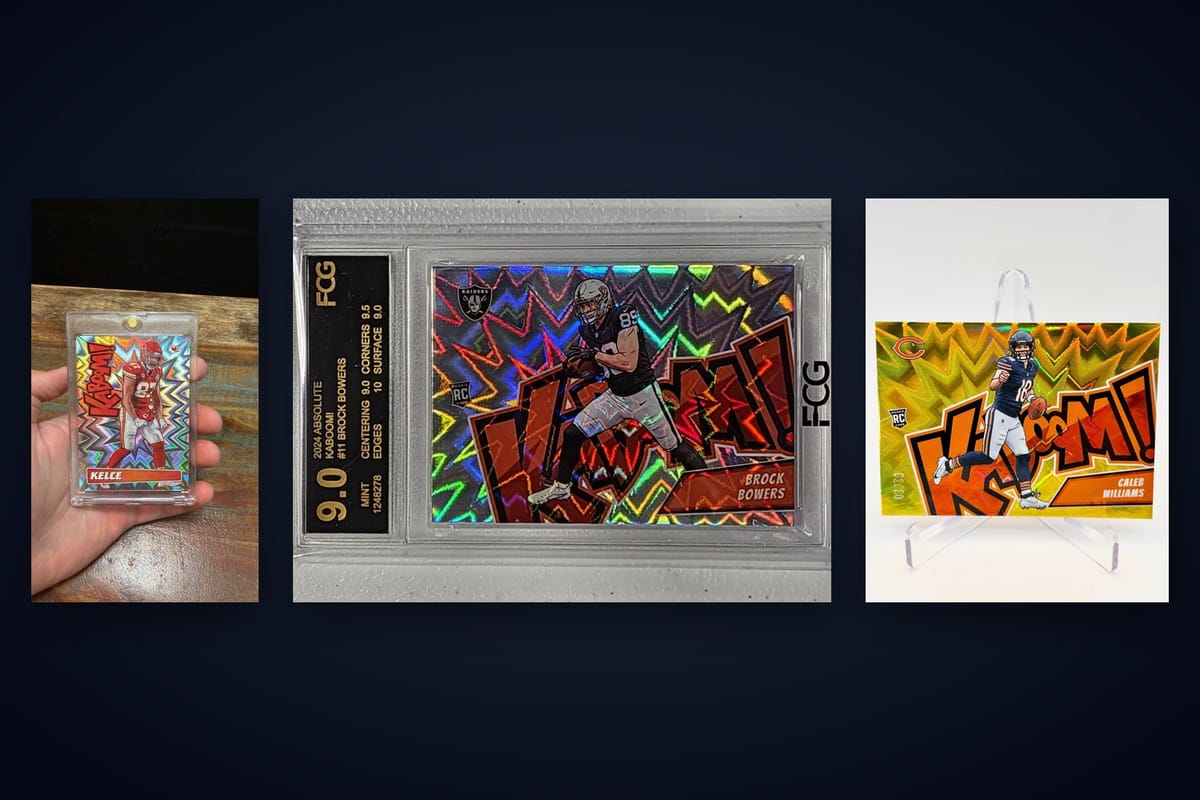
Travis Kelce [Green] #5 2024 Panini Absolute Kaboom Horizontal |
— | $11,000 | — |
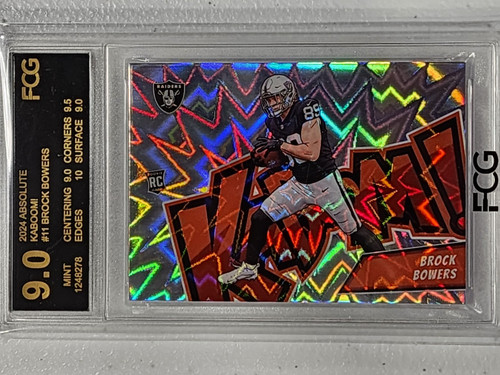 |
Brock Bowers [Gold] #11 2024 Panini Absolute Kaboom Horizontal |
— | $8,551 | — |
 |
Caleb Williams #16 2024 Panini Absolute Kaboom Horizontal |
$1,957 | $7,500 | 3.8× |
 |
Patrick Mahomes II #1 2024 Panini Absolute Kaboom Horizontal |
$1,238 | $4,290 | 3.5× |
 |
Jared Goff [Gold] #3 2024 Panini Absolute Kaboom Horizontal |
$2,500 | $3,958 | 1.6× |
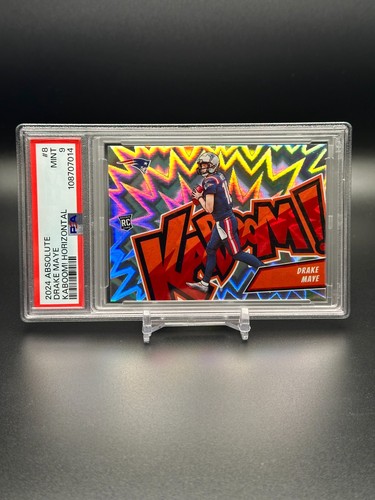 |
Drake Maye #8 2024 Panini Absolute Kaboom Horizontal |
$1,703 | $3,372 | 2× |
 |
Xavier Worthy [Gold] #12 2024 Panini Absolute Kaboom Horizontal |
$2,217 | $3,105 | 1.4× |
 |
Jayden Daniels #7 2024 Panini Absolute Kaboom Horizontal |
$1,025 | $2,716 | 2.7× |
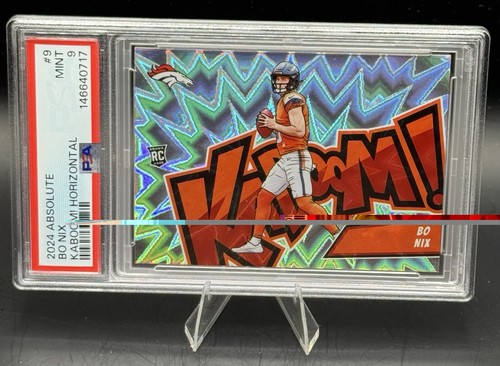 |
Bo Nix #9 2024 Panini Absolute Kaboom Horizontal |
$995.00 | $2,375 | 2.4× |
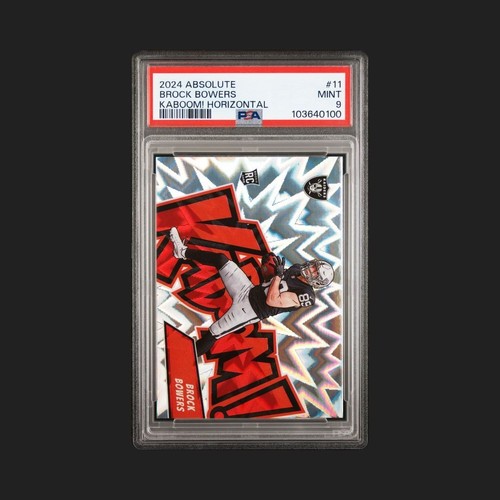 |
Brock Bowers #11 2024 Panini Absolute Kaboom Horizontal |
$500.00 | $1,302 | 2.6× |
 |
Malik Nabers #6 2024 Panini Absolute Kaboom Horizontal |
$569.72 | $996.60 | 1.8× |
 |
Travis Kelce #5 2024 Panini Absolute Kaboom Horizontal |
$469.04 | $850.00 | 1.8× |
Look up any card's current raw and graded value in Midpoint — and get an estimated grade before you pay to submit.
Table of Contents
- Section 1: What the 2024 Panini Absolute Kaboom Horizontal Set Is
- Section 2: 2024 Panini Absolute Kaboom Horizontal Price Guide Basics
- Section 3: Most Valuable 2024 Panini Absolute Kaboom Horizontal Cards
- Section 4: PSA 10 Value and the Gem Premium Gap
- Section 5: Which Kaboom Horizontal Cards Are Worth Grading
- Section 6: Condition Factors That Move Value
- Section 7: Market Trends, Authenticity, and Smart Buying and Selling
- Conclusion
- FAQ
Section 1: What the 2024 Panini Absolute Kaboom Horizontal Set Is
If you are researching 2024 Panini Absolute Kaboom Horizontal football cards value, start by understanding what you are actually pricing. Kaboom! is the loud, comic-burst style insert that Panini has built into its Absolute brand, and it has long been treated as a premium chase card rather than a standard insert.
The horizontal layout simply means the card artwork and player image run landscape rather than portrait. That matters because a horizontal Kaboom! is a different card from a vertical Kaboom! and from a base Absolute card, and each one trades on its own comps.
Kaboom! vs. base, parallels, and vertical versions
- Base Absolute cards: plentiful, low value, even for rookies, unless graded as a gem.
- Parallels: color or numbered variants of the same design, priced by scarcity.
- Kaboom! cards: widely regarded as a super short print or case-hit tier. Collectors pay for the design and the scarcity together.
- Horizontal vs. vertical Kaboom!: separate layouts that often sell at different prices even for the same player. Never use a vertical sale as a comp for a horizontal card.
Why the exact card matters
Searchers often lump every Kaboom! together, and that is how buyers overpay. Before you trust any number, confirm the layout (horizontal), the year (2024), the card number on the back, and whether the card carries a rookie designation. I will not guess at checklist numbers here, because a wrong number sends you to the wrong comps. Pull the official checklist and match it card in hand.
How to use the data in this post
The data table that follows this section comes from the Midpoint database, and all figures in it are stated as of 2026-09-04. The rest of this guide explains how to read those numbers: what separates the top cards, how big the raw-to-graded gap is, and where grading actually pays off.
Section 2: 2024 Panini Absolute Kaboom Horizontal Price Guide Basics
A useful 2024 Panini Absolute Kaboom Horizontal price guide separates three things that casual lists blur together: raw value, graded value by grade, and sales evidence. Skip any one of them and the number you see is a guess.
Raw value: the starting point
Raw means ungraded, and raw prices carry a built-in discount because the buyer is taking condition risk. A raw card that looks perfect in photos can still come back a PSA 8 after a centering or surface flaw shows up under a loupe.
- Raw prices reflect what the average buyer believes the card will grade.
- Well-photographed, sharp-cornered raw cards can sell close to graded prices.
- Poorly photographed raw cards sell for less, because buyers assume the worst.
Graded value: PSA, BGS, SGC, and others
Graded prices are quoted by company and grade. A PSA 10 and a BGS 9.5 are not interchangeable, and an SGC 10 trades differently again. If you want a refresher on how the companies differ, see this breakdown of grading scale differences by company.
Sales evidence: what to look for
A price means little without the sale record behind it. For every comp, note:
- Sale date: a six-month-old sale in a rookie market can be badly outdated.
- Platform: eBay, auction houses, and card shows can produce different results.
- Number of sales: one sale is an anecdote; several sales form a range.
- Grade and company: compare like with like.
Midpoint's card lookup covers raw and graded values across a large database of cards, so you can check a Kaboom! entry against its graded values without stitching together tabs. Treat every number as a range, not a promise.
Section 3: Most Valuable 2024 Panini Absolute Kaboom Horizontal Cards
The most valuable 2024 Panini Absolute Kaboom Horizontal cards tend to follow a predictable pattern: the best-known rookies on top, proven veterans in the middle, and role players at the bottom. The data table in this post shows where individual entries sit as of 2026-09-04, and the logic below explains why.
The rookie quarterback tier
The 2024 quarterback class drives much of the demand for this set. Jayden Daniels, Bo Nix, and Caleb Williams are the names collectors search for first, and quarterback rookies of this kind tend to carry the most liquidity. Liquidity matters: a card that sells weekly is easier to price and easier to exit than one that sells twice a year.
The skill-position rookie tier
- Marvin Harrison Jr. and Rome Odunze carry strong wide receiver demand.
- Brock Bowers draws tight end collectors and general rookie buyers alike.
- Michael Penix Jr. trades on a mix of draft story and team situation.
Rookies vs. veteran Kaboom! cards
A rookie Kaboom! usually commands a higher premium than a veteran version of the same insert, because rookie status adds a collecting reason on top of the design. Veteran stars can still hold value when the player has a long track record, but their prices tend to move slower and depend more on current performance.
What pushes a card to the top
- Player demand: performance, narrative, and team market size.
- Rookie designation: a true rookie card is a different asset from a non-rookie card.
- Scarcity: the lower the print run or population, the stronger the premium.
- Grade: a PSA 10 version often sits well above everything else for the same player.
Note that no single price makes a card the "most valuable." Compare like grades, because a PSA 10 of a mid-tier player can outsell a raw copy of a star.
Section 4: PSA 10 Value and the Gem Premium Gap
The 2024 Panini Absolute Kaboom Horizontal PSA 10 value is the number most collectors are chasing, and the gem premium is the gap between that number and the raw or PSA 9 price. The wider the gap, the more grading can add, and the more a mistake can cost you.
Why PSA 10 carries such a premium
PSA 10 is the top grade and it signals a card with near-perfect centering, corners, edges, and surface. Foil-heavy, reflective cards like many Absolute inserts can show flaws easily, so true gems can be harder to find than the packaging suggests. That scarcity is what the premium pays for.
Reading the gap by grade
- Raw to PSA 9: often a modest step. Sometimes a PSA 9 barely beats a clean raw card after fees.
- PSA 9 to PSA 10: typically the big jump. This is where profit lives.
- PSA 8 and below: often worth less than a good raw copy once grading costs are included.
Look at the table to see the raw and graded entries side by side as of 2026-09-04. For any card you own, calculate the gap yourself: PSA 10 price minus raw price, minus grading cost.
Other companies: BGS, SGC, CGC, and TAG
BGS 9.5 and BGS 10 can have their own premium, particularly for cards with strong subgrades. SGC 10 and CGC grades often sell for less than a PSA 10 in the football market, though that can differ by card. When comparing, keep the company consistent. If you want to understand how the top grades are defined, the guide to what top grades really mean is worth a read.
The expected-value mindset
Do not price a raw card at its PSA 10 value. Weight the outcomes: some chance of a 10, some of a 9, some of an 8 or lower. The gem premium only pays out when the card actually earns the 10.
Section 5: Which Kaboom Horizontal Cards Are Worth Grading
The question behind 2024 Panini Absolute Kaboom Horizontal cards worth grading is a math problem, not a feeling. A card is worth submitting when the likely graded value, after fees, beats what you could sell it for raw.
A simple grading decision framework
- Find the raw price from recent completed sales.
- Find PSA 9 and PSA 10 prices from recent sales, not asking prices.
- Estimate your odds. Be honest: a card with one soft corner is not a 10 candidate.
- Subtract costs: grading fee, shipping, insurance, and your time.
- Compare expected value to raw. If it is not clearly higher, sell raw.
Cards that usually justify grading
- Top rookies such as Jayden Daniels, Bo Nix, or Caleb Williams, where the PSA 10 premium is large relative to fees.
- Cards with centering that measures well, near 50/50 on the front.
- Cards with clean, sharp corners and an unblemished foil surface.
Cards that often do not
- Lower-demand veterans where the graded premium is thin.
- Any card with visible print lines, chipping, or heavy off-centering.
- Cards where PSA 9 and raw sell for about the same price.
Pre-grade before you pay
Grading costs add up fast, and submitting a card that comes back a 7 can wipe out your margin. Pre-grading catches problems early. Our walkthrough on how to pre-grade your card covers the process step by step. With Midpoint, you can get an estimated PSA, BGS, CGC, or TAG grade from centering, corners, edges, and surface before you spend $30 or more on a submission.
Section 6: Condition Factors That Move Value
Two copies of the same Kaboom! card can sell for very different prices purely because of condition. These are the main factors graders weigh, and the ones you can check at home.
Centering
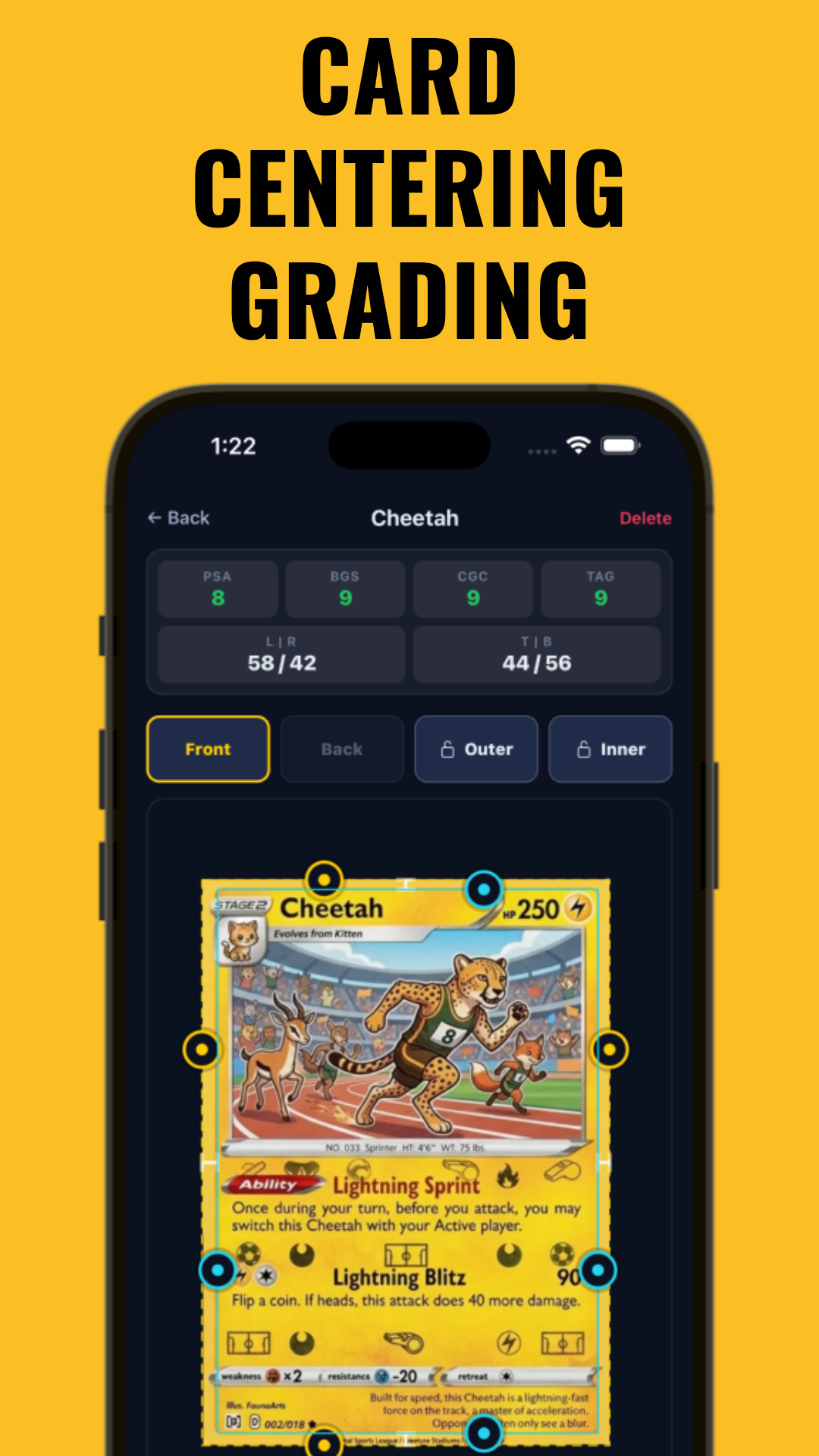
Centering is the border balance from left to right and top to bottom. It is the easiest factor to measure and often the one that kills a gem. Horizontal cards can make it harder to eyeball, because the borders look different on a landscape layout. Measure rather than guess, and see how centering impacts card value for the full picture. You can also try the free centering calculator.
Corners and edges
- Corners: look for whitening, softness, or dings under bright light.
- Edges: dark-bordered or foil cards show chipping quickly along the edge.
Surface and print quality
Shiny, reflective surfaces reveal scratches, fingerprints, and print lines that are invisible in normal lighting. Tilt the card under a single light source and look for hairlines, dimples, and print defects. A print line from the factory still counts against the grade even if you never touched the card.
How condition shows up in price
Each step down in grade usually comes with a price cut, and the drop from a 10 to a 9 is often the steepest. That is why even small flaws matter. Learn how to store valuable cards so you do not damage a gem-quality copy between pulling it and grading it.
Midpoint's AI analysis scores centering, corners, edges, and surface together, which gives you a realistic grade estimate rather than a hopeful one.
Section 7: Market Trends, Authenticity, and Smart Buying and Selling
The 2024 horizontal Kaboom! market is a rookie-driven market, which means volatility is part of the deal. Prices can climb or fall with a single game, an injury, a depth-chart change, or a new wave of supply.
Price trends and volatility
- Player performance: a breakout stretch can lift prices, and a slump or injury can cut them.
- Population growth: as more copies are graded, gem premiums tend to compress. See the guide on grading low population cards for how scarcity plays out.
- Season timing: football card demand often rises around the season and playoffs.
Because the numbers in this guide are stated as of 2026-09-04, always refresh them before a purchase.
How to verify a card before buying or selling
- Match the card number on the back with the official checklist.
- Confirm the layout: horizontal, not vertical, and Kaboom!, not a similar insert.
- Check the rookie designation printed on the card.
- Inspect the slab if graded: verify the certificate number on the grader's website.
- Pull comparable sales for the same grade and company.
Tips for buyers
- Ask for clear, high-resolution front and back photos on raw cards.
- Measure centering from the photos before you bid.
- Set a ceiling based on completed sales, not emotion.
Tips for sellers
- List graded cards with the exact company, grade, and cert number.
- Time listings for peak demand when you can.
- Track what you own with portfolio tools so you know when your collection's value has moved. Midpoint's portfolio tracking shows your collection's value over time.
Conclusion
The value of a 2024 Panini Absolute Kaboom Horizontal football card comes down to four things: who the player is, whether it is a true rookie, how scarce the card is, and what condition it is in. The raw-to-PSA 10 gap is the biggest swing factor, and it only pays out if the card actually earns the top grade.
Use the data table in this post as a snapshot as of 2026-09-04, then verify with fresh completed sales before buying, selling, or submitting. Measure centering first, inspect corners and surface under light, and do the expected-value math before paying for grading.
If you want a faster way to do that, Midpoint is free on iOS and Android and combines centering measurement, AI grade estimates, and raw vs graded card lookup in one app.
FAQ
Q: How much is a 2024 Panini Absolute Kaboom horizontal card worth?
A: It depends heavily on the player, rookie status, and grade. Top rookies command the highest prices and veterans and role players sit much lower. Check the data table above, which is stated as of 2026-09-04, and confirm with recent completed sales for your exact card and grade.
Q: What is the most valuable 2024 Panini Absolute Kaboom horizontal card?
A: Value usually concentrates in the top rookie quarterbacks and receivers, such as Jayden Daniels, Caleb Williams, Bo Nix, and Marvin Harrison Jr., especially in PSA 10. Compare cards at the same grade, because a gem copy of one player can outsell a raw copy of another.
Q: How much is a Jayden Daniels 2024 Absolute Kaboom horizontal rookie card worth?
A: Daniels is among the most in-demand names in the set, so graded copies, particularly PSA 10, tend to carry a clear premium over raw. Look up his entry in the Midpoint database and compare recent sales by grade before you buy or sell.
Q: What is a Bo Nix 2024 Absolute Kaboom horizontal rookie card selling for?
A: Bo Nix is a major rookie quarterback in this class, and his price depends on grade and recent sales activity. Use completed sales for the same grade and company, and treat any figure as a range rather than a fixed price.
Q: Are 2024 Panini Absolute Kaboom horizontal cards rare?
A: Kaboom! inserts are generally treated as a premium short-print tier, far scarcer than base cards. Exact scarcity differs by card and layout, so confirm against the official checklist and any population data for the specific card.
Q: Do graded 2024 Absolute Kaboom horizontal cards sell for more than raw cards?
A: Usually yes, especially PSA 10, which often carries the biggest premium. Lower grades such as PSA 8 may not beat a clean raw card once grading fees are counted, so pre-grade first and do the math.
Free to start
Try the Midpoint app
Grade any card from a photo, see its raw and PSA 10 value, and track what your collection is worth — free.
Get it on iPhoneGet it on Android