2025 Topps Chrome Rookie Autograph Basketball Cards Value
2025 Topps Chrome rookie autograph basketball cards value guide: raw vs PSA 10 gaps, Cooper Flagg, and which cards are worth grading.

Estimated reading time: 11 min
Key Takeaways
- 2025 Topps Chrome rookie autograph basketball cards value depends on four things: the player, the parallel, the grade, and whether the autograph itself is clean.
- The gap between raw and PSA 10 prices is one of the most useful numbers for deciding what to grade. Midpoint's figures (as of 2026-11-08) are in the data table.
- Cooper Flagg leads the demand curve, but a low-numbered parallel of a mid-tier rookie can outprice a base Refractor of a star.
- Centering and surface often decide gem outcomes, so pre-grade before you spend $30+ per submission.
- Compare realized sales, not asking prices, and always check serial numbers to identify the exact card.
Card values — live data from Midpoint's card database, as of 2026-11-08. Prices move; Midpoint refreshes these daily.
| Card | Raw | PSA 10 | Gem premium | |
|---|---|---|---|---|
 |
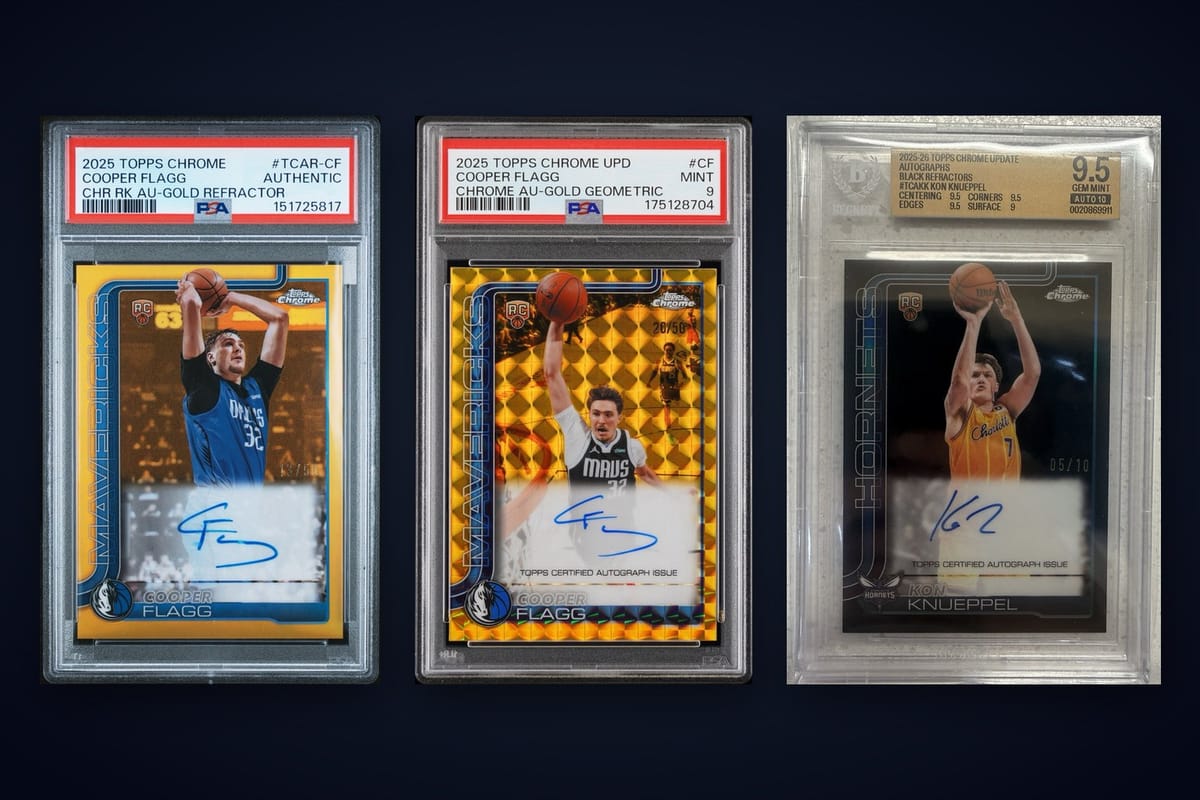
Cooper Flagg [Gold Refractor] #TCAR-CF 2025 Topps Chrome Rookie Autograph |
$23,000 | $70,609 | 3.1× |
 |
Cooper Flagg [Gold Geometric] #TCAR-CF 2025 Topps Chrome Rookie Autograph |
$11,006 | $44,240 | 4× |
 |
Kon Knueppel [Black Refractor] #TCAR-KK 2025 Topps Chrome Rookie Autograph |
$12,713 | $24,000 | 1.9× |
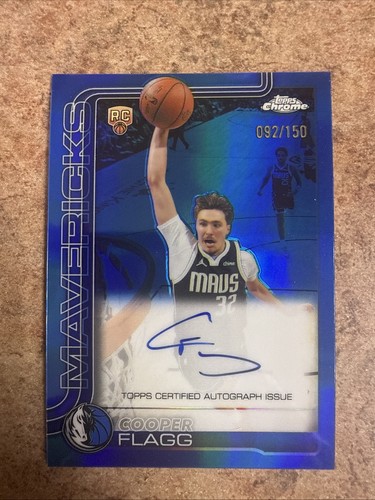 |
Cooper Flagg [Blue Refractor] #TCAR-CF 2025 Topps Chrome Rookie Autograph |
$8,863 | $19,186 | 2.2× |
 |
Kon Knueppel [Gold Refractor] #TCAR-KK 2025 Topps Chrome Rookie Autograph |
$6,408 | $17,018 | 2.7× |
 |
Cooper Flagg [Green Refractor] #TCAR-CF 2025 Topps Chrome Rookie Autograph |
$6,500 | $16,500 | 2.5× |
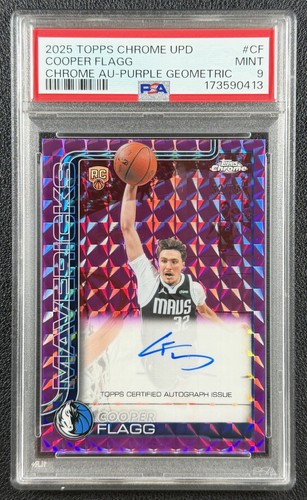 |
Cooper Flagg [Purple Refractor] #TCAR-CF 2025 Topps Chrome Rookie Autograph |
$7,319 | $14,700 | 2× |
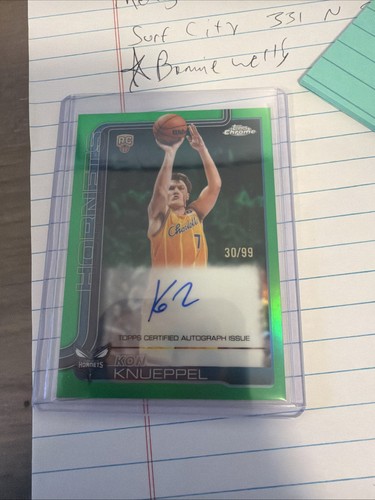 |
Kon Knueppel [Green Refractor] #TCAR-KK 2025 Topps Chrome Rookie Autograph |
$1,198 | $7,877 | 6.6× |
 |
Kon Knueppel [Purple Refractor] #TCAR-KK 2025 Topps Chrome Rookie Autograph |
$1,180 | $5,780 | 4.9× |
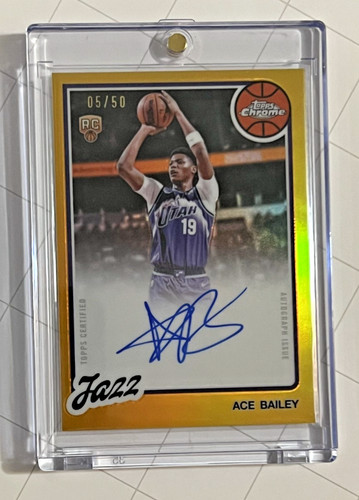 |
Ace Bailey [Gold Refractor] #TCAR-AB 2025 Topps Chrome Rookie Autograph |
$2,583 | $4,762 | 1.8× |
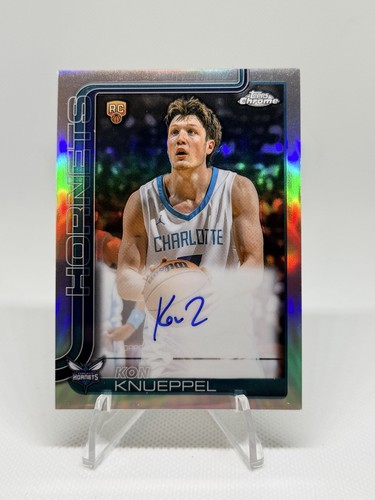 |
Kon Knueppel [Refractor] #TCAR-KK 2025 Topps Chrome Rookie Autograph |
$689.50 | $2,761 | 4× |
 |
Kon Knueppel [Blue Refractor] #TCAR-KK 2025 Topps Chrome Rookie Autograph |
$1,581 | $2,435 | 1.5× |
Look up any card's current raw and graded value in Midpoint — and get an estimated grade before you pay to submit.
Table of Contents
- Section 1: How 2025 Topps Chrome Rookie Autograph Values Work
- Section 2: The Most Valuable 2025 Topps Chrome Rookie Autograph Cards
- Section 3: Parallels, Rarity Tiers and Identifying Your Exact Card
- Section 4: PSA 10 Value and the Gem Premium Gap
- Section 5: Which Rookie Autographs Are Worth Grading
- Section 6: Price Trends, Verified Sales and When to Sell
- Section 7: Where to Buy and Sell Safely
Section 1: How 2025 Topps Chrome Rookie Autograph Values Work
If you are researching 2025 Topps Chrome rookie autograph basketball cards value, start with a simple idea: every card has two prices. One is the raw price (ungraded, as pulled from a pack). The other is the graded price, which splits again by company and grade.
The data table comes from Midpoint's own database and is dated as of 2026-11-08. Use it as your price guide for raw versus graded values, and treat any number you see elsewhere as a data point to cross-check, not a promise.
Raw vs graded: the two-price system
A raw card is priced on the assumption that it might grade well, might not, and that the buyer carries the risk. A graded card has the risk removed, so the price reflects a verified condition.
- Raw: cheapest entry point, but condition is a gamble.
- PSA 9 and similar: often a smaller premium over raw than a PSA 10 commands.
- PSA 10: the gem tier, where the biggest jump tends to happen.
Why Chrome autographs command attention
Topps Chrome is a premier chrome-finish basketball release that collectors compare rookie classes against. A rookie autograph in Chrome combines three things buyers want: the rookie designation, a signature (on-card or sticker), and the chrome look that grades and displays well.
That combination is why autographed Chrome rookies often anchor a player's entire card portfolio.
How to read the data table
When you scan the table, look at three columns in order:
- The raw price to see what an ungraded copy costs.
- The PSA 10 price to see the ceiling.
- The difference between them, which tells you whether grading is even worth considering.
A card with a tiny gap between raw and PSA 10 rarely justifies a submission. A card with a wide gap deserves a closer look at condition. We unpack that math in Sections 4 and 5.
Section 2: The Most Valuable 2025 Topps Chrome Rookie Autograph Cards
The most valuable 2025 Topps Chrome Rookie Autograph cards almost always belong to the players the hobby believes will define the next decade. In this class, Cooper Flagg sits at the top of the demand list, and his rookie autographs set the pace for everyone else.
Check the data table for the current standing of each named card. The ranking can shift, so use the date stamp (2026-11-08) as your reference point.
What pushes a rookie autograph higher
Value is a story about expectations. Several forces move it:
- Draft status: a top pick starts with a premium because buyers assume opportunity and minutes.
- On-court performance: breakout games and award talk lift prices quickly; slumps cool them.
- NBA team and market: big-market teams and playoff exposure widen the buyer pool.
- Injuries: a serious injury can pause demand, though long-term believers sometimes treat dips as entry points.
- Brand appeal: a player with national name recognition draws casual buyers, not just collectors.
Star power vs. scarcity
A common mistake is assuming the star's card always wins. A numbered parallel of a solid starter can outprice a base Refractor autograph of a bigger name, because supply is capped.
The smart comparison is player plus parallel plus grade, never player alone.
Don't ignore the mid-tier rookies
Rookies below the top tier tend to trade at lower prices, which means a smaller dollar gap between raw and graded. That does not make them poor buys. It means the grading math is tighter, and a flawed copy loses proportionally more of its value.
For specific figures on named rookies, rely on the table and on realized sales, not on guesses.
Section 3: Parallels, Rarity Tiers and Identifying Your Exact Card
Parallels are the biggest swing factor after the player. Two cards with the same signature can sit in very different price brackets purely because of color and numbering.
The rarity ladder
Collectors generally think of the autograph parallels in this order, from most common to rarest:
- Base Refractor autograph: the unnumbered entry point.
- Numbered color parallels: such as Gold, Orange, Red, and Black, each stamped with a serial number. Print runs differ by color, so check the official checklist.
- SuperFractor: a 1/1, the only copy that exists.
As a rule, a lower serial denominator means fewer copies and more upside. Always read the number printed on the card itself, since that is the only reliable source for the print run of your exact copy.
How to tell if you have a rare parallel or a base card
- Look for a stamped serial number (for example, a fraction like 05/50). No stamp usually means an unnumbered parallel or base.
- Check the color of the refractor pattern and borders against the checklist.
- Read the card back for the card number and subset name.
- Confirm the autograph type (on-card vs sticker).
Rookie Autographs vs. similar autograph subsets
Be careful with naming. The set has a dedicated Rookie Autographs subset, and other autograph issues may look similar at a glance. The label, the card number prefix, and the rookie logo are what separate them.
Before you list or buy, match three things to the official checklist: player, card number, and parallel. A mislabeled listing can cost you real money, either by underpricing a rare card or overpaying for a common one.
Short prints and variations
Some cards in the broader set may be short printed or have image variations. If your card does not match the standard photo or layout, research it before assuming it is a plain version. Variations can carry their own pricing.
Section 4: PSA 10 Value and the Gem Premium Gap
The phrase 2025 Topps Chrome Rookie Autograph PSA 10 value really describes a premium, not just a price. A PSA 10 is the top grade, and buyers pay extra for the certainty that the card is nearly flawless.
The gap between a raw copy and a PSA 10 is where grading profit lives. It is also where grading losses hide, because many submissions do not come back as a 10.
What graders look at on an autograph card
- Centering: how evenly the borders sit on all four sides.
- Corners: sharp points with no whitening or fraying.
- Edges: clean, with no chipping, which chrome cards can be prone to.
- Surface: no scratches, print lines, or dimples.
- Autograph appearance: PSA's numeric grade is based on the card's condition, but buyers still want clear, bold ink that has not smudged, skipped, or faded.
For a deeper look at how each company scores, see our guide to grading scale differences between PSA, BGS and CGC.
Centering is the quiet gem-killer
Chrome cards can arrive with off-center borders straight from the pack. Even a card that looks great at arm's length can miss a 10 because of a lopsided border. Our breakdown of how centering impacts card value shows why this one factor swings prices so much.
Sticker and on-card autographs
Some companies grade autograph quality separately, while others only note it. A strong card with a weak signature can be a hard sell at a premium. Inspect the ink under bright light before you submit.
Measuring the gap yourself
Take the PSA 10 price from the table, subtract the raw price, and note the result. That difference is your potential upside per card, before fees. Next, we turn it into a decision.
Section 5: Which Rookie Autographs Are Worth Grading
Not every card belongs in a grading submission. The 2025 Topps Chrome Rookie Autograph cards worth grading are the ones where the potential gain clearly outweighs the cost and the risk of a lower grade.
A simple expected-value test
Use this framework before you submit:
- Estimate the probability the card earns a 10, a 9, or lower.
- Multiply each outcome by its graded price from the table.
- Add them up to get an expected graded value.
- Subtract the raw price, the grading fee (often $30+, and it varies by company and service level), shipping, and selling fees.
If the result is positive with room to spare, grade. If it is thin or negative, sell raw or hold.
Cards that tend to justify grading
- Wide gap between raw and PSA 10 prices.
- Strong centering and clean corners on inspection.
- Bold, complete autograph.
- Higher-demand players or lower-numbered parallels, where a slab adds trust.
Cards that usually do not
- Visible off-centering, whitening, or surface lines.
- A tiny difference between raw and graded values.
- Faded or partial signatures.
Pre-grade before you pay
The cheapest grade is the one you skip when a card clearly will not hit your target. Midpoint measures centering down to the millimeter and gives estimated PSA, BGS, CGC, and TAG grades from centering, corners, edges, and surface, so you can screen a stack before spending anything.
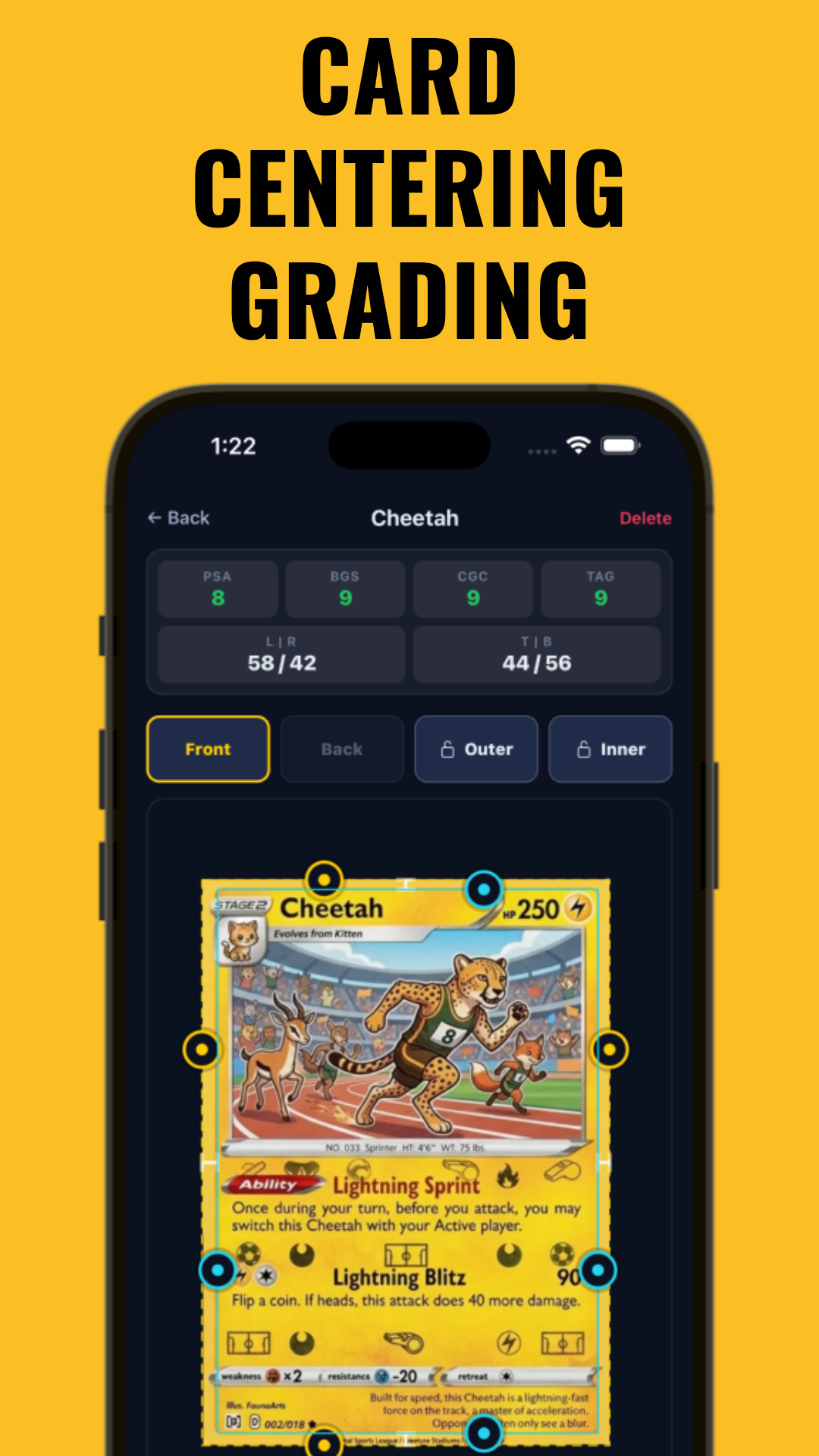
For a manual routine, follow our step-by-step guide to pre-grading your card.
Section 6: Price Trends, Verified Sales and When to Sell
A price is only meaningful if you know where it came from. Some value pages mix active listings with sold data. They are not the same thing.
Asking prices vs. realized sales
An asking price is a wish. A realized sale is a fact. For a trustworthy price guide, record these details for every comparable:
- Sale date (recent sales matter most for a fast-moving rookie).
- Platform (auction vs. fixed price).
- Grade and grading company.
- Autograph grade, if one was assigned.
- Final price, including whether it was a best offer.
Compare like with like. A PSA 10 sale of the same parallel is a comparable. A raw sale of a different parallel is not.
Population and sales volume
Population reports show how many copies each company has graded. When many PSA 10s exist, the premium can compress. When few exist, it can widen. Low sales volume also means a single sale can distort the average, so look for multiple data points. Our guide to grading low population cards explains how scarcity changes the calculation.
Volatility is built in
Rookie card prices respond to games, injuries, trades, and hype cycles. Early in a career, prices tend to be driven by expectation rather than results, which means larger swings in both directions.
When to sell
- After a performance spike or award buzz, when demand is loud.
- When a card's grade is locked in and the premium looks healthy.
- If your thesis changes, such as a long injury or a role change.
Hold when you believe in the player long-term and do not need the cash. Track your collection's value over time in Midpoint's portfolio view so decisions are based on data, not impulse.
Section 7: Where to Buy and Sell Safely
Even a perfect valuation does not help if the transaction goes wrong. Choose your channel based on the card's value and your tolerance for risk.
Common marketplaces
- eBay: the largest pool of buyers and a major source of sold data, with seller fees that reduce your net.
- Major auction houses: better for high-end or one-of-one cards, with premiums and longer timelines.
- Private sales and card shows: flexible and often lower fee, but you carry more verification risk.
Authentication and safety
For raw autograph cards, ask for clear photos of the front, back, and edges. For slabs, verify the certification number on the grading company's website and make sure the label matches the card inside.
- Use tracked, insured shipping.
- Prefer payment methods with buyer and seller protection.
- Be cautious with deals that feel too good, or sellers who refuse extra photos.
Count the fees
Your real profit is the sale price minus platform fees, payment processing, shipping, grading cost, and supplies. A card that looks profitable on paper can break even after all of that, so calculate net proceeds before you list.
Protect the value you have
A top-loader, sleeve, and stable storage can be the difference between a card that grades well and one that picks up a surface mark. Review our guide to storing valuable cards for practical setups.
Conclusion
The value of 2025 Topps Chrome rookie autograph basketball cards comes down to a handful of clear drivers: who the player is, how rare the parallel is, what grade the card earns, and how clean the autograph looks. Cooper Flagg leads attention, but numbered parallels and gem-quality condition can matter just as much as the name on the card.
Use the data table (as of 2026-11-08) to compare raw prices against PSA 10 prices, then apply the expected-value test before you submit anything. Pre-grade your best candidates with Midpoint, confirm the parallel and serial number, and sell where realized sales support your price.
FAQ
Q: What is the most valuable 2025 Topps Chrome rookie autograph basketball card?
A: Cooper Flagg's rookie autographs lead demand, and the rarest parallels, such as a SuperFractor 1/1, sit at the top of the scarcity ladder. Check the data table for the current standings as of 2026-11-08.
Q: How much is a 2025 Topps Chrome Cooper Flagg rookie autograph worth?
A: It depends on the parallel and the grade. A raw base Refractor autograph and a PSA 10 numbered parallel sit in very different brackets. Look up the specific entry in the data table and compare it with recent realized sales.
Q: What are the current prices for 2025 Topps Chrome Rookie Autographs?
A: Midpoint's database lists raw and graded prices as of 2026-11-08. Prices move with player performance and market demand, so confirm against recent sold listings before you buy or sell.
Q: Which 2025 Topps Chrome basketball rookie autograph parallels are worth the most?
A: Lower-numbered parallels tend to be worth the most because fewer copies exist. The SuperFractor 1/1 is the scarcest, followed by other low-numbered colors such as Black, Red, Orange, and Gold, though print runs differ by parallel. Always read the serial number on your card and check the official checklist.
Q: Does grading a 2025 Topps Chrome rookie autograph increase its value?
A: It can, mainly if the card earns a PSA 10 and the gap over the raw price is wide. A lower grade may add little or even leave you behind after fees. Pre-grade first to estimate the outcome.
Q: How can I tell whether my 2025 Topps Chrome rookie autograph is a rare parallel or a base card?
A: Look for a stamped serial number, check the color of the refractor finish, and match the card number and subset on the back to the official checklist. No serial stamp usually points to an unnumbered parallel or base version.
Free to start
Try the Midpoint app
Grade any card from a photo, see its raw and PSA 10 value, and track what your collection is worth — free.
Get it on iPhoneGet it on Android