55/45 Centering Explained: Example, PSA 10 Tolerance, and Visual Guide
Learn the 55/45 centering rule for PSA 10 cards, how to measure centering, compare grading standards, and avoid costly mistakes before submitting for grading.


Estimated reading time: 13 min
Key Takeaways
- The 55/45 centering rule defines the maximum front centering tolerance for PSA 10 "Gem Mint" cards and is a crucial standard for top trading card grades.
- Precise measurement of centering ratios (left/right and top/bottom) is essential—eyeballing is rarely accurate enough for the 55/45 centering threshold.
- Different grading companies (PSA, BGS, CGC) have distinct acceptable card centering standards for top grades, with the 55/45 rule being most relevant for PSA 10.
- The 55/45 rule applies to the card front, while the back allows more leeway (typically 75/25 for PSA 10).
- Using digital tools like Midpoint can increase accuracy and help collectors confidently check if their cards meet the 55/45 centering standard and PSA 10 centering tolerance before grading submissions.
Table of Contents
- Section 1: What Is the 55/45 Centering Rule?
- Section 2: How to Measure Card Centering Ratios
- Section 3: PSA 10, BGS, and CGC Centering Standards by Grade
- Section 4: 55/45 vs. 60/40 Centering Thresholds
- Section 5: 55/45 Centering Example and Visuals
- Section 6: Common Mistakes When Estimating Centering Tolerance
- Section 7: Tools and Apps for Accurate Centering Measurement
- Section 8: How Centering Affects Overall PSA Grades
- Conclusion
- FAQ
Section 1: What Is the 55/45 Centering Rule?
The Basics of Centering in Card Grading
Card centering refers to how well the printed image is positioned within the borders of a trading card. Perfect, or 50/50 centering, means the image is exactly the same distance from each border, both left/right and top/bottom. However, perfect centering is rare due to manufacturing tolerances.
The 55/45 centering rule sets a practical standard for grading, especially for PSA 10 "Gem Mint" cards. This rule defines the maximum centering tolerance allowed on the front of a card to achieve a PSA 10 grade. If your card's centering is off by more than this, it cannot earn a PSA 10.
Defining the 55/45 Rule
For PSA 10 (Gem Mint), the 55/45 centering rule means the image can be shifted so one border is up to 55% of the total width (or height) and the opposite border is down to 45%, on the card's front. Both the left/right and top/bottom axes must meet this threshold. The back is more lenient, typically allowing up to 75/25 centering for PSA 10.
- Left/Right axis: 55%/45% or better
- Top/Bottom axis: 55%/45% or better
- Back centering: Up to 75/25 for PSA 10 (see Section 3 for details)
Why Does This Rule Matter?
Cards that don't meet the 55/45 centering tolerance on the front cannot receive a PSA 10 grade, even if they are flawless in every other way. For collectors aiming for gem mint cards, understanding this centering rule and PSA 10 centering tolerance is critical—especially with grading fees rising above $30 per card. The 55/45 centering rule is also an industry reference point, so knowing whether your card is within this tolerance can save you from grading disappointment.
Section 2: How to Measure Card Centering Ratios
Step-by-Step Centering Measurement
Accurately measuring centering is the first step to knowing if your card meets the 55/45 rule and PSA 10 centering tolerance. Here’s how to check centering ratios:
- Measure the distance from the edge of the card to the edge of the printed image (border) on both sides (left/right or top/bottom).
- Add these two border measurements together to get the total border width for that axis.
- Calculate each side’s percentage: (border width / total border width) × 100.
For example, if the left border is 2.5mm and the right is 2.0mm, the total is 4.5mm. The left is 56% (2.5/4.5), and the right is 44% (2.0/4.5)—this would just miss the 55/45 centering tolerance for a PSA 10.
55/45 Centering Example
Suppose your card has a top border of 3.0mm and a bottom border of 2.5mm. The total is 5.5mm. The top border is 54.5% (3.0/5.5), and the bottom is 45.5% (2.5/5.5). This just meets the 55/45 centering rule and PSA 10 centering tolerance. Having a real 55/45 centering example helps you visually judge if a card is likely to pass or fail the rule.
Top/Bottom vs. Left/Right Centering
Both axes must meet the 55/45 centering threshold for PSA 10 on the card front. Many cards are shifted vertically or horizontally but not both—always measure both axes to ensure your card qualifies.
Manual vs. Digital Measurement
- Manual tools: Rulers, calipers, and centering gauges can work but are prone to human error—especially when border colors or foil patterns make edges hard to see.
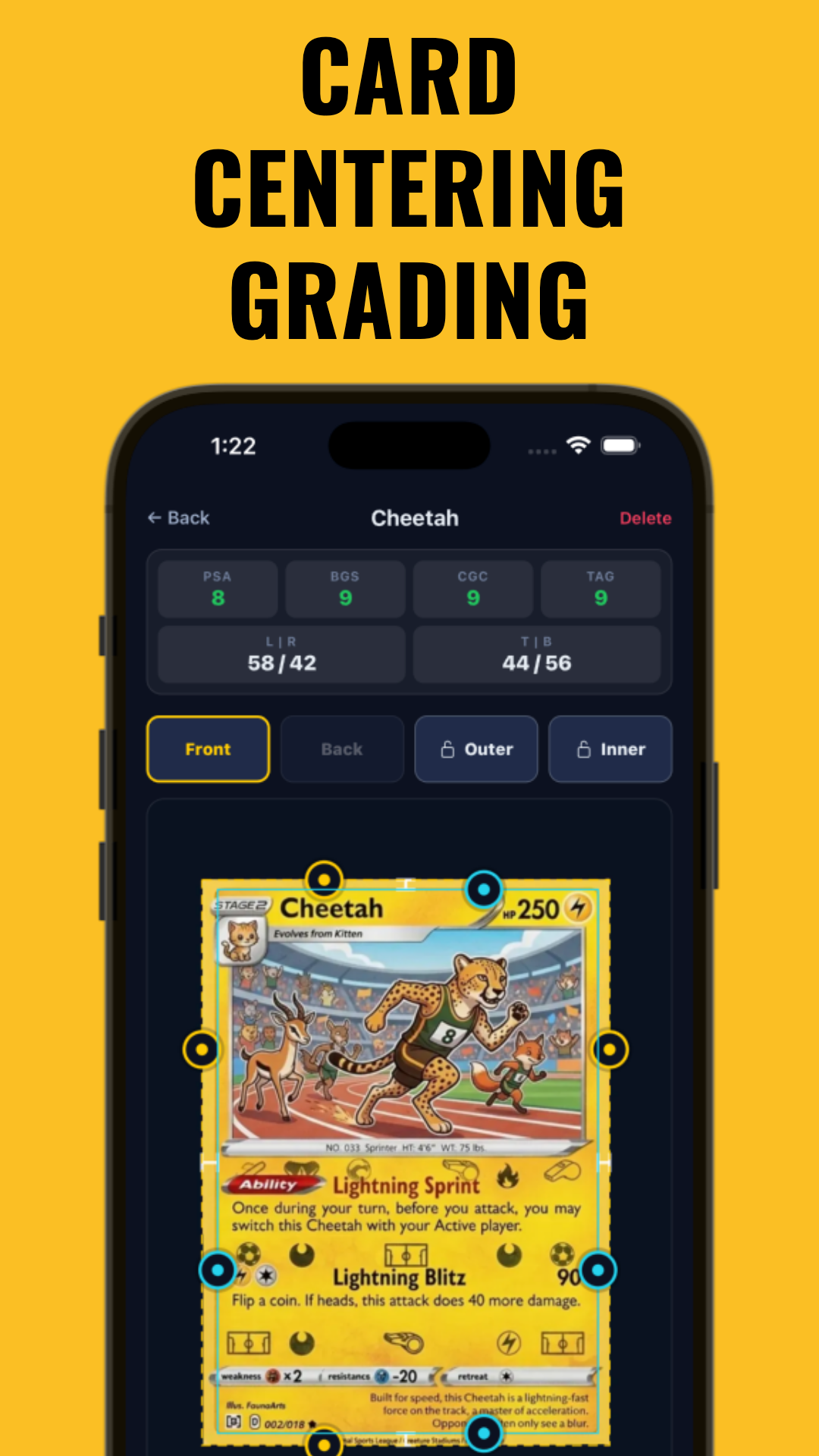
- Digital tools: Apps like Midpoint analyze scans or photos, calculate precise percentages, and may estimate PSA/BGS/CGC grades instantly, ensuring your card meets PSA 10 centering tolerance.
For a full tutorial, see How to Measure Card Centering: Step-by-Step Precision Guide.
Section 3: PSA 10, BGS, and CGC Centering Standards by Grade
PSA Centering Standards
- PSA 10 (Gem Mint): 55/45 or better on the front, 75/25 or better on the back.
- PSA 9 (Mint): 60/40 or better on the front, 90/10 or better on the back.
- PSA 8 (NM-MT): 65/35 or better on the front, 90/10 or better on the back.
BGS (Beckett) Centering Requirements
- BGS 10 (Pristine): 50/50 on the front, 60/40 on the back.
- BGS 9.5 (Gem Mint): 55/45 or better on the front, 60/40 on the back.
- BGS 9 (Mint): 60/40 or better on the front, 65/35 on the back.
CGC and TAG Standards
- CGC 10: 55/45 or better on the front, 75/25 on the back.
- TAG: Similar standards, but check their published guides for specifics.
Key differences: BGS requires stricter front centering for a true 10 (50/50), so cards that meet PSA’s gem mint centering percentage may only receive a 9.5 with BGS. Understanding these differences helps you decide where to submit your card.
This makes understanding each grading company’s acceptable card centering critical—especially if you cross-grade or submit to different companies. For a deeper dive, check out our step-by-step pre-grading guide or see our comparison of card grading centering standards for PSA, BGS, CGC, SGC, and TAG. For a direct comparison of PSA, BGS, CGC, and SGC grading, see our Card Grade Comparisons: PSA vs BGS vs CGC vs SGC Explained.
Section 4: 55/45 vs. 60/40 Centering Thresholds
What’s the Real Difference?
The difference between 55/45 centering and 60/40 centering thresholds is more than just numbers—it can be the dividing line between a card valued in the thousands and one worth much less.
- 55/45: The strict threshold for PSA 10, BGS 9.5, CGC 10. Only a slight shift is tolerated.
- 60/40: The standard for PSA 9, BGS 9. A noticeably off-center card, but still within the range most collectors consider sharp.
Visualizing the Tolerance
At 55/45, the difference between borders is only about 10% of the total width or height—a subtle, but visible, shift. 60/40 is more pronounced; experienced collectors may spot it at a glance, but newer hobbyists often need help identifying it precisely.
Why Does This Gap Matter?
- Value impact: Cards that just miss the gem mint centering percentage may drop a full grade, often reducing value significantly.
- Submission strategy: Measuring before you submit helps avoid costly mistakes. This is why tools like Midpoint can be useful for pre-grading and confirming PSA 10 centering tolerance.
For more on how centering impacts value, see How Centering Impacts Card Value: A Detailed Guide.
Section 5: 55/45 Centering Example and Visuals
Spotting Gem Mint vs. Off-Center Cards
Comparing cards that pass vs. fail the 55/45 centering rule helps collectors train their eye and avoid submission surprises. Visual examples are helpful for mastering acceptable card centering standards and PSA 10 centering tolerance. For a comprehensive overview of centering standards and tips for collectors, see Card Centering: The Definitive Guide for Grading and Collectors.
- Pass (55/45 or better): Borders look close to even, with only a slight, barely noticeable shift in image alignment.
- Fail (worse than 55/45): One border is visibly thicker than its opposite, with the image noticeably shifted. Cards like this are common 55/45 centering examples that miss PSA 10.
Real-World Example Using Midpoint
Here’s a screenshot from the Midpoint app, which highlights exact border measurements and calculates ratios instantly, helping you verify PSA 10 centering tolerance:
Comparing 50/50, 55/45, and 60/40
- 50/50: Perfectly balanced borders; extremely rare, highest possible centering score.
- 55/45: Slightly uneven but only just; qualifies for PSA 10 and is the practical target for most collectors chasing top grades.
- 60/40: More pronounced shift; drops to PSA 9 or BGS 9.
To practice with your own cards, check the Card Centering Tool: Accurate Card Grading Estimates guide.
Section 6: Common Mistakes When Estimating Centering Tolerance
Eyeballing Is Not Enough
Many collectors believe they can "eyeball" centering, but anecdotal reports and some informal studies suggest this method is unreliable. Border patterns, foil glare, and card design can all trick the eye, making it easy to miss the 55/45 centering threshold and PSA 10 centering tolerance.
Underestimating Border Irregularities
- Irregular borders: Not all borders are perfectly parallel or uniform in thickness—vintage cards especially can be tricky.
- Artwork shifts: Some sets are printed off-center as a whole, making visual estimation difficult.
Ignoring the Back
PSA 10 tolerates more on the back (up to 75/25) than the front, so focusing only on front centering can overlook issues affecting overall grade. Always check both sides if possible.
Section 7: Tools and Apps for Accurate Centering Measurement
Using digital tools like Midpoint can help you quickly and accurately measure your card’s centering ratios and estimate grading outcomes. These apps reduce human error and provide instant feedback on whether your card meets the 55/45 centering rule and PSA 10 centering tolerance.
Midpoint supports a wide range of trading cards including Pokémon, Magic: The Gathering, Yu-Gi-Oh, sports cards, and more. It’s free on iOS and Android, making it accessible for all collectors.
Section 8: How Centering Affects Overall PSA Grades
Centering is a critical factor in PSA grading, often the deciding element between a 10 and a 9. Even cards with flawless surfaces, sharp corners, and perfect edges can be denied a PSA 10 if the centering exceeds the 55/45 tolerance.
Understanding and measuring centering before submission can save grading fees and help you target the right grade level for your cards.
Conclusion
The 55/45 centering rule is a key standard for collectors aiming for PSA 10 "Gem Mint" cards. Measuring your card’s centering precisely, using digital tools like Midpoint, helps you avoid surprises and make informed grading decisions. Remember, both left/right and top/bottom borders must meet this threshold on the front, while the back allows more leniency.
By mastering how to measure and understand 55/45 centering, you can better protect your investment and maximize your collection’s value.
FAQ
What does 55/45 centering mean?
It means one border of the card’s front image takes up 55% of the total border width on that axis, and the opposite border takes up 45%, which is the maximum allowed for a PSA 10 grade.
Can a card with 55/45 centering get a PSA 10?
Yes, cards that meet or are better than the 55/45 centering threshold on both axes of the front can qualify for PSA 10, assuming other grading criteria are met.
What is a 55/45 centering example?
A card with a top border of 3.0mm and a bottom border of 2.5mm (total 5.5mm) has top border at 54.5% and bottom at 45.5%, just meeting the 55/45 centering rule.
What is PSA 10 centering tolerance?
PSA 10 centering tolerance requires the front centering to be no worse than 55/45 and the back centering no worse than 75/25.
How do I measure 55/45 centering?
Measure the borders on each side of the card’s image, add them together for each axis, then calculate the percentage each border represents of the total border width. Use digital tools like Midpoint for more precise results.