Baseball Card Prices Rising November 2026: 9 Things to Know
Baseball card prices rising in November 2026? See how to read 30-day movers, raw vs PSA 10 gaps, rookies, lockout risk, and when to buy, hold or sell.

Estimated reading time: 9 min
Key Takeaways
- Baseball card prices rising in November 2026 is a story about specific cards, not the whole hobby. Use the 30-day movers table in this post (data as of 2026-11-11) to see which ones moved.
- Always compare the raw price with the PSA 10 price. The gap between them decides whether grading is worth the fee.
- Player news, rookie hype and MLB labor uncertainty can move prices fast. Verify every spike with sold listings, not asking prices.
- Centering and condition decide whether your copy earns the premium grade. Check them before you submit.
If you are tracking baseball card prices rising in November 2026, the first thing to know is that the baseball card market in November 2026 is not one market. Some trending baseball cards are climbing on rookie hype or postseason buzz. Others sit flat for months. The collectors who come out ahead sort real movers from noise.
This guide walks through eleven checks for spotting baseball cards going up in value. It covers market direction, category comparisons, rising stars, labor risk and how to verify a spike. Use it with the 30-day movers table in this post, which lists raw and PSA 10 values as of 2026-11-11.
30-day price movers — live data from Midpoint's card database, as of 2026-11-11. Prices move; Midpoint refreshes these daily.
| Card | Raw | PSA 10 | 30-day | |
|---|---|---|---|---|
 |
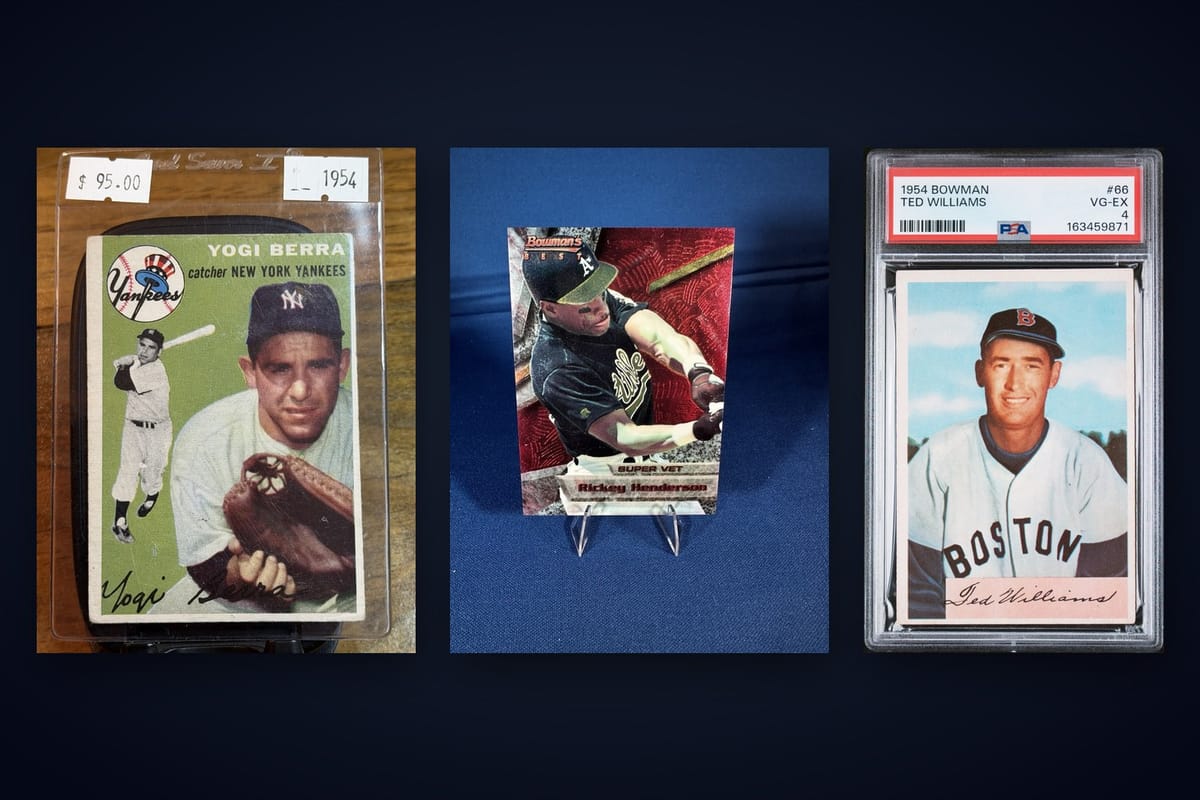
Yogi Berra #50 1954 Topps |
$75.27 | $18,959 | +33.3% |
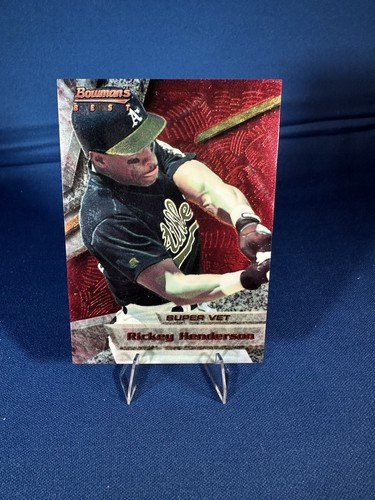 |
Rickey Henderson [Red Refractor] #4 1994 Bowman's Best |
$43.72 | $1,507 | +28.8% |
 |
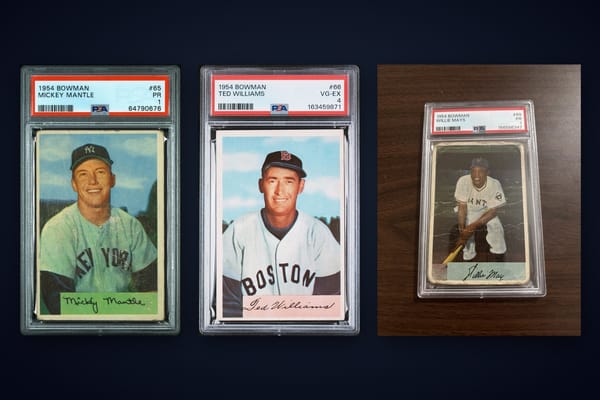
Ted Williams #66 1954 Bowman |
$2,008 | $460,502 | +27.4% |
 |
Willie Mays #305 1951 Bowman |
$3,721 | $685,770 | +13.2% |
 |
Barry Bonds #450 1988 Topps Tiffany |
$14.76 | $1,353 | +12.8% |
 |
Lou Gehrig #92 1933 Goudey |
$3,081 | $1,692,427 | +10% |
 |
Joe DiMaggio #71 1941 Play Ball |
$2,739 | $728,273 | +3% |
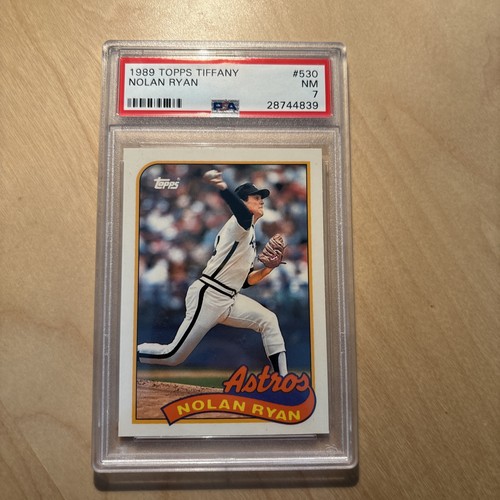 |
Nolan Ryan #530 1989 Topps Tiffany |
$19.95 | $1,024 | +2.9% |
 |
Nolan Ryan #533 1969 Topps |
$385.50 | $113,613 | 0% |
 |
Dwight Gooden #620 1985 Topps Tiffany |
$64.31 | $2,897 | 0% |
 |
Devin Fitz-Gerald [Gold Shimmer] #BCP-158 2025 Bowman Chrome Prospects |
$26.32 | $134.48 | 0% |
 |
Dom Zanni #145 1959 Venezuela Topps |
$50.00 | — | 0% |
Look up any card's current raw and graded value in Midpoint — and get an estimated grade before you pay to submit.
1. Start With the Direction of the Baseball Card Market in November 2026
Before you chase any single card, ask whether the whole market is rising, flat or mixed. A broad index can sit flat while a handful of players surge. The opposite also happens: an index can look strong because a few stars pull the average up.
The movers table in this post is a snapshot of Baseball cards that gained the most over the last 30 days, as of 2026-11-11. Read it as a list of leaders, not as proof that every baseball card is rising.
- Broad rise: many players across eras move up together.
- Narrow rise: a few names carry the gains and the rest are flat.
- Rotation: money leaves one group of cards and moves into another.
Late-year moves often look narrow or rotational, so treat each card on its own evidence.
2. Compare Baseball Against Football, Basketball and Other Card Indexes
Baseball does not move in isolation. Collectors shift money between sports based on which season is active, which stars are in the news and where the hype is. In November, football and basketball are both in season, so they compete for attention and spending.
When you read a baseball gain, put it in context:
- Check a sports-card index or category chart for football, basketball and other collectible cards over the same 30-day window.
- Ask whether baseball is outperforming, matching or lagging them.
- Remember that baseball is in its offseason, so gains now often come from anticipation, not game results.
A baseball card that rises while the broader category is flat is a stronger signal than one rising with everything else.
3. Read the 30-Day Movers Table the Right Way
The table in this post shows each card's recent move, plus raw and PSA 10 values as of 2026-11-11. Here is how to use it without getting fooled.
- Percent vs dollars: a big percentage jump on a cheap card can be a few dollars of change. A small percentage on an expensive card can be real money.
- Raw vs PSA 10: a wide gap means grading pays off if your copy grades well. A narrow gap means grading eats the profit.
- Thin sales: a price built on one or two sales can reverse quickly.
Pick two or three entries from the table that match your collection and check them against recent sold listings. That is faster and more reliable than reading every row.
4. Roki Sasaki: Hype Cards Need Extra Verification
Roki Sasaki is the kind of name that pulls searches and bids because collectors see a rare combination of international attention and a young pitcher with a high ceiling. Demand for his cards tends to follow his news cycle closely.
That can make his market volatile. A strong outing or a headline can lift prices, and a quiet stretch can cool them.
- Check whether his cards show up among the 30-day movers.
- Compare auction bid activity with the price. Rising bids on a stable price can sometimes come before a move, but it is not a reliable signal on its own.
- Be careful with pitcher cards when injury news hits. Arm injuries can hit prices hard.
If you hold his cards, decide ahead of time what news would make you sell, so you are not reacting to a spike.
5. William Contreras: Steady Performers Move Differently
William Contreras shows how an established, productive player may trade compared with a hype-driven one. Cards for consistent performers tend to rise more slowly, but they often hold their value better when attention fades.
When a card like this moves up, look for a reason: strong stats, an award discussion or a team development. Gains with a clear reason are easier to trust than gains with no explanation.
- Look at long-run price history, not just the last 30 days.
- Compare against other catchers and star position players.
- Check whether the gain sits in raw cards, graded cards or both.
6. Ronald Acuña Jr.: Star Power and Injury Sensitivity
Ronald Acuña Jr. is a true star whose card market can react to health as much as to performance. Prices for elite players often climb on good news about returning to the field and can drop on any setback.
Star cards also tend to have deep demand at many price levels, from affordable base cards to high-end graded copies. That depth means a rise can be real, but it also means you should look closely at which versions are moving.
- Separate base cards, parallels and autographs. They do not move together.
- Check the PSA 10 value against the raw value in the table, if he appears.
- Treat injury reports as a standing risk to short-term prices.
7. 2026 Rookie Cards Drawing Searches and eBay Interest
Rookie cards are where much of the November attention goes. Collectors search for them as prospects develop, debut or pile up highlights, and eBay interest tends to follow the search volume.
Rookie prices are often less stable than other groups. They depend on projection more than results, so they can jump on a hot streak and fall when a player stalls.
- Look for the true rookie card: the licensed first-year card is usually what drives value.
- Watch supply: a flood of new listings after a spike often caps the price.
- Check graded population: modern rookies often get graded in large numbers, which can narrow the PSA 10 premium.
If a card appears in the movers table and its search interest is rising, that is a stronger signal than either one alone.
8. Vintage and High-Value Graded Sales Set the Tone
Vintage and high-end graded sales do not always follow the same trends as modern rookies. They are driven by scarcity, condition and big-money buyers, and one headline sale can shift how the whole market feels.
Still, one record sale is not a trend. Look for repeated sales at similar prices in the same grade before you decide a vintage card is rising.
- Compare sales within the same grade and the same set.
- Check whether centering was a factor. Off-center vintage cards often sell for much less than well-centered ones. See how centering impacts card value.
- Be careful with grading company differences. A PSA 9 and a BGS 9 are not the same card in the market's eyes.
9. MLB Labor Uncertainty and the Lockout Question
Labor uncertainty is a real factor for baseball card demand this winter. The current collective bargaining agreement is widely reported to expire in early December 2026, and talk of a possible lockout can change how collectors behave.
It can cut both ways. Some collectors may sell ahead of an uncertain stretch with no games to generate news. Others may buy, expecting a lull and a rebound once play resumes. Neither reaction is guaranteed.
- Expect more volatility, not a set direction.
- Avoid selling out of fear when the movers table shows steady demand.
- Keep cash flexible if you plan to buy during a dip.
This applies to the baseball card market in November 2026 as much as to any other month, so decide your plan before the headlines hit.
10. Verify Every Price Increase Before You Act
A rising price on a chart is not proof. Use a short checklist before you buy, hold or sell.
- Sold listings, not asking prices: filter eBay to sold items and compare several recent sales.
- Same grade, same card: do not mix raw, PSA 9 and PSA 10 results.
- Population reports: low population can support price, while rising population can weaken it. For more, see grading low population cards.
- Sale count: a move supported by many sales beats one supported by two.
- Market index: confirm that the card is outperforming its category.
This also answers whether now is a good time to buy or sell. It depends on the card, the grade and how much of the move is confirmed.
11. Decide Whether to Grade: Raw vs PSA 10
When a card is rising, the next question is whether to grade it. Grading can add value, but only if your copy earns the grade that makes the gap worthwhile.
Centering is a common reason a good-looking card misses a top grade. Measuring it takes a minute and can save you a grading fee on a card that will not grade well.
- Compare the raw and PSA 10 values in the movers table.
- Measure centering front and back before you submit.
- Check corners, edges and surface under good light.
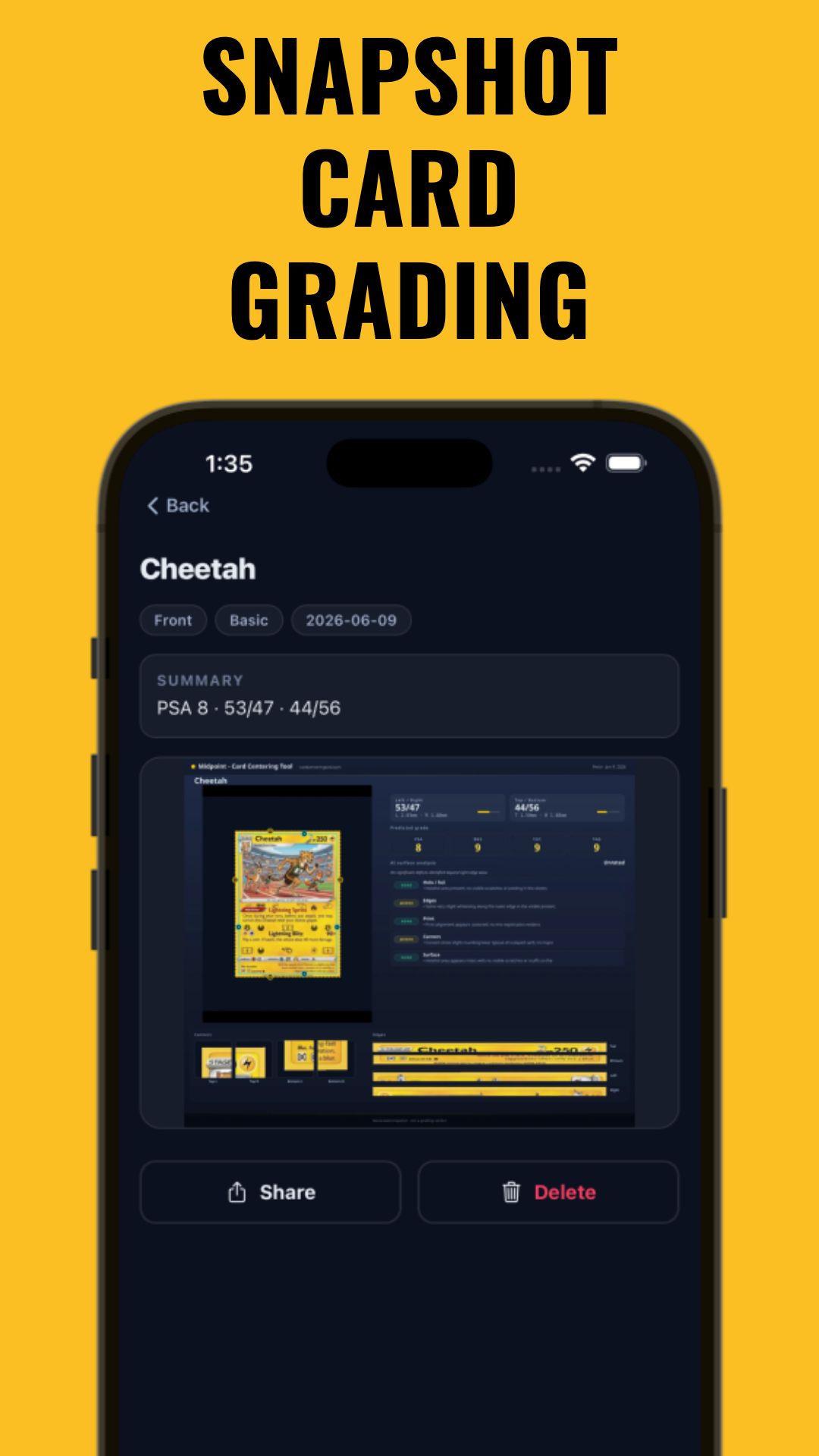
You can do this with Midpoint, which estimates PSA, BGS, CGC and TAG grades from centering, corners, edges and surface before you pay. Its free centering calculator is a quick first check. For a full process, follow this step-by-step pre-grading guide.
Conclusion
Baseball card prices rising in November 2026 is best understood card by card. Start with the 30-day movers table, compare raw and PSA 10 values, and put each gain in context against other categories. Then check the cause, whether that is a rookie surge, a star's health, a postseason story or labor uncertainty.
Verify with sold listings and population reports, and grade only when the PSA 10 premium justifies the fee and your card's centering and condition support it. That keeps you buying and selling on evidence instead of hype.
FAQ
Q: Are baseball card prices going up in November 2026?
A: It depends on the card. Some trending baseball cards have gained over the last 30 days, as shown in the movers table (data as of 2026-11-11), but gains are concentrated in specific players. Compare each card against its category and recent sold listings before assuming a broad rise.
Q: Which baseball cards are increasing in value right now?
A: The movers table in this post lists the Baseball cards with the biggest 30-day gains, including raw and PSA 10 values as of 2026-11-11. Rising stars, rookies and players with strong news cycles tend to lead, but each move should be verified with sold data.
Q: What baseball rookie cards are most popular in November 2026?
A: Collectors are searching for 2026 rookies and prospects, and names such as Roki Sasaki draw heavy attention. Popularity can change quickly, so check search interest, eBay sold listings and graded population before buying.
Q: Why are baseball card prices rising?
A: Common drivers include player performance, prospect development, postseason news, rookie hype and scarcity at high grades. Offseason anticipation and labor uncertainty can also influence demand, in either direction.
Q: Is now a good time to buy or sell baseball cards?
A: There is no single answer. Buy when a card's price is supported by many recent sales and a clear reason, and sell into hype that is not confirmed by sold data. With possible labor uncertainty ahead, plan your entry and exit points in advance.
Q: How can I check the current value of a baseball card?
A: Look at recent sold listings for the same card and grade, check the population report, and compare against a market index. A card lookup tool such as Midpoint can show raw and graded values so you can compare before you decide.
Free to start
Try the Midpoint app
Grade any card from a photo, see its raw and PSA 10 value, and track what your collection is worth — free.
Get it on iPhoneGet it on Android