Centering Standards for Magic: The Gathering — Grader Comparison & Guide
Learn the centering standards for Magic: The Gathering cards across PSA, BGS, CGC, SGC, and TAG. Get grading tips, ratios, and measurement tools.

Estimated reading time: 13 min
Key Takeaways
- Centering is a major factor in Magic: The Gathering card grading and value.
- Each grading company (PSA, BGS, CGC, SGC, TAG) has unique centering standards and tolerances.
- Front and back centering ratios (e.g., 60/40, 70/30) determine maximum grade eligibility.
- Precise measurement tools like Midpoint can help estimate centering before submitting for grading.
- Understanding centering standards can boost confidence, improve selling, and help avoid grading mistakes.
Table of Contents
- Section 1: Centering Basics for Magic: The Gathering
- Section 2: Why Both Front and Back Centering Matter
- Section 3: Grading Company Centering Standards
- Section 4: Common Centering Ratios and What They Mean
- Section 5: Accurate Centering Measurement Methods
- Section 6: Centering, Condition, and Card Value on Marketplaces
- Section 7: Era, Border, and Promo Variations in MTG Centering
- Section 8: Evaluating Centering Before Grading Submission
- Conclusion
- FAQ
Section 1: Centering Basics for Magic: The Gathering
What is Card Centering?
Centering describes how evenly the printed area of a Magic: The Gathering card is positioned within its borders. Ideal centering means the artwork and border width are symmetrical on all sides, both front and back. Collectors and grading companies scrutinize centering because it reflects print quality and aesthetics.
How is Centering Judged?
Grading companies measure the distance from the artwork to each card edge, comparing the thickness of the top, bottom, left, and right borders. If the card's printed area is shifted noticeably in any direction ("off-center"), the centering is considered subpar. Severe miscuts, where borders are missing or artwork is clipped, are rare but heavily penalized.
- Symmetrical borders = high centering score
- Visible shifts = lower centering score
Why Does Centering Matter?
Centering is one of the four primary grading criteria (the others are corners, edges, and surface). Even if a card is flawless otherwise, poor centering can prevent a top grade like PSA 10 or BGS 9.5. On the secondary market, buyers may pay premiums for well-centered Magic cards, especially in older sets where misalignments are more common.
For a deeper look at centering's impact on value, check out How Centering Impacts Card Value: A Detailed Guide.
Section 2: Why Both Front and Back Centering Matter
Grader Requirements: Front vs. Back
Every major grading company considers both the front and back centering of Magic: The Gathering cards. However, the front centering typically carries more weight in the final grade. Back centering has slightly more lenient standards, but an extremely off-center back can still lower your card’s grade.
- Front: More visually important and scrutinized
- Back: Still matters, but thresholds are less strict
Examples of Centering Impact
If a card is perfectly centered on the front but off by 80/20 on the back, most graders will cap the maximum possible grade at something below Gem Mint (e.g., PSA 9 or lower). If both sides are within the tightest ratio (such as 55/45), your card is eligible for a top grade.
Why Back Centering Still Affects Value
Even though collectors focus on the card front, back centering matters for authenticity and overall presentation. Graders like PSA, BGS, CGC, and TAG document both sides’ centering in their reports. For resale, buyers may inspect back centering in listing photos, especially for high-end Magic cards.
Section 3: Grading Company Centering Standards
PSA Centering Standards
PSA uses centering tolerances for each grade. For Magic: The Gathering cards, their published standards include:
- PSA 10 (Gem Mint): 55/45 or better on the front, 75/25 or better on the back
- PSA 9 (Mint): 60/40 or better front, 90/10 or better back
- PSA 8 (NM-MT): 65/35 or better front, 90/10 or better back
Source: PSA’s published grading standards (always confirm for changes).
BGS Centering Requirements
BGS (Beckett Grading Services) is known for subgrades, including a specific centering subscore. Their published requirements include:
- BGS 10 (Pristine): 50/50 (perfect) on front, 60/40 or better on back
- BGS 9.5 (Gem Mint): 55/45 or better front, 65/35 or better back
- BGS 9 (Mint): 60/40 or better front, 70/30 or better back
BGS is generally stricter for top grades, especially on the front.
CGC and SGC Centering Standards
CGC (Certified Guaranty Company) and SGC (Sportscard Guaranty) follow similar ratio logic, but their exact thresholds can vary and sometimes change. For most modern Magic cards:
- CGC 10: 55/45 or better front, 75/25 or better back
- SGC 10: 55/45 or better front, 80/20 or better back
Always consult the latest published standards on each grader’s site.
TAG Grading Centering
TAG Grading uses AI-driven analysis for centering, aiming for objectivity. Their thresholds are similar to traditional graders but may be more consistent. Their centering subgrades are published and transparent.
Which grader is most lenient on centering? SGC and CGC’s thresholds tend to be slightly more accommodating for back centering, but PSA and BGS are stricter for top grades. Confirm each grader’s current policies before submitting.
For detailed comparisons, see Card Centering Tool: Accurate Card Grading Estimates.
Section 4: Common Centering Ratios and What They Mean
How to Read Centering Ratios
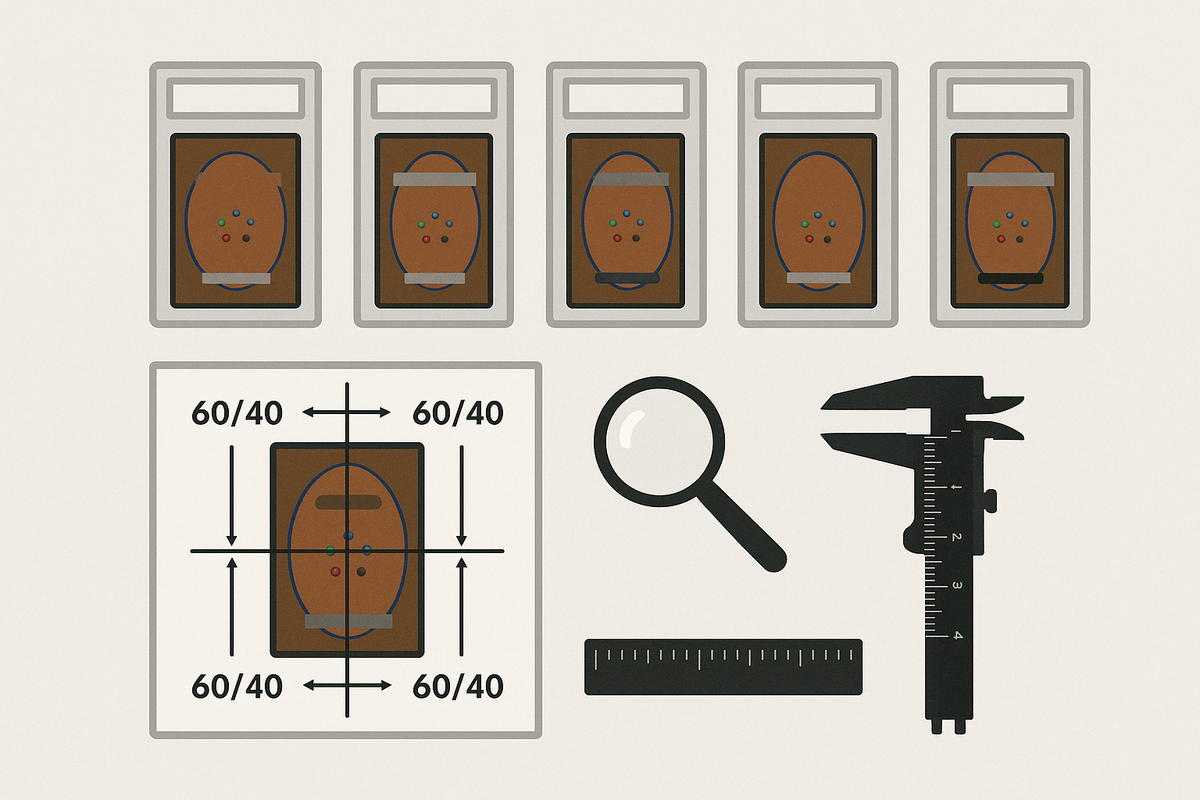
Centering ratios describe the border thicknesses as percentages. For example, "60/40" means the border on one side is 60% the width of the total, and the other side is 40%. This can refer to left/right or top/bottom.
- 50/50: Perfect centering
- 55/45: Slightly off, but visually excellent
- 60/40: Noticeably off, but still within tolerance for most Gem Mint grades
- 65/35: Acceptable for NM-MT or lower grades
- 70/30: Off-center, may only qualify for lower Mint or Near Mint grades
- 80/20 or worse: Heavily off-center; may be considered a miscut
Visualizing Acceptable vs. Unacceptable Centering
Most graders allow a small amount of shift. For example, a PSA 10 Magic card can be off by as much as 55/45 (front), but not more. Anything outside that range, like 70/30, could drop the grade to PSA 8 or lower.
Using Tools to Check Ratios
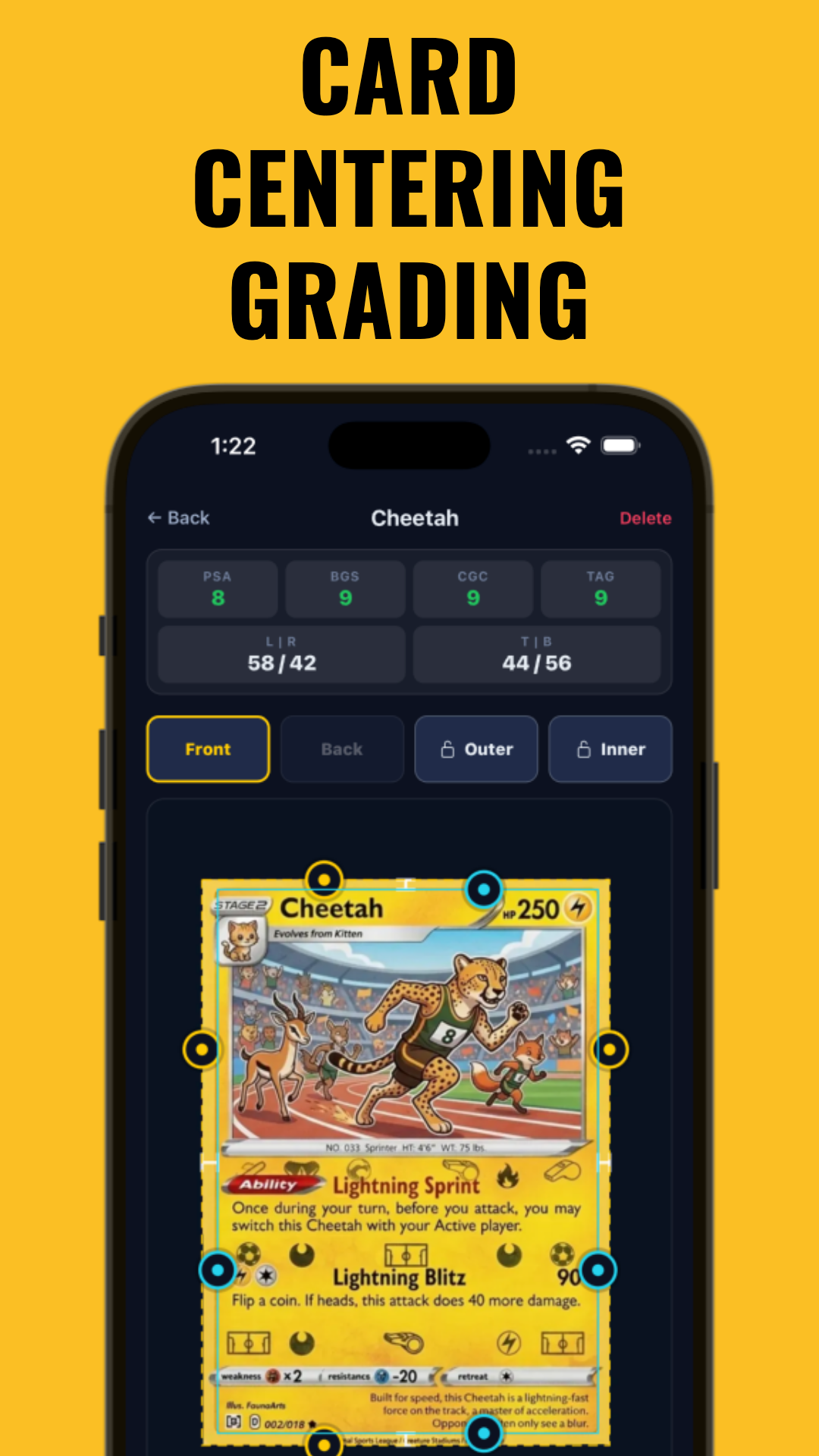
Apps like Midpoint can provide centering ratios (e.g., 58/42 left-right, 56/44 top-bottom), making it easier to see where your card falls in relation to grading standards.
Section 5: Accurate Centering Measurement Methods
Why Manual Measurement Is Challenging
Measuring centering by eye is unreliable. Even experienced collectors can misjudge border widths by a few percentage points. Precision matters—one millimeter can be the difference between a PSA 10 and PSA 9.
Measurement Tools and Apps
There are several ways to measure Magic card centering:
- Physical rulers or calipers: Accurate, but slow and error-prone
- Scanners with software: Precise, but require setup
- Photo analysis: Take a straight-on photo, then use software or apps to calculate border ratios
- Specialized centering tools/apps: Tools like Midpoint (screenshot below) automate the process, offering fast, millimeter-precise results and automated grading estimates
Step-by-Step Measurement Guide
For a full walkthrough, see How to Measure Card Centering: Step-by-Step Precision Guide. In short:
- Capture a well-lit, straight-on photo or scan
- Use a digital tool to mark the edges of the printed area and borders
- Let the app calculate the centering ratio (e.g., 59/41)
- Compare results to grading company standards before submitting
Section 6: Centering, Condition, and Card Value on Marketplaces
How Grading Standards Map to Selling Platforms
Marketplaces like TCGplayer, eBay, and Cardmarket don’t grade cards themselves, but buyers often use grading company terminology (e.g., "NM-MT", "Gem Mint") and expect similar centering tolerances. Some sellers list exact centering ratios in their descriptions or include close-up photos to show border symmetry.
Does Centering Affect Condition Ratings?
On TCGplayer, a card’s "condition" typically references corners, scratches, and wear. However, severe off-centering or miscuts (e.g., borders missing, text cut off) may require disclosing as "Moderately Played" or "Heavily Played" due to visual impact—even if the card is otherwise pack-fresh.
- NM/Mint: Minor centering flaws usually accepted
- SP/LP: Off-centering not usually a downgrade unless extreme
- Miscut: Must be disclosed; can be sought after by some collectors
Listing Photos and Disclosure
For high-value Magic cards, include clear, straight-on photos of both sides. Mention centering in the description, especially if it’s exceptional (50/50) or problematic (e.g., 75/25). Transparency protects sellers from disputes and builds buyer confidence.
For more on maximizing value, see How Centering Impacts Card Value: A Detailed Guide.
Section 7: Era, Border, and Promo Variations in MTG Centering
Era-Specific Centering Challenges
Early Magic: The Gathering print runs (Alpha, Beta, Unlimited) are known for inconsistent centering. In some sets, cards with 70/30 or worse centering are more common. Modern printings tend to be more consistent, often within 60/40 or better.
- Alpha/Beta: Wide border and cut variations; graders may be slightly more forgiving
- Revised through Modern: Stricter centering, less tolerance for major shifts
Black Border vs. White Border Cards
Black border cards (including all Magic foils and many promos) show centering flaws more dramatically than white border cards. Graders do not apply different standards, but collectors may value better-centered black border cards more highly due to eye appeal.
Promo and Specialty Print Runs
Some promos and special printings (e.g., Judge Promos, FNM promos) may have unique centering quirks. Always check the population data for your specific card and compare against grading standards. Severe miscuts (where part of another card appears) can be collectible as errors, but are not eligible for high grades.
Section 8: Evaluating Centering Before Grading Submission
Why Pre-Check Centering?
Submitting cards for professional grading can be expensive, with fees often $30+ per card. Knowing your card’s centering before sending it in helps you:
- Avoid grading disappointment (e.g., expecting a PSA 10 but getting an 8 due to centering)
- Decide whether to submit at all, especially for high-value or vintage Magic cards
- Choose the grader whose centering standards best fit your card
How to Boost Evaluation Confidence
Use a precise tool (e.g., Midpoint) to measure both front and back centering. Cross-reference your results with published standards for PSA, BGS, CGC, and TAG. If your card is close to the cutoff (e.g., 56/44 front for PSA 10), consider the risk before submitting. For step-by-step help, see How to Pre-Grade Your Card: A Step-by-Step Guide.
Estimating Your Card’s Grade
Many apps, including Midpoint, provide grade estimates based on your measured centering. This can help you decide if your Magic card is worth the cost of grading, or if you should submit to a grader with slightly more lenient centering requirements.
Conclusion
Understanding centering standards for Magic: The Gathering cards is important for collectors, sellers, and anyone considering professional grading. Each major grading company—PSA, BGS, CGC, SGC, and TAG—sets unique centering tolerances for each grade, especially for Gem Mint and Mint levels. Centering ratios like 55/45 or 60/40 are common benchmarks, and both front and back centering matter for your final grade.
Using a precise measurement tool such as Midpoint helps you evaluate your cards before submitting them for grading, potentially saving money and maximizing value. Always check the latest published grading standards and consider your specific card’s era, border color, and print run quirks. For more on grading and card prep, browse our related guides or visit the Midpoint FAQ.
FAQ
Q: What is good centering on a Magic: The Gathering card?
A: Good centering is typically 55/45 or better on the front and 75/25 or better on the back, which is eligible for a PSA 10 or equivalent Gem Mint grades. Anything within 60/40 is considered very strong.
Q: What centering is needed for a PSA 10 or BGS 9.5 on MTG cards?
A: For a PSA 10: 55/45 or better on the front, 75/25 on the back. For BGS 9.5: 55/45 or better front, 65/35 back. Stricter for BGS 10 (50/50 front).
Q: Does centering affect MTG card condition on TCGplayer?
A: Yes, but mainly for severe miscuts or extremely off-center cards. Minor centering flaws are generally accepted as Near Mint; major miscuts should be disclosed.
Q: How do you measure centering on Magic cards accurately?
A: Use a straight-on photo and a digital tool like Midpoint to mark the card borders and calculate centering ratios. Manual rulers or calipers can be used for rough estimates but are less precise.
Q: What does 60/40 centering mean on a Magic: The Gathering card?
A: 60/40 means one side’s border is 60% of the total width and the opposite is 40%. This is a common cutoff for Mint grades with most grading companies.
Q: Is a slightly off-center MTG card still worth grading?
A: Yes, if the centering is within 60/40 (front) and 90/10 (back), your card can still receive high grades and may be worth grading, especially if otherwise flawless.
Free to start
Try the Midpoint app
Grade any card from a photo, see its raw and PSA 10 value, and track what your collection is worth — free.
Get it on iPhoneGet it on Android