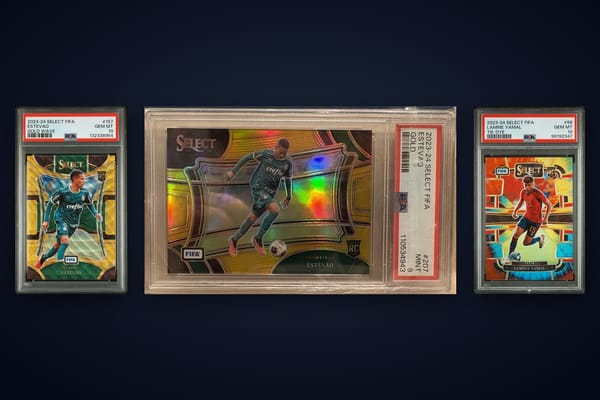
Current Value of Trading Cards: How to Accurately Assess Yours
Learn how to determine the current value of trading cards using AI grading, centering analysis, and portfolio tracking with Midpoint.


Estimated reading time: 18 min
Key Takeaways
- Understanding current value is important for buying, selling, and insuring trading cards, helping collectors make informed financial decisions and manage their collections.
- AI-powered grading tools like Midpoint can provide instant and objective estimates for PSA, BGS, CGC, and TAG grades, potentially increasing accuracy and efficiency.
- Centering, edges, corners, and surface conditions influence card value, with imperfections potentially reducing worth.
- Tracking raw vs graded values helps collectors make informed decisions, optimize profitability, and evaluate when professional grading may be worthwhile.
- Regular portfolio tracking can reveal value trends over time, help protect investments, and assist in strategic buying, selling, and insurance planning.
Table of Contents
- Section 1: Understanding Current Value in Trading Cards
- Section 2: The Role of Grading in Determining Card Value
- Section 3: How Centering Affects Current Value
- Section 4: Using AI to Estimate Card Grades and Value
- Section 5: Raw vs Graded Values: What Collectors Need to Know
- Section 6: Portfolio Tracking to Monitor Your Collection’s Worth
- Conclusion
- FAQ
Section 1: Understanding Current Value in Trading Cards
What Does "Current Value" Mean?
"Current value" generally refers to the approximate market price a trading card could fetch if sold today, reflecting its worth in the active collector and investor marketplace. This value can fluctuate based on factors including demand, rarity, condition, and grading. Unlike the face value or original purchase price, current value aims to capture the card’s present-day monetary potential.
For example, a 1999 Pokémon Base Set Charizard card purchased for $20 in the early 2000s might have a face value or sentimental value, but its current market value, influenced by demand and condition, could range widely depending on grading and condition.
Why Current Value Matters
Knowing the current value can be helpful for collectors and traders to:
- Set appropriate buy and sell prices: Sellers can avoid underpricing their cards, while buyers can aim to pay fair market rates.
- Make decisions about professional grading: Submitting a card for grading involves fees and time; understanding potential value gain helps evaluate if the investment may be worthwhile.
- Accurately insure collections: Insurance requires realistic valuations to protect against losses from theft, damage, or disasters.
- Track appreciation or depreciation: Monitoring how values evolve can inform buying, selling, and investment strategies.
- Negotiate trades: Accurate valuations can empower balanced trades and exchanges within the community.
Factors Influencing Current Value
Several elements can impact current value, including:
- Card Condition: Condition is a primary driver; cards graded mint or gem mint condition often command premium prices compared to those with visible wear.
- Grading Company and Grade: Different grading companies (PSA, BGS, CGC, TAG) have varying grading criteria and reputations, influencing market trust and price multipliers.
- Rarity and Edition: Limited print runs, first editions, short prints, and cards from popular or iconic sets can increase scarcity and desirability.
- Market Trends: Popularity surges in categories like Pokémon, Magic: The Gathering, Yu-Gi-Oh!, or sports cards can cause price volatility, with hype events or player performance impacting value.
- Historical Significance: Cards associated with major events, players, or milestones may appreciate faster.
- Authenticity and Provenance: Verified authentic cards with well-documented history often command higher trust and prices.
For example, a PSA 10 graded 2003 LeBron James rookie card is generally worth more than an ungraded or poorly centered equivalent due to its condition and grading certification.
Understanding these factors is foundational to assessing current value and successful collecting or investing.
Section 2: The Role of Grading in Determining Card Value
Professional Grading and Market Confidence
Professional grading companies such as PSA (Professional Sports Authenticator), BGS (Beckett Grading Services), CGC (Certified Guaranty Company), and TAG (Trading Authentication Group) provide inspections and assign numeric grades to cards based on condition criteria. These grades typically range from 1 (Poor) to 10 (Gem Mint), with subgrades for centering, edges, corners, and surface quality in some services like BGS.
Grading can increase buyer confidence by offering verification of a card's condition and authenticity. This standardization can reduce buyer risk, often resulting in higher demand and prices for graded cards. Grading also protects cards by encapsulating them in tamper-evident holders.
How Grades Impact Price
Grades often influence a card’s market value, sometimes significantly. Consider the following examples:
- A PSA 10 (Gem Mint) Michael Jordan 1986 Fleer rookie card may sell for substantially more than a PSA 7 (Near Mint) version, sometimes by an order of magnitude.
- Even subtle centering differences — for example, 50/50 versus 60/40 — can lower a grade by one point, which could affect value considerably.
- For modern cards, a BGS 9.5 with pristine centering and sharp corners often commands a premium over a 9.0 grade.
These price variations highlight why collectors carefully assess grading potential before submission.
Choosing the Right Grading Service
Each grading company has unique grading scales, reputation, and market acceptance. For instance:
- PSA is widely recognized, especially for vintage sports and Pokémon cards, with a high premium on PSA 10 grades.
- BGS provides subgrades for centering, edges, corners, and surface, giving detailed insights and is popular among modern sports card collectors.
- CGC has gained popularity for non-sports cards, including Magic: The Gathering and Pokémon, offering competitive grading and market trust.
- TAG focuses on sports cards with a growing reputation for thorough grading.
Understanding these nuances helps collectors select the grading service that may maximize potential card value and suits their collecting niche. For example, a Magic: The Gathering collector might prefer CGC due to their specialized expertise.
For an in-depth comparison, see our Grading Scale Differences by Company article.
Section 3: How Centering Affects Current Value
What is Centering?
Centering describes how well the image or artwork on a card is aligned within its borders. It is typically expressed as a ratio or percentage — for example, 50/50 indicates perfectly centered. Slight deviations, even millimeters off-center, can reduce a card's grade and subsequently its market price.
Centering is especially important for vintage and high-value cards, where collectors prize symmetry and presentation. For instance, a 1952 Topps Mickey Mantle card with perfect centering can fetch more than one with noticeable off-centering.
Centering's Influence on Grading
Grading companies emphasize centering in their criteria:
- PSA often deducts points for centering outside a roughly 55/45 ratio on the front of a card for high grades.
- BGS provides a subgrade specifically for centering, enabling collectors to understand precise strengths and weaknesses.
- CGC and TAG also factor centering significantly, though grading thresholds may differ.
Cards with excellent corners and surfaces but poor centering may be capped at lower grades, limiting their value. This emphasizes why pre-submission centering assessment can be useful.
Measuring Centering Accurately
Traditional centering evaluation relies on visual inspection, which is subjective and prone to human error — even expert graders can have slight inconsistencies. Midpoint’s card centering tool uses AI and image recognition to measure centering down to the millimeter, providing an objective and repeatable score.
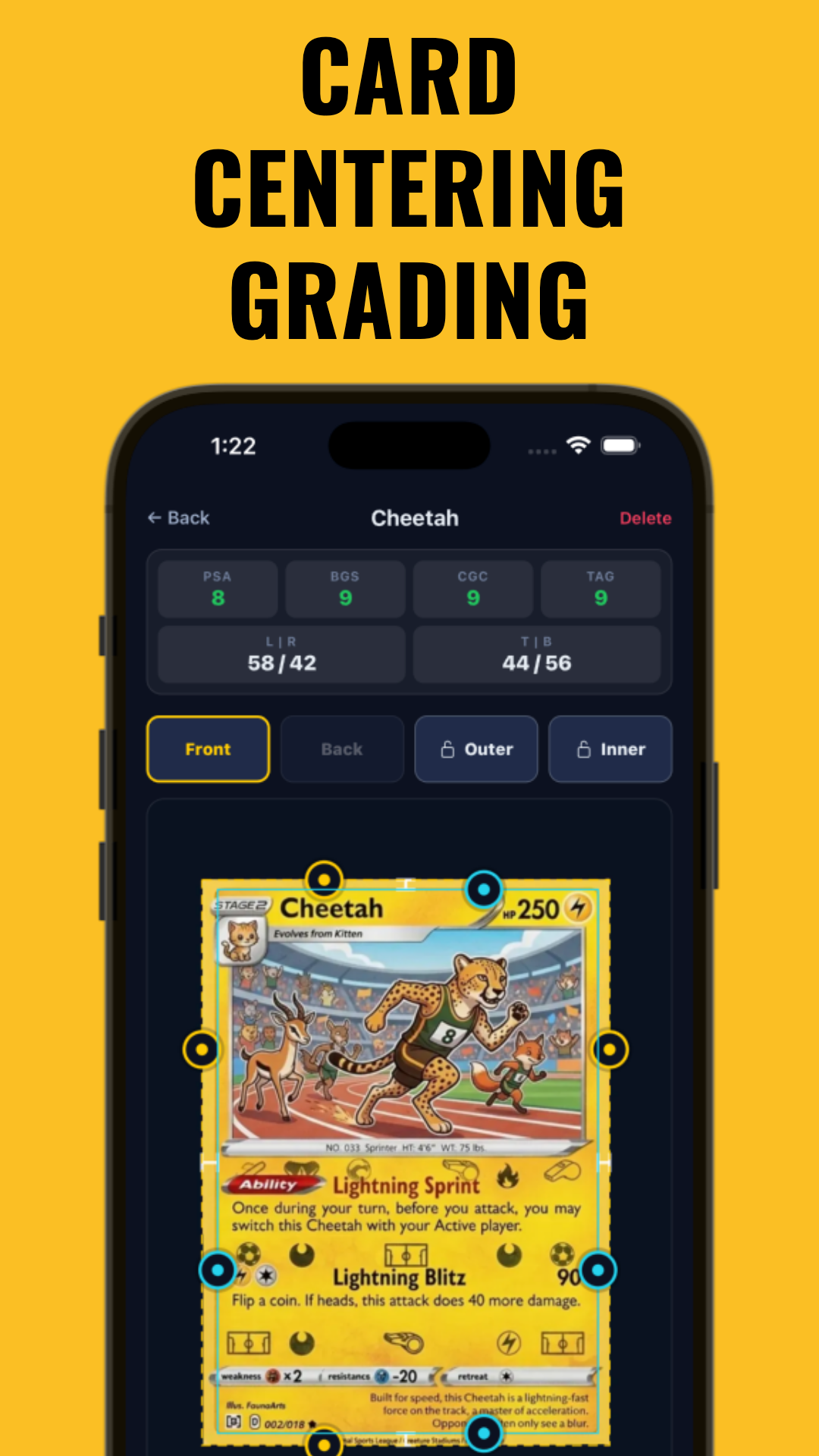
This quantification enables collectors and sellers to:
- Predict likely grade outcomes: Knowing centering scores helps estimate final grades with greater accuracy.
- Avoid unnecessary grading fees: Cards unlikely to achieve high grades can be sold raw instead of incurring submission costs.
- Make informed sales and insurance decisions: Accurate centering data supports realistic valuation for transactions and coverage.
- Compare cards objectively: When trading or bidding, centering data offers a clear advantage.
For additional insights, explore our detailed How Centering Impacts Card Value guide, which covers grading thresholds and market examples.
Section 4: Using AI to Estimate Card Grades and Value
AI-Powered Digital Grading Explained
Artificial intelligence grading employs machine learning algorithms and image recognition to analyze card features — such as centering, corners, edges, and surface quality — matching them to grading standards of PSA, BGS, CGC, and TAG. This technology is trained on many graded card images, enabling it to detect defects and estimate grades with useful accuracy.
For example, AI can detect tiny corner frays or subtle surface scratches affecting grade points.
Benefits Over Manual Assessment
- Speed: AI delivers instant grade estimates in seconds, eliminating the need for lengthy manual inspections.
- Consistency and Objectivity: AI grading avoids human biases and fatigue, providing repeatable and impartial results under standardized criteria.
- Cost-Effectiveness: By identifying cards unlikely to reach premium grades, AI helps collectors avoid expensive grading submissions that may not appreciably increase value.
- Accessibility: Collectors without grading expertise can instantly assess cards, democratizing the market.
Midpoint’s AI Grading Features
Midpoint integrates several AI capabilities:
- Precise Centering Measurements: Millimeter-accurate centering scores inform grade predictions.
- Edge and Corner Condition Analysis: Detects nicks, frays, and rounding that impact grading.
- Surface Defect Detection: Identifies scratches, print defects, stains, and other imperfections.
- Instant Multi-Service Grade Estimates: Provides predicted grades across major grading companies PSA, BGS, CGC, and TAG, enabling comparisons and informed submission decisions.
This approach creates a comprehensive card profile, empowering collectors to assess current value before committing to professional grading or sale.
To understand how AI is transforming card grading and analysis, check out our in-depth AI-Focused Comparison.
Section 5: Raw vs Graded Values: What Collectors Need to Know
Defining Raw and Graded Cards
Raw cards are ungraded trading cards sold "as-is," without professional verification. Their value depends on condition, rarity, and market demand but often carries uncertainty due to the lack of standardized grading.
Graded cards have undergone professional evaluation and encapsulation, offering verified condition and authenticity. Graded cards often command higher prices, greater liquidity, and increased buyer trust.
Comparing Values
- Raw card prices can fluctuate widely and often sell at a discount compared to graded equivalents, especially in high-end markets where grading certifies condition.
- High-grade raw cards (e.g., those appearing near mint or gem mint) may be worth submitting for grading since the premium on a PSA 9 or 10 can be several times the raw card price.
- Lower-grade raw cards with visible wear or centering issues might be better sold as-is to avoid the cost and time of grading.
- Some raw cards, especially rare vintage or misprints, can command strong prices without grading due to collector interest.
Using Midpoint to Compare Values
Midpoint’s database covers over 250,000 cards across popular categories including Pokémon, Magic: The Gathering, Yu-Gi-Oh!, and sports cards. It provides real-time lookup of raw and graded values side-by-side, empowering collectors to:
- Evaluate potential profit: Calculate whether grading submission fees are justified by the expected increase in card value.
- Make informed buy and sell decisions: Use up-to-date market data to time purchases and sales optimally.
- Track value trends: Monitor shifts in raw and graded card prices to identify emerging opportunities.
- Analyze market dynamics: Understand how grading impacts value differently across card types, eras, and conditions.
For further reading on how grading affects insurance valuations and collector strategy, see our comprehensive Card Grade Impact on Insurance Value post.
Section 6: Portfolio Tracking to Monitor Your Collection’s Worth
Why Track Your Collection?
Regular portfolio tracking offers collectors and investors an overview of their collection’s current value. This ongoing insight enables:
- Understanding appreciation or depreciation: Identify which cards or sets are increasing in value and which may be losing market appeal.
- Identifying high-value assets: Pinpoint key cards for insurance coverage, targeted sales, or trade negotiations.
- Staying informed on market shifts: React proactively to trends such as new game releases, player trades, or collector demand surges.
- Portfolio diversification: Assess collection balance across card categories, grading statuses, and market segments.
- Tax and estate planning: Maintain accurate records of collection value for financial and legal purposes.
Features of Effective Portfolio Tracking Apps
- Integration with card lookup databases: Connection to real-time market data for automatic value updates.
- Automatic value updating: Reflects the latest sales and market trends without manual input.
- Visual charts and dashboards: Displays value changes over days, months, or years through intuitive graphs.
- Organizational tools: Allows sorting by sets, grading status, card rarity, and other attributes.
- Bulk upload and scanning: Facilitates quick portfolio entry via CSV uploads or image recognition.
- Alerts and notifications: Optional alerts for significant value changes or market news.
Midpoint’s Portfolio Tracking Benefits
Midpoint offers a portfolio tracking platform supporting major card categories such as Pokémon, One Piece, Magic: The Gathering, Yu-Gi-Oh!, Lorcana, and various sports cards. Key features include:
- Real-time current value updates: Tracks both raw and graded card values with data refreshed from multiple marketplaces.
- Easy bulk upload and organization: Import large collections via CSV or API, categorize by grading status, set, or condition.
- Insightful analytics: Provides metrics like total portfolio value, average card value, top gainers and losers, and grading distribution.
- Historical value tracking: View portfolio appreciation or depreciation over customizable timeframes.
- User-friendly interface: Designed for collectors of all experience levels with intuitive navigation and helpful tooltips.
By leveraging these features, collectors can manage their collections more strategically, identify optimal times to sell or trade, and support accurate insurance valuations.
Start managing your collection’s value with confidence by exploring Midpoint today.
Conclusion
Accurately determining the current value of trading cards is important for collectors, investors, and traders aiming to maximize returns and protect their collections. Understanding the multifaceted impacts of grading, centering precision, and market value trends supports smarter decision-making and financial optimization.
AI-powered tools like Midpoint are changing the valuation process by delivering instant, precise grading estimates and portfolio tracking across a wide range of card types. These technologies can democratize access to expert-level insights, reduce costly grading errors, and empower users to make data-driven decisions.
Whether evaluating a single card or managing a large collection, utilizing advanced tools like Midpoint before submitting cards for grading or sale can help collectors achieve better outcomes. As the trading card market continues to evolve, leveraging AI and portfolio tracking is increasingly valuable for success.
FAQ
Q: What is the best way to find the current value of my trading cards?
A: Combining professional grading estimates with real-time market data is recommended. Apps like Midpoint provide AI-based grading and side-by-side comparisons of raw vs graded values for many cards, helping ensure accurate and current valuation.
Q: How does card centering affect value?
A: Centering influences grading scores. Cards with perfect or near-perfect centering often achieve higher grades and command higher prices. Midpoint’s centering tool measures this precisely, helping predict grade outcomes and market value.
Q: Should I submit raw cards for professional grading?
A: Submission decisions depend on the card’s visible condition and potential grade. Using AI grading estimates can help assess whether the anticipated increase in value justifies grading fees and wait times.
Q: Can I track my card collection’s value over time?
A: Yes, portfolio tracking tools like Midpoint enable you to monitor value changes, organize your collection by various attributes, and receive alerts on market trends, helping you manage your investments effectively.
Q: Does grading increase insurance value?
A: Professionally graded cards have verified condition and authenticity, which can support precise insurance valuations. For detailed guidance, see our Card Grade Impact on Insurance Value guide.
Q: How accurate are AI grading tools?
A: Modern AI grading tools like Midpoint provide consistent and objective estimates, especially for centering and surface condition. While they offer valuable insights, professional grading remains the final authoritative standard.
Free to start
Try the Midpoint app
Grade any card from a photo, see its raw and PSA 10 value, and track what your collection is worth — free.
Get it on iPhoneGet it on Android