Difference Between Subgrades and Overall Grade: Card Grading Comparison
Learn the difference between subgrades and overall grade in card grading. Compare how BGS, CGC, PSA use centering, corners, edges, and surface for top grades.

Estimated reading time: 13 min
Key Takeaways
- Subgrades detail centering, corners, edges, and surface – the building blocks of a card’s condition.
- The overall grade is not a simple average; it’s typically limited by the lowest subgrade.
- Rules for calculating the overall grade differ by grading company (PSA, BGS, CGC).
- Knowing the difference helps you maximize value and avoid surprises when grading cards.
- Bottom line: Subgrades provide transparency, but the overall grade is what drives value. Centering is often a key factor for top grades.
Curious about the difference between subgrades and overall grade in card grading? You’re not alone. Collectors often wonder how centering, corners, edges, and surface (the four subgrades) translate into that single, all-important slab grade. Here’s the quick answer: Subgrades give detailed breakdowns of a card’s flaws and strengths, while the overall grade summarizes its condition—usually capped by the lowest subgrade. This guide explains how it works across PSA, BGS, and CGC, including the nuances between Gem Mint and Pristine, and why centering matters so much.

Quick Comparison
| Feature | Subgrades | Overall Grade |
|---|---|---|
| Definition | Individual 1-10 scores for Centering, Corners, Edges, Surface | Single 1-10 (or 1-100) grade summarizing the card's total condition |
| Shown on Slab? | BGS/CGC: Optional PSA: Not shown |
Always shown |
| Calculation | Each area graded separately | Weighted formula (not simple average), often capped by lowest subgrade |
| Transparency | Explains why a grade was given | Does not show breakdown (unless subgrades are present) |
| Impact on Value | High subgrades can boost value, especially for rare cards | Primary driver of card’s resale price |
| Grading Companies | BGS, CGC (optional), TAG Not PSA |
All (PSA, BGS, CGC, SGC, etc.) |
| Application Beyond Cards | Used for some video games, comics, sealed items | Universal for all graded collectibles |
| Role in Top Grades | All must be perfect for Pristine/Black Label | Cannot exceed weakest subgrade (with rare exceptions) |
What Are Subgrades vs Overall Grade?
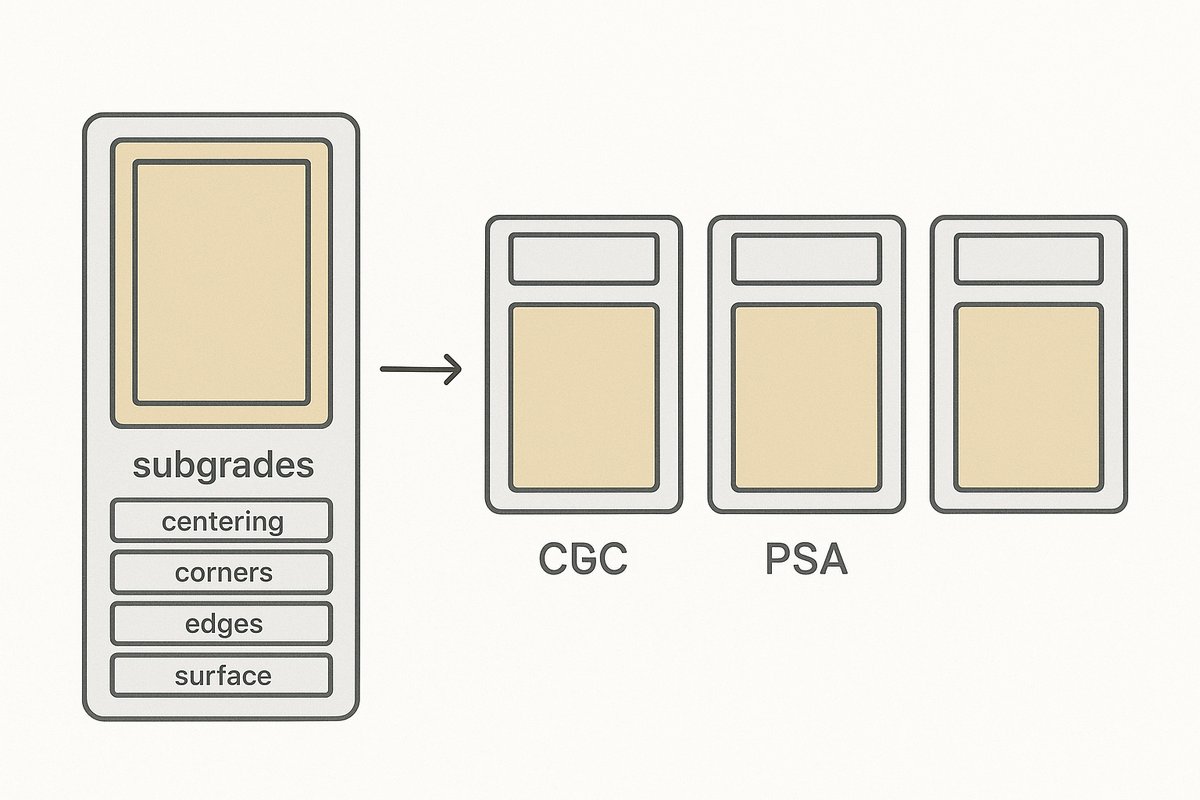
Subgrades are the scores given to the four key condition factors:
- Centering – How well the card’s front/back image is centered (measurable with tools like Midpoint)
- Corners – Sharpness and wear on corners
- Edges – Quality and flaws on the card’s outer edges
- Surface – Print defects, scratches, and stains
Each is scored (usually 1-10). The overall grade is a single number (e.g., 9, 9.5, 10) that represents the card’s total condition. This is what most buyers see first and what matters for resale value.
Not all grading companies show subgrades: BGS and CGC offer them as an option, while PSA and SGC do not. Subgrades are especially valuable for high-end cards or when selling to discerning collectors who want to understand why a card received its grade.
How Is the Overall Grade Calculated From Subgrades?
This is the most misunderstood part of grading! The overall grade is not a simple average of the subgrades. Each company has its own formula, but almost all use a weighted approach that takes into account the card's weakest areas:
- BGS (Beckett Grading Services): The overall grade can never be more than 0.5 higher than the lowest subgrade. For a BGS 10 Pristine, all subgrades must be at least 10. For BGS 9.5 Gem Mint, only one subgrade can be a 9—the rest must be 9.5+.
- CGC: Similar to BGS, but allows a slightly more lenient formula. For CGC Pristine 10, all subgrades must be 10. For Gem Mint 10, one subgrade can be 9.5.
- PSA: No subgrades, just an overall grade based on grader judgment. PSA 10s allow small flaws, making them generally easier to achieve than BGS/CGC Pristine.
For detailed company breakdowns, see Grading Scale Differences by Company.
Example: A card with subgrades: Centering 10, Corners 9.5, Edges 10, Surface 9.5
- BGS: Overall grade is 9.5 (Gem Mint), because the lowest subgrade is 9.5.
- If any subgrade drops to 9, overall grade can’t go above 9.5 (and only if other subgrades are perfect).
Why Do Subgrades Matter?
Subgrades give buyers and sellers confidence, especially for high-value cards, because they:
- Reveal which flaw(s) held the card back from a higher grade
- Explain differences between Gem Mint vs Pristine, or between PSA 10 vs BGS 10
- Can boost value if most subgrades are higher than the overall grade (e.g., a BGS 9.5 with three 10s may sell for a premium)
- Allow for targeted pre-grading with tools like Midpoint before submitting
For full transparency, many collectors prefer BGS or CGC with subgrades, especially in modern trading cards and sports cards.
How Do Different Graders Use Subgrades?
Let’s compare the three industry leaders:
- PSA: No subgrades. The overall grade is a single number, based on a holistic look at the card. PSA 10s are "Gem Mint" but allow minor flaws.
- BGS: Offers subgrades (extra cost). Overall grade calculated as above. Top grade is BGS 10 Pristine, with the rarest being the Black Label (all 10 subgrades).
- CGC: Optional subgrades. Similar rules to BGS. Pristine 10 and Gem Mint 10 are separate tiers.
This means a PSA 10 is not always as flawless as a BGS 10 Pristine or CGC Pristine 10. The impact of centering on card value can be significant, as off-center cards rarely score top subgrades.
For video games, comics, and sealed items, subgrades work similarly—often with slight tweaks to reflect the item type.
Special Cases: Pristine vs Gem Mint, Black Label vs Gold, and More
Top grades are where subgrades make the biggest difference:
- Gem Mint vs Pristine (BGS, CGC): Pristine 10 requires all subgrades to be 10. Gem Mint 10 allows one subgrade to be 9.5.
- BGS Black Label: All four subgrades are perfect 10s—these are considered extremely rare and valuable by collectors.
- BGS Gold Label: Standard Pristine 10, which may allow a single 9.5.
- CGC Pristine 10 vs Gem Mint 10: Pristine 10 = all subgrades 10; Gem Mint 10 = one 9.5 allowed.
- PSA 10 vs BGS 10: PSA 10s are more common and allow slightly more leeway. BGS 10 Pristine is harder to get, with Black Label being among the most difficult mainstream grades to achieve.
- Which grade is hardest to get? BGS Black Label 10 is widely considered the strictest, followed by CGC Pristine 10, then BGS Pristine 10, then PSA 10 and BGS 9.5/CGC Gem Mint 10.
For side-by-side details, check out the in-depth grading scale comparison.
Which Should You Choose?
Choosing between subgrades and just the overall grade depends on your goals:
- If you want maximum transparency: Use BGS or CGC with subgrades. You’ll know exactly why your card did or didn’t get a top grade.
- If you care about resale value: The overall grade is king, but strong subgrades can increase value, especially for BGS and CGC 9.5s and 10s.
- If you submit to PSA: Focus on overall eye appeal. Use a card-centering tool like Midpoint to measure centering precisely before submitting. Minor flaws can still be present in PSA 10s.
- For top-tier collectors: Chasing a BGS Black Label or CGC Pristine 10 is the ultimate challenge. All subgrades must be perfect.
- For pre-grading: Always check centering, as it’s often a deciding factor between Gem Mint and Pristine. See How to Pre-Grade Your Card for actionable tips.
In summary: subgrades are invaluable if you want transparency, especially when the difference between a PSA 10 and BGS 10 or CGC Pristine 10 can mean a significant difference in value. But the overall grade is what most buyers will focus on—so make sure your card’s weakest area is up to par before you submit.
FAQ
- What is the difference between subgrades and overall grade in card grading?
Subgrades are detailed 1-10 scores for centering, corners, edges, and surface. The overall grade (also 1-10) summarizes the card’s total condition and is usually capped by the lowest subgrade. Subgrades give transparency; the overall grade drives value. - How do BGS subgrades affect the final grade?
BGS uses the lowest subgrade as a cap: the overall grade can’t be more than 0.5 above the lowest subgrade. For a BGS Black Label (perfect 10), all subgrades must be 10. For a BGS 9.5, only one subgrade can be a 9—the rest must be 9.5 or better. - Is the overall grade just an average of the subgrades?
No. It’s a weighted formula, not a simple average. Most companies limit the overall grade by the lowest or second-lowest subgrade to ensure no major flaw is overlooked. - Can a card have high subgrades but still get a lower overall grade?
Yes. If one subgrade is much lower (for example, Centering 8, others 10), the overall grade will be capped (at 8.5 or 9, depending on the company). - Which subgrade matters most: centering, corners, edges, or surface?
All matter, but centering is often a key factor for top grades. Even a single subgrade below 10 can keep a card from Pristine/Black Label status. - Do subgrades increase the value of a graded card?
Subgrades can increase value, especially for BGS and CGC. Cards with higher subgrades (even if the overall grade is the same) often sell for a premium, especially if they’re close to a higher grade.
Free to start
Try the Midpoint app
Grade any card from a photo, see its raw and PSA 10 value, and track what your collection is worth — free.
Get it on iPhoneGet it on Android