Front vs Back Centering: What Collectors Need to Know
Learn the difference between front vs back centering, why back centering matters for card grading, and how to accurately measure centering to boost your card's value.

Estimated reading time: 13 min
Key Takeaways
- Front vs back centering both play a significant role in trading card grading, but not equally across grading companies.
- Back centering grading standards can be looser than front centering, but poor back centering can still lower your overall card grade.
- Accurately measuring both sides can boost your chance of getting top grades and maximizing card value.
- Edge centering and surface analysis are important for a complete evaluation.
- Tools like Midpoint can make centering measurement more precise and effortless.
Table of Contents
- Section 1: Understanding Front vs Back Centering
- Section 2: Why Does Back Centering Matter?
- Section 3: Grading Standards for Front and Back Centering
- Section 4: Measuring Centering – Tools and Techniques
- Section 5: How Centering Impacts Card Value
- Section 6: Edge Centering and Its Role in Grading
- Conclusion
- FAQ
Section 1: Understanding Front vs Back Centering
What is Centering?
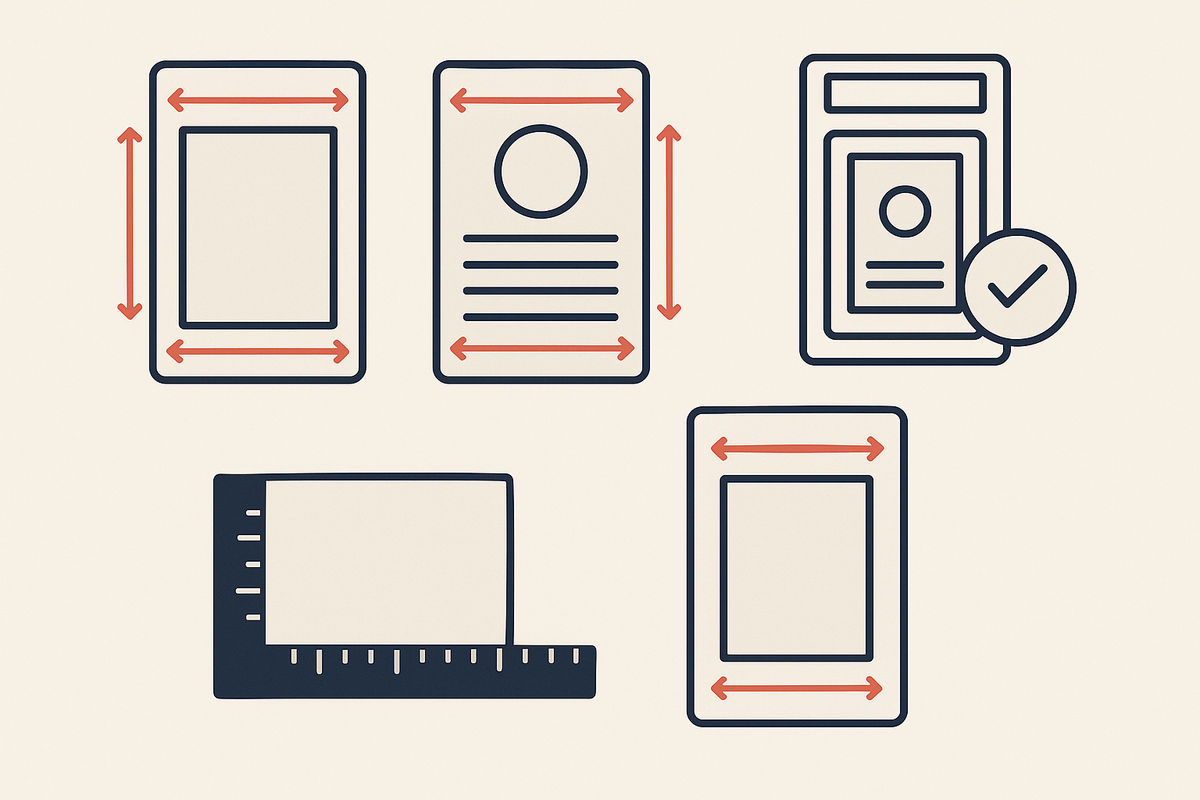
Centering measures how evenly the card’s artwork and borders are positioned relative to the card’s physical edges. Perfect centering means the image and borders are distributed equally on all sides. Collectors often focus on centering because it’s a key component in grading criteria for PSA, BGS, CGC, and TAG.
In practice, centering is a quantifiable metric. For example, if a card has a left border of 2mm and a right border of 2mm, it is considered perfectly centered horizontally. If the top and bottom borders are also equal, the card achieves ideal vertical centering. The more these measurements differ, the more "off-center" the card is considered—a factor that can influence both aesthetics and grade.
Front vs Back Centering Defined
The distinction between front and back centering is straightforward but crucial:
- Front Centering: How the artwork and borders appear on the front face of the card. This is often the side displayed and valued for visual appeal. For example, the classic 1986 Fleer Michael Jordan rookie card is known for poor front centering, making high-grade, well-centered examples more valuable.
- Back Centering: The alignment of borders and elements on the card’s reverse side. While less visible in displays, back centering is still a grading criterion, and some sets—like certain Pokémon cards with bold colored backs—make these flaws more obvious.
Because the front is what’s displayed and admired, collectors and graders often prioritize front centering. However, major grading services still evaluate back centering, just with slightly different standards.
It’s also important to note that card manufacturers sometimes use different printing and cutting processes for fronts and backs, leading to cases where a card looks perfect on the front but is off-center on the back (or vice versa). This is especially common in vintage sets, where registration between the two sides was less precise.
Common Issues with Centering
- Off-center printing causing uneven borders. For example, a Pokémon card with a noticeably thicker yellow border on the left side than on the right.
- Misaligned cutting during manufacturing. Sometimes the artwork is well-positioned, but the card is cut so that the borders are uneven, leading to centering issues.
- Design quirks (e.g., asymmetrical cards) complicating measurement. Some cards, such as early Magic: The Gathering or experimental sports issues, have design elements that make it difficult to determine where the artwork should be centered.
Knowing the difference between front vs back centering helps you target potential grade-lowering flaws before submitting your cards for expensive grading services. For a hands-on guide, see the step-by-step card centering measurement guide.
Understanding these concepts allows you to pre-screen your collection efficiently. For example, if you notice that a particular set is known for poor back centering, you may choose to be more stringent in your selection process, focusing only on cards that meet both front and back standards.
Section 2: Why Does Back Centering Matter?
Impact on Grading
Many collectors ask: Does back centering matter? The answer is yes, but the degree to which it matters varies by grading company:
- PSA, BGS, and CGC all factor in back centering to some extent. For instance, PSA’s published criteria indicate that a card with perfect front centering but extremely poor back centering (e.g., 90/10) can still be downgraded, particularly in modern issues.
- Poor back centering can cap the maximum grade, especially for modern cards. For example, a card with pristine corners, edges, and surface but a back centering of 80/20 may be capped at a PSA 9 or even lower, depending on other factors.
- Gem Mint grades require strong back centering—usually within 60/40 or 70/30 tolerances, depending on the company. For vintage cards, graders may allow more leeway, but for modern cards, standards are stricter.
Additionally, back centering can be the "tiebreaker" between two cards of similar condition. If both have perfect fronts but only one has a well-centered back, the better-centered example is more likely to receive a higher grade.
Examples of Back Centering Flaws
- One border is much thicker than the opposite side on the back. This is common in sports cards from the 1970s and 80s, where misalignment during printing led to significant back centering problems.
- Logo or text is printed off-center. On Magic: The Gathering cards, for example, the "Deckmaster" logo may be noticeably skewed toward one side, which can negatively impact grading.
- Reversed or rotated backs (rare, but can be seen as misprints rather than centering issues). These are typically classified as error cards, but if the misalignment is minor, it may simply reduce the centering subgrade.
While front centering is weighted more heavily for visual appeal, severe back centering problems can still drop a card from a 10 to a 9 or even lower, especially if the centering is outside accepted tolerances. This makes evaluating both sides important for an accurate self-assessment.
It’s also worth noting that even some collectors who display their cards in cases or slabs will inspect the back centering when considering a high-value purchase, especially for cards from highly scrutinized sets (like 1st Edition Pokémon or key sports rookies).
Collector Perception and Resale
Collectors and buyers increasingly scrutinize back centering, particularly as the hobby matures and high-value sales become more common. Even if a grading company allows slightly more lenient back centering, some buyers may still factor poor back centering into their purchase decision.
For example, in online auctions, cards with strong centering on both sides are often described in the listing and can command higher bids. Conversely, even a Gem Mint slab with a poorly centered back may see a price reduction relative to better-centered peers. This is especially true for "registry set" collectors, who compete for the finest examples in every aspect, not just the front.
For more on how these subtleties affect grading, see How Centering Impacts Card Value: A Detailed Guide.
As the market continues to mature, the expectation for well-centered backs may increase, making it wise to consider both sides when pre-grading your cards.
Section 3: Grading Standards for Front and Back Centering
PSA, BGS, CGC, and TAG Centering Criteria
Grading companies publish explicit centering standards for both front and back. Here’s a simplified breakdown:
- PSA: For a Gem Mint 10, front centering must be 55/45 or better; back centering can be 75/25. For a PSA 9, front centering can be as loose as 60/40 and back centering up to 90/10, although extreme back centering in modern cards is still penalized.
- BGS: Gem Mint 9.5 requires front centering of 50/50 to 55/45; back centering may be up to 75/25. BGS assigns subgrades, so a card with poor back centering may receive a lower subgrade but still achieve a high overall grade if other subgrades are strong.
- CGC: Similar to PSA, with back centering tolerance up to 75/25 for high grades. CGC’s published standards also specify that for a 9.5, front centering must be 55/45 and back centering within 80/20.
- TAG: Standards may be stricter on modern cards; refer to their published grader’s notes for details. TAG leverages automation in their grading process, leading to consistent enforcement of centering standards, especially for ultra-modern cards.
These ratios (e.g., 60/40) represent the proportional thickness of borders: a 60/40 card has one side 60% border, the other 40%. For instance, if a card’s left border is 3mm and the right is 2mm, the centering is 60/40 horizontally.
Why Are Standards Looser for the Back?
Front centering affects display and presentation, so it’s held to a higher standard. The back is important but typically gets a wider margin for error, reflecting the hobby’s focus on visual appeal. However, for premium grades (10s and Pristines), both front and back centering must be strong.
This difference in standards is partly due to the manufacturing process: fronts are the primary visual focus, so printers often align the front artwork more carefully. Backs, while still relevant, are less likely to be displayed and thus are given a bit more leeway. Nonetheless, as the hobby evolves, the gap between front and back expectations may be shrinking, and collectors are increasingly interested in strong centering on both sides.
Mixed Centering: Real-World Scenarios
- If your card is perfect on the front but 80/20 on the back, it will not receive a Gem Mint grade. For example, a PSA 10 Pokémon card must not only look great on the front but also have back centering within the published tolerance.
- Cards with 60/40 front and 70/30 back can still achieve a Mint 9 or similar grade. Many vintage cards fall into this category, and collectors are often willing to accept a bit of back centering variance for rare, high-grade examples.
- Vintage cards (pre-1980s) may get slight leniency due to known printing issues. For example, 1952 Topps baseball cards are known for poor centering, and graders may grant a higher grade to cards that are otherwise flawless, even if the centering is not perfect.
To see how these rules play out in practice, the article Card Centering Tool: Accurate Card Grading Estimates offers real grading examples, including side-by-side comparisons of cards with different centering profiles and the resulting grades. It’s worth reviewing these case studies before submitting valuable cards.
Grading standards can also vary depending on the card’s year and set. For instance, certain Topps and O-Pee-Chee hockey cards from the 1970s are known for production flaws, prompting graders to use historical context when judging centering. However, for modern releases, the expectation is that cards should meet or exceed the published tolerance on both sides.
Section 4: Measuring Centering – Tools and Techniques
Manual Measurement Methods
Traditionally, collectors used rulers or calipers to measure border thickness and calculate centering ratios. This method can be accurate but is slow and prone to human error, especially for cards with complex borders or busy designs.
- Measure each border (top, bottom, left, right) in millimeters. A digital caliper is best for accuracy, but a clear plastic ruler can also work for most cards.
- Calculate the centering ratio: (smallest border / largest border) x 100 = centering %. For example, a card with a 2mm left border and a 3mm right border yields (2/3) x 100 = 66.7%, or roughly 67/33 centering.
- Repeat for both sides of the card. It’s important to record measurements for front and back separately, as the printing process can result in different values.
Some collectors use overlays or printable centering guides, which can be placed on top of the card to visually estimate border symmetry. While helpful, these are still subject to parallax errors or inaccuracies for cards with non-standard dimensions.
Digital Tools: Precision and Efficiency
Modern collectors increasingly use digital card centering tools to speed up and improve accuracy. Apps like Midpoint allow you to upload card images, auto-detect edges, and instantly receive centering ratios for both front and back. This can save time and reduce guesswork.
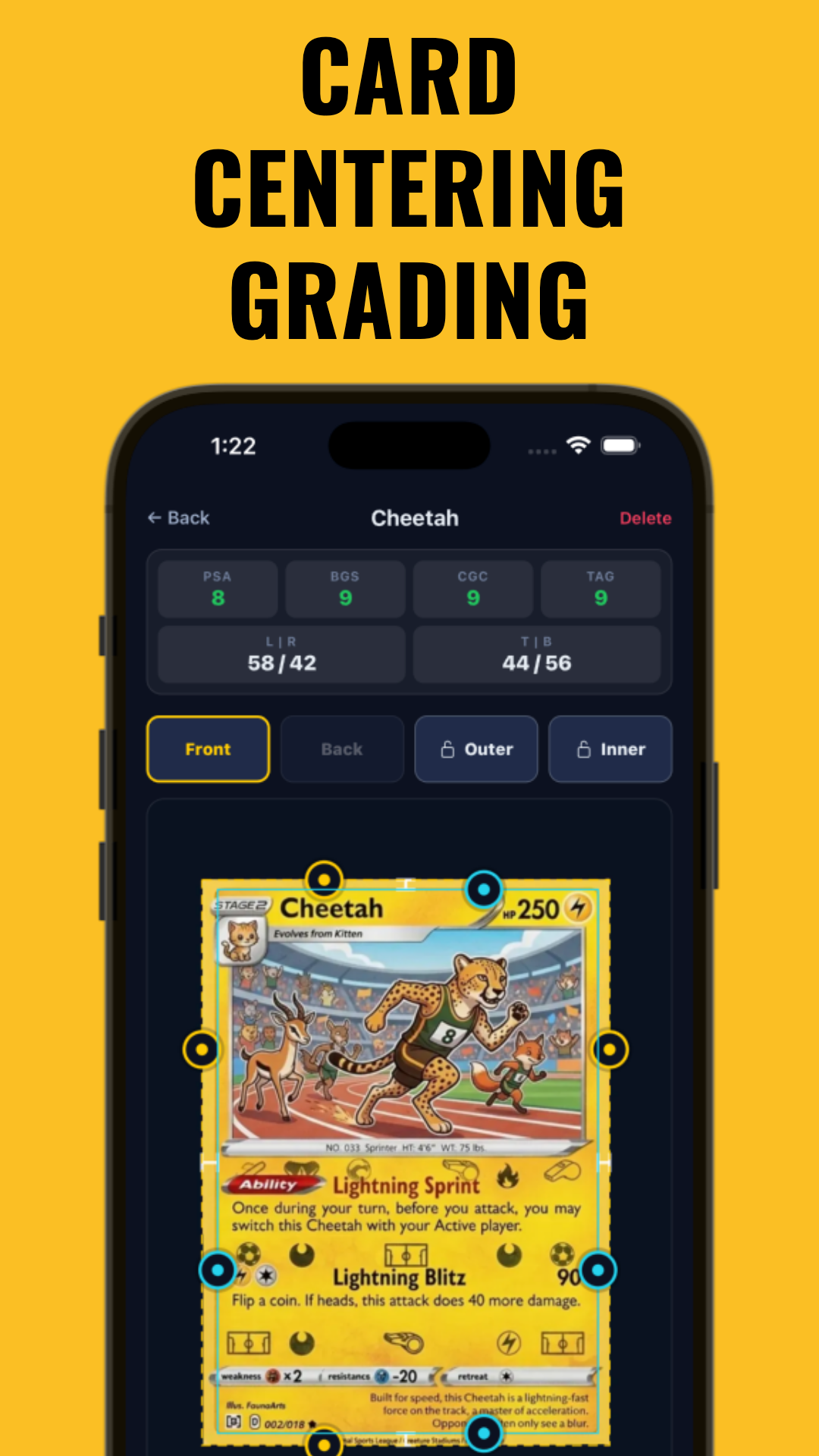
Key features of digital tools:
- Automatic edge detection and measurement down to the millimeter. This minimizes the risk of human error and allows for consistent results across large card batches.
- Side-by-side front and back analysis. Some tools, including Midpoint, allow you to view both sides of a card at once, making it easier to spot discrepancies and ensure both meet grading standards.
- Estimates for PSA, BGS, CGC, and TAG grading thresholds. Digital tools can automatically compare your card’s centering ratios against published grading standards, providing a quick "pass/fail" for each grade tier.
- Bulk card uploads for collection management. If you’re preparing a large submission, digital tools can process dozens or hundreds of cards in a single session, streamlining workflow for dealers and serious collectors.
These features make digital tools especially valuable for high-volume submitters or anyone looking to improve their grading hit rate. For example, using Midpoint, you can quickly sort your cards into those worthy of sending to PSA for a shot at a 10, and those better held back or sold raw.
Advanced AI Analysis
Some tools now employ AI to detect border asymmetry, skew, and even subtle edge centering inconsistencies. For an in-depth look at these advances, check out AI-Focused Comparison: How AI Transforms Card Centering Analysis.
AI-driven tools can also compensate for camera angle or lighting issues, providing more accurate results even from less-than-perfect photographs. For example, Midpoint uses machine learning algorithms to identify borders and artwork edges, automatically adjusting for background clutter or glare.
In addition, AI can flag cards with "hidden" centering issues, such as artwork shifts that aren’t immediately obvious to the naked eye, further increasing your odds of maximizing grading returns.
For bulk submitters, AI-powered platforms can generate reports that highlight which cards are likely to achieve top grades, saving both time and money on grading fees. These reports can be exported and shared with team members or stored for future reference, making the grading preparation process more data-driven and efficient.
Section 5: How Centering Impacts Card Value
Grading and Resale Value
Card grading is a direct driver of market value. Even a small centering flaw—front or back—can mean the difference between a Gem Mint 10 and a Mint 9, which sometimes translates to a price drop of hundreds (or even thousands) of dollars for ultra-rare cards.
- Perfectly centered cards often command the highest prices, especially in competitive TCG and sports card markets. For example, a PSA 10 1st Edition Holo Charizard can command a significant premium over a PSA 9, even if the only difference is a slight centering flaw on the back.
- Collectors may pay a premium for cards with strong centering on both sides, especially for flagship rookies and sought-after sets. In some PSA Set Registry competitions, only cards with exceptional centering are considered "top pop" (top population) examples.
- Back centering is scrutinized more today than in decades past, due to increased buyer education and population reports. As more collectors use digital tools and high-resolution scans, centering issues that might have passed unnoticed in the past are flagged more readily.
Cards that are otherwise flawless but have poor back centering may sell for less than their well-centered counterparts. For elite cards, this difference can represent hundreds or thousands of dollars.
Market Examples
- Recent sales have shown that a PSA 10 2019 Charizard can sell for several thousand dollars, while a PSA 9 with similar surface and corners but worse back centering may sell for significantly less. This illustrates how even minor back centering issues can impact value.
- Vintage Topps baseball cards with poor back centering (e.g., 85/15) are much rarer in high grades, thus high-grade examples can command substantial premiums. A 1952 Topps Mickey Mantle with strong centering on both sides can fetch multiples of the price of a similar card with off-center backs.
- Modern cards with large print runs may still have only a small percentage of perfectly centered examples. For instance, out of thousands of submitted copies, relatively few might achieve Gem Mint status due to centering alone.
For a deep dive into the financial impact of centering, explore How Centering Impacts Card Value: A Detailed Guide.
In high-stakes auctions, sellers often provide front and back scans to highlight centering quality. Listings with such images tend to attract more serious bidders, as buyers can independently assess centering and avoid surprises upon receipt.
Pre-Grading to Avoid Surprises
Measuring both front and back centering before submission helps you avoid paying grading fees on cards unlikely to earn top marks. Tools like Midpoint provide instant centering estimates and can save significant time and money. For a walkthrough, see the How to Pre-Grade Your Card: A Step-by-Step Guide.
By pre-grading your cards, you can also identify which cards are "on the bubble" for a higher grade and decide whether to submit them now or wait for a better example. This strategic approach is especially important for large collections or when submitting cards for resale, as it can help maximize your return on investment.
Dealers and high-volume flippers often use digital centering tools as part of their intake process, rejecting cards that fall outside desired tolerances and focusing only on those that have a realistic shot at Gem Mint grades. Over time, this approach can improve profit margins and reduce wasted grading fees.
Section 6: Edge Centering and Its Role in Grading
What Is Edge Centering?
Edge centering refers to how evenly the image and borders align with the physical edges of the trading card. While often discussed alongside front vs back centering, edge centering is a distinct concept—especially relevant for cards with intricate border designs or irregular shapes.
Unlike traditional centering, which often focuses on equal border thickness, edge centering includes the overall visual balance and how the artwork "sits" within the card frame. Cards with unusually shaped borders, die-cut edges, or complex backgrounds especially benefit from edge centering analysis.
How Edge Centering Is Measured
- Some tools, including Midpoint, offer automated edge detection that shows millimeter differences for each border. For example, the tool may highlight a 0.5mm discrepancy between top and bottom borders, which might be undetectable to the naked eye but significant for grading.
- Manual techniques require visually comparing all four sides and using calipers for precision. This is especially important for cards where the artwork doesn’t fill the entire frame, such as many early Magic: The Gathering issues.
- Edge centering issues are typically more apparent on the front but can also be present on the back. For example, a card with a misaligned back logo or off-center text block may lose points for edge centering.
Some advanced tools allow users to select reference points or drag measurement lines to compare distances directly, which is useful for cards with non-standard layouts or unique shapes.
Why Edge Centering Matters
- Edge centering problems can make a card appear crooked or miscut, impacting eye appeal and grade. For example, a card with a noticeably angled image—where the top left border is thicker than the bottom right—may be downgraded for poor edge centering even if the artwork itself is centered.
- Some grading companies consider edge centering when assigning subgrades, particularly for high-value submissions. BGS, for instance, includes edge centering as part of its centering subgrade, and poor edge centering can lower the overall grade even if front/back centering is within tolerance.
- Edge centering tools (learn more at What is an edge centering tool?) are increasingly popular among serious collectors. These tools help ensure that cards meet not only numerical centering standards but also visual balance expectations.
Edge centering analysis is especially important for cards with colored or patterned borders—Pokémon, Magic: The Gathering, and vintage sports cards are classic examples. For instance, a 1999 Shadowless Pokémon card with perfectly even yellow borders on the front but a misaligned blue pattern on the back may still be penalized for edge centering issues.
Some grading companies have begun to issue "miscut" or "off-center" qualifiers when edge centering is particularly poor, even if the card technically fits within the published centering ratios. This further underscores the importance of holistic edge analysis when preparing your cards for submission.
Conclusion
In the world of trading card grading, understanding front vs back centering is essential for collectors aiming for top grades and maximum card value. While front centering gets the most attention, back centering grading can make or break a submission, especially as standards tighten and buyers become more discerning. Edge centering and surface analysis round out a complete evaluation process, ensuring your cards are ready for grading—and for the open market.
Before sending your prized cards for grading, consider using reliable digital tools like Midpoint to measure centering down to the millimeter and get instant grading estimates. By understanding both front and back centering, you’ll be better equipped to make informed decisions and maximize your collection’s potential.
Whether you’re a casual collector or a high-volume dealer, taking the time to evaluate both front and back centering (along with edge centering) will help you avoid disappointing grades and optimize the value of your submissions. As the hobby becomes more competitive and buyers more sophisticated, these details are increasingly critical for success.
FAQ
Q: Does back centering matter for card grading?
A: Yes, back centering does matter. While the standards are generally looser than for front centering, poor back centering can limit the maximum grade your card receives from PSA, BGS, CGC, and TAG.
Q: What centering ratios are required for a Gem Mint grade?
A: Typically, Gem Mint (10) requires front centering of 55/45 or better and back centering of 75/25 or better, though this may vary slightly by grading company.
Q: How can I measure front and back centering accurately?
A: Use a ruler or digital caliper for manual measurement, or streamline the process with a digital card centering tool like Midpoint, which provides instant, millimeter-precise ratios for both sides.
Q: Can poor back centering reduce my card’s value even if the front is perfect?
A: Yes, especially in premium grades. Buyers and grading services increasingly pay attention to back centering, and a poorly centered back can drop a Gem Mint 10 to a Mint 9 or lower.
Q: What is edge centering and how does it differ from front/back centering?
A: Edge centering refers to the alignment of the card’s artwork with its physical edges. It’s a related but distinct concept from front and back centering, focusing on overall balance and visual appeal, especially for cards with bold borders.
Free to start
Try the Midpoint app
Grade any card from a photo, see its raw and PSA 10 value, and track what your collection is worth — free.
Get it on iPhoneGet it on Android