How Much Does Centering Affect Grade? Complete Card Centering Guide
Learn how much centering affects grade for PSA, BGS, and CGC. Discover centering ratios, measurement methods, and tips to maximize your card’s value.


Estimated reading time: 14 min
Key Takeaways
- Centering is one of the most critical factors in trading card grading, directly impacting PSA, BGS, and CGC grades.
- PSA 10, 9, and 8 have strict centering thresholds, especially on the front; back centering tolerances are more lenient.
- Accurately measuring card centering at home with tools like Midpoint can help prevent grading surprises.
- Off-center cards can cap your maximum grade, even if the card is flawless otherwise.
- Value differences between grades due to centering can be significant—sometimes several times higher for PSA 10 vs. PSA 9.
Table of Contents
- Section 1: What Is Card Centering?
- Section 2: How to Measure Card Centering
- Section 3: PSA, BGS, and CGC Centering Standards Compared
- Section 4: How Much Does Centering Affect Grade?
- Section 5: Front vs Back Centering – Which Matters Most?
- Section 6: Checking Centering Before Grading
- Conclusion
- FAQ
Section 1: What Is Card Centering?
Understanding Card Centering
Card centering refers to how evenly the image and borders are positioned on a trading card. If the borders are of equal thickness on all sides, the card is considered well-centered. Poor centering means one or more borders are noticeably thicker or thinner, and this imperfection can significantly affect a card's grade and value.
In practical terms, most trading cards are printed with a colored border or a defined design edge that should be equidistant from the edge of the card on all four sides. When the printing process misaligns the image even slightly, it creates asymmetry in border thickness. For example, the left border may be much thicker than the right, or the top border thinner than the bottom. This inconsistency is referred to as being "off-center." Centering issues are especially noticeable in vintage cards, where older printing technology led to frequent misalignments.
Collectors and graders consider centering not just for aesthetic reasons, but because it reflects both manufacturing quality and rarity. Perfectly centered cards from certain years or sets are less common and thus often more valuable.
What Does 55/45 Centering Mean?
Centering is typically expressed as a ratio, such as 55/45 or 60/40. This ratio represents the difference in border thickness between opposite sides. For example, 55/45 centering means the left border is 55% the size of the total border area, and the right is 45%. The closer the ratio is to 50/50, the better the centering.
- 50/50: Perfect centering (rare, even in PSA 10s)
- 55/45: Within PSA 10 tolerance on the front
- 60/40: Still possible for PSA 9, often seen in high grades
To calculate these ratios, you compare the distance from the card’s edge to the printed border or image on both sides. For instance, if the left border is 2.5mm and the right is 2mm, the total border width across the card is 4.5mm. Thus, the left is roughly 56% and the right 44%, or 56/44 centering. The calculation is done separately for both axes: left/right and top/bottom. The worst (furthest from 50/50) axis is what graders use.
Some cards, especially those with colored or patterned borders, make these measurements easier. Others, such as full-bleed or borderless cards (like some modern Pokémon or sports issues), require careful estimation based on elements like text alignment or artwork framing. Digital tools can assist here (see Section 2).
Why Centering Matters
Even a flawless card with poor centering will be capped at a lower grade. For collectors and investors, understanding what is good centering for a card is key to maximizing value and avoiding costly grading disappointments. For a deeper dive on terminology and standards, see How to Measure Card Centering: Step-by-Step Precision Guide.
Consider the following example: you have two copies of a 1999 Pokémon Charizard. Both are pack-fresh, with flawless corners, edges, and surfaces. One has 50/50 centering—nearly perfect—and the other is 62/38, with a noticeably thicker left border. The first has a chance at PSA 10 and could sell for significantly more than the second, which may top out at PSA 8 or 9. This value difference is especially pronounced for iconic cards or those from sets known for centering issues.
Centering also affects liquidity—cards that are well-centered are easier to sell, as most buyers prefer a card that looks balanced in a display or slab.
Section 2: How to Measure Card Centering
Manual Methods for Measuring Centering
Before digital tools, collectors measured centering with rulers, calipers, or overlay grids. Here’s how you can do it manually:
- Measure the Top and Bottom Borders: Use a millimeter ruler to record the width of the top and bottom borders of the card’s front.
- Calculate the Ratio: Add both measurements, then divide each border by the total to get the ratio (e.g., top 3mm, bottom 2.5mm: 3/5.5 = 54.5%, 2.5/5.5 = 45.5% = 55/45 centering).
- Repeat for Left/Right Borders: Do the same for side borders.
To ensure accuracy, use a transparent ruler or a digital caliper with 0.1mm precision. Some collectors use graph paper or print out overlay grids to lay atop the card (in a sleeve, to avoid damage). This can help with cards that have no clear border, as you can align the edges visually. Note that most grading companies recommend measuring the printed area—not just the colored border—if the design is asymmetrical.
If you are measuring many cards, it’s a good practice to record your measurements in a spreadsheet. List each card, border measurements, and calculated ratios. This will help you compare cards side by side and make informed decisions about which are worth submitting for grading.
Using Digital Tools Like Midpoint
Modern collectors often prefer digital solutions for accuracy. Midpoint lets you upload a card image, auto-detects edges, and calculates centering ratios—down to fractions of a millimeter. This can help reduce human error and speed up pre-grading.
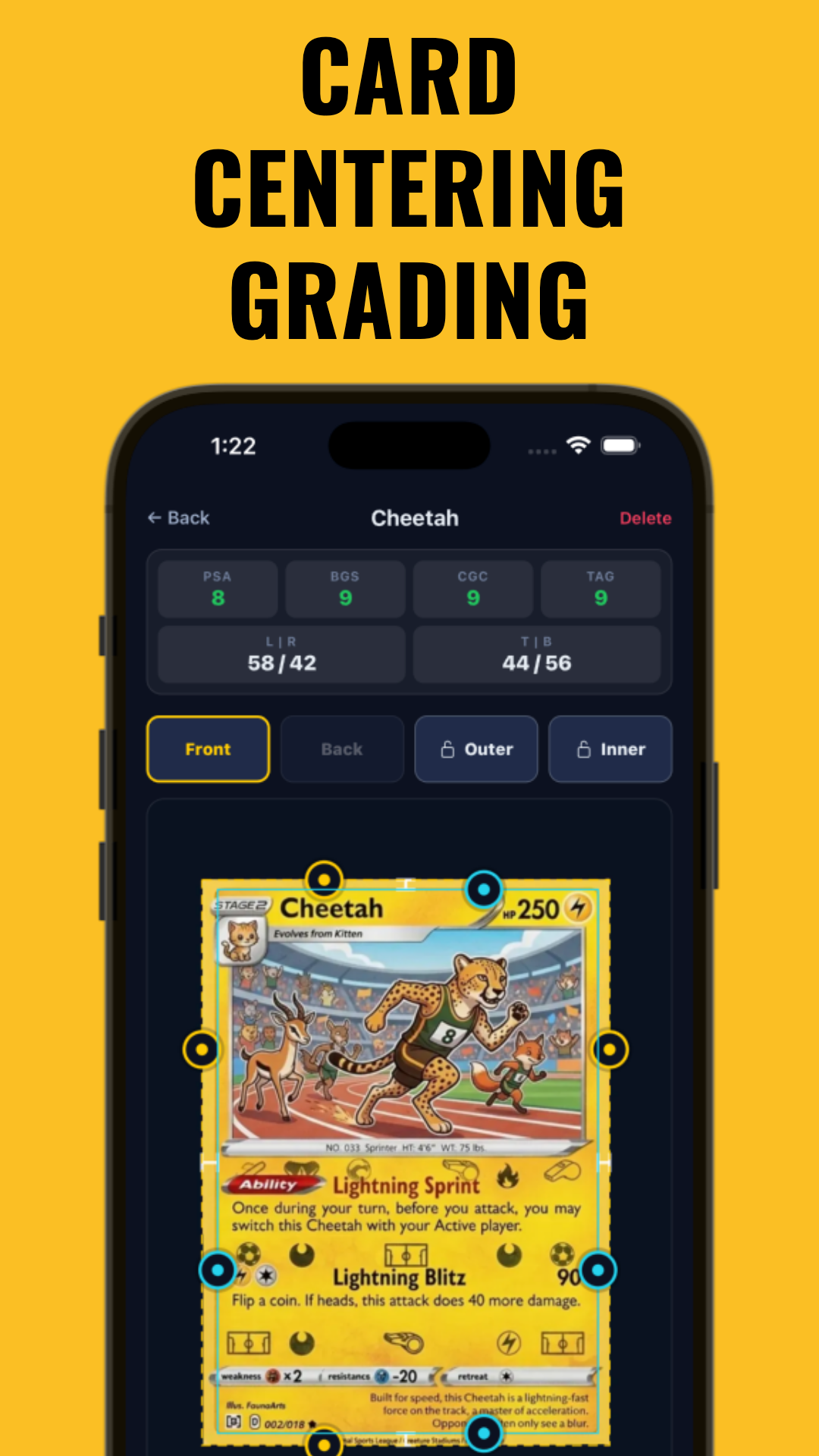
Digital tools like Midpoint use computer vision algorithms to detect card borders, even on cards with minimal or no colored frames. After uploading your card’s image (preferably scanned at 300+ DPI for sharpness), the software identifies the edges and calculates the centering ratios for both axes. Some tools allow manual adjustment, so you can fine-tune the detection if the card’s artwork is complex or the scan isn’t perfectly aligned.
With Midpoint, you can process multiple cards quickly, flagging only those that meet your target centering criteria for submission. This efficiency can be valuable for bulk grading, group submissions, or dealers reviewing many cards at a time.
Best Practices for Accurate Measurement
- Scan or photograph cards in high resolution and good lighting
- Avoid cropping out borders or tilting the card in photos
- Double-check each border (don’t assume left/right are always the same)
For an in-depth walkthrough, see this precision guide.
Additional tips:
- When photographing, place the card on a flat, neutral background (white or gray works best) and avoid shadows.
- Ensure the card is oriented perfectly upright—not rotated or skewed—as even a few degrees of tilt can affect measurement results.
- For cards with foil or reflective surfaces, avoid glare by angling your light source or using a scanner instead of a camera.
- Always check both axes: a card may be well centered left-to-right but off top-to-bottom, and vice versa.
Section 3: PSA, BGS, and CGC Centering Standards Compared
PSA Centering Tolerances
PSA (Professional Sports Authenticator) sets specific centering standards for each grade. Here’s a summary for modern and vintage cards:
- PSA 10 (Gem Mint): Front 55/45 or better; Back 75/25 or better
- PSA 9 (Mint): Front 60/40 or better; Back 90/10 or better
- PSA 8 (NM-MT): Front 65/35 or better; Back 90/10 or better
For vintage cards (pre-1980), PSA sometimes allows slightly more leniency, especially on the back.
PSA uses a centering ruler during grading, visually and physically measuring the border thickness on both axes. For particularly rare or iconic issues, graders may consider the historical context—some sets are known for poor centering (e.g., 1971 Topps Baseball), so a slightly off-center card may still receive a strong grade if it is otherwise exceptional. However, for modern cards, the standards are applied strictly, and even minor deviations can result in a grade drop.
PSA’s grading population reports indicate that a significant percentage of cards are graded 9 instead of 10 in part due to centering, highlighting how this single factor can affect both population and value.
BGS Centering Tolerances
- BGS 10 (Pristine): 50/50 (perfect, extremely rare)
- BGS 9.5 (Gem Mint): 55/45 or better on front, 60/40 or better on back
- BGS 9 (Mint): 60/40 or better on front, 65/35 or better on back
BGS (Beckett Grading Services) uses subgrades, assigning a separate score to centering, corners, edges, and surface. This allows for more granular feedback—e.g., a card might have centering 8.5 but corners 9.5, leading to an overall grade between the two. BGS is known for clear, transparent subgrades, so buyers can see exactly where a card fell short.
BGS’s 10 "Pristine" is reserved for cards with flawless centering (50/50), making it extremely rare. Most top cards receive 9.5 for centering, which allows 55/45 on the front and 60/40 on the back. This makes the BGS 10 label one of the hardest to achieve in the hobby.
CGC and Other Companies
CGC (Certified Guaranty Company) and SGC have similar standards but may interpret ratios slightly differently. For example, CGC states for a Pristine 10: 50/50 front, 60/40 back; for a Gem Mint 9.5: 55/45 front, 65/35 back.
- Some companies (like TAG) leverage AI to be more consistent—see this AI comparison.
In all cases, front centering is more heavily weighted than back centering for grade thresholds.
CGC, which is prominent in the Pokémon and TCG community, also publishes subgrades, so a card can have a 10 overall but a 9.5 in centering. CGC’s approach allows for slightly more transparency. SGC, another respected grading company, uses a similar 10-point scale and comparable centering tolerances, though their published standards are less detailed. For all companies, the key takeaway is that no matter how perfect a card is otherwise, centering outside these thresholds will cap the grade.
In recent years, technology-driven companies like TAG have started using computer vision and AI to measure centering. These methods are intended to be more consistent and less prone to human subjectivity. As the industry evolves, digital measurement is becoming more common for centering analysis.
Section 4: How Much Does Centering Affect Grade?
Centering as a Grade Limiter
Centering is one of the four main grading subcategories (centering, corners, edges, surface). A card’s worst subgrade often sets its maximum possible overall grade. If your card is otherwise flawless but has 60/40 centering, it can’t earn a PSA 10, since that exceeds the 55/45 threshold for the front.
For example:
- Card A: Perfect corners, edges, surface; centering 56/44 → PSA 10 possible
- Card B: Perfect in all aspects, centering 60/40 → Max PSA 9
- Card C: Centering 70/30 → Likely capped at PSA 7-8, regardless of other subgrades
Even a tiny difference—say, 1% over the tolerance—can mean the difference between a 10 and a 9. For high-value cards, that seemingly small discrepancy could translate to hundreds or thousands of dollars. This is why professional submitters often pre-screen cards with digital tools or magnification, rejecting anything that falls outside the tightest centering ranges for top grades.
For vintage cards, some leniency may be applied due to known printing issues. However, most modern cards are held to exact standards. Graders will use templates, rulers, or digital overlays to verify centering; borderline cards may be measured multiple times.
Price Differences Driven by Centering
The value impact of centering can be dramatic. A PSA 10 can sell for several times the price of a PSA 9 in some sports and TCGs, even if the only difference is centering. For iconic cards, a single grade drop due to centering can mean a substantial difference in value.
For example, as of 2024, a PSA 10 1986 Fleer Michael Jordan rookie card has sold for over $200,000, while a PSA 9 typically fetches significantly less—a difference that can be due in part to centering. In the world of Pokémon, a Base Set Charizard PSA 10 can command much more than a PSA 9. The only visual difference in many cases is centering.
Mid-tier grades are also affected. A PSA 8 may trade at a fraction of a PSA 9, with the drop often tied to centering or a minor flaw. For investors, understanding this value curve is essential: submitting a card with 60/40 centering for PSA 10 hopes is unlikely to result in a 10 and may lead to disappointment and lost grading fees.
Explore real-world card sales data and examples in How Centering Impacts Card Value: A Detailed Guide.
Grader Discretion and Borderline Cases
- PSA and others sometimes exercise discretion for cards right at the threshold (e.g., a 56/44 card may still gem if it presents well).
- Obvious off-centering—even within tolerance—can still be penalized for poor eye appeal.
- Some vintage cards are graded less strictly for centering, especially if factory cuts were known to be inconsistent.
It’s important to note that grading isn’t always a purely mathematical process. If a card is technically 56/44 but the centering flaw draws the eye or disrupts important text/artwork, a grader may still deduct for overall presentation. Conversely, a card right on the edge of tolerance, but with strong visual symmetry, may get the benefit of the doubt. This is why pre-screening with both measurement and visual review is key.
For vintage cards (such as pre-1980s baseball), graders understand that centering issues were common due to less precise manufacturing. In such cases, a slightly off-center card may still be considered for higher grades, but only if the market and set history support it.
Section 5: Front vs Back Centering – Which Matters Most?
Front Centering Standards
All major grading companies weigh front centering far more heavily than the back. The front is where eye appeal and the visual impact matter most to collectors and graders. PSA, for instance, will not award a 10 if the front is worse than 55/45, even if the back is perfect.
- PSA 10: Front 55/45, Back 75/25
- BGS 9.5: Front 55/45, Back 60/40
The reason is simple: when a card is displayed in a slab, the front is what buyers and collectors see first. A well-centered front creates balance and enhances the card’s overall visual appeal. Even a minor flaw in front centering is far more likely to be noticed than a similar issue on the back.
Back Centering Tolerances
Back centering tolerances are much more lenient—sometimes up to 90/10 for PSA 9 or PSA 8. That means a card can have a noticeably shifted back and still achieve high grades, provided the front is strong.
- Some sets (e.g., early Pokémon, Topps) are known for poor back centering, so graders are sympathetic within reason.
- For modern cards, back centering issues are less tolerated, but rarely drop a grade on their own unless extreme.
In practice, a card with perfect front centering and a back that is obviously off (for example, 80/20) can still receive a PSA 9 or even a 10, depending on the company and the rest of the card’s attributes. Graders usually only penalize back centering if it is so severe that it detracts from the card’s overall presentation or if it is indicative of a miscut (where the card is shifted off the sheet entirely).
Some advanced collectors will seek out cards with both perfect front and back centering for their personal collections. However, the market places a premium on front centering, and for most buyers, back flaws are a minor concern.
Which Side Matters for Value?
Collectors almost always value front centering over back. A card with a visually off-center front will sell for less, even if the grade matches another with perfect centering. If you must choose which to prioritize, always focus on the front.
For example, compare two PSA 9s: one with 55/45 front and 80/20 back, the other with 60/40 front and 50/50 back. The first card will likely command a higher price, as the front looks nearly perfect, and buyers are less concerned about the back. This is especially true for cards intended for display, as the back is rarely shown.
Dealers and investors routinely filter bulk submissions by front centering first, accepting slightly flawed backs if it means a shot at a top grade. If you’re evaluating which cards to submit, always start with the front.
Section 6: Checking Centering Before Grading
Why Pre-Check Centering?
Grading fees are often $30–$100+ per card. Submitting a card that’s capped at PSA 8 or 9 due to centering can be a costly mistake, especially if you were aiming for a 10. Pre-checking centering lets you:
- Set realistic expectations for your card’s maximum grade
- Decide which cards are worth submitting
- Avoid disappointment and wasted grading fees
For bulk submitters or dealers, this process is essential. Even hobbyists can benefit: imagine submitting a $50 card, paying $40 for grading, and receiving an 8 due to centering. That’s a net loss, especially if you could have screened it out beforehand. Pre-checking is now standard practice among experienced collectors and professionals.
Step-by-Step Pre-Grading Process
- Scan or photograph your card at high resolution
- Upload the image to a centering tool like Midpoint
- Use auto-detection or manually mark borders
- Review the calculated ratios (e.g., 56/44, 62/38)
- Compare your results to PSA/BGS/CGC standards
- Estimate the likely grade outcome
For a full walkthrough, see How to Pre-Grade Your Card: A Step-by-Step Guide.
Example: Let’s say you scan a card and Midpoint reports 58/42 left/right and 54/46 top/bottom. Since both axes are within PSA 10 thresholds (55/45 for front), you have a strong shot at a Gem Mint grade, assuming all other factors check out. If you see 62/38, you know immediately that your card is capped at PSA 9, and can decide whether grading is still worth it based on potential resale value.
Common Pitfalls and Tips
- Don’t eyeball centering; even a 2% difference can mean a grade drop
- Measure both axes (left/right and top/bottom)
- Be aware that some graders may round ratios conservatively
- When in doubt, submit cards with 54/46 or better for PSA 10 hopes
Other common mistakes to avoid:
- Photographing cards at an angle, which distorts measurements. Always shoot or scan cards flat and square.
- Not accounting for manufacturing quirks—some cards have borders that appear uneven due to design, not centering. Learn your set’s quirks before measuring.
- Assuming left/right and top/bottom are always similar—many cards are off on one axis but not the other.
- Neglecting to check the back if you’re aiming for a 10; severe back misalignment can still drop your grade.
If you are unsure, consider sharing your scans on collector forums or with experienced grading submitters. Peer feedback can help spot subtle centering issues you may have missed.
Conclusion
Centering is not just a minor detail—it’s often the single biggest factor in determining whether your card achieves a coveted Gem Mint grade or falls short. Understanding how much centering affects grade, knowing the exact PSA/BGS/CGC thresholds, and learning how to measure card centering accurately are essential steps for every card collector or investor. With digital tools like Midpoint, you can check centering in seconds and make informed grading decisions, saving both money and regret.
For further reading on the impacts of centering on value, see this detailed guide. And for advanced measuring tips, check out How to Measure Card Centering: Step-by-Step Precision Guide.
FAQ
Q: How off-center can a card be and still get a PSA 10?
A: For a PSA 10, the card’s front centering must be at least 55/45 or better. The back can be as off as 75/25. Any worse, and the card is capped at a lower grade, regardless of other condition factors.
Q: Does front centering matter more than back centering for grading?
A: Yes. All grading companies weigh front centering most heavily. Back centering is more forgiving—often up to 75/25 or 90/10 for PSA. Eye appeal and grade thresholds are determined primarily by the front.
Q: Will a 60/40 card still get a PSA 9 or PSA 10?
A: A card with 60/40 front centering can earn at most a PSA 9. For a PSA 10, front centering must be 55/45 or better. Back centering can be more off and still achieve these grades.
Q: How do you measure card centering accurately at home?
A: Use a millimeter ruler or a digital tool like Midpoint. Measure opposite borders, calculate the ratio, and compare to grading standards. Digital tools can help reduce error and save time.
Q: How much does centering lower the grade if the rest of the card is perfect?
A: Centering is a limiting factor—if it’s outside the grade’s tolerance, it will cap your grade even if all other aspects are flawless. For example, 60/40 centering on front means max PSA 9, even if the card is otherwise perfect.
Q: Is centering judged differently by PSA, BGS, and CGC?
A: Each company has its own standards, but they are similar: PSA is strictest on the front; BGS and CGC have similar but slightly different ratio thresholds. CGC and BGS sometimes allow for more precision with subgrades.
Free to start
Try the Midpoint app
Grade any card from a photo, see its raw and PSA 10 value, and track what your collection is worth — free.
Get it on iPhoneGet it on Android