Matthew Schaefer Cards Worth Money: Values and Grading
See which Matthew Schaefer cards are worth money, raw vs PSA 10 values, top parallels, and what’s worth grading or selling now.

Estimated reading time: 13 min
Key Takeaways
- Matthew Schaefer cards worth money are led by low-population rookies, especially flagship Young Guns parallels and chase autographs.
- Raw vs graded value matters a lot: a clean PSA 10 candidate can command a premium, but only if centering, corners, edges, and surface justify submission.
- The most valuable Matthew Schaefer cards are usually rare parallels, 1/1s, Shield-style cards, autograph issues, and premium patch autos.
- Recent asking prices can be misleading; sold listings and auction results are the better guide for Matthew Schaefer rookie card value.
- If you’re deciding whether to grade, sell, or hold, use a centering-and-condition check first so you don’t spend grading money on a card with weak upside.
Card values — live data from Midpoint's card database, as of 2026-11-15. Prices move; Midpoint refreshes these daily.
| Card | Raw | PSA 10 | Gem premium | |
|---|---|---|---|---|
 |
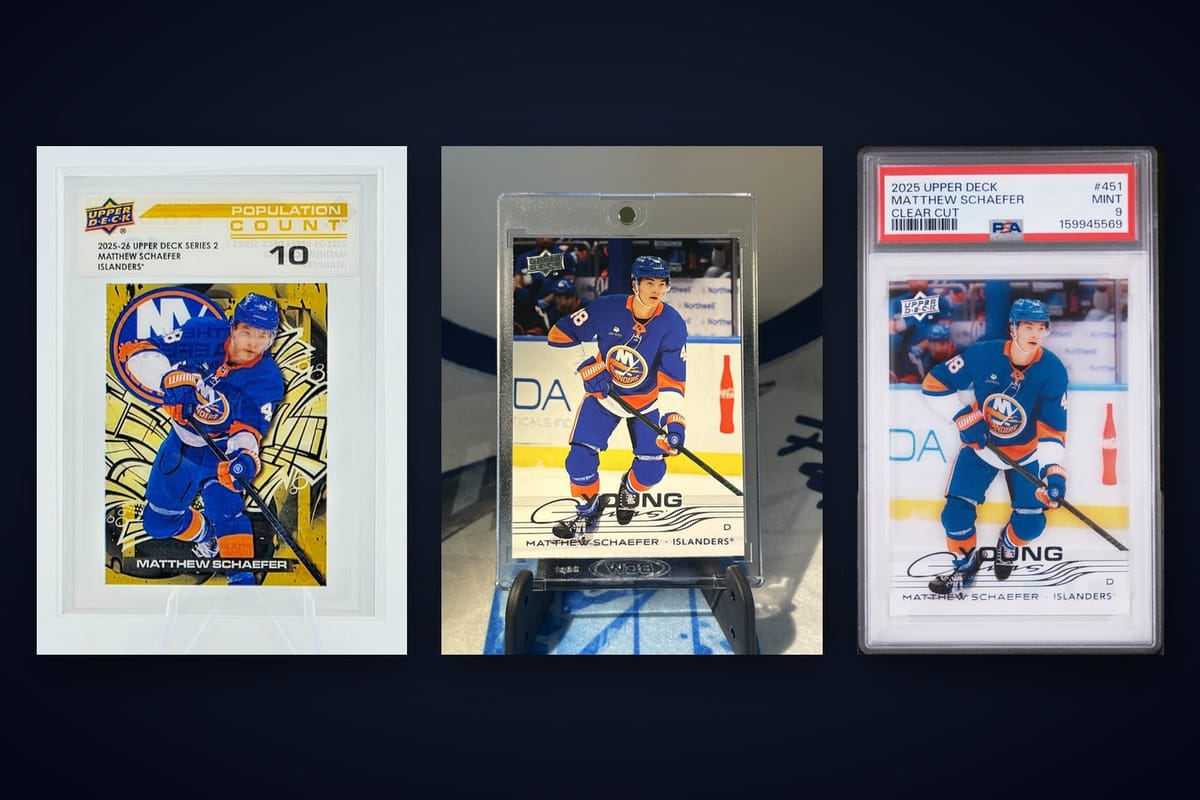
Matthew Schaefer [10] #PC-37 2025 Upper Deck Series 2 Population Count |
$2,540 | $11,535 | 4.5× |
 |
Matthew Schaefer [Exclusives] #451 2025 Upper Deck Series 2 |
$1,806 | $7,921 | 4.4× |
 |
Matthew Schaefer [Clear Cut] #451 2025 Upper Deck Series 2 |
$1,042 | $7,748 | 7.4× |
 |
Matthew Schaefer #168 2025 SP Authentic |
$1,386 | $6,582 | 4.8× |
 |
Matthew Schaefer [Gold] #DZ-57 2025 Upper Deck Series 2 Dazzlers |
$1,427 | $6,398 | 4.5× |
 |
Matthew Schaefer #DDM-MS 2025 SP Game Used Draft Day Marks |
$1,184 | $5,184 | 4.4× |
 |
Matthew Schaefer [Extended Rookie Blue Line Autograph] #AR-MS 2025 Upper Deck Allure |
$750.00 | $3,254 | 4.3× |
 |
Matthew Schaefer [Deluxe] #451 2025 Upper Deck Series 2 |
$710.00 | $3,015 | 4.3× |
 |
Matthew Schaefer [Outburst Silver] #451 2025 Upper Deck Series 2 |
$695.20 | $2,930 | 4.2× |
 |
Matthew Schaefer #P-7 2025 SP Authentic Pageantry Autograph |
$475.88 | $2,310 | 4.9× |
 |
Matthew Schaefer #3D-MS 2025 O-Pee-Chee 3-D Marquee Rookie |
$334.35 | $1,475 | 4.4× |
 |
Matthew Schaefer [Autograph] #113 2025 SkyBox Metal Universe |
$295.03 | $1,365 | 4.6× |
Look up any card's current raw and graded value in Midpoint — and get an estimated grade before you pay to submit.
Table of Contents
- Section 1: Why Matthew Schaefer Cards Are Getting Attention
- Section 2: Current Values for Key Rookie Cards and Parallels
- Section 3: The Most Valuable Matthew Schaefer Cards
- Section 4: Raw vs PSA 10 and What Makes a Card Grade Worth It
- Section 5: How to Identify, Authenticate, and Avoid Mistakes
- Section 6: Best Ways to Sell and Track Market Movement
- Section 7: What Could Move Matthew Schaefer Prices Next
Section 1: Why Matthew Schaefer Cards Are Getting Attention
Rookie hype starts with scarcity and role
Matthew Schaefer cards worth money because collectors tend to focus first on the same three things: rookie demand, scarcity, and hobby visibility. For a young defenseman, that combination can create a fast-moving market where flagship rookies, limited parallels, and autograph cards become the center of attention.
In hockey, rookie card value often builds in layers. A base rookie may be approachable for most collectors, while numbered parallels, short prints, and premium memorabilia versions become the true chase cards. That structure matters for Schaefer because buyers aren’t just asking whether he has a rookie card; they’re asking which version is actually worth paying up for.
Why flagship rookies matter most
The most watched card in a player’s first major release is usually the flagship rookie, because it becomes the reference point for the rest of the market. If that card shows strong demand, the rest of the parallel ladder often follows. If it stays soft, even rare copies can struggle to hold inflated asking prices.
For Schaefer, that means the market is built around what collectors view as “the card to own,” plus the rarer hits that sit above it. That’s why the top sales you’ll see discussed are usually not random inserts; they are recognizable rookie anchors, premium parallels, and ultra-low-population chase cards.
How Midpoint helps before you buy or grade
Before paying grading fees or chasing a hype listing, it helps to inspect the card like a grader would. Midpoint gives you an estimated PSA, BGS, CGC, or TAG grade from centering, corners, edges, and surface, so you can decide whether a Schaefer card is actually worth submission.

If you’re comparing raw and graded prices, that pre-grade check can save real money. A card that looks strong in a top-loader may still miss the mark if centering is off or if the surface has print lines, dings, or edge wear that are hard to catch in listing photos.
Section 2: Current Values for Key Rookie Cards and Parallels
How to read the pricing data
The best way to understand Matthew Schaefer rookie card value is to separate base rookies from rarer parallels and to compare raw prices with graded outcomes. Prices change often, so look up current values by set, card number, parallel, and condition. Use recent sold prices as the baseline, not the seller’s ask.
That distinction matters because asking prices often sit above the market. Sold listings, especially recent eBay sales and auction closings, are a better indicator of what buyers are actually paying.
Where the flagship value tends to sit
The 2025-26 Upper Deck Young Guns base rookie card is the market’s main reference point for many collectors. In a new rookie market, that card usually becomes the baseline for everything else: raw copies for budget buyers, strong raw examples for grading, and PSA 10s for premium collectors who want a top-pop style piece without chasing ultra-rare serial numbers. Confirm the exact card number against the set checklist before buying.
Parallel pricing is where the spread widens. A common parallel can be close to the base card in lower grades, while a rarer or numbered version can leap far above it if demand and scarcity line up. That’s why the same player can have very different prices across raw, PSA 9, and PSA 10 copies.
What to watch in sold listings
- Recent sales versus stale listings
- Raw condition versus slabbed condition
- Parallel type and serial number
- Whether the listing is an accepted offer or true sale
- Photo quality, since hidden flaws can change the real market value
For a card like Schaefer’s Young Guns rookie, even modest shifts in buyer sentiment can move prices quickly. That’s why collectors should track both the base rookie and the rarest variants, not just one headline card.
If you want a deeper framework for submission decisions, the guide on how to pre-grade your card is useful before you spend on grading. And if centering is the deciding factor, the free centering calculator can help you screen copies fast.
Section 3: The Most Valuable Matthew Schaefer Cards
1/1s, patch autos, and premium memorabilia
The most valuable Matthew Schaefer cards are typically the ones with the fewest copies and the strongest hobby appeal. That usually means one-of-ones, Shield-style cards, premium patch autos, and cards tied to standout memorabilia or autograph content. These are the cards collectors chase when they are no longer shopping for “a rookie,” but for the best version of the player’s first-year cardboard.
A 1/1 can command a huge premium because it is unique by definition, but uniqueness alone doesn’t guarantee a sale. The value still depends on set prestige, autograph presence, design quality, and whether collectors want the card category. In hockey, Shield and premium patch-auto styles often outperform plain memorabilia because they combine scarcity with visual appeal.
Rare Young Guns parallels
Among rare parallels, limited Young Guns parallels, including Upper Deck’s Outburst-style versions, are ones collectors watch closely. Exact parallel names and print runs vary by release, so check the checklist for the specific card. Limited, visually distinct parallels tend to create stronger chase demand than ordinary base rookies. For Schaefer, that means a strong parallel can become a market headline even if the base rookie remains more liquid.
Other high-value card types include:
- Numbered parallels with low print runs
- Autographs, especially on-card or premium-format autos
- Patch autographs with clean windows and bold relic pieces
- Debut-worn memorabilia cards tied to first-year usage
- True one-of-ones and shield-style chase cards
What collectors pay for beyond the name
Rare cards sell best when the player profile, the set, and the condition all align. A high-end Schaefer card with a strong design and authentic scarcity can outperform a more common rookie even if the common card is easier to identify. That’s why the market for most valuable Matthew Schaefer cards is not just about one raw price; it’s about the full stack of collectability.
When comparing high-end listings, always separate seller wishful thinking from actual market acceptance. If a card is sitting unsold at a big ask, it is not the same thing as a card that has cleared at auction.
Section 4: Raw vs PSA 10 and What Makes a Card Grade Worth It
Why PSA 10 matters so much
For modern hockey rookies, PSA 10 often acts like a multiplier for the best copies. A Schaefer raw card may be desirable on its own, but a PSA 10 can unlock a different buyer pool: registry-focused collectors, slab buyers, and investors who want the cleanest possible example.
That said, not every card should be graded. If the raw copy has soft corners, edge whitening, surface scratches, or centering issues, the grading fee can become dead money. The best Matthew Schaefer cards to grade are usually the ones with a real path to gem mint, not just a player name people like.
What graders actually punish
Top grades are usually lost on small flaws that casual sellers overlook. Focus on four areas:
- Centering: off-center borders can sink a PSA 10 candidate quickly
- Corners: tiny whitening or fraying matters more than it looks in photos
- Edges: chipping on chrome-style stock can be the difference between grades
- Surface: print lines, scratches, dimples, and roller marks are common killers
That’s why measuring centering before submission is valuable. Midpoint’s grading workflow is designed around those exact condition checks, and its centering tool helps you judge whether a card is close enough to warrant submission. If you want a more detailed explanation of centering’s impact, see how centering impacts card value.
Raw vs graded strategy for Schaefer cards
The raw-versus-graded decision depends on the card type. A base rookie with clear visual appeal may be a strong grading candidate if the centering is tight. A rare parallel may be better sold raw if the market values immediate liquidity over a long grading turnaround. A premium auto or 1/1 may be worth authenticating or slabbing mainly for protection and trust.
If you are weighing whether the grade itself changes insurable value or resale value, the article on card grade impact on insurance value is a useful companion read. And if the card is low population, the economics can change fast; the guide to grading low population cards explains why that matters.
Section 5: How to Identify, Authenticate, and Avoid Mistakes
Know the rookie card, parallel, and numbering
To avoid overpaying, you need to identify exactly what you’re looking at. With Matthew Schaefer cards worth money, small details can create major price differences. The same player, same set, and even similar design can produce wildly different outcomes depending on whether the card is base, parallel, short print, autograph, or memorabilia.
Check the card back, serial number, foil treatment, image variation, and any set-specific markings. For numbered cards, the serial stamp should be clearly visible and consistent with the product checklist. If the seller can’t provide a full front and back image, treat the listing cautiously.
Counterfeits, altered cards, and bad listings
High-demand rookies attract bad actors. Common issues include fake signatures, altered serial numbering, trimmed edges, and misleading photos that hide flaws. Even honest sellers sometimes mislabel cards, especially when they don’t know the difference between a base rookie and a rarer parallel.
Watch for these red flags:
- Photos that don’t show all corners
- Blurred serial numbering or cropped card backs
- “Looks gem mint” language with no close-up evidence
- Listings that mix up different parallels
- Unusually low prices from low-feedback sellers
Protect the card while you verify it
If you already own a valuable Schaefer rookie, store it safely before shipping, photographing, or submitting it. Damage during handling can erase the very value you’re trying to preserve. For practical storage advice, the guide on how to store valuable cards is worth a read.
Once you know the card is authentic and properly identified, you can make a cleaner decision about grading, selling, or holding. The key is to avoid reacting to hype before you’ve confirmed the exact card in hand.
Section 6: Best Ways to Sell and Track Market Movement
Where to sell Matthew Schaefer cards
The best place to sell depends on the card’s tier. For liquid, well-known cards like a base Young Guns rookie, eBay is often the broadest market. For rarer slabs, serial-numbered parallels, and premium autos, auction houses or specialty dealers may surface a stronger audience. COMC can work well for lower-friction selling if you want inventory management and a steadier storefront approach.
Local card shops can still make sense for quick cash, especially if you want immediate liquidity and don’t want to deal with shipping risk. Just remember that convenience usually comes at a price: the shop needs margin, so the offer may be below full market value.
How to compare sold prices with asks
Always compare three data points: recent sold listings, active asking prices, and dealer inventory. A listed card is not worth the posted amount unless a buyer actually accepts it. For hockey rookies in a hot cycle, the spread between ask and sale can be wide.
When using eBay, prioritize completed sales over active listings. When using auction results, focus on final hammer and whether buyer premium changes the effective total. If a dealer is charging a premium for a gem mint slab, ask whether the card justifies the premium relative to a raw copy plus grading cost.
Track your collection like an investor
If you own multiple Schaefer cards, portfolio tracking helps you understand whether the market is moving with you or against you. Midpoint’s collection tools let you monitor your holdings over time so you can spot when a card spikes, cools off, or becomes a better sell candidate. That matters when a player’s market is volatile and headlines can change demand quickly.
For collectors who care about preservation and resale, tracking value is only half the job. The other half is keeping the card in condition that will still earn top money later. If you want a broader storage-and-preservation framework, the post on storing valuable cards pairs well with this one.
Section 7: What Could Move Matthew Schaefer Prices Next
Player performance and market confidence
Matthew Schaefer card price trends will depend heavily on performance, usage, and collector confidence. If he hits rookie-season milestones, secures a meaningful role, or becomes a featured name for the Islanders, demand can increase fast. That doesn’t mean every card rises equally; base rookies may move first, while ultra-rare parallels react more selectively.
Performance matters because it helps convert hype into staying power. A player who looks good early can support stronger resale prices, while inconsistency can cool interest and create better buying opportunities for patient collectors.
Hype-driven volatility is real
Modern rookie markets are often volatile. A card may spike on buzz, then retrace when more supply hits the market or buyers shift to other prospects. In that environment, print run and scarcity are critical. Base cards are easier to find and therefore more sensitive to sentiment, while true low-population hits tend to have a firmer scarcity floor.
That’s why collectors should think in terms of tiers:
- Tier 1: base rookie, strongest liquidity, most exposed to sentiment swings
- Tier 2: serial-numbered parallels, better scarcity protection
- Tier 3: autographs, patch autos, and debut memorabilia, higher collector premium
- Tier 4: 1/1s and top chase cards, deepest scarcity and strongest trophy appeal
Hold or sell now?
There is no universal answer. If you own a clean PSA 10 candidate, the card may be worth grading and holding if you believe the player’s profile is still growing. If you have a rare parallel and the market is already paying aggressively, selling into strength can make sense. If the card has condition issues or weak centering, selling raw may avoid the risk of a disappointing grade.
For collectors who want a quick pre-submission decision, Midpoint can help you evaluate whether the card is close enough to a gem mint result. That makes it easier to decide which of your best Matthew Schaefer cards to grade and which ones to move while demand is strong.
Conclusion
Matthew Schaefer cards worth money are the ones that combine rookie demand, scarcity, and condition. The base 2025-26 Upper Deck Young Guns rookie is the key reference point, but the biggest upside usually comes from rare parallels, autographs, premium memorabilia, and one-of-one chase cards. If you’re comparing raw versus PSA 10, condition is everything: centering, corners, edges, and surface can make the difference between a profitable slab and an expensive miss.
The smartest move is to compare sold listings, verify the exact card version, and grade only when the numbers make sense. If you want help measuring centering and estimating whether a card is worth submission, try Midpoint before you spend on grading.
FAQ
Q: How much is a Matthew Schaefer Young Guns rookie card worth?
A: It depends on the exact version, condition, and whether it is raw or graded. The 2025-26 Upper Deck Young Guns base rookie card is the main benchmark, and recent sold listings are more reliable than asking prices.
Q: What is the most valuable Matthew Schaefer card?
A: In most cases, the most valuable Matthew Schaefer cards are true one-of-ones, Shield-style cards, premium autograph cards, and rare patch autos, especially when they are in strong condition.
Q: How much is a PSA 10 Matthew Schaefer card worth?
A: PSA 10 value depends on the card type. A gem mint base rookie can bring a strong premium, while a PSA 10 on a rare parallel or autograph can move into a much higher tier because collectors pay for both scarcity and condition.
Q: Are Matthew Schaefer cards a good investment?
A: They can be, but only if you buy the right card at the right price. The best bets are usually scarce parallels, strong raw copies with PSA 10 potential, and cards tied to continued player performance and collector demand.
Q: Should I sell my Matthew Schaefer card now or hold it?
A: If the card is hot, scarce, and well-priced by the market, selling into strength can make sense. If it is a clean PSA 10 candidate or you believe Schaefer’s demand will grow with performance, holding may be better.
Q: How much is a Matthew Schaefer 1-of-1 card worth?
A: There is no fixed answer because 1-of-1 value depends on the set, autograph or memorabilia content, design appeal, and buyer demand. A true 1/1 usually commands a major premium, but final price still depends on the market at the time of sale.
Free to start
Try the Midpoint app
Grade any card from a photo, see its raw and PSA 10 value, and track what your collection is worth — free.
Get it on iPhoneGet it on Android