
PSA vs CGC: The Ultimate Card Grading Comparison Guide
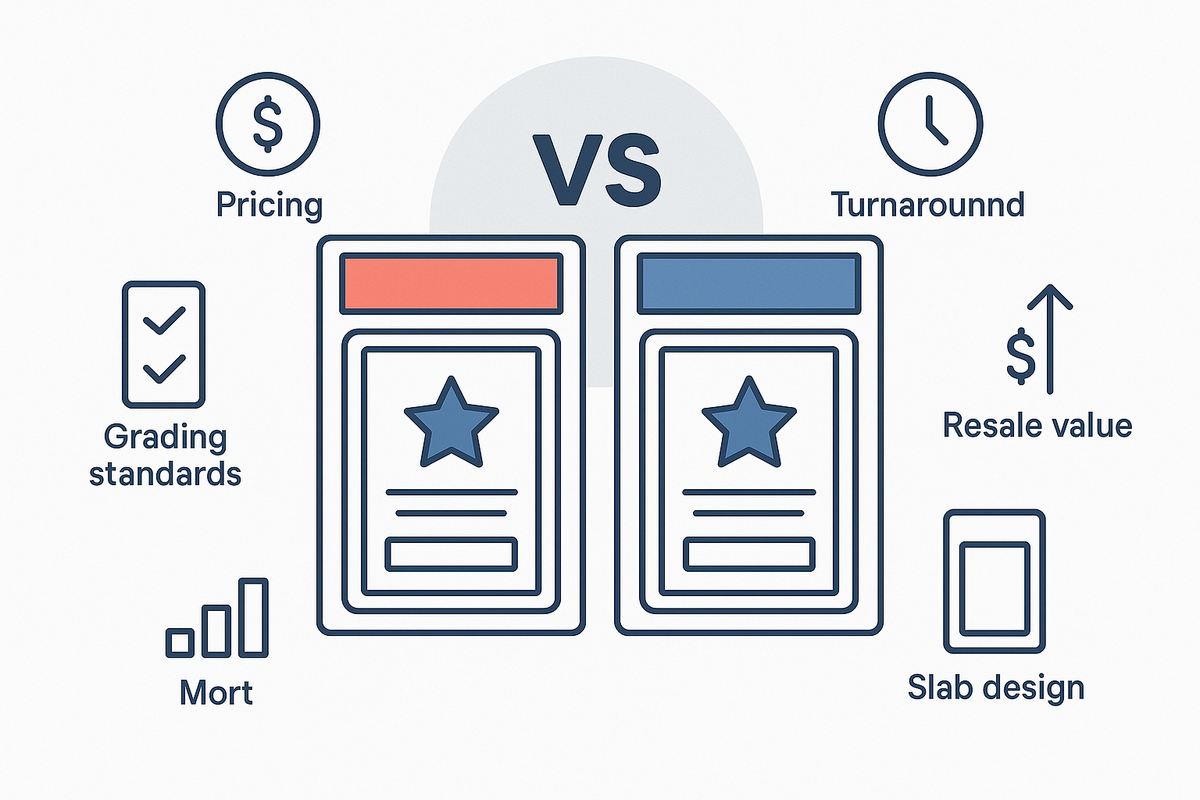
Compare PSA vs CGC for card grading: pricing, turnaround, resale value, grading standards, slab design, and more. Find out which is best for your collection.

Estimated reading time: 13 min
Key Takeaways
- PSA generally offers higher resale value and market liquidity than CGC, especially for sports and vintage cards.
- CGC provides faster turnaround times and more transparent subgrades; its Pristine 10 is widely considered harder to achieve than PSA Gem Mint 10.
- For Pokémon cards, both are strong choices, but PSA 10s typically command a premium.
- Slab design, label style, and grading standards differ; CGC is often stricter on centering and surface flaws.
- Bottom line: Choose PSA for maximum value; CGC for speed, transparency, and budget submissions.
When it comes to grading trading cards, "PSA vs CGC" is one of the most debated topics among collectors. Which company is right for you? The quick answer: PSA is widely regarded as the standard for resale and market trust, while CGC offers faster, more affordable grading with transparent subgrades. Let's break down how they compare—covering pricing, turnaround, grading standards (including Gem Mint vs Pristine grades), resale value, slab design, and more.
Quick Comparison
| Feature | PSA | CGC |
|---|---|---|
| Grading Fees (2024) | Starts at $19 (Value); $30+ for regular | Starts at $15 (Bulk); $25+ for standard |
| Turnaround Times | 30-60+ days (Value), 10-20 days (Express) | 10-30 days (Bulk/Standard), 5-10 days (Express) |
| Top Grade | Gem Mint 10 | Pristine 10 (generally considered harder to achieve than PSA 10); Gem Mint 10 |
| Subgrades | No | Yes (Centering, Corners, Edges, Surface) |
| Resale Value | Highest in industry, especially for PSA 10 | Strong but generally lower than PSA; Pristine 10 can sometimes rival PSA 10 |
| Slab & Label Design | Classic red/white label, strong brand | Modern blue/black label, scores subgrades |
| Population Reports | Largest, established since 1991 | Growing, transparent, data-rich |
| Market Liquidity | Widely accepted globally | Strong, especially for Pokémon/TCG |
| Best For | Vintage, sports, max resale | Pokémon, modern TCG, quick/budget grading |
Pricing & Grading Fees: PSA vs CGC
Grading cost is usually the first deciding factor. PSA’s base fees start higher than CGC’s, especially for non-bulk submissions:
- PSA: $19 per card (Value tier, with membership, max declared value $499); $30+ for regular submissions.
- CGC: $15 per card (Bulk, 25+ cards); $25 for Standard (no minimums). Discounts for CGC members.
Additional charges may apply for higher-value or faster-tier submissions. For large batches or lower-value cards, CGC is often more budget-friendly.
See the in-depth breakdown of how to estimate grading fees and outcomes before you submit.
Turnaround Times & Submission Tiers
Submission speed can make or break a grading strategy, especially if you're flipping or timing a hot market.
- PSA: Value tier can exceed 30-60 days during busy periods; Express/Walkthrough is much faster (as quick as 3-7 days) but expensive.
- CGC: Typically 10-30 business days for most tiers, with Express often under 10 days. CGC’s turnaround times are often more consistent, even during surges.
For collectors who want their slabs back fast or are operating on a strict timeline, CGC may have the edge.
Grading Standards: Gem Mint vs Pristine, Subgrades, and Difficulty
This is where things get nuanced. PSA uses a single overall grade (no subgrades). CGC employs subgrades (centering, corners, edges, surface), offering more transparency:
- PSA Gem Mint 10: The highest grade for PSA, allows very minor flaws. Centering must be at least 60/40 (front) and 75/25 (back).
- CGC Gem Mint 10: Requires no more than one minor flaw per subgrade. Centering must be 55/45 or better (front) and 75/25 (back).
- CGC Pristine 10: Even stricter—no flaws visible without magnification. All subgrades must be 10 except one (can be 9.5). Centering: 55/45 or better.
- BGS (for reference): Black Label 10 is the most difficult in the hobby; all subgrades must be 10. Gold Label 10 allows one 9.5 subgrade.
Getting a CGC Pristine 10—or BGS Black Label 10—is generally considered significantly tougher than PSA 10. Many cards that get PSA 10 may only reach CGC 9.5 or BGS 9.5, especially if centering isn’t perfect. For a technical deep dive into grading criteria and the role of centering, see the guide to centering and card value.
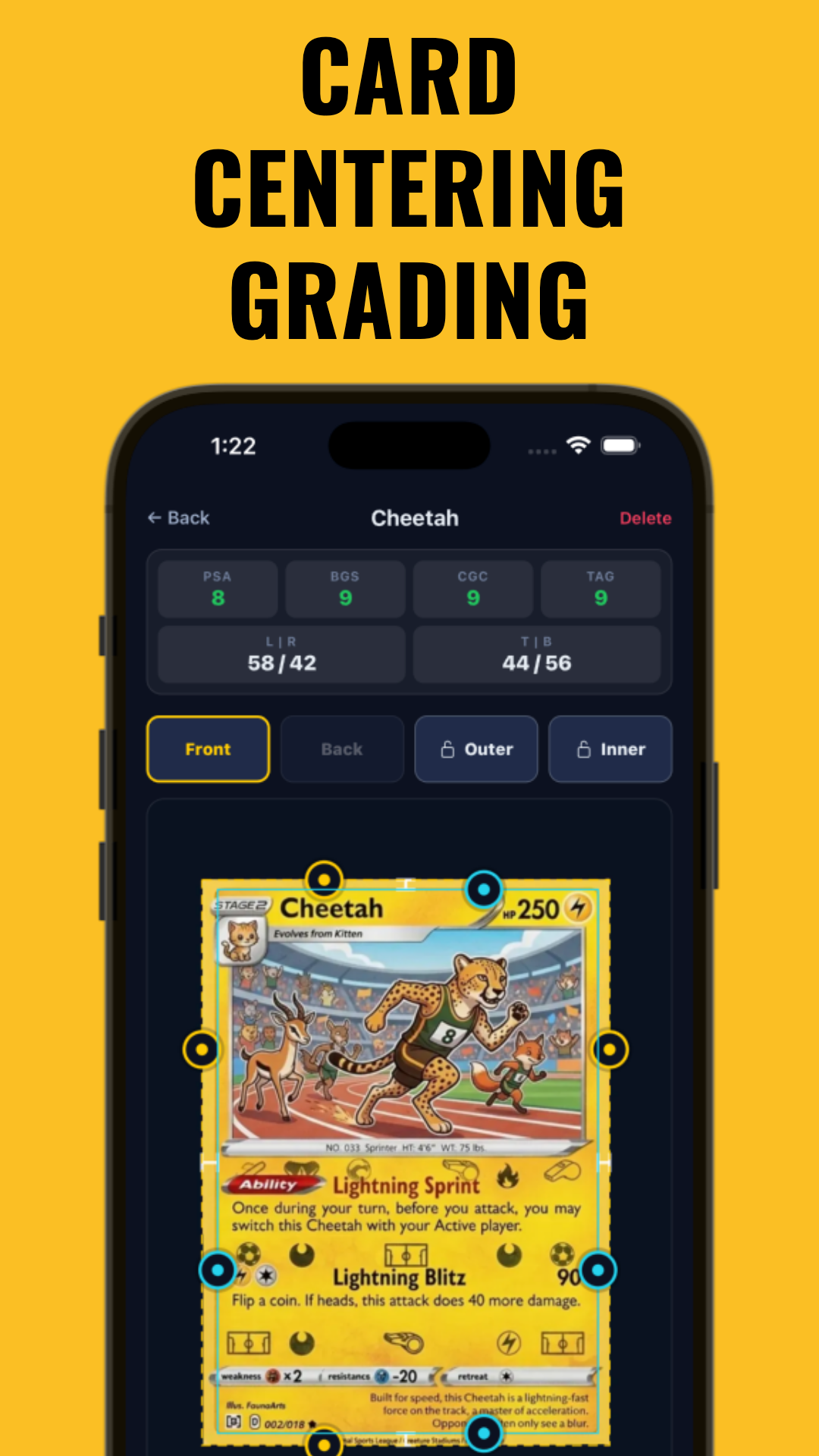
To estimate your card’s centering before grading, tools like Midpoint can help by simulating PSA, CGC, and BGS centering grades in advance.
Resale Value & Market Premium: Which Slab Sells for More?
PSA 10 cards generally command the highest prices across most categories, especially vintage sports and Pokémon cards. It is common for a PSA 10 to sell for a significant premium over a CGC 10 or BGS 9.5—sometimes more for iconic cards. Reasons include:
- PSA’s longer history and brand trust (since 1991)
- Largest pop report and collector base
- Market inertia—auction houses, breakers, and dealers often default to PSA
CGC Pristine 10 cards can sometimes rival or even surpass PSA 10 in some modern Pokémon and TCG sales, but they are much rarer. CGC 9.5 and standard 10s usually trail PSA 10 in value. BGS Black Label 10 is the hardest to get and can command a massive premium but is much less common in the wild.
For a specific card, compare recent sales on eBay and pop report data. For most collectors aiming for maximum resale, PSA is still generally preferred.
Slab Design, Label Style, and Card Protection
The look and feel of a slab is subjective but important for many collectors.
- PSA: Red/white label, clear and classic. Slabs are slightly thinner but sturdy. Highly recognizable in the hobby.
- CGC: Blue (or black for Pristine) label. Sleek, modern appearance. Subgrades are clearly listed for added transparency. Some prefer the CGC slab’s UV protection.
- BGS: Known for thick, heavy slabs and bold labels. Black Label 10 is highly coveted.
CGC’s subgrades make it easy to see why a card didn’t get a perfect 10. PSA’s single grade keeps things simple but less informative. For tips on how centering and other factors visually impact grades, check out this centering measurement guide.
Population Reports, Market Liquidity, and Brand Recognition
Population reports help you gauge rarity and market saturation. PSA’s population report is the largest and most established, making it the reference standard for most high-end sales. CGC’s database is growing rapidly, especially in the Pokémon and TCG space.
- PSA: Top choice for collectors, dealers, and auction houses. Global brand recognition.
- CGC: Rapidly catching up in TCGs. Trusted among modern collectors, especially for transparency and quick grading cycles.
Liquidity is highest with PSA, but CGC slabs (especially high grades) are widely accepted—notably for newer Pokémon and Magic cards.
Which Should You Choose?
Ultimately, your best choice depends on your collecting goals, budget, and timeline:
- Maximum Resale Value: PSA, especially for sports, vintage, and iconic Pokémon cards.
- Fast Turnaround or Budget Grading: CGC, particularly for large TCG submissions or modern cards.
- Transparency (Subgrades): CGC, if you want detailed breakdowns (centering, corners, edges, surface).
- Rarest/Most Prestigious Grade: BGS Black Label 10 (for the true perfectionist), but extremely hard to get.
- Pokémon/TCG Focus: Both are strong; PSA 10 gets the price premium, but CGC’s Pristine 10 is a true rarity.
Before submitting, it’s wise to pre-grade your cards for centering and surface flaws. Midpoint makes it easy to measure centering down to the millimeter and estimate your odds of a PSA 10 or CGC Pristine 10—helping you avoid costly surprises. For a step-by-step pre-grading strategy, see this guide to pre-grading.
FAQ
- Is PSA or CGC better for Pokémon cards?
Both are respected for Pokémon, but PSA 10s often earn higher resale prices. CGC is popular for modern sets due to faster, cheaper grading and transparent subgrades. - Does PSA graded cards sell for more than CGC?
In most cases, PSA 10 cards sell for more than their CGC 10 or 9.5 counterparts. CGC Pristine 10s can sometimes match or exceed PSA 10s, but they are rare. - Is CGC grading stricter than PSA?
Generally, yes. CGC’s grading is often considered stricter, especially for centering and surface. Their Pristine 10 is widely regarded as harder to achieve than PSA’s Gem Mint 10. - Which grading company has faster turnaround times, PSA or CGC?
CGC usually offers faster and more consistent turnaround times, particularly for bulk and standard tiers. - Can you crossgrade a CGC card to PSA and get a higher grade?
It’s possible, but not guaranteed. Some CGC 9.5s cross to PSA 10s, but CGC 10s are often equivalent to PSA 10s. Cracking a CGC slab and resubmitting to PSA carries some risk. - Which is better for resale value, PSA or CGC?
PSA is generally preferred for maximum resale value across most categories, due to its established market dominance and brand recognition.
Free to start
Try the Midpoint app
Grade any card from a photo, see its raw and PSA 10 value, and track what your collection is worth — free.
Get it on iPhoneGet it on Android