Soccer Card Prices Dropping November 2026: Buy or Sell?
Soccer card prices dropping November 2026? See why prices cool, which cards lost value, and how to grade a well-centered cheap copy.

Estimated reading time: 9 min
Key Takeaways
- Soccer card prices may be dropping in November 2026, and the likeliest explanations are new supply and World Cup hype fading now that the tournament (June to July 2026) has ended.
- Haaland cards and mid-tier rookies are usual places to look first for weakness. Messi and Ronaldo tend to hold up better.
- Falling prices can open a window to buy the dip, but only if you check sold comps and the condition of the specific copy.
- A cheap raw card that centers well can be a smarter play than paying up for a slab, as long as you measure centering before you pay to grade.
Soccer card prices dropping in November 2026 is the story collectors keep asking about, and the answer is not a simple "sell everything" or "buy everything." The soccer card market in November 2026 appears to be a mix of more supply, shifting attention, and a World Cup that has just ended.
This guide walks through what may be driving falling soccer card prices, which cards tend to lose value first, and how to use a dip without getting burned. This post does not include a price table or quote specific card prices, so check current sold comps for the raw and PSA 10 values of each player.
30-day price movers — live data from Midpoint's card database, as of 2026-11-08. Prices move; Midpoint refreshes these daily.
| Card | Raw | PSA 10 | 30-day | |
|---|---|---|---|---|
 |
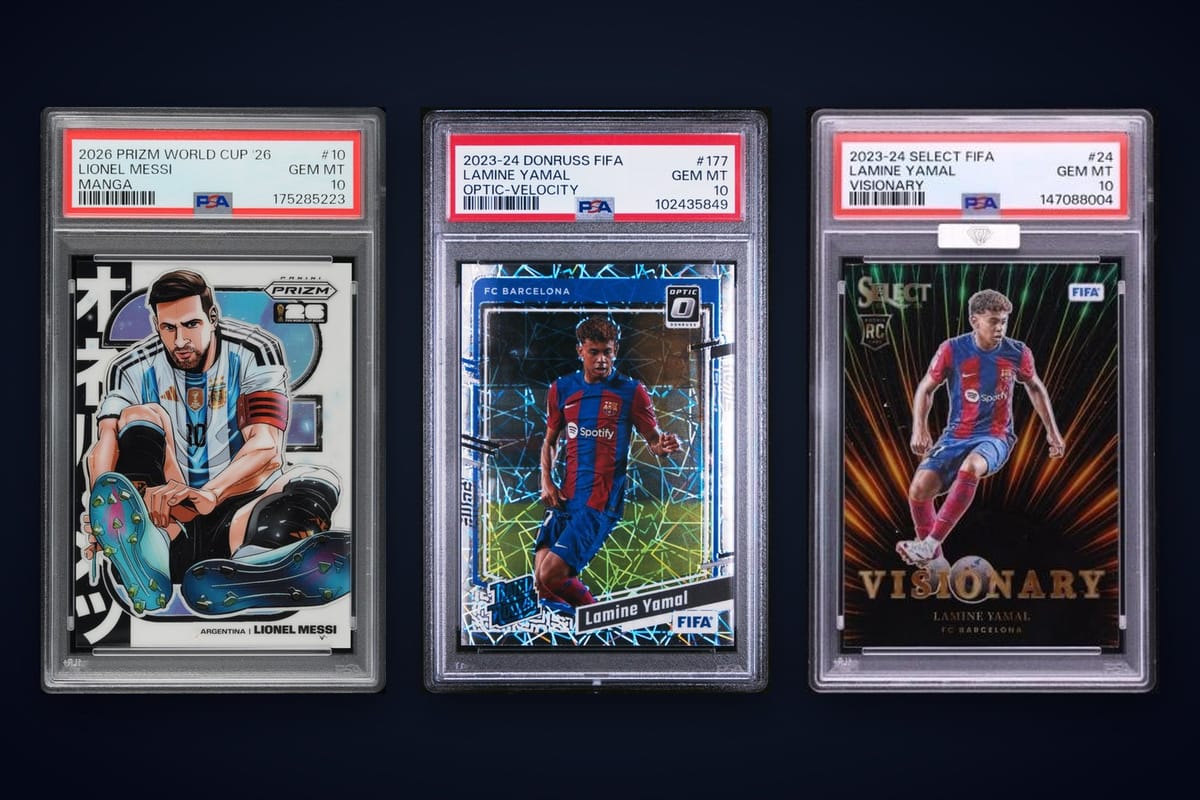
Lionel Messi #10 2026 Panini Prizm FIFA Manga |
$3,900 | $7,382 | -33.5% |
 |
Lamine Yamal [Velocity Optic] #177 2023 Panini Donruss |
$89.75 | $588.48 | 0% |
 |
Lamine Yamal #24 2023 Panini Select FIFA Visionary |
$265.15 | $1,200 | 0% |
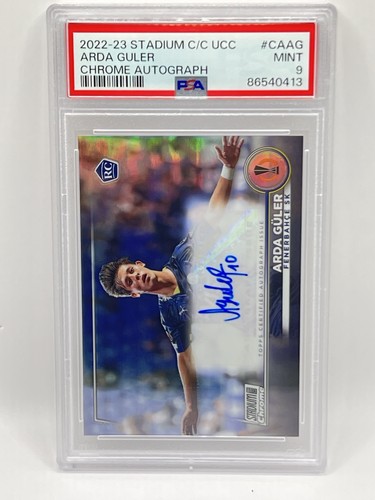 |
Arda Guler #CA-AG 2022 Stadium Club Chrome UEFA Competitions Autographs |
$101.30 | $321.00 | 0% |
 |
Lamine Yamal / Pau Cubarsi #DS-FCB 2024 Panini Select FIFA Dual Swatch |
$55.00 | $235.91 | 0% |
 |
Pele #635 1958 Alifabolaget |
$9,656 | — | 0% |
 |
Maradona #312 1979 Panini Calciatori |
$1,396 | $225,700 | 0% |
Look up any card's current raw and graded value in Midpoint — and get an estimated grade before you pay to submit.
1. Why Soccer Card Prices Are Dropping in November 2026
Prices fall when supply grows faster than demand. That is a likely explanation here, and three forces may be stacking up at once.
- More product: 2026 releases put more copies of the same players in front of buyers.
- Attention rotating: collectors chase the next release, so older cards lose the spotlight.
- Post-event cooldown: the World Cup ended in July 2026, and hype-driven demand often fades after a tournament.
None of this means the hobby is broken. It suggests the easy part of the cycle, where almost everything rose, has cooled and individual cards are being repriced one by one.
2. New 2026 Releases Are Adding Supply
Several 2026 products may be adding inventory to the market, such as:
- Topps Flagship Bundesliga: a wide-reaching base product that puts many cards of the same names into circulation.
- Stadium Club Chrome UEFA: a popular chrome set with a lot of parallels for players already in demand.
- Panini National Treasures Road to FIFA World Cup 26: a premium, World Cup-themed product that gets attention, though most of its rare cards live in the high-end tier.
The practical effect is that a player who once had a handful of listings can suddenly have dozens. When a buyer sees that many options, price pressure can follow, especially on non-numbered base and common parallels.
3. Haaland Cards Can Be Exposed
Erling Haaland is a superstar, but superstar status does not make every card safe. His cards are printed in many products, and heavy supply across many sets tends to push down the common versions first.
What to do with that information:
- Compare recent raw and PSA 10 sold prices for each Haaland card you are considering.
- Separate scarce, numbered cards from widely available base cards. They behave differently.
- Be cautious about adding more copies of a card that already has a lot of listings.
4. Mid-Tier Rookies Often Lose Value Fastest
Mid-tier rookies are the classic casualties in any soccer card market cooldown. They carry some hype from a good season or a transfer, but not the proven global demand of Messi or Ronaldo.
When the hype fades, the buyer pool is thin. A player who looked like a sure rising star can see their cards sit unsold while asking prices drift downward.
- Watch for cards where many listings are sitting unsold.
- Check whether recent sales came in below the asking prices you see.
- Avoid paying a rookie premium for a player without a long track record of collector demand.
5. Raw vs. PSA 10: Grading Premiums Are Under Pressure
A common question is whether PSA 10 soccer cards are falling as much as raw cards. The honest answer is that it depends on the card, and comparing recent raw and PSA 10 sold prices side by side will show you.
Here is how the two usually behave:
- Raw cards: they tend to react fastest to supply because anyone can list a copy, and sellers compete on price.
- PSA 10 cards: they can be stickier because a gem-grade copy is rarer, but the gap over raw shrinks when raw gets cheap.
That shrinking gap is the important part. When raw is cheap and the PSA 10 premium stays high, grading a good copy can pay off. If both fall together, the math gets tighter, and the grading fee matters more.
6. Messi and Ronaldo Show Greater Price Resilience
Lionel Messi and Cristiano Ronaldo cards tend to fall less in soft markets. The reason is demand that does not depend on a single season: both have global followings, long careers, and collectors who buy them regardless of what is trending.
That does not make them immune. It means the floor is usually firmer than for newer names. Look at recent Messi sales and compare raw to PSA 10 to see where the real premium sits.
- Established icons often attract steady buyers during dips.
- Scarcer, numbered or autographed versions usually hold better than base cards.
- Raw copies of icons are generally a safer place to park cash than speculative rookies.
7. Mbappé and Lamine Yamal: Read the Sales, Not the Hype
Kylian Mbappé and Lamine Yamal are two of the most-watched names in the soccer card market. Mbappé is an established star, while Yamal is a younger name carrying a lot of future expectation.
That difference matters in a dip. Established stars tend to hold more steadily. Younger players can swing hard in either direction because so much of their price is based on what collectors believe will happen next.
Use recent sold comps as your starting point. Compare each player's raw and PSA 10 values, then ask whether the premium for a graded copy matches how scarce and desirable that exact card is.
8. World Cup 2026 Hype Cycles: Expect a Cooldown After the Event
Tournament years follow a rhythm. Interest climbs as the event approaches, spikes while matches are played, and often cools afterward. Collectors who buy only at the peak of excitement tend to pay the most.
That affects both sides of the market right now:
- Buying after the tournament: some collectors pick up cards while hype cools, hoping to buy below peak-hype prices.
- Selling into hype: others sold before or during the event, because the post-hype cooldown can be rough. Those still holding may be deciding whether to wait.
Neither plan is guaranteed. A World Cup run can lift one player and ignore another. Treat renewed demand as a possibility, not a promise, which also answers whether soccer cards are a good investment after the 2026 World Cup: they can be, but only with realistic expectations and money you can afford to leave alone.
9. Read eBay Activity Before You Trust Any Price
Recent eBay auction activity is the best live signal of what buyers will actually pay. Asking prices are opinions. Sold prices are facts.
When you look at a soccer card's listing page, check:
- Sold vs. active listings: a card with many active listings and few sales is likely under pressure.
- Auction endings: several auctions ending below earlier prices is a sign of falling demand.
- Condition in the photos: a cheap copy might be cheap because of poor centering or damaged corners.
This is how you separate a real bargain from a card that is cheap for a reason.
10. Buy the Dip by Grading a Well-Centered Cheap Copy
Here is a practical way to use falling soccer card prices. Instead of paying a high price for a PSA 10, buy a raw copy while prices are soft, then check whether it has gem potential.
Centering is usually the first thing to check, and it is the easiest to measure. PSA's commonly cited standard for a 10 is roughly 55/45 or better on the front and 75/25 on the back, so a copy near those limits gives you a real chance.
Follow these steps before you submit:
- Measure the front and back borders. Midpoint's free centering calculator gives you the ratios in seconds.
- Inspect corners, edges and surface under good light.
- Follow a proper routine, like this step-by-step guide to pre-grading your card.
- Compare the raw price plus the current grading fee (check the grader's current pricing, since fees vary by tier and shipping adds cost) against recent PSA 10 sold prices.
If the numbers do not leave room for profit, skip it. Centering is a big driver of final grade, which is why it is worth understanding how centering impacts card value.
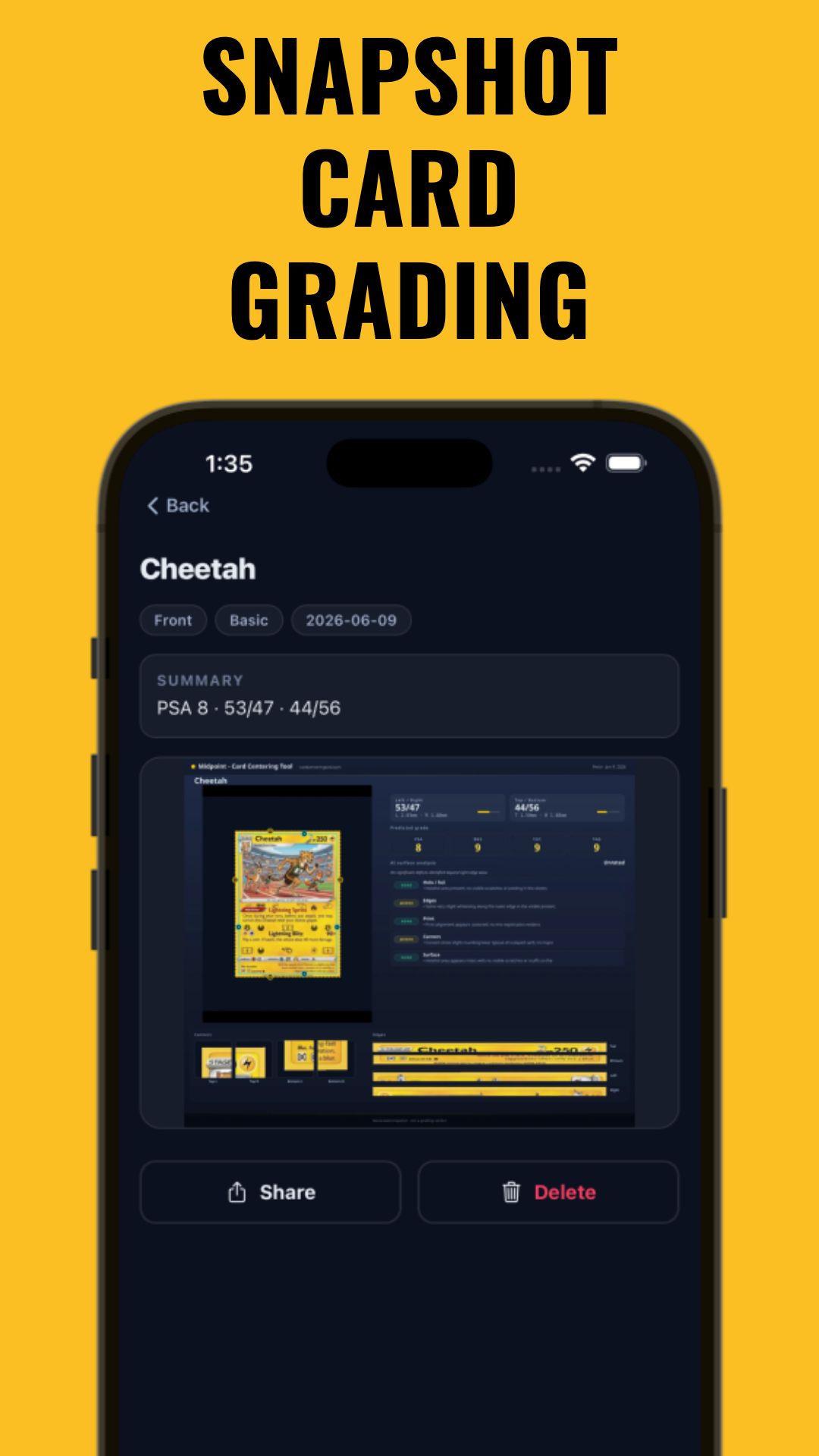
Midpoint also gives estimated PSA, BGS, CGC and TAG grades from centering, corners, edges and surface, so you can decide before you pay to submit. Grading companies score differently, so see the grading scale differences by company before choosing where to send a card.
Conclusion
Soccer card prices dropping in November 2026 looks like a market digesting new supply and post-World Cup cooling, not a reason to panic. Cards with broad print runs and thin demand, like many Haaland base cards and mid-tier rookies, tend to be the most exposed, while icons like Messi and Ronaldo tend to be steadier.
The smartest moves are simple: check sold comps, compare raw and PSA 10 values, and only buy the dip on cards you have inspected. If a cheap copy centers well, grading it can turn a soft market into an opportunity. Midpoint is free on iOS and Android if you want to measure before you spend.
FAQ
Q: Why are soccer card prices dropping in November 2026?
A: Likely supply and fading hype. 2026 releases put more copies on the market, and demand often cools after a World Cup. When supply grows faster than demand, prices soften.
Q: Which soccer cards are losing the most value right now?
A: Widely printed cards and mid-tier rookies are usually hit first, along with common Haaland cards. Check recent raw and PSA 10 sold prices for specifics.
Q: Are soccer cards a good investment after the 2026 World Cup?
A: They can be, but nothing is guaranteed. Tournament hype can lift some players and ignore others, and prices often cool afterward. Only invest money you can leave alone for a while.
Q: Should I buy soccer cards during the November 2026 price dip?
A: Buy selectively. Check sold prices, avoid cards with piles of unsold listings, and favor copies with strong centering and clean condition. Do not chase every cheap listing.
Q: Which soccer cards are holding their value best in November 2026?
A: Established icons like Lionel Messi and Cristiano Ronaldo tend to show more resilience because their demand does not depend on one season or one product.
Q: Are PSA 10 soccer cards falling as much as raw cards?
A: Not always. Raw cards tend to react faster to supply, while PSA 10 copies can be stickier because they are rarer. Compare recent sold prices for both to see the gap for each card.
Free to start
Try the Midpoint app
Grade any card from a photo, see its raw and PSA 10 value, and track what your collection is worth — free.
Get it on iPhoneGet it on Android