Tim Duncan Cards Worth Money: Rookies, Parallels & PSA 10s
Which Tim Duncan cards are worth money? Compare rookie card value, top parallels, raw vs PSA 10 and the best cards to grade before you submit.

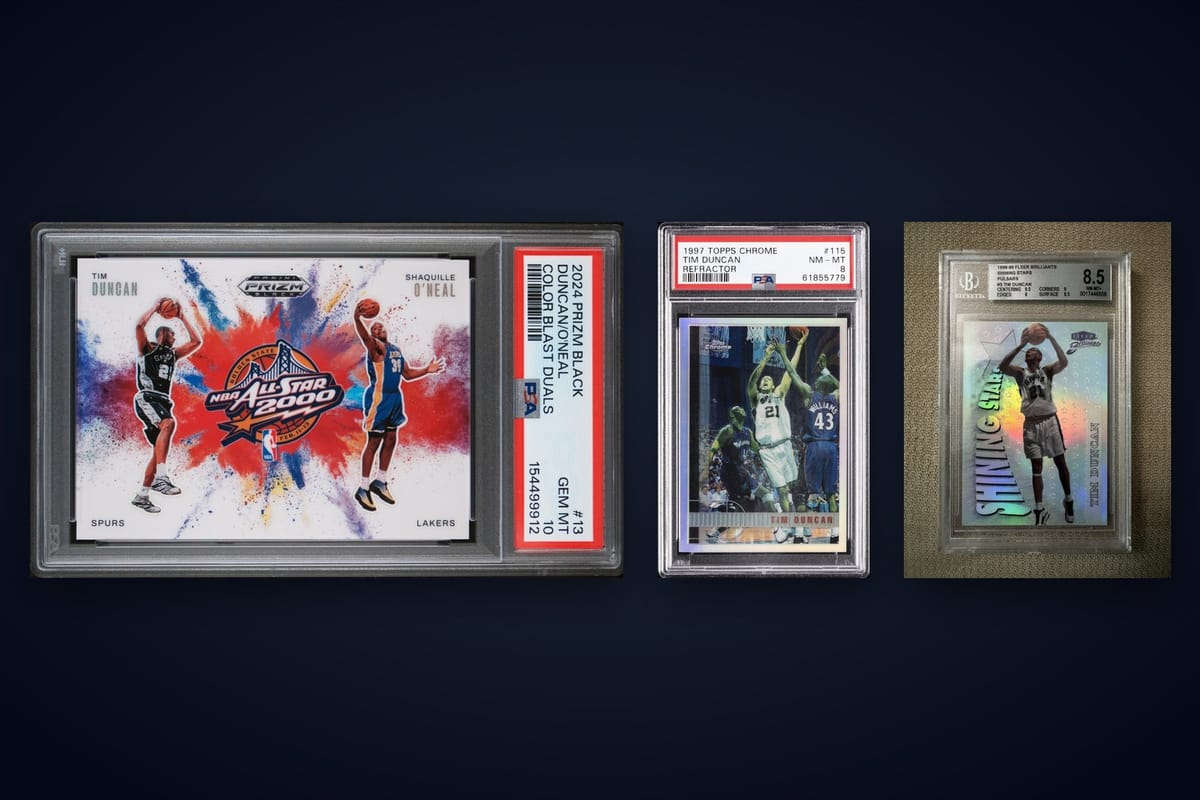
Estimated reading time: 11 min
Key Takeaways
- Tim Duncan cards worth money fall into three tiers: the 1997-98 rookies (Topps Chrome #115, SP Authentic #128, SkyBox Premium), the numbered parallels and inserts, and autographs.
- The most valuable Tim Duncan cards are scarce, serial-numbered or ultra-short-print items such as Metal Universe Precious Metal Gems and E-X2001 Jambalaya, and they trade rarely.
- Condition drives the spread between raw and Tim Duncan PSA 10 prices. Centering, corners, surface and print defects decide the grade.
- Only grade a card when the estimated grade-based upside clearly beats grading fees. Pre-grade first and compare against sold prices, not asking prices.
Card values — live data from Midpoint's card database, as of 2026-09-04. Prices move; Midpoint refreshes these daily.
| Card | Raw | PSA 10 | Gem premium | |
|---|---|---|---|---|
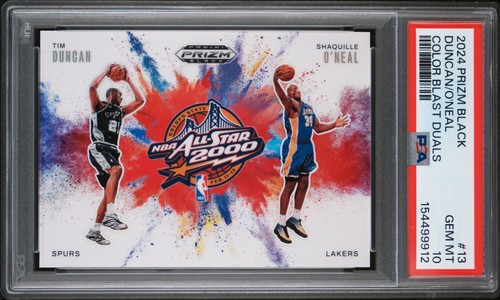 |
Shaquille O'Neal / Tim Duncan #13 2024 Panini Prizm Black Color Blast Dual |
$3,250 | $13,244 | 4.1× |
 |
Tim Duncan [Refractor] #115 1997 Topps Chrome |
$1,050 | $6,815 | 6.5× |
 |
Tim Duncan [Pulsars] #3 1998 Fleer Brilliants Shining Stars |
$275.00 | $6,461 | 23.5× |
 |
Tim Duncan / Victor Wembanyama #9 2024 Panini Prizm Black Color Blast Dual |
$2,752 | $4,850 | 1.8× |
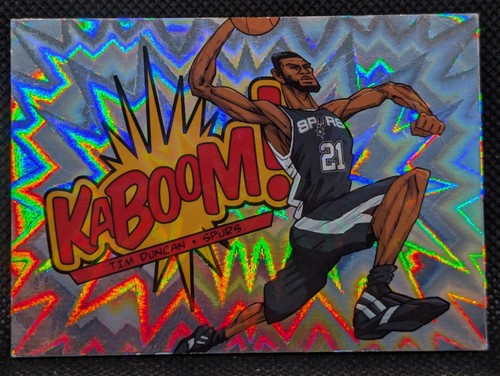 |
Tim Duncan #7 2013 Panini Innovation Kaboom |
$1,202 | $4,741 | 3.9× |
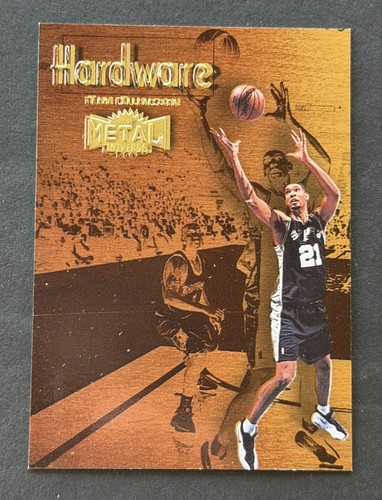 |
Tim Duncan #12 1997 Metal Universe Championship Hardware |
$211.69 | $4,425 | 20.9× |
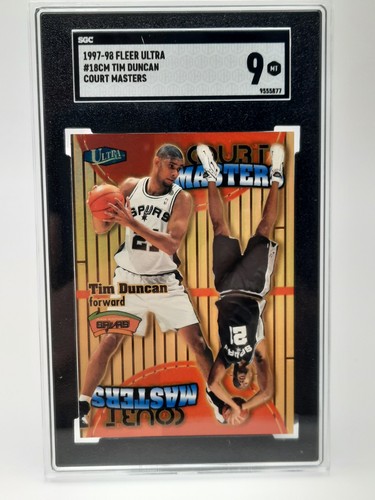 |
Tim Duncan #18 1997 Ultra Court Masters |
$171.50 | $3,750 | 21.9× |
 |
Tim Duncan [Refractor] #C8 1998 Finest Centurions |
— | $3,384 | — |
 |
Tim Duncan #18 1997 Ultra Star Power Supreme |
$358.28 | $3,369 | 9.4× |
 |
Tim Duncan #BP8 1997 Bowman's Best Picks |
$20.00 | $3,200 | 160× |
 |
Tim Duncan #1 1998 Skybox Premium That's Jam |
$864.21 | $3,119 | 3.6× |
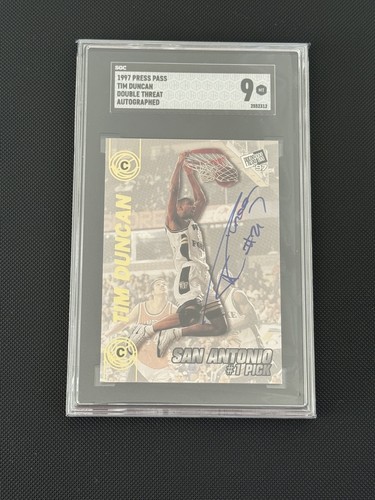 |
Tim Duncan 1997 Press Pass Autographs |
$304.20 | $2,500 | 8.2× |
Look up any card's current raw and graded value in Midpoint — and get an estimated grade before you pay to submit.
Table of Contents
- Section 1: Which Tim Duncan Cards Are Worth Money
- Section 2: Tim Duncan Rookie Card Value
- Section 3: Most Valuable Tim Duncan Cards: Parallels and Inserts
- Section 4: Autographed Tim Duncan Cards
- Section 5: Tim Duncan PSA 10 vs Raw: How Condition Moves Price
- Section 6: Best Tim Duncan Cards to Grade
- Section 7: How to Identify, Value and Decide: Sell, Hold or Grade
- Conclusion
- FAQ
Section 1: Which Tim Duncan Cards Are Worth Money
If you are asking which Tim Duncan cards are worth money, start with who he was. Duncan was the first overall pick in the 1997 NBA Draft, won five championships with the Spurs, took two MVP awards and entered the Hall of Fame in 2020. That résumé gives his 1997-98 rookie class lasting collector demand.
Not every Duncan card carries that demand, though. Value follows scarcity, condition and card type, in that order.
The three value tiers
- Tier 1, mainstream rookies: 1997-98 Topps Chrome #115, SP Authentic #128 and SkyBox Premium. These are widely available, so raw copies are accessible and the real premium sits in high grades.
- Tier 2, numbered parallels and short-print inserts: Metal Universe Precious Metal Gems (Emerald/Green and Red), E-X2001 Essential Credentials and the E-X2001 Jambalaya. These can sell for far more than any base rookie, but sales are infrequent.
- Tier 3, autographs: 1998 SkyBox Autographics and 2000 Topps Finest Moments autographs, where the autograph type matters as much as the card.
Asking prices vs completed sales
The biggest mistake with Duncan cards is quoting a listing price as the value. A seller can ask anything. A completed sale is what a buyer actually paid. For rare cards that trade once or twice a year, a single sale can reset the perceived market, so look at several comps and the dates.
The data table that follows this section lists current raw and graded values for specific Duncan cards from Midpoint's database, as of 2026-09-04. Use it as a snapshot, then cross-check against recent sold listings before you buy or sell.
Section 2: Tim Duncan Rookie Card Value
Tim Duncan rookie card value depends heavily on which set you hold. Three 1997-98 cards anchor the market.
1997-98 Topps Chrome #115
The Topps Chrome Duncan is the rookie most collectors picture first. The chromium stock gives it a glossy look, and it sits in the same product as a famous rookie class. That popularity creates a large supply of graded copies, so a PSA 10 is the benchmark and lower grades generally trade at a discount.
Chrome stock is also unforgiving. Dark borders show edge chipping, and surface lines and print dots are common reasons for lower grades. A Chrome Duncan that looks clean at arm's length can still miss a 10 under magnification.
1997-98 SP Authentic #128
SP Authentic #128 is a premium-feeling rookie with a distinct design and a strong following among long-time collectors. It is a different card from the Chrome and it has its own comp set. Do not assume the two track each other, since each follows its own supply of high grades.
1997-98 SkyBox Premium
SkyBox Premium is another respected Duncan rookie. It is often more affordable than the top Chrome or SP Authentic grades, which can make it a good entry point if you want a true 1997 rookie without paying a premium-grade price.
What affects rookie value most
- Grade: the gap between a 9 and a 10 is often the single biggest price jump.
- Card number and set: confirm you have #115 Chrome or #128 SP Authentic, not a later reprint or a different set.
- Eye appeal: centered, bright, sharp-cornered copies sell faster and for more within the same grade.
For rookies, check the data table for raw versus graded values as of 2026-09-04, then use sold comps for the exact grade you own.
Section 3: Most Valuable Tim Duncan Cards: Parallels and Inserts
The most valuable Tim Duncan cards are rarely the base rookies. They are the pieces collectors almost never see for sale.
Metal Universe Precious Metal Gems
The 1997-98 Metal Universe Precious Metal Gems (PMG) parallels are legendary in 90s basketball collecting. The Emerald/Green and Red versions are the headline Duncan variants because they are extremely scarce. When one of these sells at auction, it tends to set the tone for the whole market, and sale prices have reached levels far above any base rookie.
Because so few exist, price discovery is thin. One buyer's determination can swing a result, so treat any single record as an upper reference point, not a typical price.
E-X2001 Essential Credentials
E-X2001 Essential Credentials parallels are numbered, which gives them a built-in supply cap. Numbered cards are attractive to completionists and investors because you can identify exactly how many were produced. Verify the serial number on the card matches the listing.
1997-98 E-X2001 Jambalaya
The Jambalaya is an iconic ultra-rare insert. Its reputation comes from very long pack odds and its scarcity. Because it is so seldom offered, completed sales are sparse, and grading status matters a great deal. Always compare like-for-like grades and confirm authenticity before paying a premium.
Why scarcity cards behave differently
- Low liquidity: you may wait months for a comp.
- Wide spreads: bid and ask can be far apart.
- Authentication matters: counterfeits and altered cards target the rarest items. Buy graded or from reputable sellers.
Midpoint's database tracks raw and graded values across over 1.5 million cards, and the table after Section 1 shows several of these Duncan parallels as of 2026-09-04.
Section 4: Autographed Tim Duncan Cards
Duncan autographs are a separate market. Two names come up most: the 1998 SkyBox Autographics and the 2000 Topps Finest Moments autograph.
1998 SkyBox Autographics
SkyBox Autographics is an early autograph insert with strong nostalgia value. Collectors look for a clean signature, strong contrast between ink and card, and a card that has not been handled heavily. Compare sales of the same card, not a different autograph issue.
2000 Topps Finest Moments
The Finest Moments autograph is a Topps product with its own comp history. Pay attention to the specific version, since Topps products often include parallels with different scarcity.
On-card vs sticker autographs
This distinction matters for price and buyer confidence.
- On-card: the player signed the card directly. Collectors usually prefer this for its look and perceived authenticity.
- Sticker: the player signed a label that was applied to the card. Still legitimate, but typically viewed as less desirable.
Read the listing carefully, and confirm which type the specific card was issued with.
Authentication and grading
An autograph card has two things to evaluate: the card's condition and the signature's authenticity and quality. A card can have a perfect surface and a faded signature, and a grading company will typically assess each separately. Buy autographs with third-party authentication where possible, and be cautious about unlabeled signatures.
Check how the autograph was issued before you pay up. A card with an authentic, on-card, strong signature and clean corners is the version that tends to hold value best over time.
Section 5: Tim Duncan PSA 10 vs Raw: How Condition Moves Price
The gap between a raw card and a Tim Duncan PSA 10 is where most collectors make or lose money. Grading companies evaluate centering, corners, edges and surface, and Duncan's 1997 cards can be tough on each.
Centering
Centering measures how evenly the image sits within the borders. 1990s cards often have off-center prints, and a card with obviously uneven borders will not reach a 10. Measure both axes before you think about submitting. Our guide on how centering impacts card value explains the ratios in detail.
Corners, edges and surface
- Corners: look for whitening or softness, especially on dark-bordered cards.
- Edges: chipping is a common issue on chromium stock.
- Surface: scratches, print lines, fingerprints and dimples can all cap a grade.
- Print defects: dots, snow and registration issues were common in the era and can prevent a top grade even if the card looks pristine.
PSA vs BGS vs SGC vs raw
Each grader uses a different scale and weights things differently. PSA gives a single number, while BGS provides subgrades. SGC is known for its distinctive slab and is popular for vintage and 90s material. Raw cards sell at a discount that reflects the buyer's uncertainty about condition. For a breakdown, see our guide to grading scale differences by company.
The practical rule: a 10 earns a premium because it is rare, not because the card is worth more in absolute terms. Check the table after Section 1 for raw and graded figures as of 2026-09-04, and see how wide the spread is for each specific card.

Section 6: Best Tim Duncan Cards to Grade
The best Tim Duncan cards to grade are the ones where a high grade adds meaningful value over the raw price and the card has a realistic chance of earning it.
Good grading candidates
- 1997-98 Topps Chrome #115: strong demand and a clear raw-to-graded spread, as long as the centering and edges look clean.
- SP Authentic #128: worth submitting when the card is sharp and well centered.
- SkyBox Premium: a lower-cost option where a 10 can still be a satisfying result.
- Numbered parallels and inserts: usually worth authentication, since a slab adds trust on rare items.
Cards to think twice about
- Cards with visible off-centering, whitening or surface damage.
- Common base cards from later years where grading fees could exceed any gain.
- Raw copies bought on hope without checking the card closely.
Do the grading math
Compare three numbers: the raw price, the likely graded price at each grade (9 versus 10), and total cost including grading fees, shipping and insurance. If a 9 barely beats the raw price, grading is a gamble that only pays when you hit a 10.
Pre-grade before you pay
A pre-grade check saves money. Use the free centering calculator for a quick measurement, or follow our step-by-step pre-grading guide. Midpoint goes further with AI estimates of PSA, BGS, CGC and TAG grades from centering, corners, edges and surface, so you know what you are likely to get before you pay a fee.
Section 7: How to Identify, Value and Decide: Sell, Hold or Grade
How to identify your Tim Duncan card
Before pricing anything, identify it precisely. Look at the back of the card for these details:
- Year and set: for example 1997-98 Topps Chrome, SP Authentic or SkyBox Premium.
- Card number: #115 for Topps Chrome and #128 for SP Authentic.
- Parallel: Refractor, Precious Metal Gems or another variant. Colors and finishes must match exactly.
- Serial number: numbered cards print a stamp like 12/50 on the front or back.
- Autograph: check whether it is on-card or sticker, and whether it is authenticated.
- Rookie designation: confirm it is a true rookie issue.
Where to check value
- eBay sold listings: filter to sold items, not active ones.
- Auction archives: useful for high-end and rare cards where eBay comps are sparse.
- Price guides: a starting point, but they lag the market.
- Population reports: show how many copies exist at each grade, which helps you judge scarcity. See our guide on grading low population cards.
- Midpoint: look up raw and graded values and track your portfolio over time.
Sell, hold or grade?
Duncan is a Hall of Famer with a championship career, which supports long-term interest. But no card is guaranteed to rise, and prices can fall. Hold cards you love and can store safely, and see our guide to storing valuable cards. Sell when a price meets your goals. Grade when the numbers support it.
Conclusion
Tim Duncan cards worth money are not a single group. The 1997-98 rookies (Topps Chrome #115, SP Authentic #128 and SkyBox Premium) offer accessible entry points where grade drives price. The rarest items, including Metal Universe Precious Metal Gems, E-X2001 parallels and the Jambalaya, sit at the top of the market but trade rarely. Autographs add another layer in which card condition and signature type both count.
Before you buy, sell or submit, identify the exact card, compare completed sales rather than asking prices, and estimate the grade you are likely to receive. That discipline protects you from overpaying and from grading fees that do not pay off. Try Midpoint to measure centering, estimate grades and track what your Duncan cards are worth.
FAQ
Q: What Tim Duncan cards are worth money?
A: The 1997-98 rookies lead the way, including Topps Chrome #115, SP Authentic #128 and SkyBox Premium, especially in high grades. Numbered parallels and inserts such as Metal Universe Precious Metal Gems, E-X2001 Essential Credentials and the E-X2001 Jambalaya can be worth far more, as can authenticated autographs like 1998 SkyBox Autographics and 2000 Topps Finest Moments.
Q: How much is a 1997 Topps Chrome Tim Duncan rookie card worth?
A: It depends mainly on grade. A raw copy sells at a discount, and a PSA 10 earns a significant premium. Check the Midpoint data table for raw and graded values as of 2026-09-04, then compare recent eBay sold listings for the exact grade you own.
Q: What is the most valuable Tim Duncan card?
A: The most valuable are typically the scarcest, led by the Metal Universe Precious Metal Gems Emerald/Green and Red parallels, which have drawn some of the highest prices at auction. Because they trade so rarely, treat any single sale as a high-end reference, not a typical price.
Q: How much is a Tim Duncan Precious Metal Gems card worth?
A: These are among the highest-value Duncan cards, and prices vary widely by color, condition and grade. With so few sales, results depend on who is bidding. Review auction archives and any recent comps for the specific color you own.
Q: Are Tim Duncan rookie cards a good investment?
A: Duncan's Hall of Fame career supports lasting collector interest, but no card is guaranteed to appreciate. Condition, scarcity and market demand matter most. Buy cards you are comfortable holding, check sold comps, and do not grade without a realistic shot at a high grade.
Q: How do I find out how much my Tim Duncan basketball card is worth?
A: Identify the year, set, card number and parallel, then check eBay sold listings, auction archives and population reports. You can also look up raw and graded values in Midpoint and pre-grade the card to estimate what a grading company might assign.
Free to start
Try the Midpoint app
Grade any card from a photo, see its raw and PSA 10 value, and track what your collection is worth — free.
Get it on iPhoneGet it on Android