Which Grader Is Most Lenient on Centering? Full Comparison Guide
Discover which grader is most lenient on centering for Gem Mint 10s. Compare PSA, BGS, CGC, SGC & more with updated centering standards and real examples.

Estimated reading time: 14 min
Key Takeaways
- SGC is generally regarded as one of the more lenient graders on card centering for top grades, with PSA also considered relatively lenient.
- PSA, BGS, CGC, SGC, and TAG all have published centering standards—know their differences before submitting cards.
- Front and back centering tolerances differ; back centering is usually more lenient across all companies.
- Recent years have seen updates or clarifications to centering standards, so always check the latest guidelines.
- Using a tool like Midpoint helps you pre-measure and estimate potential grades—saving time and grading fees.
Table of Contents
- Section 1: Why Centering Matters in Card Grading
- Section 2: PSA Centering Standards and Leniency
- Section 3: BGS Centering Requirements Explained
- Section 4: CGC and SGC Centering Tolerances Compared
- Section 5: TAG Grading Centering and Modern Innovations
- Section 6: Centering Tolerance by Grade—Full Breakdown
- Section 7: Vintage vs. Modern Cards—Are Standards Different?
- Section 8: Tools & Tips—Pre-Grading Centering with Confidence
- Conclusion
- FAQ
Section 1: Why Centering Matters in Card Grading
The Role of Centering in Collectible Card Grading
Centering is one of the core criteria that every major trading card grading company uses. It refers to how evenly the card's printed image is positioned between its borders—both front and back. Poor centering can significantly reduce a card’s grade, even if the corners, edges, and surface are flawless. For high-value cards, even a few millimeters off can mean a substantial difference in value.
Why Graders Judge Centering Differently
Each grading company establishes its own standards, with slightly different tolerances for what counts as well-centered. Some are stricter, especially on the front, while others allow more leeway—especially for vintage or certain label tiers. Understanding these differences is crucial for maximizing your grade and ROI.
- Front vs. Back: Most graders are stricter on front centering than back.
- Gem Mint 10: The standards for a Gem Mint 10 are often the tightest and most scrutinized.
- Vintage vs. Modern: Some companies offer more leniency on vintage cards due to historical printing limitations.
How Centering Is Measured
Centering is typically expressed as a ratio (e.g., 55/45 or 60/40), meaning the percentage of border space on each side. A 50/50 card is perfectly centered. Some graders use digital tools, but most still rely on visual estimation, which introduces subjectivity.
For a step-by-step measurement guide, see the How to Measure Card Centering: Step-by-Step Precision Guide.
Section 2: PSA Centering Standards and Leniency
PSA Centering Standards: What Does PSA Allow?
PSA (Professional Sports Authenticator) is one of the largest card grading companies, known for detailed but sometimes forgiving centering standards. Here’s how PSA centering standards break down for their main grades:
- PSA 10 (Gem Mint): Front: 55/45 or better; Back: 75/25 or better
- PSA 9: Front: 60/40 or better; Back: 90/10 or better
- PSA 8: Front: 65/35 or better; Back: 90/10 or better
For a Gem Mint 10, PSA allows up to a 55/45 split on the front—meaning one side can have up to 10% more border than the other. The back is more lenient, allowing 75/25.
Is PSA Considered Lenient?
Among top graders, PSA is considered moderately lenient—especially compared to BGS and CGC. It’s not the most forgiving, but for modern cards, a PSA 10 is often considered easier to achieve than a BGS 10.
- PSA does not provide subgrades for centering, so borderline cards sometimes receive higher overall grades.
- Collectors often target PSA for cards with slightly off-center fronts.
Recent Changes in PSA Centering Standards
PSA has periodically clarified its centering guidelines for both modern and vintage cards. While the core ratios remain, the company has stated that "visual appeal" may allow minor exceptions, especially on older issues. Still, the published ratios are the best baseline.
To estimate your card’s centering and potential PSA grade, consider using Midpoint for millimeter-accurate measurements and instant grade prediction.
Section 3: BGS Centering Requirements Explained
BGS Centering Requirements by Grade
BGS (Beckett Grading Services) is known for its precision and subgrades, with centering a prominent factor in their overall score. BGS centering requirements are:
- BGS 10 (Pristine): Front: 50/50 to 55/45; Back: 60/40 or better
- BGS 9.5 (Gem Mint): Front: 50/50 to 60/40; Back: 65/35 or better
- BGS 9: Front: 60/40 or better; Back: 70/30 or better
- BGS 8.5: Front: 65/35 or better; Back: 75/25 or better
How BGS Subgrades Affect Centering Leniency
BGS uses subgrades, giving cards a specific centering grade (e.g., 9.5 for centering alone). The lowest subgrade can only be 0.5 below the final grade (except in rare cases), so weak centering can drag down an otherwise pristine card.
- Strict on Front: BGS is among the strictest for centering on Gem Mint 10s.
- Subgrades: Clear centering subgrades make BGS less forgiving for off-center cards.
PSA vs. BGS Centering: Which Is More Forgiving?
For most cards, PSA is generally more lenient than BGS on centering. For example, a card with 55/45 centering might get a PSA 10, but only a BGS 9.5 or 9 for centering. The transparent subgrade system means BGS rarely "misses" an off-center card.
For an in-depth comparison of AI and manual grading approaches, see AI-Focused Comparison: How AI Transforms Card Centering Analysis.
Section 4: CGC and SGC Centering Tolerances Compared
CGC Centering Standards
CGC (Certified Guaranty Company), known in the trading card and comic grading space, has centering standards similar to BGS:
- CGC 10 (Pristine): Front: 50/50 to 55/45; Back: 60/40 or better
- CGC 9.5: Front: 55/45 or better; Back: 65/35 or better
- CGC 9: Front: 60/40 or better; Back: 70/30 or better
CGC offers subgrades as an option—if you pay for them, you can see the exact centering score. This transparency is helpful for crossovers and resale.
SGC Centering: The Most Lenient?
SGC (Sportscard Guaranty Corporation) is often regarded as one of the more lenient major graders on centering—especially for Gem Mint 10s. Here are their published ratios:
- SGC 10: Front: up to 60/40 permitted; Back: 85/15 or better
- SGC 9: Front: 65/35 or better; Back: 90/10 or better
This 60/40 tolerance for an SGC 10 is more forgiving than PSA, BGS, or CGC, making SGC a popular choice for cards that are just outside PSA or BGS Gem Mint centering tolerances.
Front vs. Back Centering—Which Matters More?
All graders weigh front centering more heavily than back. For example, SGC allows a back ratio of 85/15 for a 10, while PSA and BGS hover around 75/25 or 70/30. If you're submitting a card with a slightly off-center back, SGC may be a better bet for a top grade.
Section 5: TAG Grading Centering and Modern Innovations
TAG Grading and Automated Centering Analysis
TAG (Technical Authentication & Grading) is a newer entrant with a tech-driven approach. Their centering evaluation is conducted digitally, aiming for higher consistency and less human error.
- TAG 10: Front: 55/45 or better (digitally measured); Back: 60/40 or better
- TAG 9.5: Front: 60/40 or better; Back: 70/30 or better
TAG’s digital tools make their centering standards transparent and reproducible. However, their published tolerances are similar to BGS and PSA—not more lenient, but potentially more consistent.
How TAG Compares to Traditional Graders
TAG’s centering tolerances do not exceed SGC’s in leniency, but their digital approach appeals to collectors looking for precision. For borderline cases, SGC is still more forgiving, while TAG offers consistency and traceability.
Using Tools to Match TAG’s Precision
If you want to match TAG’s digital accuracy, tools like Midpoint let you measure centering down to the millimeter before you submit, ensuring you know your card’s likelihood for a desired grade.
Section 6: Centering Tolerance by Grade—Full Breakdown
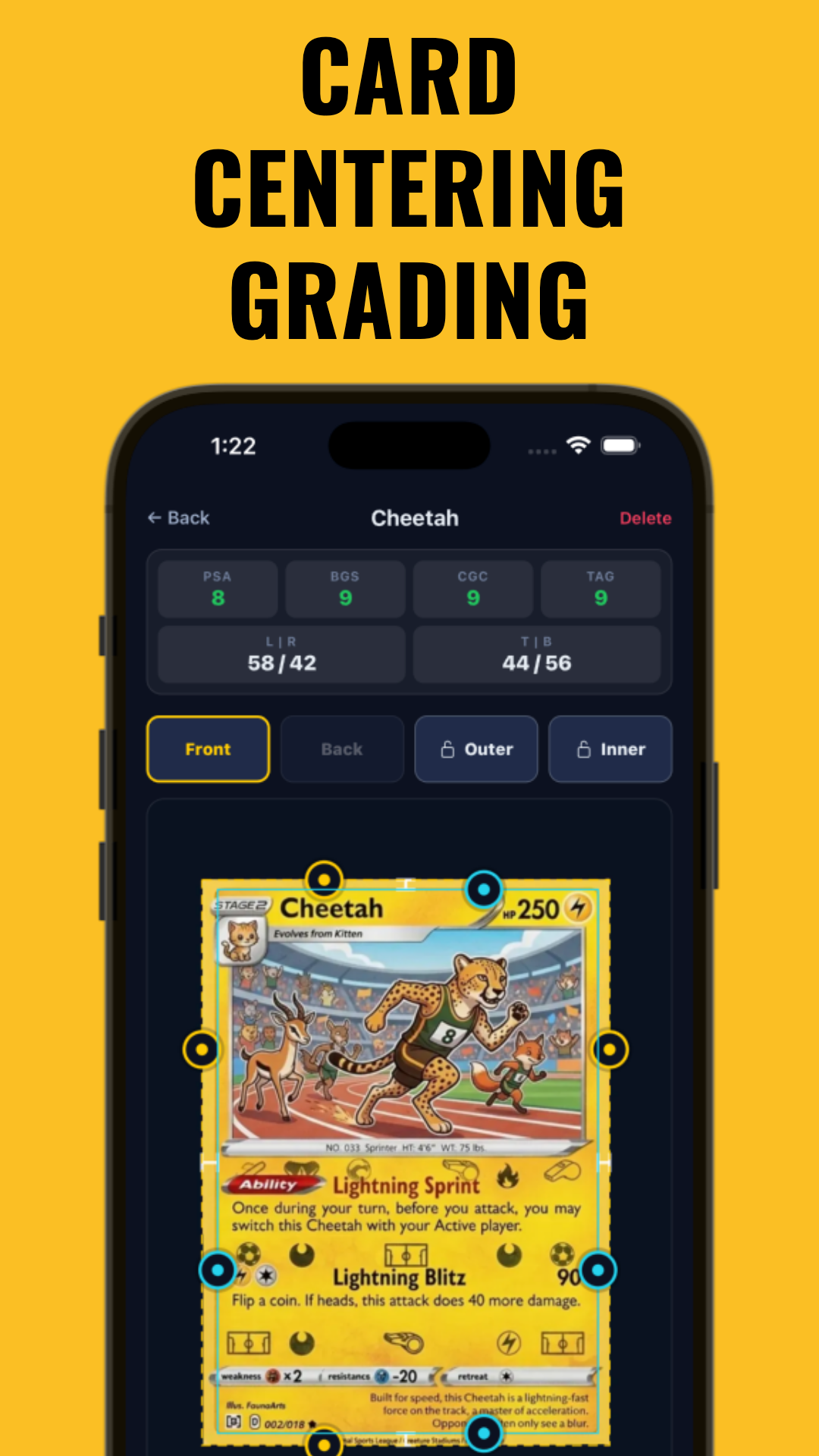
Summary Table: Centering Ratios for Gem Mint 10s
- PSA 10: Front 55/45, Back 75/25
- BGS 10: Front 55/45, Back 60/40
- CGC 10: Front 55/45, Back 60/40
- SGC 10: Front 60/40, Back 85/15
- TAG 10: Front 55/45, Back 60/40
For lower grades, each company becomes more lenient. For example, a PSA 9 allows 60/40 front, and an SGC 9 allows 65/35. The back is always more forgiving.
What Happens During Crossovers?
If you’re crossing a card from one grader to another (e.g., BGS to PSA), centering can be the deciding factor. A card that earns a BGS 9.5 for centering might receive a PSA 10 due to slightly more lenient standards. SGC is sometimes chosen if your card is just outside the PSA or BGS Gem Mint range.
How Subgrades and Labels Affect Leniency
Paying for subgrades (BGS, CGC) gives you more transparency, but doesn’t change the base ratio required for a top grade. Some companies occasionally offer “qualifiers” (e.g., OC for “off center”), but these impact desirability and value. For more on the value impact, see How Centering Impacts Card Value: A Detailed Guide.
Section 7: Vintage vs. Modern Cards—Are Standards Different?
Why Vintage Cards Get More Leniency
Printing technology in the 1950s-1980s was far less precise than today’s digital processes. Recognizing this, most grading companies apply slightly more lenient centering standards to vintage cards—sometimes officially, sometimes as an “unwritten” rule.
- PSA: States that "manufacturing standards at the time" are considered, sometimes allowing up to 60/40 for certain vintage issues on a 10.
- SGC: Explicitly allows more leniency for pre-1980 cards.
- BGS/CGC: May use discretion, but do not publish separate vintage standards.
Modern Cards: No Room for Error
For modern cards (post-2000), graders expect nearly perfect centering. Any deviation from the published Gem Mint ratios almost always results in a lower grade.
How to Approach Vintage Submissions
If you have a borderline vintage card, PSA or SGC is usually the best choice. Be sure to check their current vintage-specific guidelines. For more tips, see How to Pre-Grade Your Card: A Step-by-Step Guide.
Section 8: Tools & Tips—Pre-Grading Centering with Confidence
Why Pre-Measuring Matters
Submitting a card for grading can cost $30 or more per card. Knowing your centering before you submit is key to avoiding wasted fees on cards that won’t meet your target grade. Manual measurement with a ruler is possible, but digital tools are more accurate and efficient.
Using Midpoint for Accurate Centering Estimates
Midpoint is a digital card centering tool that lets you upload card scans or photos, automatically detect card borders, and calculate centering ratios down to the millimeter. It then estimates your likely PSA, BGS, CGC, and TAG grades instantly, so you can make informed submission decisions.
- Bulk upload and batch processing for entire collections
- Manual adjustment for tricky cards or misaligned scans
- AI-powered surface and edge analysis (for full pre-grading)
Visual Guides and Calculators
Many collectors use printable centering tools or online calculators, but software like Midpoint provides precision and instant feedback for all major graders. For more, check out Card Centering Tool: Accurate Card Grading Estimates.
Conclusion
When it comes to which grader is most lenient on centering, SGC is often cited as the most forgiving for Gem Mint 10s, where their 60/40 tolerance is more lenient than other major companies. PSA is next, allowing 55/45, followed by BGS, CGC, and TAG, all of which have stricter requirements. Every grader is more lenient on the back, but the front is what matters most for your card’s eye appeal and grade.
Centering standards can change or be clarified, and the difference between a 10 and a 9.5 can mean a significant difference in value. Always check published guidelines, use a reliable measurement tool like Midpoint, and consider your card’s era and type. By understanding each company’s approach and pre-grading with precision, you maximize your chance at the highest grade—and the highest value.
FAQ
Q: Which grading company is the most lenient on centering?
A: SGC is generally regarded as the most lenient on centering, allowing up to 60/40 centering for a Gem Mint 10. PSA is next, permitting 55/45, while BGS, CGC, and TAG require stricter ratios for their top grades.
Q: What centering does PSA 10 allow?
A: PSA 10 (Gem Mint) allows up to 55/45 centering on the front and 75/25 on the back. Slight exceptions may be made for some vintage issues.
Q: Is BGS or PSA more forgiving on centering?
A: PSA is generally more forgiving than BGS on centering, especially for Gem Mint 10s. BGS has stricter requirements and uses centering subgrades, making it harder for off-center cards to earn top grades.
Q: Does back centering matter as much as front centering?
A: No, back centering is always held to a more lenient standard by all major graders. The front is weighted more heavily in grade calculation and eye appeal.
Q: Did PSA change its centering standards recently?
A: PSA has clarified its centering guidelines in recent years but has not significantly changed the core ratios. Always check their published standards for the latest updates.
Q: What centering ratio is needed for a 10 on CGC or SGC?
A: CGC 10 requires 55/45 or better on the front and 60/40 or better on the back. SGC 10 is more lenient: up to 60/40 front and 85/15 back.
Free to start
Try the Midpoint app
Grade any card from a photo, see its raw and PSA 10 value, and track what your collection is worth — free.
Get it on iPhoneGet it on Android