11 Centering Tips for Panini Basketball Cards (And All TCGs)
Discover expert centering tips for Panini basketball cards, plus Pokemon, MTG, One Piece, and vintage cards. Learn how to measure, tools to use, and grading standards.

Estimated reading time: 10 min
Key Takeaways
- Proper centering is important for maximizing your Panini basketball card’s grade and value.
- These centering tips can also be applied to Pokemon, MTG, One Piece, and vintage cards.
- Use precise tools like Midpoint, rulers, or calipers to measure centering as accurately as possible.
- Familiarize yourself with PSA, BGS, and CGC’s centering standards for both the front and back of your cards.
Centering can influence the value of your Panini basketball cards, as well as Pokemon, MTG, One Piece, and vintage sports cards. Even modern cards with sharp corners and flawless surfaces can lose a grade due to off-center borders. This listicle breaks down essential centering tips for Panini basketball cards, covers the quirks of TCGs and vintage cards, and includes methods for measuring, judging, and maximizing your card’s grading potential. Whether you’re prepping cards for PSA, BGS, CGC, or just want to learn how to grade Pokemon cards, these tips can help you spot and address centering issues before you submit—and before you spend money on grading.
1. Visually Judge Centering First
The first step in evaluating any card, from Panini basketball to Pokemon, is a simple visual inspection. Hold the card at eye level and compare the border thickness on all four sides. For Panini cards, borders may be thin, colored, or have design elements that make judgment tricky.
Some quick tips:
- Use a solid, well-lit background to avoid distraction.
- Look for visible slants or borders that are obviously thicker on one side.
- Check both the front and back; back centering is especially important for Pokemon and vintage sports cards.
2. Measure Left-Right and Top-Bottom Borders
Once you’ve eyeballed the card, it’s time to measure. Use a millimeter ruler, caliper, or a digital tool like Midpoint for precision. Measure the distance from the edge of the card to the printed area on both the left-right and top-bottom sides.
For example:
- If the left border measures 2.5mm and the right is 1.5mm, it’s off-center left-to-right.
- Record your measurements for each side (top, bottom, left, right).
For a complete walkthrough, see How to Pre-Grade Your Card: A Step-by-Step Guide.
3. Calculate Centering Percentages
Grading companies like PSA, BGS, and CGC use centering percentages to set grade thresholds. The formula is:
- (Smaller border width / (Smaller + Larger border width)) x 100 = Centering %
Example: If left = 2mm, right = 3mm, then (2/5) x 100 = 40%. For PSA 10, Panini basketball cards are generally expected to have at least 55/45 centering on the front and 75/25 on the back.
Many collectors use the free Centering Calculator at Midpoint for instant calculations and grading estimates.
4. Know PSA, BGS, and CGC Centering Standards
Each grader has its own standard for centering. For Panini basketball cards, PSA states:
- PSA 10: 55/45 or better on the front, 75/25 or better on the back
- PSA 9: 60/40 or better on the front
- BGS 9.5: 50/50 up to 55/45 on the front, 60/40 on the back
- CGC: Standards are similar but may be stricter for TCGs (Pokemon, MTG, One Piece)
Check the grading scale differences guide for a full breakdown by company.
5. Don’t Forget Back Centering (Pokemon, Vintage, Sports)
Many collectors focus only on the front, but back centering is also considered for Pokemon, vintage card centering, and modern Panini basketball cards. PSA and CGC both have minimum back centering percentages for higher grades.
For Pokemon cards, the back is iconic and misalignments are easily spotted. MTG and One Piece card centering are judged similarly. Always flip your card and measure again.
- Poor back centering can lower a card’s grade, even if the front is well-centered.
- TCG fans: Practice on "back centering Pokemon" for notoriously tricky Wizards-era cards.
6. Use a Centering Tool or App for Accuracy
Manual measuring can be prone to error, especially for chrome/prizm cards or those with faint borders. Digital tools like Midpoint can speed up the process and provide millimeter-accurate results. You can upload a card photo, adjust the grid, and get instant centering percentages and estimated grades for PSA, BGS, CGC, and TAG.
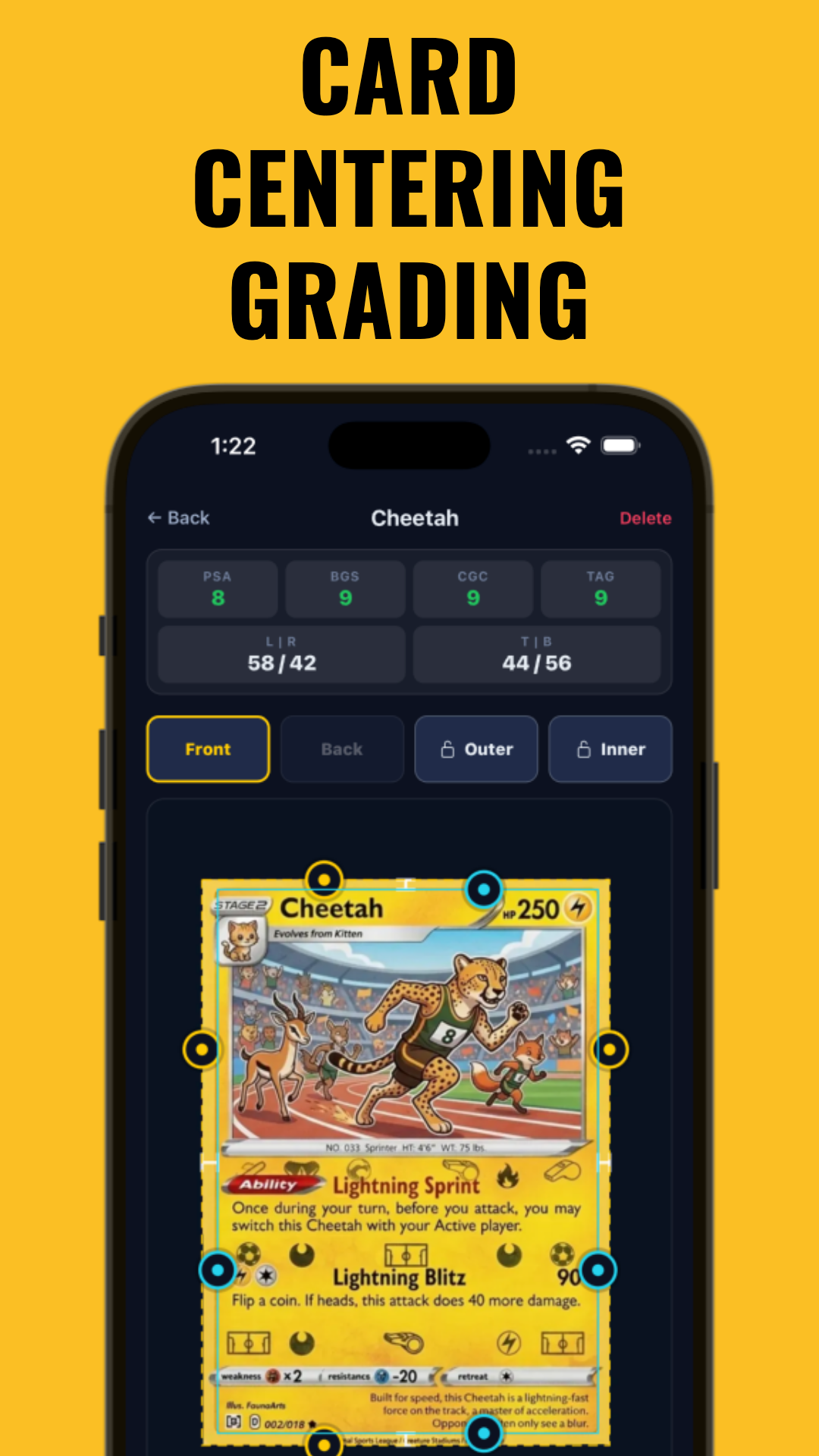
For bulk collections, Midpoint’s batch upload lets you pre-grade multiple cards quickly.
Read more about how AI is being used in centering analysis in AI-Focused Comparison: How AI Transforms Card Centering Analysis.
7. Centering Tips for Chrome, Prizm, and Foil Cards
Panini Prizm basketball cards, as well as Pokemon and MTG foils, can be tough to judge. Reflective surfaces and minimal borders make it easy to mis-measure.
- Use indirect lighting to reduce glare.
- Look for printing guides or design elements near the edge as reference points.
- Magnification or digital zoom can help spot small misalignments.
For chrome and prizm, digital centering tools may provide more consistent results than visual inspection alone.
8. Spot Common Centering Mistakes
Even experienced collectors make centering errors. The most frequent mistakes include:
- Only checking the front centering, not the back
- Measuring to the card edge instead of the printed border
- Ignoring slanted or diamond-cut cards (corners may be square but the image is skewed)
- Using poor lighting or low-res scans
To avoid these, always double-check both sides, measure carefully, and use a tool for confirmation.
9. How Centering Impacts Overall Grade (Corners, Edges, Surface)
Centering is just one part of the card grading equation. Corners, edges, and surface all matter, but a badly off-center card is unlikely to earn a top grade, even if the rest is flawless. For example, a Panini basketball card with Gem Mint corners but 70/30 centering typically cannot get a PSA 10.
For a deep dive on how centering affects value and insurance, see How Centering Impacts Card Value: A Detailed Guide and Card Grade Impact on Insurance Value: The Ultimate Guide.
- Some graders (like BGS) subgrade centering separately; others (like PSA) factor it into the overall grade.
- Vintage cards (pre-1980) may sometimes receive lenience for centering, but not always.
10. Centering Quirks by Card Type (TCGs, Vintage, Modern Sports)
Every type of card has its own centering quirks. For example:
- Pokemon: Back centering is as critical as the front, especially for modern sets.
- MTG: Early print runs (Alpha, Beta) are known for off-center cuts.
- One Piece: Recent Bandai cards often have tight tolerances but occasional miscuts.
- Vintage sports: Printing technology was less precise, so off-center cards are common.
For a detailed card-type breakdown, check the full per-type guides at Midpoint and their blog.
11. Practice Makes Perfect—Pre-Grade Before Submitting
Grading fees can add up, and sending in off-center cards may not be cost-effective. Always pre-grade your cards for centering and other defects before submitting to PSA, BGS, or CGC. Use the Midpoint app or another trusted tool alongside a physical inspection.
- Compare your results to published standards and past graded examples.
- Join online forums or grading groups to share scans and get second opinions.
- Document your measurements for future reference or insurance.
For step-by-step instructions, see How to Pre-Grade Your Card: A Step-by-Step Guide.
Conclusion
Understanding centering is important for getting the best grades—and the best value—from your Panini basketball cards, Pokemon, MTG, One Piece, and vintage sports cards. With these centering tips, you’ll be able to spot misalignments, avoid common mistakes, and use digital tools like Midpoint to get objective, millimeter-precise results. Remember: measure both front and back, use the right tools, and pre-grade before you pay for grading. Your collection (and wallet) will thank you.
FAQ
Q: How do you tell if a basketball card is centered correctly?
A: Start by visually comparing the thickness of the card’s borders on all sides, then measure the distance from the edge of the card to the printed image using a ruler, caliper, or centering tool. Use the centering percentage formula to see if it meets grading standards.
Q: What is the PSA centering standard for basketball cards?
A: For a PSA 10, basketball cards generally need at least 55/45 centering on the front and 75/25 on the back. Lower grades allow more variance; for example, PSA 9 requires 60/40 front centering.
Q: How do you calculate card centering percentages?
A: Measure both borders (e.g., left and right), add them together, then divide the smaller by the total and multiply by 100. For example, left 2mm, right 3mm: (2/(2+3)) x 100 = 40% on the smaller side (60/40 centering).
Q: Do you need to check both the front and back of a card for centering?
A: Yes. Both front and back centering are considered for top grades by PSA, BGS, CGC, and other graders. Back centering is especially important for Pokemon, vintage, and some sports cards.
Q: What tools are best for measuring sports card centering?
A: Useful tools include a digital centering app like Midpoint, millimeter rulers, calipers, or dedicated centering gauges. Digital tools can provide instant percentages and grading estimates.
Q: Does centering matter more than corners, edges, and surface for grading?
A: Centering is one of four main grading factors (alongside corners, edges, and surface). All are important. Severely off-center cards cannot receive the highest grades, even if other aspects are flawless.
Free to start
Try the Midpoint app
Grade any card from a photo, see its raw and PSA 10 value, and track what your collection is worth — free.
Get it on iPhoneGet it on Android